Results by title
325 books match the query 'Race identity' and 6 start with w
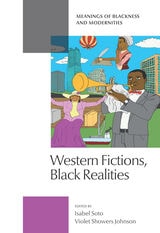
Western Fictions, Black Realities
Meanings of Blackness and ModernitiesIsabel Soto
Michigan State University Press, 2012
This anthology interrogates two salient concepts in studying the black experience. Ushered in with the age of New World encounters, modernity emerged as brutal and complex, from its very definition to its manifestations. Equally challenging is blackness, which is forever dangling between the range of uplifting articulations and insidious degradation. The essays in Western Fictions address the conflicting confluences of these two terms. Questioning Eurocentric and mainstream American interpretations, they reveal the diverse meanings of modernities and blackness from a wide range of milieus of the black experience. Interdisciplinary and wide-ranging in thematic and epochal scope, they use theoretical and empirical studies of a range of subjects to demonstrate that, indeed, blackness is relevant for understanding modernities and vice versa.

When Race Becomes Real
Black and White Writers Confront Their Personal HistoriesEdited by Bernestine Singley
Southern Illinois University Press, 2002
When Race Becomes Real is a critically acclaimed collection that pushes the boundaries of current discussions about race. In these personal and evocative essays, thirty contemporary black and white writers describe their own intimate experiences with race and discrimination, taking an unflinching look at both society and themselves. The result is an incisive and powerful anthology that rethinks what it means to be black—and white—in the modern world.
Only through frank and tough conversation, Singley tells us, can America hope to realize its goals of justice and racial equality. This collection opens that much needed honest dialogue, exploring a wide range of racial experiences in relation to a myriad of topics: from crime and religion to humor, history, and desire. Readers will find within these pages examinations of the roots of racial beliefs and the origins of the language and rules that have heretofore governed discussion; analysis of the reasons behind our reticence to discuss the subject openly; and suggestions for solutions to the problems that plague open racial discourse. The writers of When Race Becomes Real demonstrate the progress that can be made when our ingrained wariness on the subject of race is abandoned, and we instead confront the issue openly and personally. Included are contributions by a variety of authors, from Pulitzer Prize winners such as Robert Coles, Leonard Pitts, and Natalie Angier to popular writers and emerging voices. In each essay the author sweeps aside the cautious rules that often dominate racial discussions to address what race really means in the twenty-first century.
When Race Becomes Real directly tackles one of our most taboo subjects with bravery, wit, and emotion. Sometimes shocking, sometimes amusing but always honest, this collection encourages readers to move beyond the ineffective reluctance and objectivity that hinder contemporary conversations and in doing so forge a new path in racial consciousness.
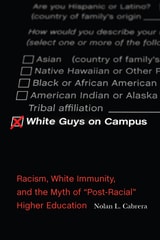
White Guys on Campus
Racism, White Immunity, and the Myth of "Post-Racial" Higher EducationCabrera, Nolan L
Rutgers University Press, 2019
On April 22, 2015, Boston University professor Saida Grundy set off a Twitter storm with her provocative question: “Why is white America so reluctant to identify white college males as a problem population?” White Guys on Campus is a critical examination of race in higher education, centering Whiteness, in an effort to unveil the frequently unconscious habits of racism among White male undergraduates. Nolan L. Cabrera moves beyond the “few bad apples” frame of contemporary racism, and explores the structures, policies, ideologies, and experiences that allow racism to flourish. This book details many of the contours of contemporary, systemic racism, while engaging the possibility of White students to participate in anti-racism. Ultimately, White Guys on Campus calls upon institutions of higher education to be sites of social transformation instead of reinforcing systemic racism, while creating a platform to engage and challenge the public discourse of “post- racialism.”

White Identities
A Critical Sociological ApproachSteve Garner and Simon Clarke
Pluto Press, 2009
The study of white ethnicities is becoming increasingly important in the social sciences. This book provides a critical introduction to the topic.
Whiteness has traditionally been seen as "ethnically transparent" - the marker against which other ethnicities are measured. This analysis is clearly incorrect, but only recently have many race and ethnicity scholars moved away from focusing on ethnic minorities and instead oriented their studies around the construction of white identities. Simon Clarke and Steve Garner's book is designed to guide students as they explore how white identities are forged using both sociological and psycho-social ideas.
Including an excellent survey of the existing literature and original research from the UK, this book will be an invaluable guide for sociology students taking modules in race and ethnicity.
White Rebels in Black
German Appropriation of Black Popular CulturePriscilla Layne
University of Michigan Press, 2018
Whiteness Interrupted
White Teachers and Racial Identity in Predominantly Black SchoolsMarcus Bell
Duke University Press, 2021