79 books match the query 'Religion and science' and 4 start with w
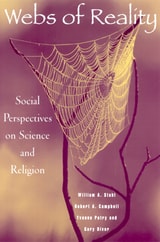
cover of Webs of Reality: Social Perspectives on Science and Religion

Webs of Reality

Social Perspectives on Science and Religion

Stahl, William

Rutgers University Press, 2002

Science and religion are often thought to be advancing irreconcilable goals and thus to be mutually antagonistic. Yet in the often acrimonious debates between the scientific and religions communities, it is easy to lose sight of the fact that both science and religion are systems of thought and knowledge that aim to understand the world and our place in it.

Webs of Reality
is a rare examination of the interrelationship between religion and science from a social science perspective, offering a broader view of the relationship, and posing practical questions regarding technology and ethics. Emphasizing how science and religion are practiced instead of highlighting the differences between them, the authors look for the subtle connections, tacit understandings, common history, symbols, and implicit myths that tie them together. How can the practice of science be understood from a religious point of view? What contributions can science make to religious understanding of the world? What contributions can the social sciences make to understanding both knowledge systems? Looking at religion and science as fields of inquiry and habits of mind, the authors discover not only similarities between them but also a wide number of ways in which they complement each other.
[more]
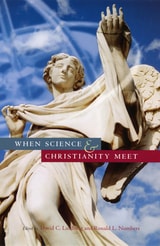
cover of When Science and Christianity Meet

When Science and Christianity Meet

Edited by David C. Lindberg and Ronald L. Numbers

University of Chicago Press, 2003
This book, in language accessible to the general reader, investigates twelve of the most notorious, most interesting, and most instructive episodes involving the interaction between science and Christianity, aiming to tell each story in its historical specificity and local particularity.
 
Among the events treated in When Science and Christianity Meet are the Galileo affair, the seventeenth-century clockwork universe, Noah's ark and flood in the development of natural history, struggles over Darwinian evolution, debates about the origin of the human species, and the Scopes trial. Readers will be introduced to St. Augustine, Roger Bacon, Pope Urban VIII, Isaac Newton, Pierre-Simon de Laplace, Carl Linnaeus, Charles Darwin, T. H. Huxley, Sigmund Freud, and many other participants in the historical drama of science and Christianity.
 
“Taken together, these papers provide a comprehensive survey of current thinking on key issues in the relationships between science and religion, pitched—as the editors intended—at just the right level to appeal to students.”—Peter J. Bowler, Isis
 
[more]
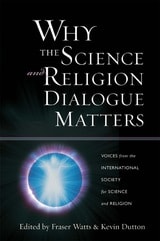
cover of Why the Science and Religion Dialogue Matters: Voices from the International Society for Science and Religion

Why the Science and Religion Dialogue Matters

Voices from the International Society for Science and Religion

Fraser Watts

Templeton Press, 2006

Each world faith tradition has its own distinctive relationship with science, and the science-religion dialogue benefits from a greater awareness of what this relationship is. In this book, members of the International Society for Science and Religion (ISSR) offer international and multi-faith perspectives on how new discoveries in science are met with insights regarding spiritual realities.The essays reflect the conviction that “religion and science each proceed best when they’re pursued in dialogue with each other, and also that our fragmented and divided world would benefit more from a stronger dialogue between science and religion.”
In Part One, George F. R. Ellis, John C. Polkinghorne, and Holmes Rolston III, each a Templeton Prize winner, discuss their views on why the science and religion dialogue matters. They are joined in Part Two by distinguished theologians Fraser Watts and Philip Clayton, who place the dialogue in an international context; John Polkinghorne’s inaugural address to the ISSR in 2002 is also included. In Part Three, five members of the ISSR look at the distinctive relationships of their faiths to science:
•Carl Feit on Judaism
•Munawar Anees on Islam
•B.V. Subbarayappa on Hinduism
•Trinh Xuan Thuan on Buddhism
•Heup Young Kim on Asian Christianity
George Ellis, the recently elected second president of ISSR, summarizes the contributions of his colleagues. Ronald Cole-Turner then concludes the book with a discussion of the future of the science and religion dialogue.
[more]
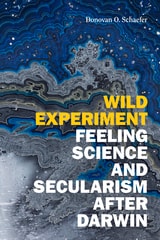
cover of Wild Experiment: Feeling Science and Secularism after Darwin

Wild Experiment

Feeling Science and Secularism after Darwin

Donovan O. Schaefer

Duke University Press, 2022

In Wild Experiment, Donovan O. Schaefer challenges the conventional wisdom that feeling and thinking are separate. Drawing on science studies, philosophy, affect theory, secularism studies, psychology, and contemporary literary criticism, Schaefer reconceptualizes rationality as defined by affective processes at every level. He introduces the model of “cogency theory” to reconsider the relationship between evolutionary biology and secularism, examining mid-nineteenth-century Darwinian controversies, the 1925 Scopes Trial, and the New Atheist movement of the 2000s. Along the way, Schaefer reappraises a range of related issues, from secular architecture at Oxford to American eugenics to contemporary climate denialism. These case studies locate the intersection of thinking and feeling in the way scientific rationality balances excited discovery with anxious scrutiny, in the fascination of conspiracy theories, and in how racist feelings assume the mantle of rational objectivity. The fact that cognition is felt, Schaefer demonstrates, is both why science succeeds and why it fails. He concludes that science, secularism, atheism, and reason itself are not separate from feeling but comprehensively defined by it.
[more]