Results by title
145 books match the query 'Report writing' and 14 start with w
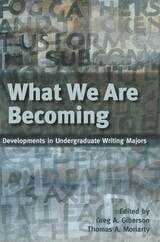
What We Are Becoming
Developments in Undergraduate Writing MajorsGreg Giberson and Thomas A. Moriarty
Utah State University Press, 2010
Contributors to the volume address a range of vital questions for undergraduate programs, including such issues as the competition for majors within departments, the job market for undergraduates, varying focuses and curricula of such majors, and the formation of them in departments separate from English. Other chapters discuss the importance of flexibility, consider arguments for a rhetorical or civic discourse core for the writing major, address the relationship between rhetoric and composition majors, and review the role of multiliteracies in the major.
The field of composition has not come to a consensus on the shape, content, or focus of the undergradutate major. But as individual programs develop and refine their curricula, one thing has become clear: we must think about them in ways that go beyond our particular circumstances, theorize them in ways that secure their place on our campuses and in our discipline for years to come. What We Are Becoming is an effort to do just that.
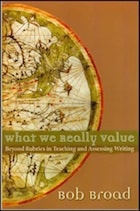
What We Really Value
Beyond Rubrics in Teaching and Assessing WritingBob Broad
Utah State University Press, 2003
What We Really Value traces the origins of traditional rubrics within the theoretical and historical circumstances out of which they emerged, then holds rubrics up for critical scrutiny in the context of contemporary developments in the field. As an alternative to the generic character and decontextualized function of scoring guides, he offers dynamic criteria mapping, a form of qualitative inquiry by which writing programs (as well as individual instructors) can portray their rhetorical values with more ethical integrity and more pedagogical utility than rubrics allow.
To illustrate the complex and indispensable insights this method can provide, Broad details findings from his study of eighty-nine distinct and substantial criteria for evaluation at work in the introductory composition program at "City University." These chapters are filled with the voices of composition instructors debating and reflecting on the nature, interplay, and relative importance of the many criteria by which they judged students' texts. Broad concludes his book with specific strategies that can help writing instructors and programs to discover, negotiate, map, and express a more robust truth about what they value in their students' rhetorical performances.
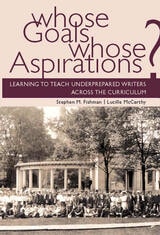
Whose Goals Whose Aspirations
Learning to Teach Underprepared Writers across the CurriculumStephen M. Fishman and Lucille McCarthy
Utah State University Press, 2002
Ever since Horace Mann promoted state supported schooling in the 1850s, the aims of U.S. public education have been the subject of heated national debate. Whose Goals? Whose Aspirations? joins this debate by exploring clashing educational aims in a discipline-based university classroom and the consequences of these clashes for "underprepared" writers.
In this close-up look at a White middle-class teacher and his ethnically diverse students, Fishman and McCarthy examine not only the role of Standard English in college writing instruction but also the underlying and highly charged issues of multiculturalism, race cognizance, and social class.
Wiring The Writing Center
Eric Hobson
Utah State University Press, 1998
Women Writing the Academy
Audience, Authority, and TransformationGesa E. Kirsch. Foreword by John Trimbur
Southern Illinois University Press, 1993
Women Writing the Academy is based on an extensive interview study by Gesa E. Kirsch that investigates how women in different academic disciplines perceive and describe their experiences as writers in the university.
Kirsch’s study focuses on the writing strategies of successful women writers, their ways of establishing authority, and the kinds of audiences they address in different disciplinary settings. Based on multiple interviews with thirty-five women from five different disciplines (anthropology, education, history, nursing, and psychology) and four academic ranks (seniors, graduate students, and faculty before and after tenure), this is the first book to systematically explore the academic context in which women write and publish.
While there are many studies in literary criticism on women as writers of fiction, there has not been parallel scholarship on women as writers of professional discourse, be it inside or outside the academy. Through her research, for example, Kirsch found that women were less likely than their male counterparts to think of their work as sufficiently significant to write up and submit for publication, tended to hold on to their work longer than men before sending it out, and were less likely than men to revise and resubmit manuscripts that had been initially rejected.
This book is significant in that it investigates a new area of research— gender and writing—and in doing so brings together findings on audience, authority, and gender.
Working with Faculty Writers
Anne Ellen Geller and Michele Eodice
Utah State University Press, 2013
Contributors from a variety of institution types and perspectives consider who faculty writers are and who they may be in the future, reveal the range of locations and models of support for faculty writers, explore the ways these might be delivered and assessed, and consider the theoretical, philosophical, political, and pedagogical approaches to faculty writing support, as well as its relationship to student writing support.
With the pressure on faculty to be productive researchers and writers greater than ever, this is a must-read volume for administrators, faculty, and others involved in developing and assessing models of faculty writing support.
Writing Genres
Amy J. Devitt
Southern Illinois University Press, 2008
In Writing Genres, Amy J. Devitt examines genre from rhetorical, social, linguistic, professional, and historical perspectives and explores genre's educational uses, making this volume the most comprehensive view of genre theory today.
Writing Genres does not limit itself to literary genres or to ideas of genres as formal conventions but additionally provides a theoretical definition of genre as rhetorical, dynamic, and flexible, which allows scholars to examine the role of genres in academic, professional, and social communities.
Writing Genres demonstrates how genres function within their communities rhetorically and socially, how they develop out of their contexts historically, how genres relate to other types of norms and standards in language, and how genres nonetheless enable creativity. Devitt also advocates a critical genre pedagogy based on these ideas and provides a rationale for first-year writing classes grounded in teaching antecedent genres.
Writing Groups
History, Theory, and ImplicationsAnne Ruggles Gere
Southern Illinois University Press, 1987
Drawing upon previously unpublished archival materials as well as historical accounts, Gere traces the history of writing groups in America, from their origins over a century ago to their recent reappearance in the works of Macrorie, Elbow, Murray, and others.
From this historical perspective Gere examines the theoretical foundations of writing groups, challenging the traditional concept of writing as an individual performance. She offers instead a broader view of authorship that includes both individual and social dimensions, with implications not only for the teaching of composition but also for theories of rhetoric and literacy.
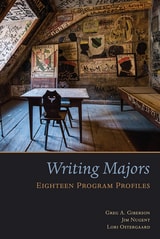
Writing Majors
Eighteen Program ProfilesGreg Giberson
Utah State University Press, 2015
The writing major is among the most exciting scenes in the evolving American university. Writing Majors is a collection of firsthand descriptions of the origins, growth, and transformations of eighteen different programs. The chapters provide useful administrative insight, benchmark information, and even inspiration for new curricular configurations from a range of institutions.
A practical sourcebook for those who are building, revising, or administering their own writing majors , this volume also serves as a historical archive of a particular instance of growth and transformation in American higher education. Revealing bureaucratic, practical, and institutional matters as well as academic ideals and ideologies, each profile includes sections providing a detailed program review and rationale, an implementation narrative, and reflection and prospection about the program.
Documenting eighteen stories of writing major programs in various stages of formation, preservation, and reform and exposing the contingencies of their local and material constitution, Writing Majors speaks as much to the “how to” of building writing major programs as to the larger “what,” “why,” and “how” of institutional growth and change.
Writing New Media
Theory and Applications for Expanding the Teaching of CompositionAnne Frances Wysocki, Johndan Johnson-Eilola, Cynthia L. Selfe, & Geoffrey Sirc
Utah State University Press, 2004
As new media mature, the changes they bring to writing in college are many and suggest implications not only for the tools of writing, but also for the contexts, personae, and conventions of writing. An especially visible change has been the increase of visual elements-from typographic flexibility to the easy use and manipulation of color and images. Another would be in the scenes of writing-web sites, presentation "slides," email, online conferencing and coursework, even help files, all reflect non-traditional venues that new media have brought to writing. By one logic, we must reconsider traditional views even of what counts as writing; a database, for example, could be a new form of written work.
The authors of Writing New Media bring these ideas and the changes they imply for writing instruction to the audience of rhetoric/composition scholars. Their aim is to expand the college writing teacher's understanding of new media and to help teachers prepare students to write effectively with new media beyond the classroom. Each chapter in the volume includes a lengthy discussion of rhetorical and technological background, and then follows with classroom-tested assignments from the authors' own teaching.
Writing Studies Research in Practice
Methods and MethodologiesEdited by Lee Nickoson and Mary P. Sheridan, Foreword by Gesa E. Kirsch
Southern Illinois University Press, 2012
An essential reference for students and scholars exploring the methods and methodologies of writing research.
What does it mean to research writing today? What are the practical and theoretical issues researchers face when approaching writing as they do? What are the gains or limitations of applying particular methods, and what might researchers be overlooking? These questions and more are answered by the writing research field’s leading scholars in Writing Studies Research in Practice: Methods and Methodologies.
Editors Nickoson and Sheridan gather twenty chapters from leaders in writing research, spanning topics from ethical considerations for researchers, quantitative methods, and activity analysis to interviewing and communitybased and Internet research. While each chapter addresses a different subject, the volume as a whole covers the range of methodologies, technologies, and approaches—both old and new—that writing researchers use, and examines the ways in which contemporary writing research is understood, practiced, and represented.
An essential reference for experienced researchers and an invaluable tool to help novices understand research methods and methodologies, Writing Studies Research in Practice includes established methods and knowledge while addressing the contemporary issues, interests, and concerns faced by writing researchers today.
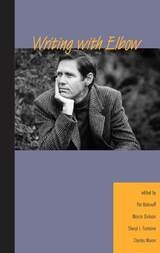
Writing With Elbow
edited by Pat Belanoff, Marcia Dickson, Sheryl I. Fontaine, & Charles Moran
Utah State University Press, 2002
Writing with Elbow is a must-read collection for composition scholars, teachers, English educationists, and graduate students.
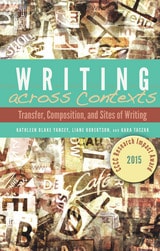
Writing across Contexts
Transfer, Composition, and Sites of WritingKathleen Yancey
Utah State University Press, 2014
Addressing how composers transfer both knowledge about and practices of writing, Writing across Contexts explores the grounding theory behind a specific composition curriculum called Teaching for Transfer (TFT) and analyzes the efficacy of the approach. Finding that TFT courses aid students in transfer in ways that other kinds of composition courses do not, the authors demonstrate that the content of this curriculum, including its reflective practice, provides a unique set of resources for students to call on and repurpose for new writing tasks.
The authors provide a brief historical review, give attention to current curricular efforts designed to promote such transfer, and develop new insights into the role of prior knowledge in students' ability to transfer writing knowledge and practice, presenting three models of how students respond to and use new knowledge—assemblage, remix, and critical incident.
A timely and significant contribution to the field, Writing across Contexts will be of interest to graduate students, composition scholars, WAC and writing-in-the-disciplines scholars, and writing program administrators.
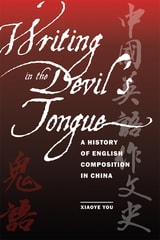
Writing in the Devil's Tongue
A History of English Composition in ChinaXiaoye You
Southern Illinois University Press, 2010
Winner, CCCC Outstanding Book Award
Until recently, American composition scholars have studied writing instruction mainly within the borders of their own nation, rarely considering English composition in the global context in which writing in English is increasingly taught. Writing in the Devil’s Tongue challenges this anachronistic approach by examining the history of English composition instruction in an East Asian country. Author Xiaoye You offers scholars a chance to observe how a nation changed from monolingual writing practices to bilingual writing instruction in a school setting.
You makes extensive use of archival sources to help trace bilingual writing instruction in China back to 1862, when English was first taught in government schools. Treating the Chinese pursuit of modernity as the overarching theme, he explores how the entry of Anglo-American rhetoric and composition challenged and altered the traditional monolithic practice of teaching Chinese writing in the Confucian spirit. The author focuses on four aspects of this history: the Chinese negotiation with Anglo-American rhetoric, their search for innovative approaches to instruction, students’ situated use of English writing, and local scholarship in English composition.
Unlike previous composition histories, which have tended to focus on institutional, disciplinary, and pedagogical issues, Writing in the Devil’s Tongue brings students back to center stage by featuring several passages written by them in each chapter. These passages not only showcase rhetorical and linguistic features of their writings but also serve as representative anecdotes that reveal the complex ways in which students, responding to their situations, performed multivalent, intercultural discourses. In addition, You moves out of the classroom and into the historical, cultural, and political contexts that shaped both Chinese writing and composing practices and the pedagogies that were adopted to teach English to Chinese in China. Teachers, students, and scholars reading this book will learn a great deal about the political and cultural impact that teaching English composition has had in China and about the ways in which Chinese writing and composition continues to be shaped by rich and diverse cultural traditions and political discourses.
In showcasing the Chinese struggle with teaching and practicing bilingual composition, Writing in the Devil’s Tongue alerts American writing scholars and teachers to an outdated English monolingual mentality and urges them to modify their rhetorical assumptions, pedagogical approaches, and writing practices in the age of globalization.