Results by title
81 books match the query 'Revolutions, Uprisings & Rebellions' and 4 start with w
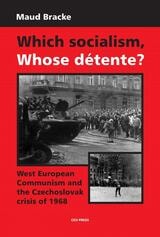
Which Socialism, Whose Detente?
West European Communism and the Czechoslovak Crisis of 1968Maud Bracke
Central European University Press, 2007
This study analyzes the impact of the Czechoslovak crisis of 1968–1969 on the two major communist parties in the West: the Italian and French ones. Discusses the central strategic and ideological tensions which these parties needed to deal with: domestic belonging versus allegiance to the world communist movement, doctrinal orthodoxy in a context of rapid societal changes, and the question of revolution and reform. These key problems were situated in different contexts: the crisis in the "world communist movement" after 1956 and the Sino-Soviet rift, socio-economic modernization and political radicalization in Western Europe, and the shift from Cold War to early détente on the European continent. The research for this work is based on the study of a large collection of recently released primary sources, particularly, the internal records of various communist parties in Europe.
[more]
Work, Sex, and Power
The Forces that Shaped Our HistoryWillie Thompson
Pluto Press, 2015
This is the history of the world, from the origins of the Cosmos to the present day, seen through three major narratives: work, sex and power - the forces that have done more than any other to shape the world as we see it now.
It expertly explores the foundations of our developing society by showing how these grand themes have recurred throughout the various phases of global history. From communities of Palaeolithic hunter-gatherers, through feudalism and onto the capitalistic machine-civilisation of recent centuries, Willie Thompson takes us on a journey that is fundamentally opposed to mainstream histories which concentrate on monarchs, politicians and military commanders.
At the centre of this book lies the interaction between humans and their environment. By exploring history in this way, it reveals a simple yet powerful materialist understanding of how we got to where we are today, and opens a door to a different reading of our world.
[more]
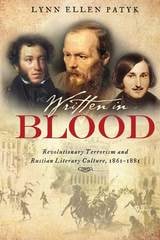
Written in Blood
Revolutionary Terrorism and Russian Literary Culture, 1861–1881Lynn Ellen Patyk
University of Wisconsin Press, 2017
Written in Blood offers a fundamentally new interpretation of the emergence of modern terrorism, arguing that it formed in the Russian literary imagination well before any shot was fired or bomb exploded. In March 1881, Russia stunned the world when a small band of revolutionaries calling themselves "terrorists" assassinated the Tsar-Liberator, Alexander II. Horrified Russians blamed the influence of European political and social ideas, while shocked Europeans perceived something new and distinctly Russian in a strategy of political violence that became known the world over as "terrorism" or "the Russian method."
Lynn Ellen Patyk contends that the prototype for the terrorist was the Russian writer, whose seditious word was interpreted as an audacious deed—and a violent assault on autocratic authority. The interplay and interchangeability of word and deed, Patyk argues, laid the semiotic groundwork for the symbolic act of violence at the center of revolutionary terrorism. While demonstrating how literary culture fostered the ethos, pathos, and image of the revolutionary terrorist and terrorism, she spotlights Fyodor Dostoevsky and his "terrorism trilogy"—Crime and Punishment (1866), Demons (1870–73), and The Brothers Karamazov (1878–80)—as novels that uniquely illuminate terrorism's methods and trajectory. Deftly combining riveting historical narrative with penetrating literary analysis of major and minor works, Patyk's groundbreaking book reveals the power of the word to spawn deeds and the power of literature to usher new realities into the world.
Lynn Ellen Patyk contends that the prototype for the terrorist was the Russian writer, whose seditious word was interpreted as an audacious deed—and a violent assault on autocratic authority. The interplay and interchangeability of word and deed, Patyk argues, laid the semiotic groundwork for the symbolic act of violence at the center of revolutionary terrorism. While demonstrating how literary culture fostered the ethos, pathos, and image of the revolutionary terrorist and terrorism, she spotlights Fyodor Dostoevsky and his "terrorism trilogy"—Crime and Punishment (1866), Demons (1870–73), and The Brothers Karamazov (1878–80)—as novels that uniquely illuminate terrorism's methods and trajectory. Deftly combining riveting historical narrative with penetrating literary analysis of major and minor works, Patyk's groundbreaking book reveals the power of the word to spawn deeds and the power of literature to usher new realities into the world.
[more]
Written in Blood
Revolutionary Terrorism and Russian Literary Culture, 1861–1881Lynn Ellen Patyk
University of Wisconsin Press, 2020
Written in Blood offers a fundamentally new interpretation of the emergence of modern terrorism, arguing that it formed in the Russian literary imagination well before any shot was fired or bomb exploded. Lynn Ellen Patyk contends that the prototype for the terrorist was the Russian writer, whose seditious word was interpreted as an audacious deed—and a violent assault on autocratic authority. Deftly combining riveting historical narrative with penetrating literary analysis of major and minor works, Patyk’s groundbreaking book reveals the power of the word to spawn deeds and the power of literature to usher new realities into the world.
[more]