Results by title

7 books match the query 'Scandals'
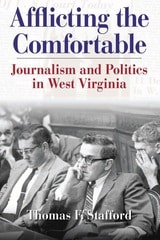
cover of Afflicting the Comfortable: Journalism and Politics in West Virginia

Afflicting the Comfortable

Journalism and Politics in West Virginia

Thomas F. Stafford

West Virginia University Press, 2011

"Government corruption was not invented in West Virginia. But there are people who contend that West Virginia officials have done more than their share over the years to develop state-of-the-art techniques in vote theft, contract kickbacks, influence peddling and good old-fashioned bribery, extortion, fraud, tax evasion and outright stealing."  New York Times

While investigating  the Invest Right scandal, Thomas Stafford, a former journalist for the Charleston Gazette, found himself in a very precarious position. As a reporter he felt obligated to tell the whole truth, and he believed in the need to serve the public and those West Virginians who were being abused by a political machine. In Afflicting the Comfortable, Stafford relates such tales of the responsibility of journalism and politics in coordination with scandals that have unsettled the Mountain State over the past few decades. His probing would take him from the halls of Charleston to the center of our nation's ruling elite. Guided by his senses of duty, right, and fairness, he plunged head first into the misdeeds of West Virginia's politicians. His investigations would preface the downfall of a governor and an adminstration that robbed the state and the citizens of West Virginia for many years.

[more]
cover of Beneath the Veil of the Strange Verses: Reading Scandalous Texts

Beneath the Veil of the Strange Verses

Reading Scandalous Texts

Jeremiah L. Alberg

Michigan State University Press, 2013
Jeremiah Alberg’s fascinating book explores a phenomenon almost every news reader has experienced: the curious tendency to skim over dispatches from war zones, political battlefields, and economic centers, only to be drawn in by headlines announcing a late-breaking scandal. Rationally we would agree that the former are of more significance and importance, but they do not pique our curiosity in quite the same way. The affective reaction to scandal is one both of interest and of embarrassment or anger at the interest. The reader is at the same time attracted to and repulsed by it. Beneath the Veil of the Strange Verses describes the roots out of which this conflicted desire grows, and it explores how this desire mirrors the violence that undergirds the scandal itself. The book shows how readers seem to be confronted with a stark choice: either turn away from scandal completely or become enthralled and thus trapped by it. Using examples from philosophy, literature, and the Bible, Alberg leads the reader on a road out of this false dichotomy. By its nature, the author argues, scandal is the basis of our reading; it is the source of the obstacles that prevent us from understanding what we read, and of the bridges that lead to a deeper grasp of the truth.
[more]
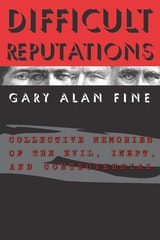
cover of Difficult Reputations: Collective Memories of the Evil, Inept, and Controversial

Difficult Reputations

Collective Memories of the Evil, Inept, and Controversial

Gary Alan Fine

University of Chicago Press, 2001

We take reputations for granted. Believing in the bad and the good natures of our notorious or illustrious forebears is part of our shared national heritage. Yet we are largely ignorant of how such reputations came to be, who was instrumental in creating them, and why. Even less have we considered how villains, just as much as heroes, have helped our society define its values.
Presenting essays on America's most reviled traitor, its worst president, and its most controversial literary ingénue (Benedict Arnold, Warren G. Harding, and Lolita), among others, sociologist Gary Alan Fine analyzes negative, contested, and subcultural reputations. Difficult Reputations offers eight compelling historical case studies as well as a theoretical introduction situating the complex roles in culture and history that negative reputations play.

Arguing the need for understanding real conditions that lead to proposed interpretations, as well as how reputations are given meaning over time, this book marks an important contribution to the sociologies of culture and knowledge.
[more]
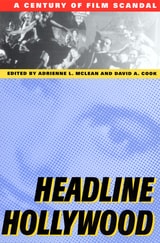
cover of Headline Hollywood: A Century of Film Scandal

Headline Hollywood

A Century of Film Scandal

McLean, Adrienne L

Rutgers University Press, 2001
Hollywood has long been associated with scandal--with covering it up, with managing its effects, and, in some cases, with creating and directing it. In putting together Headline Hollywood, Adrienne McLean and David Cook approach the relationship between Hollywood and scandal from a fresh perspective. The contributors consider some of the famous transgressions that shocked Hollywood and its audiences during the last century, and explore the changing meaning of scandal over time by zeroing in on issues of power: Who decides what crimes and misdemeanors should be circulated for public consumption and titillation? What makes a Hollywood scandal scandalous? What are the uses of scandal? The essays are arranged chronologically to show how Hollywood scandals have evolved relative to changing moral and social orders. This collection will prove essential to the field of film studies as well as to anyone interested in the character and future direction of American culture. Contributors are Mark Lynn Anderson, Cynthia Baron, James Castonguay, Nancy Cook, Mary Desjardins, Lucy Fischer, Lee Grieveson, Erik Hedling, Peter Lehman, William Luhr, Adrienne L. McLean, Susan McLeland, and Sam Stoloff. Adrienne L. McLean is an assistant professor of film studies at the University of Texas at Dallas. David A. Cook is a professor of film and media studies at Emory University. He is the author of A History of Film Narrative.
[more]
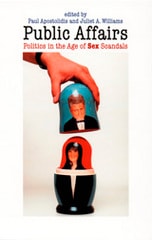
cover of Public Affairs: Politics in the Age of Sex Scandals

Public Affairs

Politics in the Age of Sex Scandals

Paul Apostolidis and Juliet A. Williams, eds.

Duke University Press, 2004

Public affairs—or sex scandals—involving prominent politicians are as revealing of American culture as they are of individual peccadillos. Implicated in their unfolding are a broad range of institutions, trends, questions, and struggles, including political parties, Hollywood, the Christian right, new communications technologies, the restructuring of corporate media, feminist and civil rights debates, and the meaning of public life in the “society of the spectacle.” The contributors to Public Affairs examine, from a variety of perspectives, how political sex scandals take shape, gain momentum, and alter the U.S. political and cultural landscape.

The essays in Public Affairs reflect on a number of sex scandals while emphasizing the Clinton/Lewinsky affair, certainly the most avidly followed and momentous sex scandal in American political history. Leading scholars situate contemporary public affairs in the context not only of earlier sex scandals in American politics (such as Thomas Jefferson’s and Sally Hemings’s affair), but also of more purely political scandals (including Teapot Dome and Watergate) and sex scandals centered around public figures other than politicians (such as the actor Hugh Grant and the minister Jimmy Swaggart). Some essays consider the Clinton affair in light of feminist and anti-racist politics, while others discuss the dynamics of scandals as major media events. By charting a critical path through the muck of scandal rather than around it, Public Affairs illuminates why sex scandals have become such a prominent feature of American public life.

Contributors. Paul Apostolidis, Jodi Dean, Joshua Gamson, Theodore J. Lowi, Joshua D. Rothman, George Shulman, Anna Marie Smith, Jeremy Varon, Juliet A. Williams
[more]
cover of Rumors of Indiscretion: The University of Missouri's "Sex Questionnaire" Scandal in the Jazz Age

Rumors of Indiscretion

The University of Missouri's "Sex Questionnaire" Scandal in the Jazz Age

Lawrence J. Nelson

University of Missouri Press, 2003
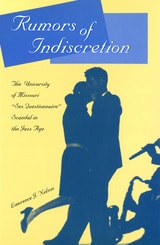
In March 1929 hundreds of students at the University of Missouri received a questionnaire that asked their opinions of marriage, family, and sexual issues. Several questions were regarded as too intimate for university students, especially females. The so-called Sex Questionnaire, the product of a sociology class project, soon fell into the hands of the university’s president, dean of women, and the local press, which deemed it “A Filthy Questionnaire.” The Missouri legislature soon jumped into the controversy as the ensuing uproar went statewide and attracted national attention; a cry arose for the expulsion of the students and professors responsible. Beyond the questionnaire, rumors also circulated that something “too terrible” to mention had gone on at the university. Investigations followed, including one by the American Association of University Professors.
Although the controversy surrounding the questionnaire was not limited to sharp generational lines, college students—part of the decade’s “modern youth”—challenged Victorian ideas held by those who were frightened by the path American society seemed to be following during the 1920s. Nelson places the episode within the history and development of the University of Missouri as well as the “culture war” in America during the Jazz Age. He argues that the decade was marked by both change and the persistence of tradition. But while many sought change, radicals were few. What was actually lost in the Jazz Age was Victorianism and its rigid requirements for an orderly culture in which each member had a sharply defined role, violations of which carried societal sanctions.
Nelson uses the University of Missouri episode to demonstrate that while Victorianism’s unrealistic notions were lost, tradition and its most basic tenets—decorum, respect for authority, a sense of shame, strong family relationships, and the definition of right and wrong—survived. Employing previously untapped archival and printed material, Rumors of Indiscretion examines sexual attitudes, divorce, the “new woman,” the limits of academic expression, and much more in an exciting but uneasy time in American life.
[more]
cover of Secrets, Sex, and Spectacle: The Rules of Scandal in Japan and the United States

Secrets, Sex, and Spectacle

The Rules of Scandal in Japan and the United States

Mark D. West

University of Chicago Press, 2006

A leader of a global superpower is betrayed by his mistress, who makes public the sordid details of their secret affair. His wife stands by as he denies the charges. Debates over definitions of moral leadership ensue. Sound familiar? If you guessed Clinton and Lewinsky, try again. This incident involved former Japanese prime minister Sosuke Uno and a geisha.

In Secrets, Sex, and Spectacle, Mark D. West organizes the seemingly random worlds of Japanese and American scandal—from corporate fraud to baseball cheaters, political corruption to celebrity sexcapades—to explore well-ingrained similarities and contrasts in law and society. In Japan and the United States, legal and organizational rules tell us what kind of behavior is considered scandalous. When Japanese and American scandal stories differ, those rules—rules that define what’s public and what’s private, rules that protect injuries to dignity and honor, and rules about sex, to name a few—often help explain the differences. In the cases of Clinton and Uno, the rules help explain why the media didn’t cover Uno’s affair, why Uno’s wife apologized on her husband’s behalf, and why Uno—and not Clinton—resigned.

Secrets, Sex, and Spectacle offers a novel approach to viewing the phenomenon of scandal—one that will be applauded by anyone who has obsessed over (or ridiculed) these public episodes.

[more]