Results by title
397 books match the query 'Rome' and 11 start with w

WEB OF FANTASIES
Gaze, Image, & Gender in Ovid’s MetamorphosesPatricia B Salzman-Mitchell
The Ohio State University Press, 2005
The book observes that while feminist models of the gaze can create productive readings of the poem, these models are too limited and reductive for such a protean and complex text as Metamorphoses. This work brings forth the pervasive importance of the act of looking in the poem which will affect future readings of Ovid’s epic.
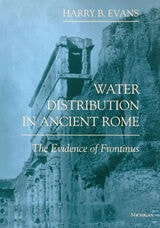
Water Distribution in Ancient Rome
The Evidence of FrontinusHarry B. Evans
University of Michigan Press, 1997
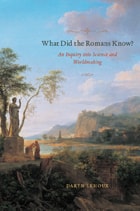
What Did the Romans Know?
An Inquiry into Science and WorldmakingDaryn Lehoux
University of Chicago Press, 2012
When the Lamp is Shattered
Desire and Narrative in CatullusMichaela Janan
Southern Illinois University Press, 1993
The poetry of the Late Roman Republican poet Gaius Valerius Catullus, a rich document of the human heart, is the earliest-known reasonably complete body of erotic verse in the West.
Though approximately 116 poems survive, uncertainties about the condition of the fragmented manuscript and the narrative order of the poems make the Catullan text unusually problematic for the modern critic. Indeed, the poems can be arranged in a number of ways, making a multitude of different plots possible and frustrating the reader’s desire for narrative closure.
Micaela Janan contends that since unsatisfied desire structures both the experience of reading Catullus and its subject matter, critical interpretation of the text demands a "poetics of desire." Furthermore, postmodern critical theory, narratology, and psychoanalysis suggest a flexible concept of the "subject" as a site through which a multitude of social, cultural, and unconscious forces move. Human consciousness, Janan contends, is inherently incomplete and in a continuous process of transformation. She therefore proposes an original and provocative feminist reading of Catullus, a reading informed by theories of consciousness and desire as ancient as Plato and as contemporary as Freud and Lacan.
The Late Roman Republic in which Catullus lived, Janan reminds us, was a time of profound social upheaval when political and cultural institutions that had persisted for centuries were rapidly breaking down—a time not unlike our own. Catullus’ poetry provides an unusually honest look at his culture and its contradictory representations of class, gender, and power. By bringing to the study of this major work of classical literature the themes of consciousness and desire dealt with in postmodern scholarship, Janan’s book invites a new conversation among literary disciplines.
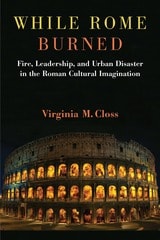
While Rome Burned
Fire, Leadership, and Urban Disaster in the Roman Cultural ImaginationVirginia M. Closs
University of Michigan Press, 2020
Working in the increasingly repressive environment of the early principate, Roman authors frequently employed “figured” speech and mythopoetic narratives to address politically risky topics. In response to shifting political and social realities, the literature of the early imperial period reimagines and reanimates not just historical fires, but also archetypal and mythic representations of conflagration. Throughout, the author engages critically with the growing subfield of disaster studies, as well as with theoretical approaches to language, allusion, and cultural memory.
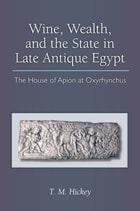
Wine, Wealth, and the State in Late Antique Egypt
The House of Apion at OxyrhynchusT. M. Hickey
University of Michigan Press, 2012
The "glorious house" of the senatorial family of the Flavii Apiones is the best documented economic entity of the Roman Empire during the fifth through seventh centuries, that critical period of transition between the classical world and the Middle Ages. For decades, the rich but fragmentary manuscript evidence that this large agricultural estate left behind, preserved for 1,400 years by the desiccating sands of Egypt, has been central to arguments concerning the agrarian and fiscal history of Late Antiquity, including the rise of feudalism.
Wine, Wealth, and the State in Late Antique Egypt is the most authoritative synthesis concerning the economy of the Apion estate to appear to date. T. M. Hickey examines the records of the family's wine production in the sixth century in order to shed light on ancient economic practices and economic theory, as well as on the wine industry and on estate management. Based on careful study of the original manuscripts, including unpublished documents from the estate archive, he presents controversial conclusions, much at odds with the "top down" models currently dominating the scholarship.
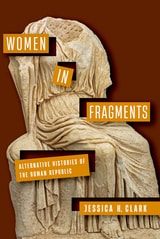
Women in Fragments
Alternative Histories of the Roman RepublicJessica H. Clark
University of Wisconsin Press, 2026
Our sources of knowledge about women in the ancient Roman Republic are flawed. Roman historians were uniformly male, as were most historians of ancient Rome until quite recently. In the historiography handed down by Enlightenment-era scholars, women generally played marginal and often sexualized roles, relegated to the footnotes by historians who assumed the Roman Republic to be fully androcentric. The evidence, however, suggests otherwise. In this detailed and insightful volume, Jessica H. Clark returns to the source material to gain insight into how Roman men understood the lives, roles, and contributions of the women they wrote about.
Reexamining the puzzle pieces of ancient literature, Clark proposes that the earliest Roman historians represented women in complex ways, revealing their appreciation of women’s communities and women’s engagement in the project of the Republic, in contrast to the attitudes assumed by scholars in the eighteenth and nineteenth centuries. She attributes those scholars’ assumptions to the social and political circumstances of their own times and demonstrates how these assumptions have continued to inform our own perceptions of Roman women and therefore Roman society more generally. This study ultimately uncovers not only the women of the Roman Republic but also how modern preconceptions have distorted their image and the stories we tell about ancient Rome.
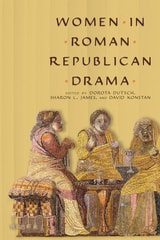
Women in Roman Republican Drama
Edited by Dorota Dutsch, Sharon L. James, and David Konstan
University of Wisconsin Press, 2015
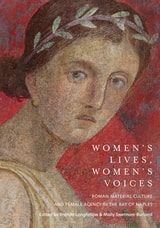
Women's Lives, Women's Voices
Roman Material Culture and Female Agency in the Bay of NaplesEdited by Brenda Longfellow and Molly Swetnam-Burland
University of Texas Press, 2021
Literary evidence is often silent about the lives of women in antiquity, particularly those from the buried cities of Pompeii and Herculaneum. Even when women are considered, they are often seen through the lens of their male counterparts. In this collection, Brenda Longfellow and Molly Swetnam-Burland have gathered an outstanding group of scholars to give voice to both the elite and ordinary women living on the Bay of Naples before the eruption of Vesuvius.
Using visual, architectural, archaeological, and epigraphic evidence, the authors consider how women in the region interacted with their communities through family relationships, businesses, and religious practices, in ways that could complement or complicate their primary social roles as mothers, daughters, and wives. They explore women-run businesses from weaving and innkeeping to prostitution, consider representations of women in portraits and graffiti, and examine how women expressed their identities in the funerary realm. Providing a new model for studying women in the ancient world, Women’s Lives, Women’s Voices brings to light the day-to-day activities of women of all classes in Pompeii and Herculaneum.

World Film Locations
RomeEdited by Gabriel Solomons
Intellect Books, 2014
World Film Locations: Rome takes the reader on a cinematic journey through the city with stops at key locations that include the Pantheon, Piazza Navona, Via Veneto, Piazza del Popolo, Sant'Angelo Bridge and, of course, the Trevi Fountain, made famous worldwide in its appearances in Federico Fellini’s La Dolce Vita and Jean Negulesco’s Three Coins in the Fountain. A carefully selected compilation of forty-six key films set in Rome, including The Belly of an Architect, The Facts of Murder, The Bicycle Thief, Roman Holiday, and The Talented Mr. Ripley, is complemented by essays that further examine the relationship between the city and cinema to provide an engaging, colorful, and insightful page-turning journey for both travelers and film buffs alike.
Writing Imperial History
Tacitus from Agricola to AnnalesBram L. H. ten Berge
University of Michigan Press, 2023