Results by title
149 books match the query 'Russia (Federation)' and 5 start with w
We Remember, We Love, We Grieve
Mortuary and Memorial Practice in Contemporary RussiaElizabeth Warner and Svetlana Adonyeva
University of Wisconsin Press, 2021
“We remember, we love, we grieve” is a common epitaph in this part of the world. As contemporary Russia contends with the Soviet Union’s legacy of dismantling older ways of life, the phrase ripples beyond individual loss—it encapsulates communities’ determination to preserve their customs when faced with oppression. This volume offers insight into a core cultural practice, exploring the dynamism of tradition.
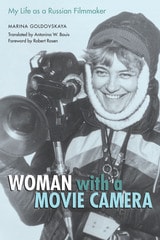
Woman with a Movie Camera
My Life as a Russian FilmmakerBy Marina Goldovskaya
University of Texas Press, 2006
Marina Goldovskaya is one of Russia's best-known documentary filmmakers. The first woman in Russia (and possibly the world) to combine being a director, writer, cinematographer, and producer, Goldovskaya has made over thirty documentary films and more than one hundred programs for Russian, European, Japanese, and American television. Her work, which includes the award-winning films The House on Arbat Street, The Shattered Mirror, and Solovky Power, has garnered international acclaim and won virtually every prize given for documentary filmmaking.
In Woman with a Movie Camera, Goldovskaya turns her lens on her own life and work, telling an adventurous, occasionally harrowing story of growing up in the Stalinist era and subsequently documenting Russian society from the 1960s, through the Thaw and Perestroika, to post-Soviet Russia. She recalls her childhood in a Moscow apartment building that housed famous filmmakers, being one of only three women students at the State Film School, and working as an assistant cameraperson on the first film of Andrei Tarkovsky, Russia's most celebrated director. Reviewing her professional filmmaking career, which began in the 1960s, Goldovskaya reveals her passion for creating films that presented a truthful picture of Soviet life, as well as the challenges of working within (and sometimes subverting) the bureaucracies that controlled Russian film and television production and distribution. Along the way, she describes a host of notable figures in Russian film, theater, art, and politics, as well as the technological evolution of filmmaking from film to video to digital media.
A compelling portrait of a woman who broke gender and political barriers, as well as the eventful four decades of Russian history she has documented, Woman with a Movie Camera will be fascinating reading for a wide audience.
Women with a Thirst for Destruction
The Bad Mother in Russian CultureJenny Kaminer
Northwestern University Press, 2014
Winner, 2014 AWSS Best Book in Slavic/East European/Eurasian Women's Studies
In Russian culture, the archetypal mother is noble and self-sacrificing. In Women with a Thirst for Destruction, however, Jenny Kaminer shows how this image is destabilized during periods of dramatic rupture in Russian society, examining in detail the aftermath of three key moments in the country’s history: the emancipation of the serfs in 1861, the Russian Revolution of 1917, and the fall of the Communist regime in 1991. She explores works both familiar and relatively unexamined: Leo Tolstoy’s Anna Karenina, Mikhail Saltykov-Shchedrin’s The Golovlev Family, Fyodor Gladkov’s Cement, and Liudmila Petrushevskaia’s The Time: Night, as well as a late Soviet film (Vyacheslav Krishtofovich’s Adam’s Rib, 1990) and media coverage of the Chechen conflict. Kaminer’s book speaks broadly to the mutability of seemingly established cultural norms in the face of political and social upheaval.

Women's Activism in Contemporary Russia
Linda Racioppi
Temple University Press, 1997
Linda Racioppi and Katherine O'Sullivan See present a concise history of women's situation in tsarist Soviet Russia, which shows how their ability to organize was constrained by social strictures and state policies. They also analyze how the state-sponsored Soviet Women's Committee and new groups like the Independent Women's Forum, the Women's League, and the International Institute for Entrepreneurial Development responded to the challenges and opportunities of the transition. The authors examine the dynamics among these groups as well. The personal life histories of the activists reflect the ways women have responded to the changing political, economic, and social landscape in the former Soviet Union.
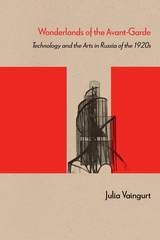
Wonderlands of the Avant-Garde
Technology and the Arts in Russia of the 1920sJulia Vaingurt
Northwestern University Press, 2013
In postrevolutionary Russia, as the Soviet government pursued rapid industrialization, avant-garde artists declared their intent to serve the nascent state and to transform life in accordance with their aesthetic designs. Despite their utilitarian intentions, however, most avant-gardists rarely created works regarded as practical instruments of societal transformation. Exploring this paradox, Vaingurt claims that the artists’ fusion of technology and aesthetics prevented their creations from being fully conscripted into the arsenal of political hegemony. The purposes of avant-garde technologies, she contends, are contemplative rather than constructive. Looking at Meyerhold’s theater, Tatlin’s and Khlebnikov’s architectural designs, Mayakovsky’s writings, and other works from the period, Vaingurt offers an innovative reading of an exceptionally complex moment in the formation of Soviet culture.