Results by title
67 books match the query 'Sea' and 5 start with w
We Live with the Sea
Ecologizing Safety in Post-Tsunami JapanAndrew Littlejohn
Duke University Press, 2026
What Kind of Island in What Kind of Sea?
Franz Fühmann
Lever Press, 2021
Where Rivers Meet the Sea
The Political Ecology of WaterStephanie Kane
Temple University Press, 2012
Where fresh water appears to be abundant and generally accessible, chronic pollution may be relatively ignored as a public issue. Yet there are those whose lives, livelihoods, and traditions are touched directly by the destructive albeit essential relationship between humans and water.
In her passionate and persuasively argued Where Rivers Meet the Sea, Stephanie Kane compares two cities and nations—Salvador, Brazil and Buenos Aires, Argentina—as she tells the stories of those who organize in the streets, petition the courts, and challenge their governments to implement and enforce existing laws designed to protect springs, lakes, harbors, and rivers.
Illuminating the complex and distinctive cultural forces in the South Atlantic that shape conflicts and collaborations pertaining to particular waterfront settings, Kane shows the dilemmas, inventiveness, and persistence that provide the foundation for environmental and social justice movements writ large.
Where Texas Meets the Sea
Corpus Christi and Its HistoryBy Alan Lessoff
University of Texas Press, 2019
A favorite destination of visitors to the Texas coast, Corpus Christi is a midsize city that manages to be both cosmopolitan and provincial, networked and local. It is an indispensable provider of urban services to South Texas, as well as a port of international significance. Its industries and military bases and, increasingly, its coastal research institutes give it a range of connections throughout North America. Despite these advantages, however, Corpus Christi has never made it into the first rank of Texas cities, and a keen self-consciousness about the city’s subordinate position has driven debates over Corpus’s identity and prospects for decades.
In this masterful urban history—a study that will reshape the way that Texans look at all their cities—Alan Lessoff analyzes Corpus Christi’s place within Texas, the American Southwest, the western Gulf of Mexico, and the U.S.-Mexican borderlands from the city’s founding in 1839 to the present. He portrays Corpus as a place where westward Anglo expansion overwhelmed the Hispanic settlement process from the south, leaving a legacy of conflicting historical narratives that colors the city’s character even now. Lessoff also explores how competing visions of the city’s identity and possibilities have played out in arenas ranging from artwork in public places to schemes to embellish, redevelop, or preserve the downtown waterfront and North Padre Island. With a deep understanding of the geographic, historical, economic, and political factors that have formed the city, Lessoff demonstrates that Corpus Christi exemplifies the tensions between regional and cosmopolitan influences that have shaped cities across the Southwest.
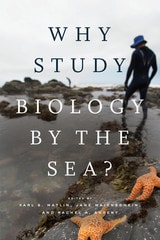
Why Study Biology by the Sea?
Edited by Karl S. Matlin, Jane Maienschein, and Rachel A. Ankeny
University of Chicago Press, 2020
From the Stazione Zoologica in Naples to the Marine Biological Laboratory in Woods Hole, the Amoy Station in China, or the Misaki Station in Japan, students and researchers at seaside research stations have long visited the ocean to investigate life at all stages of development and to convene discussions of biological discoveries. Exploring the history and current reasons for study by the sea, this book examines key people, institutions, research projects, organisms selected for study, and competing theories and interpretations of discoveries, and it considers different ways of understanding research, such as through research repertoires. A celebration of coastal marine research, Why Study Biology by the Sea? reveals why scientists have moved from the beach to the lab bench and back.