322 books match the query 'Social Policy' and 16 start with w

cover of W. E. B. Du Bois: Revolutionary Across the Color Line

W. E. B. Du Bois

Revolutionary Across the Color Line

Bill V. Mullen

Pluto Press, 2016

On the 27th August, 1963, the day before Martin Luther King electrified the world from the steps of the Lincoln Memorial with the immortal words, 'I Have a Dream', the life of another giant of the Civil Rights movement quietly drew to a close in Accra, Ghana: W.E.B. DuBois. In this new biography, Bill V. Mullen interprets the seismic political developments of the Twentieth Century through Du Bois’s revolutionary life. 

Du Bois was born in Massachusetts in 1868, just three years after formal emancipation of America’s slaves. In his extraordinarily long and active political life, he would emerge as the first black man to earn a PhD from Harvard; surpass Booker T. Washington as the leading advocate for African American rights; co-found the NAACP, and involve himself in anti-imperialist and anti-colonial struggles across Asia and Africa. Beyond his Civil Rights work, Mullen also examines Du Bois's attitudes towards socialism, the USSR, China’s Communist Revolution, and the intersectional relationship between capitalism, poverty and racism. 

An accessible introduction to a towering figure of American Civil Rights, perfect for anyone wanting to engage with Du Bois’s life and work.

[more]
cover of Wake: Why the Battle over Diverse Public Schools Still Matters

Wake

Why the Battle over Diverse Public Schools Still Matters

Karey Alison Harwood

Rutgers University Press, 2024
The Wake County Public School System was once described as a beacon of hope for American school districts. It was both academically successful and successfully integrated. It accomplished these goals through the hard work of teachers and administrators, and through a student assignment policy that made sure no school in the countywide district became a high poverty school. Although most students attended their closest school, the “diversity policy” modified where some students were assigned to make sure no school had more than 40% of its students qualifying for free or reduced-price lunch or more than 25% performing below grade level. When the school board election of 2009 swept into office a majority who favored “neighborhood schools,” the diversity policy that had governed student assignment for years was eliminated. Wake: Why the Battle Over Diverse Public Schools Still Matters tells the story of the aftermath of that election, including the fierce public debate that ensued during school board meetings and in the pages of the local newspaper, and the groundswell of community support that voted in a pro-diversity school board in 2011. What was at stake in those years was the fundamental direction of the largest school district in North Carolina and the 14th largest in the U.S. Would it maintain a commitment to diverse schools, and if so, how would it balance that commitment with various competing interests and demands? Through hundreds of published opinion articles and several in depth interviews with community leaders, Wake examines the substance of that debate and explores the community’s vision for public education. Wake also explores the importance of knowing the history of a place, including the history of school segregation. Wake County’s example still resonates, and the battle over diverse public schools still matters, because owning responsibility for the problem of segregated schools (or not) will shape the direction of America’s future.
 
[more]
cover of Welfare Discipline: Discourse, Governance and Globalization

Welfare Discipline

Discourse, Governance and Globalization

Sanford F. Schram

Temple University Press, 2005

For the past decade, political scientist Sanford Schram has led the academic effort to understand how Americans and their political officials talk about poverty and welfare and what impact that discourse has on policy and on the global society.

In Welfare Discipline, Schram argues that it is time to take stock of the new forms of welfare and to develop even better methods to understand them. He argues for a more contextualized approach to examining welfare policy, from the use of the idea of globalization to justify cutbacks, to the increasing employment of U.S. policy discourse overseas, to the development of asset-based approaches to helping the poor.

Stressing the importance of understanding the ways we talk about welfare, how we study it, and, critically, what we do not discuss and why, Schram offers recommendations for making welfare policy both just and effective.
[more]
cover of Welfare Reform and Political Theory

Welfare Reform and Political Theory

Lawrence M. Mead

Russell Sage Foundation, 2005
During the 1990s, both the United States and Britain shifted from entitlement to work-based systems for supporting their poor citizens. Much research has examined the implications of welfare reform for the economic well-being of the poor, but the new legislation also affects our view of democracy—and how it ought to function. By eliminating entitlement and setting behavioral conditions on aid, welfare reform challenges our understanding of citizenship, political equality, and the role of the state. In Welfare Reform and Political Theory, editors Lawrence Mead and Christopher Beem have assembled an accomplished list of political theorists, social policy experts, and legal scholars to address how welfare reform has affected core concepts of political theory and our understanding of democracy itself. Welfare Reform and Political Theory is unified by a common set of questions. The contributors come from across the political spectrum, each bringing different perspectives to bear. Carole Pateman argues that welfare reform has compromised the very tenets of democracy by tying the idea of citizenship to participation in the marketplace. But William Galston writes that American citizenship has in some respects always been conditioned on good behavior; work requirements continue that tradition by promoting individual responsibility and self-reliance—values essential to a well-functioning democracy. Desmond King suggests that work requirements draw invidious distinctions among citizens and therefore destroy political equality. Amy Wax, on the other hand, contends that ending entitlement does not harm notions of equality, but promotes them, by ensuring that no one is rewarded for idleness. Christopher Beem argues that entitlement welfare served a social function—acknowledging the social value of care—that has been lost in the movement towards conditional benefits. Stuart White writes that work requirements can be accepted only subject to certain conditions, while Lawrence Mead argues that concerns about justice must be addressed only after recipients are working. Alan Deacon is well to the left of Joel Schartz, but both say government may actively promote virtue through social policy—a stance some other contributors reject. The move to work-centered welfare in the 1990s represented not just a change in government policy, but a philosophical change in the way people perceived government, its functions, and its relationship with citizens. Welfare Reform and Political Theory offers a long overdue theoretical reexamination of democracy and citizenship in a workfare society.
[more]
cover of Welfare in America: How Social Science Fails the Poor

Welfare in America

How Social Science Fails the Poor

William M. Epstein

University of Wisconsin Press, 1997

William M. Epstein charges that most current social welfare programs are not held to credible standards in their design or their results. Rather than spending less on such research and programs, however, Epstein suggests we should spend much more, and do the job right.
     The American public and policymakers need to rely on social science research for objective, credible information when trying to solve problems of employment, affordable housing, effective health care, and family integrity. But, Epstein contends, politicians treat welfare issues as ideological battlegrounds; they demand immediate results from questionable data and implement policies long before social researchers can complete their analyses. Social scientists often play into the political agenda, supporting poorly conceived programs and doing little to test and revise them. Analyzing Aid to Families with Dependent Children (AFDC) and the recent welfare reform act, Food Stamps, Medicaid, job training, social services, and other programs, Epstein systematically challenges the conservative’s vain hope that neglect is therapeutic for the poor, as well as the liberal’s conceit that a little bit of assistance is sufficient.
[more]
cover of What Government Can Do: Dealing with Poverty and Inequality

What Government Can Do

Dealing with Poverty and Inequality

Benjamin I. Page and James R. Simmons

University of Chicago Press, 2000

It is often said that the federal government cannot or should not attempt to address America's problems of poverty and inequality—because its bureaucracy is wasteful or its programs ineffective. But is this true? In this book, Benjamin I. Page and James R. Simmons examine a number of federal and local programs, detailing what government action already does for its citizens and assessing how efficient it is at solving the problems it seeks to address. Their conclusion, surprisingly, is the polar opposite of the prevailing rhetoric—What Government Can Do is an insightful and compelling argument that it both can and should do more.
[more]
cover of Whatever Happened to Antisemitism?: Redefinition and the Myth of the 'Collective Jew'

Whatever Happened to Antisemitism?

Redefinition and the Myth of the 'Collective Jew'

Antony Lerman

Pluto Press, 2020

'This elegantly written, erudite book is essential reading for all of us, whatever our identifications' - Lynne Segal

Antisemitism is one of the most controversial topics of our time. The public, academics, journalists, activists and Jewish people themselves are divided over its meaning. Antony Lerman shows that this is a result of a 30-year process of redefinition of the phenomenon, casting Israel, problematically defined as the 'persecuted collective Jew', as one of its main targets.

This political project has taken the notion of the 'new antisemitism' and codified it in the flawed International Holocaust Remembrance Alliance's 'working definition' of antisemitism. This text is the glue holding together an international network comprising the Israeli government, pro-Israel advocacy groups, Zionist organizations, Jewish communal defence bodies and sympathetic governments fighting a war against those who would criticize Israel.

The consequences of this redefinition have been alarming, supressing free speech on Palestine/Israel, legitimizing Islamophobic right-wing forces, and politicizing principled opposition to antisemitism.

[more]
cover of When Are You Coming Home?: How Young Children Cope When Parents Go to Jail

When Are You Coming Home?

How Young Children Cope When Parents Go to Jail

Hilary Cuthrell

Rutgers University Press, 2023
As the United States approaches its 50th year of mass incarceration, more children than ever before have experienced the incarceration of a parent. The vast majority of incarceration occurs in locally operated jails and disproportionately impacts families of color, those experiencing poverty, and rural households. However, we are only beginning to understand the various ways in which children cope with the incarceration of a parent – particularly the coping of young children who are most at risk for the adversity and also the most detrimentally impacted. When Are You Coming Home?  helps answer questions about how young ones are faring when a parent is incarcerated in jail. Situated within a resilience model of development, the book presents findings related to children’s stress, family relationships, health, home environments, and visit experiences through the eyes of the children and families. This humanizing, social justice-oriented approach discusses the paramount need to support children and their families before, during, and after a parent’s incarceration while the country simultaneously grapples with strategies of reform and decarceration.
 
[more]
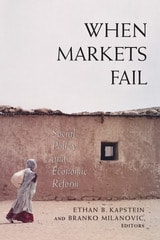
cover of When Markets Fail: Social Policy and Economic Reform

When Markets Fail

Social Policy and Economic Reform

Ethan B. Kapstein

Russell Sage Foundation, 2002

The sweeping political and economic changes of the past decade—including the spread of democracy, pro-market policies, and economic globalization—have dramatically increased the demand in developing countries for social programs such as unemployment compensation, pensions, and income supplements for the poor. When Markets Fail examines how emerging market economies in Eastern Europe, Latin America, North Africa, and the Middle East are shaping their social policies in response to these changes. The contributors—leading scholars of development and social policy—use detailed case studies to examine whether the emerging economies are likely to move toward European-style welfare systems, characterized by high unemployment benefits and large entitlements, or if they will opt for more austere, stripped-down welfare regimes. They find that much will depend on how well emerging economies perform economically, but that the political forces, ideological preferences, and historical backgrounds of each country will also play a decisive role. In his chapter on Central and Eastern Europe, Peter Lindert focuses on how aging populations and the fall of communism have fostered increased need for social assistance in the region. In contrast, Nancy Birdsall and Stephen Haggard highlight the positive role of democratization and Western-style social programs in promoting East Asian social policies. Zafiris Tzannatos and Iqbal Kaur argue that governments in North Africa and the Middle East must foster both human capital formation and competition in the market for social services if they are to meet the growing need for services. When Markets Fail presents some evidence that a global convergence in social policies may be taking place: as Europe slowly makes its welfare provisions less generous, the emerging market economies will be under increasing demographic and political pressure to make their social welfare systems more comprehensive. The book also examines the vital role that organizations such as the World Bank, the International Monetary Fund, and the Asian Development Bank can play in fostering effective social services in developing economies. Economic globalization and political liberalization have produced many economic winners around the world, but these forces have created losers as well. When Markets Fail addresses the problem of how governments in developing countries have responded to the plight of those losers through social policy. The success of these policies, however, remains sharply contested, as is their role in helping to achieve meaningful poverty reduction. When Markets Fail is essential reading for anyone interested in economic liberalization and its consequences for the developing world.
[more]
cover of When Sex Threatened the State: Illicit Sexuality, Nationalism, and Politics in Colonial Nigeria, 1900-1958

When Sex Threatened the State

Illicit Sexuality, Nationalism, and Politics in Colonial Nigeria, 1900-1958

Saheed Aderinto

University of Illinois Press, 2015

Breaking new ground in the understanding of sexuality's complex relationship to colonialism, When Sex Threatened the State illuminates the attempts at regulating prostitution in colonial Nigeria.
 
As Saheed Aderinto shows, British colonizers saw prostitution as an African form of sexual primitivity and a problem to be solved as part of imperialism's "civilizing mission". He details the Nigerian response to imported sexuality laws and the contradictory ways both African and British reformers advocated for prohibition or regulation of prostitution. Tracing the tensions within diverse groups of colonizers and the colonized, he reveals how wrangling over prostitution camouflaged the negotiating of separate issues that threatened the social, political, and sexual ideologies of Africans and Europeans alike.
 
The first book-length project on sexuality in early twentieth century Nigeria, When Sex Threatened the State combines the study of a colonial demimonde with an urban history of Lagos and a look at government policy to reappraise the history of Nigerian public life.

[more]
cover of White Care: The Impact of Race on American Infrastructure

White Care

The Impact of Race on American Infrastructure

Cotten Seiler

University of Chicago Press, 2026

Framing infrastructure as the expression of a state’s care for its population, White Care explores the crucial role of race in the building, maintenance, scope, and quality of US infrastructure.
 
Infrastructure delivers to its users a range of benefits, from health, safety, and sanitation to mobility, energy, and education. It is, as Cotten Seiler argues, how modern states show care for their populations. White Care recounts the rise and fall of public infrastructure in the United States, unearthing its origins as an investment in those Americans deemed most highly evolved, showing the political stakes of its desegregation, and accounting for its current state of dilapidation.
 
From the late nineteenth century through much of the twentieth, government investments in physical (“hard”) and social (“soft”) infrastructure constituted a regime of care that Seiler calls “custodial liberalism.” This regime achieved legitimacy with the New Deal, which conferred upon white citizens a bounty of life-enhancing public works. But custodial liberalism began to unravel in the postwar decades, as Americans of color gained access to public schools, housing, swimming pools, parks, and other sites from which they had long been excluded. As the infrastructural commons were desegregated, white Americans withdrew from the social compact that had empowered them and turned toward neoliberalism, with its program of austerity and privatization. This racialized renunciation has deprived everyone—including themselves—of a cleaner, greener, healthier, safer, more affordable, and more functional environment.

 
[more]
cover of Why Are So Many Americans in Prison? 

Why Are So Many Americans in Prison? 

Steven Raphael

Russell Sage Foundation, 2013
Between 1975 and 2007, the American incarceration rate increased nearly fivefold, a historic increase that puts the United States in a league of its own among advanced economies. We incarcerate more people today than we ever have, and we stand out as the nation that most frequently uses incarceration to punish those who break the law. What factors explain the dramatic rise in incarceration rates in such a short period of time? In Why Are So Many Americans in Prison? Steven Raphael and Michael A. Stoll analyze the shocking expansion of America’s prison system and illustrate the pressing need to rethink mass incarceration in this country. Raphael and Stoll carefully evaluate changes in crime patterns, enforcement practices and sentencing laws to reach a sobering conclusion: So many Americans are in prison today because we have chosen, through our public policies, to put them there. They dispel the notion that a rise in crime rates fueled the incarceration surge; in fact, crime rates have steadily declined to all-time lows. There is also little evidence for other factors commonly offered to explain the prison boom, such as the deinstitutionalization of the mentally ill since the 1950s, changing demographics, or the crack-cocaine epidemic. By contrast, Raphael and Stoll demonstrate that legislative changes to a relatively small set of sentencing policies explain nearly all prison growth since the 1980s. So-called tough on crime laws, including mandatory minimum penalties and repeat offender statutes, have increased the propensity to punish more offenders with lengthier prison sentences. Raphael and Stoll argue that the high-incarceration regime has inflicted broad social costs, particularly among minority communities, who form a disproportionate share of the incarcerated population. Why Are So Many Americans in Prison? ends with a powerful plea to consider alternative crime control strategies, such as expanded policing, drug court programs, and sentencing law reform, which together can end our addiction to incarceration and still preserve public safety. As states confront the budgetary and social costs of the incarceration boom, Why Are So Many Americans in Prison? provides a revealing and accessible guide to the policies that created the era of mass incarceration and what we can do now to end it.
[more]
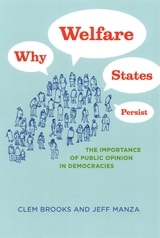
cover of Why Welfare States Persist: The Importance of Public Opinion in Democracies

Why Welfare States Persist

The Importance of Public Opinion in Democracies

Clem Brooks and Jeff Manza

University of Chicago Press, 2007

The world’s richer democracies all provide such public benefits as pensions and health care, but why are some far more generous than others? And why, in the face of globalization and fiscal pressures, has the welfare state not been replaced by another model? Reconsidering the myriad issues raised by such pressing questions, Clem Brooks and Jeff Manza contend here that public opinion has been an important, yet neglected, factor in shaping welfare states in recent decades.

Analyzing data on sixteen countries, Brooks and Manza find that the preferences of citizens profoundly influence the welfare policies of their governments and the behavior of politicians in office. Shaped by slow-moving forces such as social institutions and collective memories, these preferences have counteracted global pressures that many commentators assumed would lead to the welfare state’s demise. Moreover, Brooks and Manza show that cross-national differences in popular support help explain why Scandinavian social democracies offer so much more than liberal democracies such as the United States and the United Kingdom.

Significantly expanding our understanding of both public opinion and social policy in the world’s most developed countries, this landmark study will be essential reading for scholars of political economy, public opinion, and democratic theory.

[more]
cover of Willing and Unable: Doctors' Constraints in Abortion Care

Willing and Unable

Doctors' Constraints in Abortion Care

Lori R. Freedman

Vanderbilt University Press, 2010

Willing and Unable explores the social world where abortion politics and mainstream medicine collide. The author interviewed physicians of obstetrics and gynecology around the United States to find out why physicians rarely integrate abortion into their medical practice. While abortion stigma, violence, and political contention provide some explanation, her findings demonstrate that willing physicians are further encumbered by a variety of barriers within their practice environments.
Structural barriers to the mainstream practice of abortion effectively institutionalize the buck-passing of abortion patients to abortion clinics. As the author notes, "Public-health-minded HMOs and physician practices could significantly change the world of abortion care if they stopped outsourcing it."
Drawing from forty in-depth interviews, the book presents a challenge to a commonly held assumption that physicians decide whether or not to provide abortion based on personal ideology. Physician narratives demonstrate how their choices around learning, doing, and even having abortions themselves disrupt the pro-choice/pro-life moral and political binary.

[more]
cover of Wisconsin and the Shaping of American Law

Wisconsin and the Shaping of American Law

Joseph A. Ranney

University of Wisconsin Press, 2017

State laws affect nearly every aspect of our daily lives—our safety, personal relationships, and business dealings—but receive less scholarly attention than federal laws and courts. Joseph A. Ranney looks at how state laws have evolved and shaped American history, through the lens of the historically influential state of Wisconsin.

Organized around periods of social need and turmoil, the book considers the role of states as legal laboratories in establishing American authority west of the Appalachians, in both implementing and limiting Jacksonian reforms and in navigating legal crises before and during the Civil War—including Wisconsin's invocation of sovereignty to defy federal fugitive slave laws. Ranney also surveys judicial revolts, the reforms of the Progressive era, and legislative responses to struggles for civil rights by immigrants, women, Native Americans, and minorities in the nineteenth and twentieth centuries. Since the 1960s, battles have been fought at the state level over such issues as school vouchers, voting, and abortion rights.
[more]
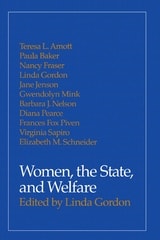
cover of Women, the State, and Welfare

Women, the State, and Welfare

Edited by Linda Gordon

University of Wisconsin Press, 1990

Women, the State, and Welfare is the first collection of essays specifically about women and welfare in the United States.  As an introduction to the effects of welfare programs, it is intended for general readers as well as specialists in sociology, history, political science, social work, and women’s studies.  The book begins with a review essay by Linda Gordon that outlines current scholarship about women and welfare.  The chapters that follow explore discrimination against women inherent in many welfare programs; the ways in which welfare programs reinforce basic gender programs in society; the contribution of organized, activist women to the development of welfare programs; and differences of race and class in the welfare system.  By giving readers access to a number of perspectives about women and welfare, this book helps position gender at the center of welfare scholarship and policy making and places welfare issues at the forefront of feminist thinking and action.
[more]