Results by title
231 books match the query 'Society' and 8 start with w

War and Society in Colonial Zambia, 1939–1953
Alfred Tembo
Ohio University Press, 2021
Written from a Zambian perspective, this leading study shows how the British colony of Northern Rhodesia (later Zambia) organized and deployed human, military, and natural resources during and after the Second World War.
The Second World War brought unprecedented pressures to bear on Britain’s empire, which then included colonial Northern Rhodesia. Through new archival materials and oral histories, War and Society in Colonial Zambia tells—from an African perspective—the story of how the colony organized its human and natural resources on behalf of the imperial government.
Alfred Tembo first examines government propaganda and recruitment of personnel for the Northern Rhodesia Regiment, which served in East Africa, Palestine, Ceylon, Burma, and India. Later, Zambia’s economic contribution to the Allied war effort would foreground the central importance of the colony’s mining industry as well as its role as supplier of rubber and beeswax following the fall of the Southeast Asian colonies to the Japanese in early 1942. Finally, Tembo presents archival and oral evidence about life on the home front, including the social impact of wartime commodity shortages, difficulties posed by incoming Polish refugees, and the more interventionist forms of colonial governance that these circumstances engendered.
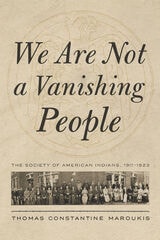
We Are Not a Vanishing People
The Society of American Indians, 1911–1923Thomas Constantine Maroukis
University of Arizona Press, 2021
Historian Thomas Constantine Maroukis discusses the goals, strategies, successes, and failures of the Indigenous intellectuals who came together to form the SAI. They engaged in lobbying, producing publications, informing the media, hundreds of speaking engagements, and annual conferences to argue for reform. Unfortunately, the forces of this era were against reforming federal policies: The group faced racism, a steady stream of negative stereotyping as a so-called vanishing race, and an indifferent federal bureaucracy. They were also beset by internal struggles, which weakened the organization.
This work sheds new light on the origins of modern protest in the twentieth century, and it shows how the intellectuals and activists associated with the SAI were able to bring Indian issues before the American public, challenging stereotypes and the “vanishing people” trope. Maroukis argues that that the SAI was not an assimilationist organization; they were political activists trying to free Indians from government wardship while maintaining their cultural heritage.
West Germany under Construction
Politics, Society, and Culture in the Adenauer EraRobert G. Moeller, Editor
University of Michigan Press, 1997

What's so Funny?
The Comic Conception of Culture and SocietyMurray S. Davis
University of Chicago Press, 1993
Drawing on a vast array of jokes and the work of dozens of comedians from Jay Leno and Lenny Bruce to Steve Allen and Billy Crystal, Davis reminds us of the extraordinarily subversive power of comedy. When we laugh, we accept the truth of the comic moment: that this is the way life really is. The book is in two parts. In the first, Davis explores the cultural conventions that even simple jokes take apart—the rules of logic, language, rationality, and meaning. In the second, he looks at the social systems that have been at the root of jokes for centuries: authority figures, power relations, and institutions. Whatever their style, comedians use the tools of the trade—ambiguous meanings, missed signals, incongruous characters, unlikely events—to violate our expectations about the world.
Setting comedy within a rich intellectual tradition—from Plato to Freud, Hobbes to Kant, in philosophy as well as sociology—Davis makes a convincing case for comedy as a subtle, complex, and articulated theory of culture and society. He reveals the unsuspected ways in which comedy, with its spotlight on the gap between appearance and reality, the ideal and the actual, can be a powerful mode for understanding the world we have made.
Whatever Happened to Sherlock Holmes?
Detective Fiction, Popular Theology, and SocietyRobert S. Paul
Southern Illinois University Press, 1991
Robert S. Paul suggests that the reason detective fiction has won legions of readers may be that "the writer of detective fiction, without conscious intent, appeals directly to those moral and spiritual roots of society unconsciously affirmed and endorsed by the readers."
Because detective stories deal with crime and punishment they cannot help dealing implicitly with theological issues, such as the reality of good and evil, the recognition that humankind has the potential for both, the nature of evidence (truth and error), the significance of our existence in a rational order and hence the reality of truth, and the value of the individual in a civilized society.
Paul argues that the genre traces its true beginning to the Enlightenment and documents two related but different reactions to the theological issues involved: first, a line of writers who are generally positive in relation to their cultural setting, such as Edgar Allan Poe, Wilkie Collins, Conan Doyle; and second, a reactionary strain, critical of the prevailing culture, that begins in William Godwin’s Caleb Williams and continues through the anti-heroic writers like Arsène Lupin to Raymond Chandler, Dashiell Hammett, and John MacDonald.
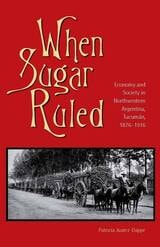
When Sugar Ruled
Economy and Society in Northwestern Argentina, Tucumán, 1876–1916Patricia Juarez-Dappe
Ohio University Press, 2010
Two tropical commodities—coffee and sugar—dominated Latin American export economies in the nineteenth and early twentieth centuries. When Sugar Ruled: Economy and Society in Northwestern Argentina, Tucumán, 1876–1916 presents a distinctive case that does not quite fit into the pattern of many Latin American sugar economies.
During the last quarter of the nineteenth century, the province of Tucumán emerged as Argentina’s main sugar producer, its industry catering almost exclusively to the needs of the national market and financed mostly by domestic capital. The expansion of the sugar industry provoked profound changes in Tucumán’s economy as sugar specialization replaced the province’s diversified productive structure. Since ingenios relied on outside growers for the supply of a large share of the sugarcane, sugar production did not produce massive land dispossession and resulted in the emergence of a heterogeneous planter group. The arrival of thousands of workers from neighboring provinces during the harvest season transformed rural society dramatically. As the most dynamic sector in Tucumán’s economy, revenues from sugar enabled the provincial government to participate in the modernizing movement sweeping turn-of-the-century Argentina.
Patricia Juarez-Dappe uncovers the unique features that characterized sugar production in Tucumán as well as the changes experienced by the province’s economy and society between 1876 and 1916, the period of most dramatic sugar expansion. When Sugar Ruled is an important addition to the literature on sugar economies in Latin America and Argentina.
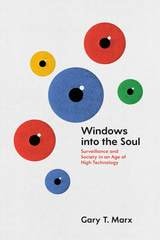
Windows into the Soul
Surveillance and Society in an Age of High TechnologyGary T. Marx
University of Chicago Press, 2016
In this landmark book, Marx sums up a lifetime of work on issues of surveillance and social control by disentangling and parsing the empirical richness of watching and being watched. Using fictional narratives as well as the findings of social science, Marx draws on decades of studies of covert policing, computer profiling, location and work monitoring, drug testing, caller identification, and much more, Marx gives us a conceptual language to understand the new realities and his work clearly emphasizes the paradoxes, trade-offs, and confusion enveloping the field. Windows into the Soul shows how surveillance can penetrate our social and personal lives in profound, and sometimes harrowing, ways. Ultimately, Marx argues, recognizing complexity and asking the right questions is essential to bringing light and accountability to the darker, more iniquitous corners of our emerging surveillance society.
For more information, please see www.garymarx.net.
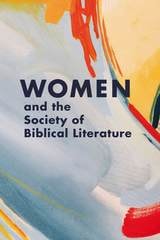
Women and the Society of Biblical Literature
Nicole L. Tilford
SBL Press, 2019
Celebrate 125 years of women's history in the Society of Biblical Literature.
Fourteen years after eight male biblical scholars met in Philip Schaff's study to create the Society of Biblical Literature and Exegesis, the Society admitted its first woman, Anna Ely Rhoads, in 1894. Since Rhoads joined, the careers and lives of women in SBL have changed radically from those earliest members, whose careers were largely tied to the careers of their fathers or spouses and to institutions concerned with the education of young women. Current members now serve on editorial boards and committees; women present papers and publish books; they teach and mentor students. Leading women biblical scholars from around the world reflect on their experiences studying the Bible academically in the twentieth and twenty-first centuries. This volume is a valuable tool for scholars and students interested in the lives and experiences of women in academic fields, the history of the SBL, and developments in the academic study of the Bible.
Features
- An essay on the history of women in the SBL, tracing some of the struggles and accomplishments of the Society's earliest members
- More than twenty-five autobiographical reflections from former SBL presidents, Council members, editors, and active members
- Reflections from members who specialize in a variety of subdisciplines, representing a range of academic and alternative academic careers