Results by title
200 books match the query 'Sociology of Religion' and 5 start with w
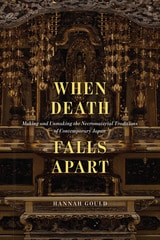
When Death Falls Apart
Making and Unmaking the Necromaterial Traditions of Contemporary JapanHannah Gould
University of Chicago Press, 2023
Deep in the Fukuyama mountainside, “the grave of the graves” (o-haka no haka) houses acres of unwanted headstones—the material remains of Japan’s discarded death rites. In the past, the Japanese dead became venerated ancestors through sustained ritual offerings at graves and at butsudan, Buddhist altars installed inside the home. But in twenty-first-century Japan, this intergenerational system of care is rapidly collapsing.
In noisy carpentry studios, flashy funeral-goods showrooms, neglected cemeteries, and cramped kitchens where women prepare memorial feasts, Hannah Gould analyzes the lifecycle of butsudan, illuminating how they are made, circulate through religious and funerary economies, mediate intimate exchanges between the living and the dead, and—as the population ages, families disperse, and fewer homes have space for large lacquer cabinets—eventually fall into disuse. What happens, she asks, when a funerary technology becomes obsolete? And what will take its place? Gould examines new products better suited to urban apartments: miniature urns and sleek altars inspired by Scandinavian design, even reliquary jewelry. She visits an automated columbarium and considers new ritual practices that embrace impermanence. At an industry expo, she takes on the role of “demonstration corpse.” Throughout, Gould invites us to rethink memorialization and describes a distinct form of Japanese necrosociality, one based on material exchanges that seek to both nurture the dead and disentangle them from the world of the living.
When Peace Is Not Enough
How the Israeli Peace Camp Thinks about Religion, Nationalism, and JusticeAtalia Omer
University of Chicago Press, 2013
Why God?
Explaining Religious PhenomenaRodney Stark
Templeton Press, 2017
Defining religion over the past century has, ironically, led to theories that exclude belief in God, proposing that all systems of thought concerning the meaning of life are religions. Of course, this makes it impossible to distinguish the village priest from the village atheist, or Communism from Catholicism. Worse yet, it makes all religious behavior irrational, presuming that, for example, people knowingly pray to an empty sky.
Renowned sociologist of religion Rodney Stark offers a comprehensive, decisive, God-centered theory of religion in his book, Why God: Explaining Religious Phenomena. While his intent is not to insist that God exists, Stark limits religions to systems of thought based on belief in supernatural beings—to Gods. With this God-focused theory, Stark explores the entire range of religious topics, including the rise of monotheism, the discovery of sin, causes of religious hostility and conflict, and the role of revelations.
Each chapter of Why God? builds a comprehensive framework, starting with the foundations of human motivations and ending with an explanation of why most people are religious. Stark ultimately settles what religion is, what it does, and why it is a universal feature of human societies.
Why God? is a much needed guide for anyone who wants a thorough understanding of religion and our relationship to it, as well as a firm refutation to those who think religion can exist without the divine.
Why I Am Not a Secularist
William E. Connolly
University of Minnesota Press, 2000
Writing Indians
Literacy, Christianity, and Native Community in Early AmericaHilary E. Wyss
University of Massachusetts Press, 2000
A study of cultural encounter, this book takes a fresh look at the much ignored and often misunderstood experience of Christian Indians in early America. Focusing on New England missionary settlements from the mid-seventeenth to the early nineteenth centuries, Hilary E. Wyss examines the ways in which Native American converts to Christianity developed their own distinct identity within the context of a colonial culture.
With an approach that weaves together literature, religious studies, and ethno-history, Wyss grounds her work in the analysis of a rarely read body of “autobiographical” writings by Christian Indians, including letters, journal entries, and religious confessions. She then juxtaposes these documents to the writings of better known Native Americans like Samson Occom as well as to the published works of Anglo-Americans, such as Mary Rowlandson's famous captivity narrative and Eleazor Wheelock's accounts of his charity schools.
In their search for ostensibly “authentic” Native voices, scholars have tended to overlook the writings of Christian Indians. Yet, Wyss argues, these texts reveal the emergence of a dynamic Native American identity through Christianity. More specifically, they show how the active appropriation of New England Protestantism contributed to the formation of a particular Indian identity that resisted colonialism by using its language against itself.