Results by title
323 books match the query 'Southeast Asia' and 8 start with w
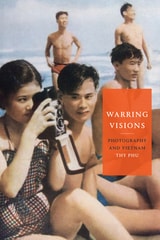
Warring Visions
Photography and VietnamThy Phu
Duke University Press, 2021
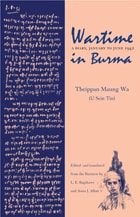
Wartime in Burma
A Diary, January to June 1942Theippan Maung Wa
Ohio University Press, 2009
This diary, begun after the Japanese attack on Pearl Harbor and covering the invasion of Burma up to June 1942, is a moving account of the dilemmas faced by the well-loved and prolific Burmese author Theippan Maung Wa (a pseudonym of U Sein Tin) and his family. At the time of the Japanese invasion, U Sein Tin was deputy secretary in the Ministry of Home and Defense Affairs. An Oxford-trained member of the Indian Civil Service, working for the British administration on the eve of the invasion, he lived with his wife and three small children in Rangoon.
Wartime in Burma is a stirring memoir that presents a personal account of U Sein Tin’s feelings about the war, his anxiety for the safety of his family, the bombing of Rangoon, and what happened to them during the next six chaotic months of the British retreat. The author and his family leave Rangoon to live in a remote forest in Upper Burma with several other Burmese civil servants, their staff, and valuable possessions—rich pickings for robbers. His diary ends abruptly on June 5, his forty-second birthday; U Sein Tin was murdered on June 6 by a gang of Burmese bandits. The diary pages, scattered on the floor of the house, were rescued by his wife and eventually published in Burma in 1966. What survives is a unique account that shines new light on the military retreat from Burma.
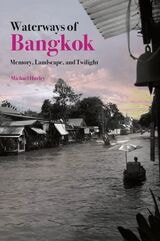
Waterways of Bangkok
Memory, Landscape and TwilightMichael Hurley
National University of Singapore Press, 2025
This ethnographic study explores memory along the waterways, a realm of boats and hovels, merchants and war captives, temples and ghosts. The river also flows into the dissonant realities of Thailand, a country of deep conflicts over power and national ideology. Based on research in a time of political turmoil, centered on the late years of the long-reigning monarch, Rama IX, this book invites readers to look beyond established images of Thai society. More broadly, this work will speak to readers interested in water, cities, and the bonds of memory and landscape.
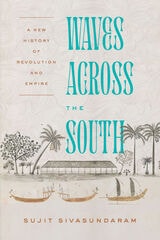
Waves Across the South
A New History of Revolution and EmpireSujit Sivasundaram
University of Chicago Press, 2020
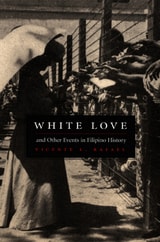
White Love and Other Events in Filipino History
Vicente L. Rafael
Duke University Press, 2000
With a focus on the contradictions and ironies that suffuse Filipino history, Rafael delineates the multiple ways that colonialism has both inhabited and enabled the nationalist discourse of the present. His topics range from the colonial census of 1903-1905, in which a racialized imperial order imposed by the United States came into contact with an emergent revolutionary nationalism, to the pleasures and anxieties of nationalist identification as evinced in the rise of the Marcos regime. Other essays examine aspects of colonial domesticity through the writings of white women during the first decade of U.S. rule; the uses of photography in ethnology, war, and portraiture; the circulation of rumor during the Japanese occupation of Manila; the reproduction of a hierarchy of languages in popular culture; and the spectral presence of diasporic Filipino communities within the nation-state. A critique of both U.S. imperialism and Filipino nationalism, White Love and Other Events in Filipino History creates a sense of epistemological vertigo in the face of former attempts to comprehend and master Filipino identity.
This volume should become a valuable work for those interested in Southeast Asian studies, Asian-American studies, postcolonial studies, and cultural studies.
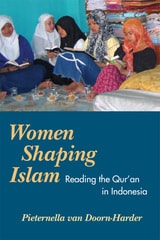
Women Shaping Islam
Reading the Qu'ran in IndonesiaPieternella van Doorn-Harder
University of Illinois Press, 2006
In Women Shaping Islam, Pieternella van Doorn-Harder explores the work of these contemporary women leaders, examining their attitudes toward the rise of radical Islamists; the actions of the authoritarian Soeharto regime; women's education and employment; birth control and family planning; and sexual morality. Ultimately, van Doorn-Harder reveals the many ways in which Muslim women leaders understand and utilize Islam as a significant force for societal change; one that ultimately improves the economic, social, and psychological condition of women in Indonesian society.
World Making with Malay-Indonesian Manuscripts
Circulation, Contestation and ConnectionEdited by Maznah Mohamad and Sher Banu Khan
National University of Singapore Press, 2026
What new framings emerge when we revisit the vibrant world of Malay-Indonesian manuscripts, looking beyond the boundaries imposed by colonial and nationalist scholarship? This volume revitalizes manuscript studies by using texts in entirely fresh ways, situating them as dynamic instruments of knowledge and cultural transformation. Through contextual readings, it uncovers multiple historical and cultural narratives within and between manuscripts, challenging established understandings of power, identity, and authorship. Chapters explore themes ranging from the origins of kingdoms and intellectual traditions to the reinvention of contemporary lives through politicized readings of older texts.
By foregrounding the diversity and versatility of Malay-Indonesian textual traditions, this book recenters manuscripts as vital agents in shaping Southeast Asian histories, decenters fixed notions of a singular “Malay” worldview, and reveals the fluidity of cultural memory across time and place.
Writing the Past, Inscribing the Future
History as Prophecy in Colonial JavaNancy K. Florida
Duke University Press, 1995
Babad Jaka Tingkir, the historical prophecy that Writing the Past, Inscribing the Future translates and reads, is uniquely suited for such a study. Composing an engaging history of the emergence of Islamic power in central Java around the turn of the sixteenth century, Babad Jaka Tingkir was written from the vantage of colonial exile to contest the more dominant dynastic historical traditions of nineteenth-century court literature. Florida reveals how this history’s episodic form and focus on characters at the margins of the social order work to disrupt the genealogical claims of conventional royal historiography—thus prophetically to open the possibility of an alternative future.