Results by title
149 books match the query 'Spanish & Portuguese' and 5 start with w
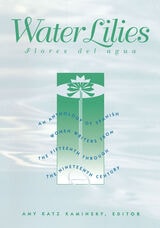
Water Lilies
An Anthology of Spanish Women Writers from the Fifteenth through the Nineteenth CenturyAmy Kaminsky
University of Minnesota Press, 1995
Poetry and prose by Spanish women presented here in both English and Spanish.
A dazzling sampler, Water Lilies brings to light a rich and until now largely invisible version of Spanish literary history. These hard-to-find works, most translated for the first time, are printed on facing pages in Spanish and English and located within a critical, biographical, and historical overview.
Here are five centuries of writing by Spanish women, the unknown recovered from obscurity, the well-known seen as they rarely have been-in the context of a women’s literary history. Some of these writers, like Rosalía de Castro in “The Bluestockings” and Teresa de Cartagena in Wonder at the Work of God, question the relationship between the woman writer and the act of writing. Some, like the poet Carolina Coronado in “The Twin Geniuses: Sappho and Saint Teresa of Jesus,” overtly seek a literary tradition. Others, like Saint Teresa in her Life and Luisa Sigea in her poetry, provide touchstones for women in search of such a tradition.Legends and stories of women’s friendships, the inconstancy of men, and the love of God; Spain’s first autobiographical text; secular and religious poetry from medieval through recent times; an excerpt from one of the few chivalresque novels written by a woman; a full-length Golden Age comedia: this is the wide range of works Water Lilies comprises. Brought together for the first time, the writers articulate their resistance to, and their complicity in, a literary history that, until now, has tried to exclude them.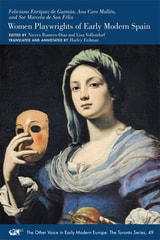
Women Playwrights of Early Modern Spain
Feliciana Enríquez de Guzmán, Ana Caro Mallén, and Sor Marcela de San Félix
Iter Press, 2016
This volume presents ten plays by three leading women playwrights of Spain’s Golden Age. Included are four bawdy and outrageous comic interludes; a full-length comedy involving sorcery, chivalry, and dramatic stage effects; and five short religious plays satirizing daily life in the convent. A critical introduction to the volume positions these women and their works in the world of seventeenth-century Spain.
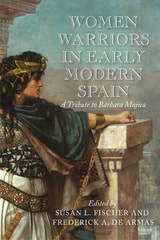
Women Warriors in Early Modern Spain
A Tribute to Barbara MujicaSusan L. Fischer
University of Delaware Press, 2019
Published by University of Delaware Press. Distributed worldwide by Rutgers University Press.
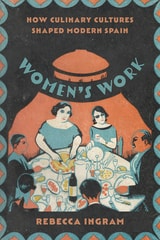
Women’s Work
How Culinary Cultures Shaped Modern SpainRebecca Ingram
Vanderbilt University Press, 2022
We are living in a moment in which famous chefs, Michelin stars, culinary techniques, and gastronomical accolades attract moneyed tourists to Spain from all over the world. This has prompted the Spanish government to declare its cuisine as part of Spanish patrimony. Even with this widespread global attention, we know little about how Spanish cooking became a litmus test for demonstrating Spain's modernity and, relatedly, the roles ascribed to the modern Spanish women responsible for daily cooking.
Efforts to articulate a new, modern Spain infiltrated writing in multiple genres and media. Women's Work offers a sharp reading of diverse sources, placed in their historical context, that yields a better understanding of the roles of food within an inherently uneven modernization process. Further, author Rebecca Ingram's perceptive critique reveals the paradoxical messages women have navigated, even in texts about a daily practice that shaped their domestic and work lives. Women's Work posits that this is significant because of the degree to which domestic activities, including cooking, occupied women's daily lives, even while issues like their fitness as citizens and participation in the public sphere were hotly debated. At the same time, progressive intellectuals from diverse backgrounds began to invoke Spanish cooking and eating as one measure of Spanish modernity.
Women's Work shows how culinary writing engaged these debates and reached women at the site of much of their daily labor—the kitchen—and, in this way, shaped their thinking about their roles in modernizing Spain.
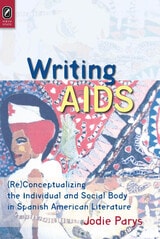
Writing AIDS
(Re)Conceptualizing the Individual and Social Body in Spanish American LiteratureJodie Parys
The Ohio State University Press, 2012