Results by title
77 books match the query 'States' and 4 start with w
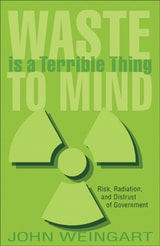
Waste is a Terrible Thing to Mind
Risk, Radiation, and Distrust of GovernmentWeingart, John
Rutgers University Press, 2007
It is an unenviable task, but one that all state governments face: finding a final “resting place” for low-level nuclear waste from power plants, hospitals, university laboratories, and other industries. John Weingart was the official in New Jersey who for many years led this onerous charge. This book is the story of how he and a commission appointed by the governor, instead of imposing a top-down solution, designed an approach that would confront public fears by seeking a community that would volunteer to host a disposal facility. Initially, this novel approach was surprisingly successful, as leaders in a dozen municipalities stepped forward to say they might be interested. Once their interest became known, however, the process in each town derailed. Residents demanded assurances of zero-percent risk and expressed profound distrust of government assertions and promises.
Waste Is a Terrible Thing to Mind is a compelling, suspenseful, and amusing insider’s account of New Jersey policy and politics, but it is also a larger saga of the challenges facing society in the post–9/11 era when the public’s distrust of government is increasing at the same time that its sensitivity to health and safety threats is heightened.
For more information, see: http://wasteisaterriblethingtomind.com/
"Written with a wry sense of humor, it is a pleasure to read and could provide the blueprint for future efforts to find locations for controversial land uses."
- Marie Curtis, Executive Director, New Jersey Environmental Lobby
"A penetrating look at one state's struggle with radioactive waste ... offering some tantalizing reflections on the public understanding of science and how we, in a democratic society, deal with complexity and uncertainty."
- Jay Kaufman, State Senator, Massachusetts State Legislature
"A provocative story, laced with humor, demonstrates how public distrust of government can make it impotent. It should be read by anyone working on public policy issues, especially planning, growth, and the environment."
- Harriet Keyserling, Former Energy Committee Chair, South Carolina State Legislature
"Readers interested in environmental policy, land use and how governments make decisions will learn much from this fine reflective insider's account. It's also a primer on how to survive and thrive in state government."
- David N. Kinsey, Visiting Professor, Woodrow Wilson School Princeton University
"... a fascinating case study of how a government agency creatively tried to solve an intractable public issue. Although the agency failed in its quest to recruit a town to host a low-level radioactive waste site, Weingart's detailed and often humorous narrative of the agency's efforts is a clear winner."
- Jack Sabatino, Judge, New Jersey Superior Court
"... a very engaging and sometimes discouraging case study about the pitfalls and perils of trying to site a controversial facility the right way."
- Gregg Larson, Administrator, Center for Biometric Research, University of Minnesota

Where Women Run
Gender and Party in the American StatesKira Sanbonmatsu
University of Michigan Press, 2010
“Kira Sanbonmatsu has done a masterful job of linking the representation of women in elective office to the activities of party organizations in the states. She combines qualitative and quantitative data to show how women are navigating the campaign process to become elected leaders and the changing role of party organizations in their recruitment and election. It is a significant contribution to the study of representative democracy.”
--Barbara Burrell, Northern Illinois University
“Sanbonmatsu has produced an excellent study that will invigorate research on the role of political parties and the recruitment of women candidates. Using a variety of methods and data sources, she has crafted a tightly constructed, clearly argued, and exceedingly well-written study. A commendable and convincing job.”
--Gary Moncrief, Boise State University
“Sanbonmatsu offers important insights in two neglected areas of American politics: the role of political parties in recruiting candidates and the continued under-representation of women in elected office. Connecting the two subjects through careful qualitative and statistical methods, insightful interpretation of the literature and interesting findings, the book is a significant new addition to scholarship on parties, gender, and political recruitment.”
--Linda Fowler, Dartmouth College
Kira Sanbonmatsu is Associate Professor of Political Science at Rutgers University and Senior Scholar at the Eagleton Institute of Politics’ Center for American Women and Politics (CAWP). She was previously associate professor at Ohio State University. She is the author of Democrats, Republicans, and the Politics of Women’s Place.

Wisconsin and the Shaping of American Law
Joseph A. Ranney
University of Wisconsin Press, 2017
Organized around periods of social need and turmoil, the book considers the role of states as legal laboratories in establishing American authority west of the Appalachians, in both implementing and limiting Jacksonian reforms and in navigating legal crises before and during the Civil War—including Wisconsin's invocation of sovereignty to defy federal fugitive slave laws. Ranney also surveys judicial revolts, the reforms of the Progressive era, and legislative responses to struggles for civil rights by immigrants, women, Native Americans, and minorities in the nineteenth and twentieth centuries. Since the 1960s, battles have been fought at the state level over such issues as school vouchers, voting, and abortion rights.
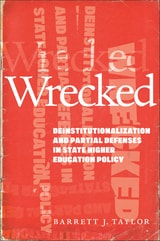
Wrecked
Deinstitutionalization and Partial Defenses in State Higher Education PolicyBarrett J. Taylor
Rutgers University Press, 2022