Results by title
117 books match the query 'Storytelling' and 4 start with w
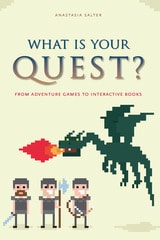
What Is Your Quest?
From Adventure Games to Interactive BooksAnastasia Salter
University of Iowa Press, 2014
What Is Your Quest? examines the future of electronic literature in a world where tablets and e-readers are becoming as common as printed books and where fans are blurring the distinction between reader and author. The construction of new ways of storytelling is already underway: it is happening on the edges of the mainstream gaming industry and in the spaces between media, on the foundations set by classic games. Along these margins, convergent storytelling allows for playful reading and reading becomes a strategy of play.
One of the earliest models for this new way of telling stories was the adventure game, the kind of game centered on quests in which the characters must overcome obstacles and puzzles. After they fell out of fashion in the 1990s, fans made strenuous efforts to keep them alive and to create new games in the genre. Such activities highlight both the convergence of game and story and the collapsing distinction between reader and author. Continually defying the forces of obsolescence, fans return abandoned games to a playable state and treat stories as ever-evolving narratives. Similarly, players of massive multiplayer games become co-creators of the game experience, building characters and creating social networks that recombine a reading and gaming community.
The interactions between storytellers and readers, between programmers and creators, and among fans turned world-builders are essential to the development of innovative ways of telling stories. And at the same time that fan activities foster the convergence of digital gaming and storytelling, new and increasingly accessible tools and models for interactive narrative empower a broadening range of storytellers. It is precisely this interactivity among a range of users surrounding these new platforms that is radically reshaping both e-books and games and those who read and play with them.
[more]
What John Knows
Storytelling in the Fourth GospelDouglas Estes
SBL Press, 2025
The Gospel of John is a story that claims to speak about the past; however, in order to say something about the past, storytellers must know something of that past. In this follow-up to How John Works: Storytelling in the Fourth Gospel, a team of international scholars moves beyond genre, style, and character to examine the types of knowledge the Fourth Evangelist drew upon to write his gospel. Contributors Paul N. Anderson, Richard Bauckham, Jo-Ann A. Brant, Andrew J. Byers, Douglas Estes, Edward H. Gerber, Stan Harstine, Wendy E. S. North, George L. Parsenios, Christopher A. Porter, Tyler Smith, and Catrin H. Williams focus on a range of topics, including memory, tradition, spirit, rhetoric, imagination, and more. Together the twelve essays build a narrative epistemology that establishes what a writer must know in order to craft a narrative about the past. This collection is sure to become an essential textbook for students of the gospels in general and John in particular.
[more]

What's Black and White and Reid All Over?
Something Hilarious Happened at the LibraryRob Reid
American Library Association, 2012
[more]
What's Nature Worth
Terre Satterfield
University of Utah Press, 2004
Based on either written or oral interviews with a dozen prominent environmental writers, What’s Nature Worth? explores how the art of storytelling might bring new perspectives and insights to economic and policy discussions regarding the "value" of nature and the environment. The diverse points of view explored, and the writers’ insistence on careful interpretation, demonstrate that environmental values are complex, rich, and deeply felt—far more so than mainstream economic methodology would have us believe. There is general consensus among the contributors that the narrative form allows for an exploration of the richness of what it means to "value" nature without being preachy or didactic. Following interviews with the twelve authors, examples of their work demonstrate how indirect expressions of value, in the words of Allison Hawthorne Deming, have an "emotional hue" that can replenish the energy depleted by the coldness of cost-benefit arguments.
[more]