Results by title
270 books match the query 'Technology' and 12 start with w
Ways of Knowing
A New History of Science, Technology, and MedicineJohn V. Pickstone
University of Chicago Press, 2001
Covering an incredibly wide range of subjects, from minerals and machines to patients and pharmaceuticals, and from experimental physics to genetic engineering, Pickstone's Ways of Knowing challenges the reader to reexamine traditional conceptualizations of the history, philosophy, and social studies of science, technology, and medicine.
When Biometrics Fail
Gender, Race, and the Technology of IdentityShoshana Amielle Magnet
Duke University Press, 2011

When the Yellow River Floods
Water, Technology, and Nation-Building in Early Twentieth-Century Chinese LiteratureHui-Lin Hsu
Hong Kong University Press, 2024
When the Yellow River Floods explores the relationship between environmental degradation, hydraulic engineering, and nation-building in the context of Liu E’s The Travels of Lao Can. This book provides a unique perspective on modern Chinese literary history that goes beyond conventional narratives that focus solely on political and cultural factors. The main areas covered include the role of water management in literary nation-building and the connections between the novel’s various themes, such as river engineering, medical and political discourses, national sentiment, and landscape description.
By offering a comprehensive analysis of The Travels of Lao Can, this book broadens the understanding of nation-building in early twentieth-century China, highlighting the impact of environmental crises and hydraulics on the formation of national literature and consciousness. When the Yellow River Floods provides a new perspective on the environmental roots of modern Chinese literature, making it an essential read for those seeking to understand the complex interplay between literature, the environment, and national identity in China. This book will be of interest to scholars and students of Chinese literature, history, and environmental studies.

Whoosh Goes the Market
Algorithms, Automation, and AlienationDaniel Scott Souleles
University of Chicago Press, 2024
Markets are messy, and no one knows this better than traders who work tirelessly to predict what they will do next. In Whoosh Goes the Market, Daniel Scott Souleles takes us into the day-to-day experiences of a team at a large trading firm, revealing what it’s actually like to make and lose money on contemporary capital markets.
The traders Souleles shadows have mostly moved out of the pits and now work with automated, glitch-prone computer systems. They remember the days of trading manually, and they are suspicious of algorithmically driven machine-learning systems. Openly musing about their own potential extinction, they spend their time expressing fear and frustration in profanity-laced language. With Souleles as our guide, we learn about everything from betting strategies to inflated valuations, trading swings, and market manipulation. This crash course in contemporary finance vividly reveals the existential anxiety at the evolving front lines of American capitalism.

Whose Dog Are You?
The Technology of Dog Breeds and The Aesthetics of Modern Human-Canine RelationsMartin Wallen
Michigan State University Press, 2017
Why the Wheel Is Round
Muscles, Technology, and How We Make Things MoveSteven Vogel
University of Chicago Press, 2016
Steven Vogel combines his engineering expertise with his remarkable curiosity about how things work to explore how wheels and other mechanisms were, until very recently, powered by the push and pull of the muscles and skeletal systems of humans and other animals. Why the Wheel Is Round explores all manner of treadwheels, hand-spikes, gears, and more, as well as how these technologies diversified into such things as hand-held drills and hurdy-gurdies. Surprisingly, a number of these devices can be built out of everyday components and materials, and Vogel’s accessible and expansive book includes instructions and models so that inspired readers can even attempt to make their own muscle-powered technologies, like trebuchets and ballista.
Appealing to anyone fascinated by the history of mechanics and technology as well as to hobbyists with home workshops, Why the Wheel Is Round offers a captivating exploration of our common technological heritage based on the simple concept of rotation. From our leg muscles powering the gears of a bicycle to our hands manipulating a mouse on a roller ball, it will be impossible to overlook the amazing feats of innovation behind our daily devices.
Wicked, Incomplete, and Uncertain
User Support in the Wild and the Role of Technical CommunicationJason Swarts
Utah State University Press, 2018
Technical writers traditionally create large volumes of idealized tasks and procedures in help documentation, but this is no longer the only approach, or even the best approach. Shifting responsibility for user support to users via crowdsourcing is a risky alternative. Just as with other mass-collaborative enterprises, contributors to a forum may not be aware of the kind of knowledge they are creating or how their contributions connect with those made by others. Wicked, Incomplete, and Uncertain describes the kinds of writing and help practices in which user forums engage, why users seem to find these forums credible and appealing, and what companies can learn about building user communities to support this form of assistance.
Through investigation of user-forum activities, Swarts identifies a new set of contributions that technical communicators can make—not only by creating content but also by curating content, shaping conversations, feeding information back into the user community, and opening channels of discovery and knowledge creation that can speak to users and software developers alike
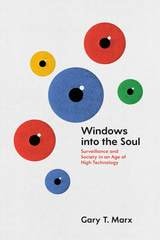
Windows into the Soul
Surveillance and Society in an Age of High TechnologyGary T. Marx
University of Chicago Press, 2016
In this landmark book, Marx sums up a lifetime of work on issues of surveillance and social control by disentangling and parsing the empirical richness of watching and being watched. Using fictional narratives as well as the findings of social science, Marx draws on decades of studies of covert policing, computer profiling, location and work monitoring, drug testing, caller identification, and much more, Marx gives us a conceptual language to understand the new realities and his work clearly emphasizes the paradoxes, trade-offs, and confusion enveloping the field. Windows into the Soul shows how surveillance can penetrate our social and personal lives in profound, and sometimes harrowing, ways. Ultimately, Marx argues, recognizing complexity and asking the right questions is essential to bringing light and accountability to the darker, more iniquitous corners of our emerging surveillance society.
For more information, please see www.garymarx.net.

Wireless Power Transfer
Theory, technology, and applicationsNaoki Shinohara
The Institution of Engineering and Technology, 2018

Women, Gender, and Technology
Edited by Mary Frank Fox, Deborah G. Johnson, and Sue V. Rosser
University of Illinois Press, 2006
An interdisciplinary investigation of the co-creation of gender and technology
Each of the ten chapters in Women, Gender, and Technology explores a different aspect of how gender and technology work--and are at work--in particular domains, including film narratives, reproductive technologies, information technology, and the profession of engineering. The volume's contributors include representatives of over half a dozen different disciplines, and each provides a novel perspective on the foundational idea that gender and technology co-create one another. Together, their articles provide a window on to the rich and complex issues that arise in the attempt to understand the relationship between these profoundly intertwined notions.

Wonderlands of the Avant-Garde
Technology and the Arts in Russia of the 1920sJulia Vaingurt
Northwestern University Press, 2013
In postrevolutionary Russia, as the Soviet government pursued rapid industrialization, avant-garde artists declared their intent to serve the nascent state and to transform life in accordance with their aesthetic designs. Despite their utilitarian intentions, however, most avant-gardists rarely created works regarded as practical instruments of societal transformation. Exploring this paradox, Vaingurt claims that the artists’ fusion of technology and aesthetics prevented their creations from being fully conscripted into the arsenal of political hegemony. The purposes of avant-garde technologies, she contends, are contemplative rather than constructive. Looking at Meyerhold’s theater, Tatlin’s and Khlebnikov’s architectural designs, Mayakovsky’s writings, and other works from the period, Vaingurt offers an innovative reading of an exceptionally complex moment in the formation of Soviet culture.
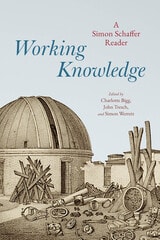
Working Knowledge
A Simon Schaffer ReaderSimon Schaffer
University of Chicago Press, 2026
Working Knowledge is the first English-language collection of essays by Simon Schaffer, coauthor of Leviathan and the Air-Pump, a landmark text in the history of science. Though the latter may be his most famous book, Schaffer is also renowned for seminal articles on Isaac Newton and the cultures of popular spectacle, nineteenth-century physics and its practices of labor discipline and standardization, the history of anthropology and collecting, and the globe-spanning cultural interactions that have shaped modern science. Working Knowledge compiles these well-known pieces alongside newer selections, making them accessible in a single place and representing the huge scope and impact of Schaffer’s oeuvre.
The Reader divides sixteen of Schaffer’s articles across five thematic sections, which take up timely issues like the turn toward global histories of science; the intersection of science and capitalism; the interaction between bodies and machines; and the connection between science, politics, and the environment. Eight new essays by notable historians such as Adrian Johns, Lissa Roberts, and Steven Shapin bring Schaffer’s pieces into discussion with current scholarship. Illustrations and brief commentaries by Schaffer and the artist Adam Lowe, a longtime collaborator, are included throughout the volume.
Bringing together essential articles that were previously scattered across several publications, Working Knowledge is an insightful introduction to Schaffer and his ever-relevant writing.