Results by title
141 books match the query 'Twentieth Century' and 4 start with w

War and Disease
Biomedical Research on Malaria in the Twentieth CenturyLeo B. Slater
Rutgers University Press, 2009
Malaria is one of the leading killers in the world today. Though drugs against malaria have a long history, attempts to develop novel therapeutics spanned the twentieth century and continue today. In this historical study, Leo B. Slater shows the roots and branches of an enormous drug development project during World War II. Fighting around the globe, American soldiers were at high risk for contracting malaria, yet quinine–a natural cure–became harder to acquire. A U.S. government-funded antimalarial program, initiated by the National Research Council, brought together diverse laboratories and specialists to provide the best drugs to the nation's military. This wartime research would deliver chloroquinine–long the drug of choice for prevention and treatment of malaria–and a host of other chemotherapeutic insights.
A massive undertaking, the antimalarial program was to biomedical research what the Manhattan Project was to the physical sciences.
A volume in the Critical Issues in Health and Medicine series, edited by Rima D. Apple and Janet Golden.
[more]

Women against Abortion
Inside the Largest Moral Reform Movement of the Twentieth CenturyKarissa Haugeberg
University of Illinois Press, 2017
Women from remarkably diverse religious, social, and political backgrounds made up the rank-and-file of anti-abortion activism. Empowered by--yet in many cases scared of--the changes wrought by feminism, they founded grassroots groups, developed now-familiar strategies and tactics, and gave voice to the movement's moral and political dimensions. Drawing on oral histories and interviews with prominent figures, Karissa Haugeberg examines American women 's fight against abortion. Beginning in the 1960s, she looks at Marjory Mecklenburg's attempt to shift the attention of anti-abortion leaders from the rights of fetuses to the needs of pregnant women. Moving forward she traces the grassroots work of Catholic women, including Juli Loesch and Joan Andrews, and their encounters with the influx of evangelicals into the movement. She also looks at the activism of evangelical Protestant Shelley Shannon, a prominent pro-life extremist of the 1990s. Throughout, Haugeberg explores important questions such as the ways people fused religious conviction with partisan politics, activists' rationalizations for lethal violence, and how women claimed space within an unshakably patriarchal movement.
[more]
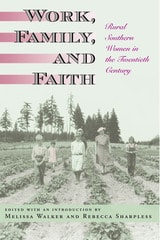
Work, Family, and Faith
Rural Southern Women in the Twentieth CenturyEdited & Intro by Melissa Walker & Rebecca Sharpless
University of Missouri Press, 2006
At the beginning of the twentieth century, the majority of rural southerners were dependent on agriculture and eked out a living as tenants on land owned by someone else. Women took on multiple duties, from child rearing to labor in the fields, to help meet their own goals of independence, well-being, and family persistence on the land. Over the course of the century, however, women found their lives and their work transformed. Government intervention, the Great Depression, and industrial job opportunities created by the two world wars and the development of Sun Belt industries lured or pushed tens of thousands of black and white rural southerners off the land.
As the American South changed around them, becoming more urban and industrialized, some women struggled to help their families survive in the increasingly large-scale and commercial agricultural economy, while other women eagerly seized opportunities to engage in rural reform, get better educations, and work at off-farm jobs. Whether they moved to the cities or stayed on the farms, most of these women continued to struggle against poverty and relied on tradition and inner strength to get by.
This well-researched, sharply focused, and keenly insightful collection of essays takes readers across the twentieth-century South, from rural roadside stands to tobacco fields to Sloss-Sheffield Steel’s “Sloss Quarters” in Birmingham. Covering the full scope of southern rural women’s varied lives, this book will be of particular value to anyone interested in sociology, women’s studies, or southern history.
[more]

World Deforestation in the Twentieth Century
John F. Richards and Richard P. Tucker
Duke University Press, 1988
[more]