Results by title
109 books match the query 'United States. Army' and 6 start with w
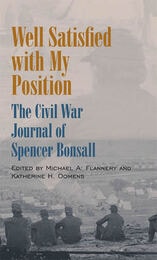
Well Satisfied with My Position
The Civil War Journal of Spencer BonsallEdited by Michael A. Flannery and Katherine H. Oomens
Southern Illinois University Press, 2007
Well Satisfied with My Position offers a first-person account of army life during the Civil War’s Peninsula Campaign and Battle of Fredericksburg. Spencer Bonsall, who joined the 81st Pennsylvania Infantry as a hospital steward, kept a journal from March 1862 until March 1863, when he abruptly ceased writing. Editors Michael A. Flannery and Katherine H. Oomens place his experiences in the context of the field of Civil War medicine and continue his story in an epilogue.
Trained as a druggist when he was in his early twenties, Bonsall traveled the world, spent eight years on a tea plantation in India, and settled in Philadelphia, where he worked in the city surveyor’s office. But in March 1862, when he was in his mid-forties, the lure of serving his country on the battlefield led Bonsall to join the 81st Pennsylvania Infantry as a hospital steward.
Bonsall enjoyed his life with the Union army at first, comparing bivouacking in the woods to merely picnicking on a grand scale. “We are about as jolly a set of old bachelors as can be found in Virginia,” Bonsall wrote. But his first taste of the aftermath of battle at Fair Oaks and the Seven Days’ Battles in Virginia changed his mind about the joys of soldiering—though he never lost his zeal for the Union cause.
Bonsall details the camp life of a soldier from firsthand experience, outlines the engagements of the 81st, and traces the Battle of Fredericksburg and the Peninsula Campaign. He records facts not available elsewhere about camp conditions, attitudes toward Union generals and Confederate soldiers, and troop movements.
From the end of June to late October 1862, Bonsall’s illness kept him from writing in his journal. He picked up the record again in December 1862, just before the Battle of Fredericksburg, Virginia, in which the Union suffered a staggering 10,200 casualties and the 81st Pennsylvania lost more than half its men. He vividly describes the bloody aftermath. Bonsall’s horse was shot out from underneath him at the battle of Gettysburg, injuring him seriously and ending his military career. Although he was listed as “sick in hospital” on the regiment’s muster rolls, he was labeled a deserter in the U.S. Army records. Indeed, after recovery from his injuries, Bonsall walked away from the army to resume life in Philadelphia with his wife and child.
Published for the first time, Bonsall’s journal offers an unusually personal glimpse into the circumstances and motives of a man physically ruined by the war. Seventeen illustrations, including some drawn by Bonsall himself, help bring this narrative to life.
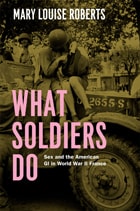
What Soldiers Do
Sex and the American GI in World War II FranceMary Louise Roberts
University of Chicago Press, 2013
That’s not the picture of the Greatest Generation that we’ve been given, but it’s the one Mary Louise Roberts paints to devastating effect in What Soldiers Do. Drawing on an incredible range of sources, including news reports, propaganda and training materials, official planning documents, wartime diaries, and memoirs, Roberts tells the fascinating and troubling story of how the US military command systematically spread—and then exploited—the myth of French women as sexually experienced and available. The resulting chaos—ranging from flagrant public sex with prostitutes to outright rape and rampant venereal disease—horrified the war-weary and demoralized French population. The sexual predation, and the blithe response of the American military leadership, also caused serious friction between the two nations just as they were attempting to settle questions of long-term control over the liberated territories and the restoration of French sovereignty.
While never denying the achievement of D-Day, or the bravery of the soldiers who took part, What Soldiers Do reminds us that history is always more useful—and more interesting—when it is most honest, and when it goes beyond the burnished beauty of nostalgia to grapple with the real lives and real mistakes of the people who lived it.

William Alexander Lord Stirling
George Washington's Noble GeneralPaul David Nelson
University of Alabama Press, 1987
At the beginning of the Revolutionary War Stirling was appointed a colonel in the New Jersey Continental Line and from there rose to the rank of Major General. A brave and loyal soldier, he greatly impressed General George Washington, who made him commander of one of the five divisions of the Continental Army. Serving in this capacity, Stirling made his reputation as a military man fighting in the battles of Long Island, White Plains, Trenton, Brandywine, Germantown, and Monmouth. He spent the winter of 1777-78 with Washington at Valley Forge. From time to time he carried out independent military operations, most notably a raid against Staten Island in January 1780. Stirling’s buoyant optimism and reckless enthusiasm for any task led one military comrade to state that his high birth and good humor provided him with many more opportunities in life than his skill and intelligence would have permitted. He died while in command of the Northern Department on January 15, 1783, full of military glory and, according to one cynic, “good liquor.”
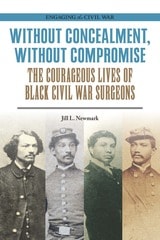
Without Concealment, Without Compromise
The Courageous Lives of Black Civil War SurgeonsJill L. Newmark
Southern Illinois University Press, 2023
Of some twelve thousand Union Civil War surgeons, only fourteen were Black men. This book is the first-ever comprehensive exploration of their lives and service. Jill L. Newmark’s outstanding research uncovers stories hidden for more than 150 years, illuminating the unique experiences of proud, patriotic men who fought racism and discrimination to attend medical school and serve with the U.S. military. Their efforts and actions influenced societal change and forged new pathways for African Americans.
Individual biographies bring to light Alexander T. Augusta, who challenged discriminatory laws; William P. Powell Jr., who pursued a military pension for twenty-five years; Anderson R. Abbott, a friend of Elizabeth Keckley’s; John van Surly DeGrasse, the only Black surgeon to serve on the battlefield; John H. Rapier Jr., an international traveler; Richard H. Greene, the only Black surgeon known to have served in the Navy; Willis R. Revels, a preacher; Benjamin A. Boseman, a politician and postmaster; and Charles B. Purvis, who taught at Howard University. Information was limited for five other men, all of whom broke educational barriers by attending medical schools in the United States: Cortlandt Van Rensselaer Creed, William B. Ellis, Alpheus W. Tucker, Joseph Dennis Harris, and Charles H. Taylor.
Newmark presents all available information about the surgeons’ early lives, influences, education, Civil War service, and post-war experiences. Many of the stories overlap, as did the lives of the men. Each man, through his service as a surgeon during the war and his lifelong activism for freedom, justice, and equality, became a catalyst of change and a symbol of an emancipated future.
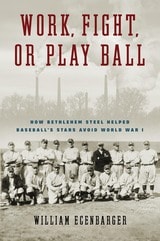
Work, Fight, or Play Ball
How Bethlehem Steel Helped Baseball's Stars Avoid World War IEcenbarger, William
Temple University Press, 2024
Some players used the steel mill and shipyard leagues to avoid wartime military duty, irking Major League owners, who saw their rosters dwindling. Bethlehem Steel President Charles Schwab (no relation to the financier) saw the league as a means to stave off employee and union organizing. Most fans loudly criticized the ballplayers, but nevertheless showed up to watch the action on the diamond.
Ecenbarger traces the 1918 Steel League’s season and compares the fates of the players who defected to industry or continued to play stateside with the travails of the Major Leaguers, such as Christy Mathewson, Ty Cobb, and Grover Cleveland Alexander, who served during the war.
Work, Fight, or Play Ball reveals the home field advantage brought on by the war, which allowed companies to profit from Major League players.
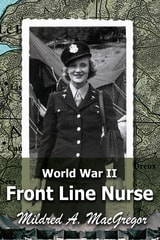
World War II Front Line Nurse
Mildred A. MacGregor
University of Michigan Press, 2008
In late 1942, along with so many others who signed up to support the war effort, thirty-year-old Mildred Radawiec left a comfortable position as a nurse at the University of Michigan Hospital and postponed her marriage to a soon-to-be doctor to volunteer as a surgical nurse in the major battle theaters of the war. Radawiec was one of thirty volunteers from the hospital surgical staff that comprised the University of Michigan Unit, the 298th General Hospital, as the University of Michigan Hospital was called.
Radawiec's first-person history recounts her wartime experience with sharp detail and grace and sets the stage for a you-are-there experience---from the thrill of signing up and shipping out; to the harrowing ocean crossing and the arduous trip through the Sahara; to dangerous air raids and moving at a moment's notice, often at night with the lights off to avoid attacks. Radawiec was near Omaha Beach in France soon after D-Day, June 6, 1944, and details stories of marathon stints assisting the injured on the front lines as they poured in by the hundreds. Radawiec also traveled to Belgium and Germany and set up in the area near Aachen in the fall of 1944. In Germany she experienced Buzz Bombs---pilotless flying bombs---and even witnessed the death of a fellow nurse in a bombing attack in which medics brought in wounded soldiers by the truckload. Radawiec also leavens her story with uplifting tales of heroism and courage and intersperses the narrative with poignant letters from her family and fiancé.
This stirring personal account of war will mesmerize anyone interested in World War II history and women's too-often-overlooked role in it.