Results by title
349 books match the query 'Violence' and 13 start with w
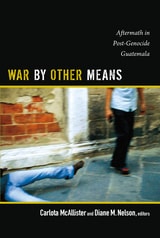
War by Other Means
Aftermath in Post-Genocide GuatemalaCarlota McAllister and Diane M. Nelson, eds.
Duke University Press, 2013
Contributors consider a wide range of issues confronting present-day Guatemala: returning refugees, land reform, gang violence, neoliberal economic restructuring, indigenous and women's rights, complex race relations, the politics of memory, and the challenges of sustaining hope. From a sweeping account of Guatemalan elites' centuries-long use of violence to suppress dissent to studies of intimate experiences of complicity and contestation in richly drawn localities, War by Other Means provides a nuanced reckoning of the injustices that made genocide possible and the ongoing attempts to overcome them.
Contributors. Santiago Bastos, Jennifer Burrell, Manuela Camus, Matilde González-Izás, Jorge Ramón González Ponciano, Greg Grandin, Paul Kobrak, Deborah T. Levenson, Carlota McAllister, Diane M. Nelson, Elizabeth Oglesby, Luis Solano, Irmalicia Velásquez Nimatuj, Paula Worby
War on Autism
On the Cultural Logic of Normative ViolenceAnne McGuire
University of Michigan Press, 2016
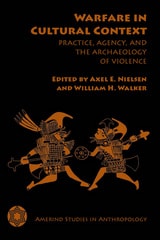
Warfare in Cultural Context
Practice, Agency, and the Archaeology of ViolenceEdited by Axel E. Nielsen and William H. Walker
University of Arizona Press, 2009
However, contributors argue, this model-and-evidence approach has given rise to multiple competing hypotheses and ambiguity rather than to full, coherent explanations of what turns out to be surprisingly complex acts of war. The chapters in Warfare in Cultural Context contend that agency and culture, inherited values and dispositions (such as religion and other cultural practices), beliefs, and institutions are always woven into the conduct of war.
This revealing book focuses on the ways that specific people construed their interests and life projects, and their problems and possibilities, and consequently chose among alternative courses of action. Using archaeological and ethnohistorical data from various parts of the world, the contributors explore the multiple avenues for the cultural study of warfare that these ideas make possible. Contributions focus on cultural aspects of warfare in Mesoamerica, South America, North America, and Southeast Asia. Case studies include warfare among the Maya, Inca, southwestern Pueblos, Mississippian cultures, and the Enga of Papua New Guinea.
When Colombia Bled
A History of the Violencia in TolimaJames David Henderson
University of Alabama Press, 1985
A definitive account of the conflict that transformed twentieth-century Colombia.0false18 pt18 pt00falsefalsefalse
When Colombia Bled: A History of the Violencia in Tolima by James D. Henderson is a compelling and deeply researched examination of one of the most traumatic periods in modern Colombian history. Focusing on the department of Tolima, the book chronicles La Violencia, the undeclared civil war between Colombia's Liberal and Conservative parties that engulfed the nation from the late 1940s through the early 1960s. Through a richly detailed narrative, Henderson traces the political tensions, social divisions, and local rivalries that transformed regional disputes into a devastating cycle of violence affecting countless rural communities.
Drawing on extensive archival research, government records, contemporary accounts, and regional sources, Henderson reveals how national political struggles intersected with local circumstances to create a uniquely destructive conflict. The book explores the experiences of political leaders, campesinos, community activists, and ordinary citizens whose lives were shaped by insecurity, displacement, and armed confrontation. By focusing on Tolima, one of the regions most deeply affected by the conflict, Henderson offers a nuanced perspective on the broader forces that influenced Colombia's political development and social transformation.
Both an authoritative regional study and a major contribution to Latin American history, When Colombia Bled provides essential insight into the historical roots of political violence in Colombia and the enduring legacy of a conflict that helped shape the nation's modern identity.
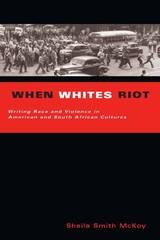
When Whites Riot
Writing Race and Violence in American and South African CulturesSheila Smith McKoy
University of Wisconsin Press, 2001
In a bold work that cuts across racial, ethnic, cultural, and national boundaries, Sheila Smith McKoy reveals how race colors the idea of violence in the United States and in South Africa—two countries inevitably and inextricably linked by the central role of skin color in personal and national identity.
Although race riots are usually seen as black events in both the United States and South Africa, they have played a significant role in shaping the concept of whiteness and white power in both nations. This emerges clearly from Smith McKoy's examination of four riots that demonstrate the relationship between the two nations and the apartheid practices that have historically defined them: North Carolina's Wilmington Race Riot of 1898; the Soweto Uprising of 1976; the Los Angeles Rebellion in 1992; and the pre-election riot in Mmabatho, Bhoputhatswana in 1994. Pursuing these events through narratives, media reports, and film, Smith McKoy shows how white racial violence has been disguised by race riots in the political and power structures of both the United States and South Africa.
The first transnational study to probe the abiding inclination to "blacken" riots, When Whites Riot unravels the connection between racial violence—both the white and the "raced"—in the United States and South Africa, as well as the social dynamics that this connection sustains.
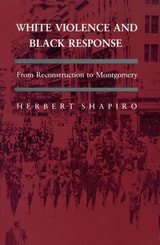
White Violence and Black Response
From Reconstruction to MontgomeryHerbert Shapiro
University of Massachusetts Press, 1988
We are taught that America is a society based on respect for the law and orderly procedures. That the Constitution stands as a safeguard of individual freedom, and the courts and the police are supposedly established to enforce the law. When a controversial issue arises in the American fabric, it is to be resolved not in the streets but through the democratic processes of elections. Yet, for blacks these liberal values have been turned into their opposites. The courts have most often stood silent in the face of racist violence or have turned their wrath against the victims, not the perpetrators; the police have protected the mob rather than the mobbed and have often either aided the lynchers or displayed amazing inability to identify them. Where race is concerned, legislative or judicial action to deal with controversial issues has often come late and been partial in nature, while white violence has continued to terrorize black Americans without hindrance.
In White Violence and Black Response: From Reconstruction to Montgomery, Herbert Shapiro explores the depths of violence generated by white racism and the irony of the American association with violence as a behavior of black people. Citing the nation's political leadership, educational institutions, and news media as institutions that fail to educate Americans about the oppressive social conditions that have root in these criminal acts, Shapiro is able to expose the ways in which white supremacy operates within American institutions and the responses by black people in this powerful read.
Why We Harm
Presser, Lois
Rutgers University Press, 2013
2014 Choice Outstanding Academic Title
Criminologists are primarily concerned with the analysis of actions that violate existing laws. But a growing number have begun analyzing crimes as actions that inflict harm, regardless of the applicability of legal sanctions. Even as they question standard definitions of crime as law-breaking, scholars of crime have few theoretical frameworks with which to understand the etiology of harmful action.
In Why We Harm, Lois Presser scrutinizes accounts of acts as diverse as genocide, environmental degradation, war, torture, terrorism, homicide, rape, and meat-eating in order to develop an original theoretical framework with which to consider harmful actions and their causes. In doing so, this timely book presents a general theory of harm, revealing the commonalities between actions that impose suffering and cause destruction.
Harm is built on stories in which the targets of harm are reduced to one-dimensional characters—sometimes a dangerous foe, sometimes much more benign, but still a projection of our own concerns and interests. In our stories of harm, we are licensed to do the harmful deed and, at the same time, are powerless to act differently. Chapter by chapter, Presser examines statements made by perpetrators of a wide variety of harmful actions. Appearing vastly different from one another at first glance, Presser identifies the logics they share that motivate, legitimize, and sustain them. From that point, she maps out strategies for reducing harm.
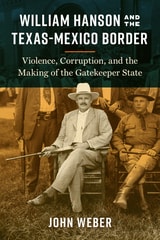
William Hanson and the Texas-Mexico Border
Violence, Corruption, and the Making of the Gatekeeper StateJohn Weber
University of Texas Press, 2024
An examination of the career of Texas Ranger and immigration official William Hanson illustrating the intersections of corruption, state-building, and racial violence in early twentieth century Texas.
At the Texas-Mexico border in the 1910s and 1920s, William Hanson was a witness to, and an active agent of, history. As a Texas Ranger captain and then a top official in the Immigration Service, he helped shape how US policymakers understood the border, its residents, and the movement of goods and people across the international boundary. An associate of powerful politicians and oil company executives, he also used his positions to further his and his patrons' personal interests, financial and political, often through threats and extralegal methods.
Hanson’s career illustrates the ways in which legal exclusion, white-supremacist violence, and official corruption overlapped and were essential building blocks of a growing state presence along the border in the early twentieth century. In this book, John Weber reveals Hanson’s cynical efforts to use state and federal power to proclaim the border region inherently dangerous and traces the origins of current nativist politics that seek to demonize the border population. In doing so, he provides insight into how a minor political appointee, motivated by his own ambitions, had lasting impacts on how the border was experienced by immigrants and seen by the nation.
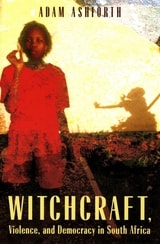
Witchcraft, Violence, and Democracy in South Africa
Adam Ashforth
University of Chicago Press, 2004
In Witchcraft, Violence, and Democracy in South Africa, Adam Ashforth examines how people in Soweto and other parts of post-apartheid South Africa manage their fear of 'evil forces' such as witchcraft. Ashforth examines the dynamics of insecurity in the everyday life of Soweto at the turn of the twenty-first century. He develops a new framework for understanding occult violence as a form of spiritual insecurity and documents new patterns of interpretation attributing agency to evil forces. Finally, he analyzes the response of post-apartheid governments to issues of spiritual insecurity and suggests how these matters pose severe long-term challenges to the legitimacy of the democratic state.
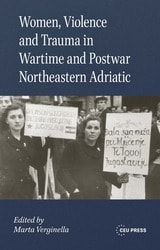
Women, Violence and Trauma in Wartime and Postwar Northeastern Adriatic
Marta Verginella
Central European University Press, 2026
Drawing on a rich range of sources—psychiatric records, diaries, autobiographies, oral histories, literature, film, and archival documents—the contributors foreground voices long marginalized in official histories. Together, the chapters reveal both vulnerability and resilience, tracing how trauma was lived, narrated, silenced, and politically instrumentalized across different post-war contexts, from the early Cold War to post-socialist societies. This collection reshapes debates in gender history, memory studies, and trauma research, offering new insights into how women endured, interpreted, and transformed the violent legacies of the twentieth century.
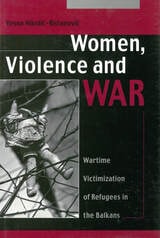
Women, Violence and War
Wartime Victimization of Refugees in the BalkansVesna Nikolic-Ristanovic
Central European University Press, 2000
Based on interviews with seventy women refugees, Women, Violence and War is a book about war as it is seen, lived and interpreted by women who were citizens of the former Yugoslavia.
Many of the accounts portray the horrific experiences the victims had to face and the book addresses issues of sexual, physical and psychological violence, as well as problems of confinement, upheaval and family separation. In a completely new insight the book dispels the myth that many of the women were peasants, and shows that in fact they were educated, middle-class women with independent careers. The study also depicts how some of the victims attempt to come to terms with the aftermath of wartime abuse.
This probing, accurate and unique investigation of victimization is an unparalleled volume that presents a completely new perspective maintaining that violence against women in war is not independent of peace-time victimization and the imbalance of power between sexes.
Women’s Perspectives on Human Security
Violence, Environment, and SustainabilityRichard Matthew; Patricia A. Weitsman; Gunhild Hoogensen Gjørv; Nora Davis; Tera Dornfeld
Ohio University Press, 2020
Violent conflict, climate change, and poverty present distinct threats to women worldwide. Importantly, women are leading the way creating and sharing sustainable solutions.
Women’s security is a valuable analytical tool as well as a political agenda insofar as it addresses the specific problems affecting women’s ability to live dignified, free, and secure lives. First, this collection focuses on how conflict impacts women’s lives and well-being, including rape and gendered constructions of ethnicity, race, and religion. The book’s second section looks beyond the scope of large-scale violence to examine human security in terms of environmental policy, food, water, health, and economics.
Multidisciplinary in scope, these essays from new and established contributors draw from gender studies, international relations, criminology, political science, economics, sociology, biological and ecological sciences, and planning.
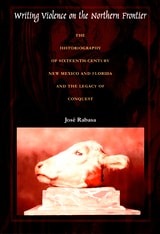
Writing Violence on the Northern Frontier
The Historiography of Sixteenth-Century New Mexico and Florida and the Legacy of ConquestJosé Rabasa
Duke University Press, 2000
To advance his argument Rabasa analyzes visual and verbal representations, colonialist programs, and the theories of colonization that informed the historiography of sixteenth-century New Mexico and Florida, which includes the territory from the Pacific coast to Kansas, and from present-day Florida to Tennessee and Arkansas. Using little-known materials from the northern borderlands of Spanish imperial expansion, Rabasa works to complicate notions of violence and their relationship to writing. Understood in juxtaposition with modern texts on postcolonial theory, his description of the dual function of these colonial texts—to represent material acts of violence and to act as violence itself—also emphasizes the lingering effects of this phenomenon in contemporary intellectual work and everyday life. In this way Writing Violence on the Northern Frontier serves not only as an explanation of what colonialist texts do but also instigates new ways of thinking about colonial discourse.
This book will interest scholars of colonial studies and early North American history, as well as a broader audience interested in interdisciplinary perspectives on the topic of racial, ethnic, and literary violences.