Results by title
67 books match the query 'War and society' and 10 start with w
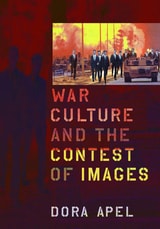
War Culture and the Contest of Images
Apel, Dora
Rutgers University Press, 2012
War Culture and the Contest of Images analyzes the relationships among contemporary war, documentary practices, and democratic ideals. Dora Apel examines a wide variety of images and cultural representations of war in the United States and the Middle East, including photography, performance art, video games, reenactment, and social media images. Simultaneously, she explores the merging of photojournalism and artistic practices, the effects of visual framing, and the construction of both sanctioned and counter-hegemonic narratives in a global contest of images.
As a result of the global visual culture in which anyone may produce as well as consume public imagery, the wide variety of visual and documentary practices present realities that would otherwise be invisible or officially off-limits. In our digital era, the prohibition and control of images has become nearly impossible to maintain. Using carefully chosen case studies—such as Krzysztof Wodiczko’s video projections and public works in response to 9/11 and the wars in Iraq and Afghanistan, the performance works of Coco Fusco and Regina Galindo, and the practices of Israeli and Palestinian artists—Apel posits that contemporary war images serve as mediating agents in social relations and as a source of protection or refuge for those robbed of formal or state-sanctioned citizenship.
While never suggesting that documentary practices are objective translations of reality, Apel shows that they are powerful polemical tools both for legitimizing war and for making its devastating effects visible. In modern warfare and in the accompanying culture of war that capitalism produces as a permanent feature of modern society, she asserts that the contest of images is as critical as the war on the ground.
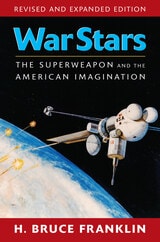
War Stars
The Superweapon and the American ImaginationH. Bruce Franklin
University of Massachusetts Press, 2008
In this new and expanded edition of an already classic work, H. Bruce Franklin brings the epic story of the superweapon and the American imagination into the ominous twenty-first century, demonstrating its continuing importance both to comprehending our current predicament and to finding ways to escape from it.
Sweeping through two centuries of American culture and military history, Franklin traces the evolution of superweapons from Robert Fulton's eighteenth-century submarine through the strategic bomber, atomic bomb, and Star Wars to a twenty-first century dominated by “weapons of mass destruction,” real and imagined. Interweaving culture, science, technology, and history, he shows how and why the American pursuit of the ultimate defensive weapon—guaranteed to end all war and bring universal triumph to American ideals—has led our nation and the world into an epoch of terror and endless war.
War and American Life
Reflections on Those Who Serve and SacrificeJames Wright
Brandeis University Press, 2022
An engaging collection of essays focusing on American veterans.
War and American Life is a book of essays and reflections by celebrated historian and former marine James Wright, who has been active as an advocate, teacher, and scholar. Featuring both previously published pieces and new essays, the book considers veterans in America and the ways in which our society needs better to understand who they are and what they have done on the nation’s behalf—and the responsibilities that follow this recognition.
War and Public Memory
Case Studies in Twentieth-Century EuropeDavid A. Messenger
University of Alabama Press, 2020
In order to understand the history of twentieth-century Europe, we must first appreciate and accept how different societies and cultures remember their national conflicts. We must also be aware of the ways that those memories evolve over time. In War and Public Memory: Case Studies in Twentieth-Century Europe, Messenger outlines the relevant history of war and its impact on different European nations and assesses how and where the memory of these conflicts emerges in political and public discourse and in the public sphere and public spaces of Europe.
The case studies presented emphasize the major wars fought on European soil as well as the violence perpetrated against civilian populations. Each chapter begins with a brief overview of the conflict and then proceeds with a study of how memory of that struggle has entered into public consciousness in different national societies. The focus throughout is on collective social, cultural, and public memory, and in particular how memory has emerged in public spaces throughout Europe, such as parks, museums, and memorial sites.
Messenger discusses memories of the First World War for both the victors and the vanquished as well as their successor states. Other events discussed include the Bolshevik Revolution and subsequent conflicts in the former Soviet Union, the Armenian genocide, the collapse of Yugoslavia, the legacy of the civil war in Spain, Germanys reckoning with its Nazi past, and the memory of occupation and the Holocaust in France and Poland.
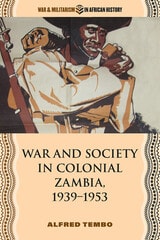
War and Society in Colonial Zambia, 1939–1953
Alfred Tembo
Ohio University Press, 2021
Written from a Zambian perspective, this leading study shows how the British colony of Northern Rhodesia (later Zambia) organized and deployed human, military, and natural resources during and after the Second World War.
The Second World War brought unprecedented pressures to bear on Britain’s empire, which then included colonial Northern Rhodesia. Through new archival materials and oral histories, War and Society in Colonial Zambia tells—from an African perspective—the story of how the colony organized its human and natural resources on behalf of the imperial government.
Alfred Tembo first examines government propaganda and recruitment of personnel for the Northern Rhodesia Regiment, which served in East Africa, Palestine, Ceylon, Burma, and India. Later, Zambia’s economic contribution to the Allied war effort would foreground the central importance of the colony’s mining industry as well as its role as supplier of rubber and beeswax following the fall of the Southeast Asian colonies to the Japanese in early 1942. Finally, Tembo presents archival and oral evidence about life on the home front, including the social impact of wartime commodity shortages, difficulties posed by incoming Polish refugees, and the more interventionist forms of colonial governance that these circumstances engendered.
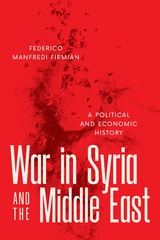
War in Syria and the Middle East
A Political and Economic HistoryFederico Manfredi Firmian
University of Texas Press, 2025
A wide-ranging examination of the causes of war in Syria and the Middle East.
In War in Syria and the Middle East, Federico Manfredi Firmian uses historical, political, and economic lenses to examine how Syria’s civil war is part of a broad pattern of social breakdown increasingly prevalent across the Arab and Islamic worlds. This expansive book argues that many conflicts across the Middle East today are rooted in fundamental ideological divides that originated with European imperialism. In Syria, the iniquities of French rule gave way to the radicalism of the Arab Socialist Baʿth Party, which promised to dismantle imperial legacies and capitalist logics through nationalizations, land redistribution, and central planning.
Baʿthist Syria, however, ultimately failed to provide a viable alternative to capitalism. In fact, its failures, and the failures of other revolutionary regimes of socialist inspiration, provided an opening for armed Islamist movements to challenge both secular authoritarian rule and US foreign policies—ultimately leading to civil war. Combining a multidisciplinary approach with fieldwork, War in Syria and the Middle East argues for a global perspective on a pressing, ongoing conflict.
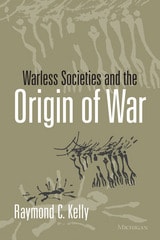
Warless Societies and the Origin of War
Raymond C. Kelly
University of Michigan Press, 2000
Kelly addresses fundamental questions concerning the trinity of interrelationship between human nature, war, and the constitution of society: Is war a primordial and pervasive feature of human existence or a set of practices that arose at a certain time in our recent prehistoric past? Are there peaceful societies in which war is absent and, if so, what are they like and how do they differ from warlike societies? Do the critical differentiating features pertain to child-rearing practices, to modes of conflict resolution, to social and economic inequality, to resource competition, or to the constitution of social groups?
As the conclusions of such an inquiry are central to our conceptions of human nature, the book will interest a wide range of readers, from those curious about the origins of collective violence to those studying the roles social institutions play in society.
Raymond C. Kelly is Professor of Anthropology, University of Michigan.

When Forests Run Amok
War and Its Afterlives in Indigenous and Afro-Colombian TerritoriesDaniel Ruiz-Serna
Duke University Press, 2023
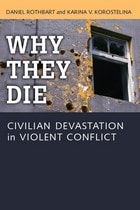
Why They Die
Civilian Devastation in Violent ConflictDaniel Rothbart and Karina V. Korostelina
University of Michigan Press, 2013
Why do civilians suffer most during times of violent conflict? Why are civilian fatalities as much as eight times higher, calculated globally for current conflicts, than military fatalities? In Why They Die, Daniel Rothbart and Karina V. Korostelina address these questions through a systematic study of civilian devastation in violent conflicts. Pushing aside the simplistic definition of war as a guns-and-blood battle between two militant groups, the authors investigate the identity politics underlying conflicts of many types. During a conflict, all those on the opposite side are perceived as the enemy, with little distinction between soldiers and civilians. As a result, random atrocities and systematic violence against civilian populations become acceptable.
Rothbart and Korostelina devote the first half of the book to case studies: deportation of the Crimean Tatars from the Ukraine, genocide in Rwanda, the Lebanon War, and the war in Iraq. With the second half, they present new methodological tools for understanding different types of violent conflict and discuss the implications of these tools for conflict resolution.
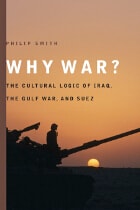
Why War?
The Cultural Logic of Iraq, the Gulf War, and SuezPhilip Smith
University of Chicago Press, 2005
Comprised of case studies of the War in Iraq, the Gulf War, and the Suez Crisis, Why War? decodes the cultural logic of the narratives that justify military action. Each nation, Smith argues, makes use of binary codes—good and evil, sacred and profane, rational and irrational, to name a few. These codes, in the hands of political leaders, activists, and the media, are deployed within four different types of narratives—mundane, tragic, romantic, or apocalyptic. With this cultural system, Smith is able to radically recast our "war stories" and show how nations can have vastly different understandings of crises as each identifies the relevant protagonists and antagonists, objects of struggle, and threats and dangers.
The large-scale sacrifice of human lives necessary in modern war, according to Smith, requires an apocalyptic vision of world events. In the case of the War in Iraq, for example, he argues that the United States and Britain replicated a narrative of impending global doom from the Gulf War. But in their apocalyptic account they mistakenly made the now seemingly toothless Saddam Hussein once again a symbol of evil by writing him into the story alongside al Qaeda, resulting in the war's contestation in the United States, Britain, and abroad.
Offering an innovative approach to understanding how major wars are packaged, sold, and understood, Why War? will be applauded by anyone with an interest in military history, political science, cultural studies, and communication.