Results by title
368 books match the query 'West' and 30 start with w
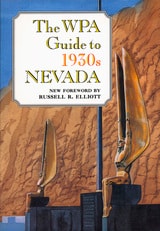
WPA Guide to 1930s Nevada
Writer's Program
University of Nevada Press, 1991
When Las Vegas boasted two motion picture theatres and the University of Nevada student population reached a high of twelve hundred, the original edition of The WPA Guide to 1930s Nevada was just coming off the press. First published in 1940 as Nevada: A Guide to the Silver State, part of the Work Projects Administration's American Guide Series, the book remains one of Nevada's premier tour and travel volumes. The WPA Guide to 1930s Nevada includes material on the state's geography and geology, plant and animal life, churches and schools. The native population is discussed, as are the arts, mining, ranching, press, sports, and recreation during the 1930s. The period photographs spread throughout the volume give an excellent picture of Nevada in the early part of the twentieth century and complement the profiles of thirty cities and eight detailed tour descriptions that follow the pattern of the major highway through the state.

Wake of the Unseen Object
Travels through Alaska's Native LandscapesTom Kizzia
University of Alaska Press, 2020

Warfare and Diplomacy in Pre-Colonial West Africa
Robert S. Smith
University of Wisconsin Press, 1989
Wasatch Winter Trails
John Veranth
University of Utah Press, 1991

Water in the West
A High Country News ReaderChar Miller
Oregon State University Press, 2000
Waterhouses
Landscapes, Housing, and the Making of Modern LagosMark Duerksen
Ohio University Press, 2024
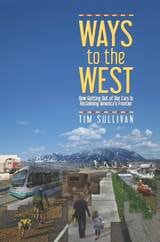
Ways to the West
How Getting Out of Our Cars Is Reclaiming America's FrontierTim Sullivan
Utah State University Press, 2015
In Ways to the West, Tim Sullivan embarks on a car-less road trip through the Intermountain West, exploring how the region is taking on what may be its greatest challenge: sustainable transportation. Combining personal travel narrative, historical research, and his professional expertise in urban planning, Sullivan takes a critical yet optimistic and often humorous look at how contemporary Western cities are making themselves more hospitable to a life less centered on the personal vehicle.
The modern West was built by the automobile, but so much driving has jeopardized the West’s mystic hold on the American future. At first, automobility heightened the things that made the West great, but love became dependence, and dependence became addiction. Via his travels by bicycle, bus, and train through Las Vegas, Phoenix, Denver, Boise, Salt Lake City, and Portland, Sullivan captures the modern transportation evolution taking place across the region and the resulting ways in which contemporary Western communities are reinterpreting classic American values like mobility, opportunity, adventure, and freedom.
Finding a West created, lost, and reclaimed, Ways to the West will be of great interest to anyone curious about sustainable transportation and the history, geography, and culture of the American West.
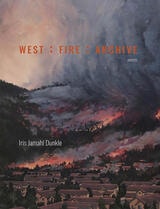
West
Fire : ArchiveIris Jamahl Dunkle
University Press of Colorado, 2021
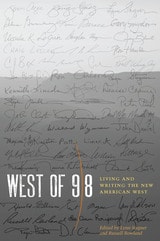
West of 98
Living and Writing the New American WestEdited by Lynn Stegner and Russell Rowland
University of Texas Press, 2011
What does it mean to be a westerner? With all the mythology that has grown up about the American West, is it even possible to describe "how it was, how it is, here, in the West—just that," in the words of Lynn Stegner? Starting with that challenge, Stegner and Russell Rowland invited several dozen members of the western literary tribe to write about living in the West and being a western writer in particular. West of 98 gathers sixty-six literary testimonies, in essays and poetry, from a stellar collection of writers who represent every state west of the 98th parallel—a kind of Greek chorus of the most prominent voices in western literature today, who seek to "characterize the West as each of us grew to know it, and, equally important, the West that is still becoming."
In West of 98, western writers speak to the ways in which the West imprints itself on the people who live there, as well as how the people of the West create the personality of the region. The writers explore the western landscape—how it has been revered and abused across centuries—and the inescapable limitations its aridity puts on all dreams of conquest and development. They dismantle the boosterism of manifest destiny and the cowboy and mountain man ethos of every-man-for-himself, and show instead how we must create new narratives of cooperation if we are to survive in this spare and beautiful country. The writers seek to define the essence of both actual and metaphoric wilderness as they journey toward a West that might honestly be called home.
A collective declaration not of our independence but of our interdependence with the land and with each other, West of 98 opens up a whole new panorama of the western experience.
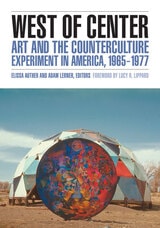
West of Center
Art and the Counterculture Experiment in America, 1965–1977Elissa Auther
University of Minnesota Press, 2012
In the heady and hallucinogenic days of the 1960s and ’70s, a diverse range of artists and creative individuals based in the American West—from the Pacific coast to the Rocky Mountains and the Southwest—broke the barriers between art and lifestyle and embraced the new, hybrid sensibilities of the countercultural movement. Often created through radically collaborative artistic practices, such works as Paolo Soleri’s earth homes, the hand-built architecture of the Drop City and Libre communes, Yolanda López’s political posters, the multisensory movement workshops of Anna and Lawrence Halprin, and the immersive light shows and video-based work by the Ant Farm and Optic Nerve collectives were intended to generate new life patterns that pointed toward social and political emancipation.
In West of Center, Elissa Auther and Adam Lerner bring together a prominent group of scholars to elaborate the historical and artistic significance of these counterculture projects within the broader narrative of postwar American art, which skews heavily toward New York’s avant-garde art scene. This west of center countercultural movement has typically been associated with psychedelic art, but the contributors to this book understand this as only one dimension of the larger, artistically oriented, socially based phenomenon. At the same time, they reveal the disciplinary, geographic, and theoretical biases and assumptions that have led to the dismissal of countercultural practices in the history of art and visual culture, and they detail how this form of cultural and political activity found its place in the West.
A companion to an exhibition originating at the Museum of Contemporary Art Denver, this book illuminates how, in the western United States, the counterculture’s unique integration of art practices, political action, and collaborative life activities serves as a linchpin connecting postwar and contemporary artistic endeavors.
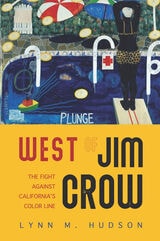
West of Jim Crow
The Fight against California's Color LineLynn M. Hudson
University of Illinois Press, 2020
Lynn M. Hudson deepens our understanding of the practices that African Americans in the West deployed to dismantle Jim Crow in the quest for civil rights prior to the 1960s. Faced with institutionalized racism, black Californians used both established and improvised tactics to resist and survive the state's color line. Hudson rediscovers forgotten stories like the experimental all-black community of Allensworth, the California Ku Klux Klan's campaign of terror against African Americans, the bitter struggle to integrate public swimming pools in Pasadena and elsewhere, and segregationists' preoccupation with gender and sexuality.
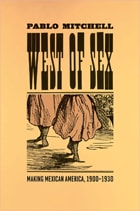
West of Sex
Making Mexican America, 1900-1930Pablo Mitchell
University of Chicago Press, 2012
Sex can be an oppressive force, a tool to shame, divide, and control a population. But it can also be a force for change, for the legal and physical challenge of inequity and injustice. In West of Sex, Pablo Mitchell uses court transcripts and criminal cases to provide the first coherent picture of Mexican-American sexuality at the turn of the twentieth century, and a truly revelatory look at sexual identity in the borderlands.
As Mexicans faced a rising tide of racial intolerance in the American West, some found cracks in the legal system that enabled them to assert their rights as full citizens, despite institutional hostility. In these chapters, Mitchell offers a rare glimpse into the inner workings of ethnicity and power in the United States, placing ordinary Mexican women and men at the center of the story of American sex, colonialism, and belonging.
Other chapters discuss topics like prostitution, same-sex intimacy, sexual violence, interracial romance, and marriage with an impressive level of detail and complexity. Written in vivid and accessible prose, West of Sex offers readers a new vision of sex and race in American history.
West of the Border
The Multicultural Literature of the Western American FrontiersNoreen Groover Lape
Ohio University Press, 2000
Expanding the scope of American borderland and frontier literary scholarship, West of the Border examines the writings of nineteenth- and turn-of-the-century Native, African, Asian, and Anglo American frontier writers. This book views frontiers as “human spaces” where cultures make contact as it considers multicultural frontier writers who speak from “west of the border.”
James P. Beckwourth, a half-black fur trader; Sarah Winnemucca Hopkins, a Paiute translator; Salishan author Mourning Dove; Cherokee novelist John Rollin Ridge; Sui Sin Far, an Anglo-Chinese short story writer, and her sister, romance novelist Onoto Watanna; and Mary Austin, a white southwestern writer- each of these intercultural writers faces a rite of passage into a new social order. Their writings negotiate their various frontier ordeals: the encroachment of pioneers on the land; reservation life; assimilation; Christianity; battles over territories and resources; exclusion; miscegenation laws; and the devastation of the environment.
In West of the Border, Noreen Groover Lape raises issues inherent in American pluralism today by broaching timely concerns about American frontier politics, conceptualizing frontiers as intercultural contact zones, and expanding the boundaries of frontier literary studies by giving voice to minority writers.
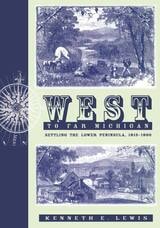
West to Far Michigan
Settling the Lower Peninsula, 1815-1860Kenneth E. Lewis
Michigan State University Press, 2001
Employing numerous primary sources, West to Far Michigan traces changes and patterns of settlement crucial to documenting the large-scale development of southern Michigan as a region. Diaries, letters, memoirs, gazetteers, and legal documents serve to transform the more abstract elements of economic and social change into more human terms. Through the experiences of the early Agriculturists process, we can gain insight into how their triumphs played out in communities within the region to produce small-scale elements that comprise the fabric of the larger cultural landscape.
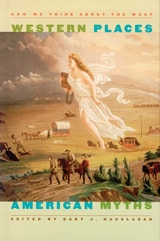
Western Places, American Myths
How We Think About The WestGary J. Hausladen
University of Nevada Press, 2006
In Western Places, American Myths: How We Think About the West, geographer Gary J. Hausladen brings together leading scholars to consider how popular perceptions about the West contribute to our understanding of the region’s geography. Topics include ranching, gambling, cinema, the National Park System, and the roles of minorities in Western expansion. The essays are divided into three sections. “Continuity and Change” addresses themes that are relevant to the entire region including the relationship between the American West and the academic field of historical geography. In part two, “Enduring Regional Voices,” the essays depart from predominantly white Euro-American male interpretations to study other perspectives, namely those of women, Mormons, Mexican Americans, and Native Americans. “The West as Visionary Place” investigates the culture of the region.
Drawing from diverse media, contributors explore various images and their contributions to our understanding about the American West. In the final chapter, key western movies are used to examine the issues of settlement and utopianism, as well as empire and territorial expansion. As a collection, these twelve essays reflect the eclectic nature of Western scholarship, examining diverse topics—some historical, some contemporary—from sometimes conflicting perspectives, with widely divergent scope and voices. Western Places, American Myths brings together geography, history, popular culture, and a comprehensive view of the region, bridging the humanities and social sciences.
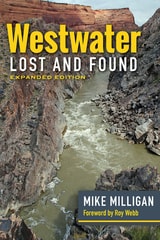
Westwater Lost and Found
Expanded EditionMike Milligan
Utah State University Press, 2024
This expanded edition brings to light historical events and explores how Westwater’s location greatly contributed to early Grand (Upper) Colorado River boaters’ knowledge and how the lush Westwater Valley and Cisco became critical stops for water, wood, and grass along the North Branch of the Old Spanish Trail. Other new additions include explorer Ellsworth Kolb’s unpublished manuscript describing his 1916–1917 boating experiences on the Grand and Gunnison Rivers; two stories relating to Outlaw Cave, one of which expands upon the mystery of the outlaw brothers; a letter from James E. Miller to Frederick S. Dellenbaugh in 1906 revealing new information about his boating excursion with Oro DeGarmo Babcock on the Grand River in 1897; and a portion of botanist Frederick Kreutzfeld’s little-known journal of 1853 that describes Captain John W. Gunnison’s railroad survey.
Loaded with extensive information and river-running history, Milligan’s guide is sure to enhance readers’ knowledge of the Upper Colorado River and Grand Canyon regions. Boaters, river guides, scholars of the American West, and historians of the Colorado, Green, and Gunnison Rivers or the Old Spanish Trail will gain much from this new edition.
What Is Africa to Me?
Fragments of a True-to-Life AutobiographyMaryse Condé
Seagull Books, 2017
What Is Africa to Me? traces the late 1950s to 1968, chronicling Condé’s life in Sékou Touré’s Guinea to her time in Kwame N’Krumah’s Ghana, where she rubbed shoulders with Malcolm X, Che Guevara, Julius Nyerere, and Maya Angelou. Accusations of subversive activity resulted in Condé’s deportation from Ghana. Settling down in Sénégal, Condé ended her African years with close friends in Dakar, including filmmakers, activists, and Haitian exiles, before putting down more permanent roots in Paris.
Condé’s story is more than one of political upheaval, however; it is also the story of a mother raising four children as she battles steep obstacles, of a Guadeloupean seeking her identity in Africa, and of a young woman searching for her freedom and vocation as a writer. What Is Africa to Me? is a searing portrait of a literary genius—it should not be missed.
What Music Did
The Story of Numerocracy in the WestTony Conrad. Edited by Patrick Nickleson
University of Michigan Press, 2026
Throughout the book, readers encounter scenes from over two thousand years of history, mathematics, and music: Pythagoras using pebbles to articulate didactic number games to his disciples; Galileo fretting a hill and listening with a musician’s ear to calculate the rate of acceleration under gravity; Rameau trapping Western music in a five-limit tuning system, and what could have been if he were more adept with numbers. Even when drawing on classical sources to explore canonical figures like Saint Augustine, What Music Did offers idiosyncratic critical insights that highlight our ongoing cultural reverence when answers result in simple whole number ratios like 3:2, 4:3, or 5:4. What Music Did is Tony Conrad’s extended indictment of music’s role, from the Pythagoreans to the twentieth century, in upholding the use of number as a clandestine and circumscribed armature of power.
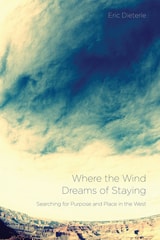
Where the Wind Dreams of Staying
Searching for Purpose and Place in the WestEric Dieterle
Oregon State University Press, 2016
Dieterle’s journey leads from the plateau of eastern Washington through the landscapes of seven states, ending in the shadow of the San Francisco peaks in northern Arizona. Readers will find rich, detailed explorations of western landscapes balanced with stories of personal reflection, determination, doubt, and fulfillment.
White Slaves, African Masters
An Anthology of American Barbary Captivity NarrativesEdited by Paul Baepler
University of Chicago Press, 1999
Though Barbary privateers began to seize North American colonists as early as 1625, Barbary captivity narratives did not begin to flourish until after the American Revolution. During these years, stories of Barbary captivity forced the U.S. government to pay humiliating tributes to African rulers, stimulated the drive to create the U.S. Navy, and brought on America's first post-revolutionary war. These tales also were used both to justify and to vilify slavery.
The accounts collected here range from the 1798 tale of John Foss, who was ransomed by Thomas Jefferson's administration for tribute totaling a sixth of the annual federal budget, to the story of Ion Perdicaris, whose (probably staged) abduction in Tangier in 1904 prompted Theodore Roosevelt to send warships to Morocco and inspired the 1975 film The Wind and the Lion. Also included is the unusual story of Robert Adams, a light-skinned African American who was abducted by Arabs and used by them to hunt negro slaves; captured by black villagers who presumed he was white; then was sold back to a group of Arabs, from whom he was ransomed by a British diplomat.
Long out of print and never before anthologized, these fascinating tales open an entirely new chapter of early American literary history, and shed new light on the more familiar genres of Indian captivity narrative and American slave narrative.
Whitman East and West
New Contexts for Reading Walt WhitmanEd Folsom
University of Iowa Press, 2002
Confirming the growing international spirit of American studies, the essays in Whitman East and West developed out of a landmark conference in Beijing, the first major conference in China to focus on an American poet. Scholars from Asia, Europe, and North America set out to track the ways in which Whitman's poetry has become part of China's cultural landscape as well as the literary landscapes of other countries. By describing his assimilation into other cultures and his resulting transformation into a hybrid poet, these essayists celebrate Whitman's multiple manifestations in other languages and contexts.
Wide Skies
Finding a Home in the WestGary Holthaus
University of Arizona Press, 1997
A true place in the world: how many people have looked for it and how many have finally found it in the American West? Here, with writer Gary Holthaus, readers will reflect upon their own sense of place as they travel the lands and enter the lives of people in small towns and on ranches all over the West from Utah to Oregon to Alaska. Farmers and merchants, writers and teachers, truckers and trappers: their stories ring with hope and fear as their wide-open spaces increasingly come under siege.
Here are reflections on a long journey, together with notes of a personal odyssey and a plea for preserving the West's natural beauty-its meadows and mountains, its bears and Golden Eagles, its antelope and wolverines. This is important, says Holthaus, because if the region is home for him and for others, too, then it is crucial for newcomers and old-timers alike not to "further foul a nest that is becoming increasingly crowded." As he finds his way and adjusts his eyes to modern realities of greed and indifference, he also comes to grips with loss and learns to balance "the harm one inevitably does" with acts of compassion and positive change.
Deep in the national consciousness, the mythical West of film and fiction continues to shape our vision of ourselves as Americans. This book is a view not from the media, not from think tanks or legislators or policy makers, but from Westerners themselves, who tell us about the circumstances of their lives. Their West is indisputably the real West, and only as we come to understand better its realities will we come to know ourselves both as individuals and as a nation.
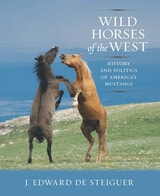
Wild Horses of the West
History and Politics of America's MustangsJ. Edward de Steiguer
University of Arizona Press, 2011
In Wild Horses of the West, J. Edward de Steiguer provides an entertaining and well-researched look at one of the most controversial animal welfare issues of our time—the protection of free-roaming horses on the West’s public lands. This is the first book in decades to include the entire story of these magnificent animals, from their evolution and biology to their historical integration into conquistador, Native American, and cowboy cultures. And the story isn’t over. De Steiguer goes on to address the modern issues— ecology, conservation, and land management—surrounding wild horses in the West today.
Featuring stunning color photographs of wild horses, this extremely thorough and engaging blend of history, science, and politics will appeal to students of the American West, conservation activists, and anyone interested in the beauty and power of these striking animals.
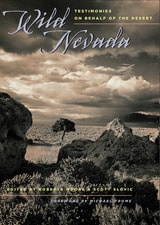
Wild Nevada
Testimonies on Behalf of the DesertRoberta Moore
University of Nevada Press, 2005
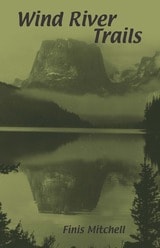
Wind River Trails
Finis Mitchell
University of Utah Press, 1999
Mitchell draws on decades of experience to describe the trails, routes, wildlife, glaciers, lakes, and streams in Wyoming's fabulous two-and-a-quarter million acre Wind River Range.
A short hike was the beginning of a long career in wilderness living for Finis Mitchell of Rock Springs, Wyoming. He has scaled 244 peaks, including four times to the trop of Gannett Peak, the highest mountain in the state. A vigorous supporter of wilderness, the mountain man pours out his philosophy at meetings and slide shows with amazing attention to detail. He has taken 105,345 pictures as a hobby and uses them in his slide shows to show people their own public lands.
He has drawn on his vast experience in the Wind Rivers to describe, in this guide book, the trails, routes, wildlife, glaciers, 4,000 lakes and 800 miles of streams in Wyoming’s fabulous two and a quarter million acre Wind River Range.
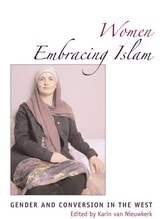
Women Embracing Islam
Gender and Conversion in the WestEdited by Karin van Nieuwkerk
University of Texas Press, 2006
Many Westerners view Islam as a religion that restricts and subordinates women in both private and public life. Yet a surprising number of women in Western Europe and America are converting to Islam. What attracts these women to a belief system that is markedly different from both Western Christianity and Western secularism? What benefits do they gain by converting, and what are the costs? How do Western women converts live their new Islamic faith, and how does their conversion affect their families and communities? How do women converts transmit Islamic values to their children? These are some of the questions that Women Embracing Islam seeks to answer.
In this vanguard study of gender and conversion to Islam, leading historians, sociologists, anthropologists, and theologians investigate why non-Muslim women in the United States, several European countries, and South Africa are converting to Islam. Drawing on extensive interviews with female converts, the authors explore the life experiences that lead Western women to adopt Islam, as well as the appeal that various forms of Islam, as well as the Nation of Islam, have for women. The authors find that while no single set of factors can explain why Western women are embracing Islamic faith traditions, some common motivations emerge. These include an attraction to Islam's high regard for family and community, its strict moral and ethical standards, and the rationality and spirituality of its theology, as well as a disillusionment with Christianity and with the unrestrained sexuality of so much of Western culture.
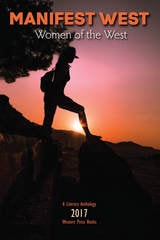
Women of the West
Caleb Seeling
University Press of Colorado, 2017
The 2017 volume in the Manifest West series, Women of the West, delves into the rich mixing pot created in the West, derived from assorted cultures and ethnicities and from a variety of beliefs and traditions across the world, all manifested in today’s Western culture.
There is no one type of Western woman. They are beautifully diverse in race, religion, and sexual orientation, yet they are bonded through the shared experiences and approaches to life that identify them as distinctly Western. Like individual squares of a quilt, women’s interactions with the culture, landscape, and geography of the West, as well as with their families and one another, offer us a unified variety.
In this collection of poems, short stories, and creative nonfiction, twenty-five writers and poets present a broad understanding of the Western woman, sometimes defying and sometimes reinforcing expectations and stereotypes. Perspectives vary from daughters grieving the loss of fathers whose rugged ways resonated with them to mothers striving to share an adoration for the delicacy of nature with their sons. For every woman seeking to conquer the wilderness, another yearns to be tamed by it. These are the stories of natives and Natives, of immigrants from around the world, spanning from eastern states of America to Vietnam in the East. From historical figures toting guns and whips to those who must overcome today’s manifestations of violence against women, these ladies, and so many more, are the Women of the West.
Manifest West is Western Press Books’ literary anthology series. The press, affiliated with Western State Colorado University, produces one anthology annually and focuses on Western regional writing.

World Film Locations
Los AngelesEdited by Gabriel Solomons
Intellect Books, 2011
World Film Locations
San FranciscoEdited by Scott Jordan Harris
Intellect Books, 2013
Audiences across the world, as well as many of the world’s greatest film directors—including Buster Keaton, Orson Welles, George Lucas, Francis Ford Coppola, David Fincher, and Steven Soderbergh—have been seduced by San Francisco. This book is the ideal escape to the city by the bay for arm chair travelers and cinephiles alike.
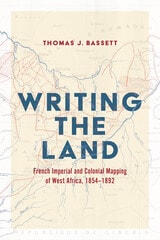
Writing the Land
French Imperial and Colonial Mapping of West Africa, 1854–1892Thomas J. Bassett
University of Chicago Press, 2027
Reveals the intertwined nature of imperial mapping and map history through the making of the colony of French Soudan in nineteenth-century West Africa.
Thomas J. Bassett’s Writing the Land argues that mapping played a key role in France’s territorial conquest of Africa, and that the process of imperial expansion and colonization shaped map history by influencing how maps were constructed, circulated, and used. Analyzing military and surveying campaigns over half a century in an area that became the colony of French Soudan, Bassett focuses on the social and spatial problems that surveyors and mapmakers tried to solve in the process of territorial conquest, as well as the conflicts that arose as they pursued their goals.
In their efforts to obtain this territory, French military leaders, cartographers, and expedition members came into continual contact with local Africans, with whom they negotiated and clashed. Often, imperial officers relied on intermediaries to navigate West African geography, drawing on the knowledge of political authorities, interpreters, guides, and long-distance traders; the maps they produced are inextricable from these interactions. Ultimately, Bassett claims, examining the processes of mapping in the context of these encounters leads us to understand these maps anew as Euro-African constructions, ones that emerge from a complex process of exchange and domination.