Results by title
130 books match the query 'Women's rights' and 21 start with w

W Stands for Women
How the George W. Bush Presidency Shaped a New Politics of GenderMichaele L. Ferguson and Lori J. Marso, eds.
Duke University Press, 2007
In W Stands for Women ten feminist scholars analyze various aspects of Bush’s persona, language, and policy to show how his administration has shaped a new politics of gender. One contributor points out the shortcomings of “compassionate conservatism,” a political philosophy that requires a weaker class to be the subject of compassion. Another examines Lynndie England’s participation in the abuse of prisoners at Abu Ghraib in relation to the interrogation practices elaborated in the Army Field Manual, practices that often entail “feminizing” detainees by stripping them of their masculine gender identities. Whether investigating the ways that Bush himself performs masculinity or the problems with discourse that positions non-Western women as supplicants in need of saving, these essays highlight the far-reaching consequences of the Bush administration’s conflation of feminist rhetoric, conservative gender ideology, and neoconservative national security policy.
Contributors. Andrew Feffer, Michaele L. Ferguson, David S. Gutterman, Mary Hawkesworth, Timothy Kaufman-Osborn, Lori Jo Marso, Danielle Regan, R. Claire Snyder, Iris Marion Young, Karen Zivi
Michaela Ferguson and Karen Zivi appeared on KPFA’s Against the Grain on September 11, 2007. Listen to the audio.
Michaela Ferguson and Lori Jo Marso appeared on WUNC’s The State of Things on August 30, 2007. Listen to the audio.
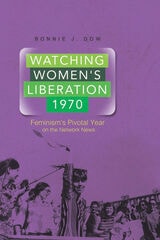
Watching Women's Liberation, 1970
Feminism's Pivotal Year on the Network NewsBonnie J. Dow
University of Illinois Press, 2014
In Watching Women's Liberation, 1970: Feminism's Pivotal Year on the Network News, Bonnie J. Dow uses case studies of key media events to delve into the ways national TV news mediated the emergence of feminism's second wave. First legitimized as a big story by print media, the feminist movement gained broadcast attention as the networks’ eagerness to get in on the action was accompanied by feminists’ efforts to use national media for their own purposes. Dow chronicles the conditions that precipitated feminism's new visibility and analyzes the verbal and visual strategies of broadcast news discourses that tried to make sense of the movement.
Groundbreaking and packed with detail, Watching Women's Liberation, 1970 shows how feminism went mainstream--and what it gained and lost on the way.
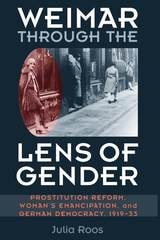
Weimar through the Lens of Gender
Prostitution Reform, Woman's Emancipation, and German Democracy, 1919-33Julia Roos
University of Michigan Press, 2010
"This book will make a valuable contribution to the field of German history, as well as the histories of gender and sexuality. The argument that Weimar feminism did bring about tangible gains for women needs to be made, and Roos has done so convincingly."
---Julia Sneeringer, Queens College
Until 1927, Germany had a system of state-regulated prostitution, under which only those prostitutes who submitted to regular health checks and numerous other restrictions on their personal freedom were tolerated by the police. Male clients of prostitutes were not subject to any controls. The decriminalization of prostitution in 1927 resulted from important postwar gains in women's rights; yet this change---while welcomed by feminists, Social Democrats, and liberals—also mobilized powerful conservative resistance. In the early 1930s, the right-wing backlash against liberal gender reforms like the 1927 prostitution law played a fateful role in the downfall of the Weimar Republic and the rise of Nazism.
Weimar through the Lens of Gender combines the political history of early twentieth-century Germany with analytical perspectives derived from the fields of gender studies and the history of sexuality. The book's argument will be of interest to a broad readership: specialists in the fields of gender studies and the history of sexuality, as well as historians and general readers interested in Weimar and Nazi Germany.
Julia Roos is Assistant Professor of History at Indiana University, Bloomington.
Jacket art: "Hamburg, vermutlich St. Pauli, 1920er–30er Jahre," photographer unknown, s/w-Fotografie. (Courtesy of the Museum für Hamburgische Geschichte.)

When You Dare to Say Yes
Jill Derby and Nevada ActivismJill Derby
University of Nevada Press, 2024
Derby’s account of the awakening of her post-college experience living abroad and stories of her global travels infuse this memoir with an international perspective and entertaining vignettes. Ultimately, Derby shares her personal understanding of the transformative power of living among different cultures.
Where Human Rights Begin
Edited by Wendy Chavkin and Ellen Chesler
Rutgers University Press, 2005
More than a decade ago, three landmark world conferences placed the human rights of women on the international agenda. The first, in Vienna, officially extended the definition of human rights to include a woman’s right to self-determination and equality. A year later, in Cairo, this concept was elaborated to deal explicitly with issues of sexuality and procreation. Subsequently, at a conference in Beijing, the international community committed to a wide range of practical interventions to advance women’s sexual, social, political, and economic rights.
Despite these accomplishments, we find ourselves at an ever more difficult juncture in the struggle to fully realize women’s rights as human rights. Complications, such as terrorism and the “war” against it, the HIV/AIDS pandemic, the incursion of religious fundamentalism into governments, and the U.S. government’s retreat from the international agenda on sexual and reproductive rights have raised questions about the direction of policy implementations and have prevented straightforward progress.
This timely collection brings together eight wide-reaching and provocative essays that examine the practical and theoretical issues of sexual and reproductive health policy and implementation.

Why We Lost the ERA
Jane J. Mansbridge
University of Chicago Press, 1986
In March 1972 the Equal Rights Amendment to the United States Constitution-the ERA-passed the Senate of the United States with a vote of 84 to 8, seventeen votes more than the two-thirds required for constitutional amendments. In the ensuing ten years, a majority of Americans consistently told interviewers that they favored this amendment to the Constitution. Yet on June 30, 1982, the deadline for ratifying the amendment passed with only thirty-five of the required thirty-eight states having ratified.
How did this happen? In How We Lost the ERA, political scientist Jane J. Mansbridge tells the story of the ERA's rise and fall, revealing self-defeating, contradictory forces within the movement supporting the amendment and how those contributed to its demise. The surprising challenges Mansbridge uncovers here remain salient to political struggles and democratic theory today.

Wildcat Women
Narratives of Women Breaking Ground in Alaska's Oil and Gas IndustryCarla Williams
University of Alaska Press, 2018
Wives Not Slaves
Patriarchy and Modernity in the Age of RevolutionsKirsten Sword
University of Chicago Press, 2021
Kirsten Sword’s richly researched history reconstructs the stories of wives who fled their husbands between the mid-seventeenth and early nineteenth centuries, comparing their plight with that of other runaway dependents. Wives not Slaves explores the links between local justice, the emerging press, and transatlantic political debates about marriage, slavery and imperial power. Sword traces the relationship between the distress of ordinary households, domestic unrest, and political unrest, shedding new light on the social changes imagined by eighteenth-century revolutionaries, and on the politics that determined which patriarchal forms and customs the new American nation would—and would not—abolish.

Woman Suffrage and Citizenship in the Midwest, 1870-1920
Sara Egge
University of Iowa Press, 2018
Winner of the 2019 Gita Chaudhuri Prize
Winner of the 2019 Benjamin F. Shambaugh Award
Historian Sara Egge offers critical insights into the woman suffrage movement by exploring how it emerged in small Midwestern communities—in Clay County, Iowa; Lyon County, Minnesota; and Yankton County, South Dakota. Examining this grassroots activism offers a new approach that uncovers the sophisticated ways Midwestern suffragists understood citizenship as obligation.
These suffragists, mostly Yankees who migrated from the Northeast after the Civil War, participated enthusiastically in settling the region and developing communal institutions such as libraries, schools, churches, and parks. Meanwhile, as Egge’s detailed local study also shows, the efforts of the National American Women’s Suffrage Association did not always succeed in promoting the movement’s goals. Instead, it gained support among Midwesterners only when local rural women claimed the right to vote on the basis of their well-established civic roles and public service.
By investigating civic responsibility, Egge reorients scholarship on woman suffrage and brings attention to the Midwest, a region overlooked by most historians of the movement. In doing so, she sheds new light onto the ways suffragists rejuvenated the cause in the twentieth century.
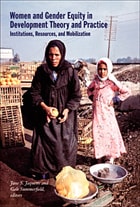
Women and Gender Equity in Development Theory and Practice
Institutions, Resources, and MobilizationJane S. Jaquette and Gale Summerfield, eds.
Duke University Press, 2006
Highlighting key institutional issues, contributors analyze the two approaches that dominate the field: women in development (WID) and gender and development (GAD). They assess the results of gender mainstreaming, the difficulties that development agencies have translating gender rhetoric into equity in practice, and the conflicts between gender and the reassertion of indigenous cultural identities. Focusing on resource allocation, contributors explore the gendered effects of land privatization, the need to challenge cultural traditions that impede women’s ability to assert their legal rights, and women’s access to bureaucratic levers of power. Several essays consider women’s mobilizations, including a project to provide Internet access and communications strategies to African NGOs run by women. In the final essay, Irene Tinker, one of the field’s founders, reflects on the interactions between policy innovation and women’s organizing over the three decades since women became a focus of development work. Together the contributors bridge theory and practice to point toward productive new strategies for women and gender in development.
Contributors. Maruja Barrig, Sylvia Chant, Louise Fortmann, David Hirschmann, Jane S. Jaquette, Diana Lee-Smith, Audrey Lustgarten, Doe Mayer, Faranak Miraftab, Muadi Mukenge, Barbara Pillsbury, Amara Pongsapich, Elisabeth Prügl, Kirk R. Smith, Kathleen Staudt, Gale Summerfield, Irene Tinker, Catalina Hinchey Trujillo

Women and National Development
The Complexities of ChangeEdited by Wellesley Editorial Committee
University of Chicago Press, 1978
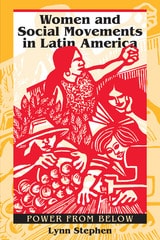
Women and Social Movements in Latin America
Power from BelowBy Lynn Stephen
University of Texas Press, 1997
Women's grassroots activism in Latin America combines a commitment to basic survival for women and their children with a challenge to women's subordination to men. Women activists insist that issues such as rape, battering, and reproductive control cannot be divorced from women's concerns about housing, food, land, and medical care.
This innovative, comparative study explores six cases of women's grassroots activism in Mexico, El Salvador, Brazil, and Chile. Lynn Stephen communicates the ideas, experiences, and perceptions of women who participate in collective action, while she explains the structural conditions and ideological discourses that set the context within which women act and interpret their experiences. She includes revealing interviews with activists, detailed histories of organizations and movements, and a theoretical discussion of gender, collective identity, and feminist anthropology and methods.
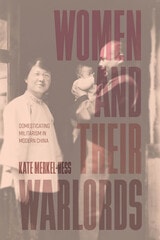
Women and Their Warlords
Domesticating Militarism in Modern ChinaKate Merkel-Hess
University of Chicago Press, 2024
In Women and Their Warlords, historian Kate Merkel-Hess examines the lives and personalities of the female relatives of the military rulers who governed regions of China from 1916 to 1949. Posing for candid photographs and sitting for interviews, these women did not merely advance male rulers’ agendas. They advocated for social and political changes, gave voice to feminist ideas, and shaped how the public perceived them. As the first publicly political partners in modern China, the wives and concubines of Republican-era warlords changed how people viewed elite women’s engagement in politics. Drawing on popular media sources, including magazine profiles and gossip column items, Merkel-Hess draws unexpected connections between militarism, domestic life, and state power in this insightful new account of gender and authority in twentieth-century China.
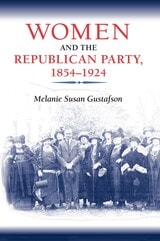
Women and the Republican Party, 1854-1924
Melanie Susan Gustafson
University of Illinois Press, 2001
Acclaimed as groundbreaking since its publication, Women and the Republican Party, 1854-1924 explores the forces that propelled women to partisan activism in an era of widespread disfranchisement and provides a new perspective on how women fashioned their political strategies and identities before and after 1920.
Melanie Susan Gustafson examines women's partisan history against the backdrop of women's political culture. Contesting the accepted notion that women were uninvolved in political parties before gaining the vote, Gustafson reveals the length and depth of women's partisan activism between the founding of the Republican Party, whose abolitionist agenda captured the loyalty of many women, and the passage of the Nineteenth Amendment. Her account also looks at the complex interplay of partisan and nonpartisan activity; the fierce debates among women about how to best use their influence; the ebb and flow of enthusiasm for women's participation; and the third parties that fused the civic world of reform organizations with the electoral world of voting and legislation.
Women in Politics in the American City
Myra Holman
Temple University Press, 2014
This book provides the first comprehensive evaluation of the influence of gender on the behavior of mayors and city council members in the United States. Holman considers the effects of gender in local, urban politics and analyzes how a leader's gender does-and does not-influence policy preferences, processes, behavior, and outcomes.
Holman effectively uses original survey data to evaluate policy attitudes, combined with observations of city council meetings and interviews with leaders and community members. In doing so, she demonstrates the importance of considering the gender of leaders in local office.
Women in Politics in the American City emphasizes that the involvement of women in local politics does matter and that it has significant consequences for urban policy as well as state and local democracy.

Women in Revolutionary Paris, 1789-1795
Edited and translated by Darlene Gay Levy, Harriet Branson Applewhite, and Mary Durham Johnson
University of Illinois Press, 1979
"This unique collection of documents will be a boon to teachers of history and to scholars of the French Revolution. . . . Recommended."
-- Library Journal
Women on the Defensive
Living through Conservative TimesSylvia Bashevkin
University of Chicago Press, 1998
Prevailing accounts of the fate of women's movements in that decade ascribe their hardships to a postfeminist ideology or the result of a "backlash" against women, particularly in America. Sylvia Bashevkin's study excavates, however, a much more complex situation. By identifying the policies and goals held in common by feminists in all three countries and tracing their collision course with the conservative policies of the three administrations, she is able to document setbacks but also some progress, despite the right-of-center leaders. She also challenges the assumption that organized interests in the United States are less vulnerable in hard times than those in parliamentary systems, finding that the elections of Ronald Reagan, Brian Mulroney, and Margaret Thatcher had similar effects on both sides of the Atlantic. Her comparative analysis reveals that the policies of current leaders, while marginally better than their predecessors, will not allow women and women's movements to regain lost ground.
Organized thematically, rather than by country, Women on the Defensive describes the difficult relationship between feminists and conservatives during a time of bitter ideological and policy battles when the vibrant social movements of the 1960s and 1970s were seriously threatened.

Women's Lives in Colonial Quito
Gender, Law, and Economy in Spanish AmericaBy Kimberly Gauderman
University of Texas Press, 2003
What did it mean to be a woman in colonial Spanish America? Given the many advances in women's rights since the nineteenth century, we might assume that colonial women had few rights and were fully subordinated to male authority in the family and in society—but we'd be wrong. In this provocative study, Kimberly Gauderman undermines the long-accepted patriarchal model of colonial society by uncovering the active participation of indigenous, mestiza, and Spanish women of all social classes in many aspects of civil life in seventeenth-century Quito.
Gauderman draws on records of criminal and civil proceedings, notarial records, and city council records to reveal women's use of legal and extra-legal means to achieve personal and economic goals; their often successful attempts to confront men's physical violence, adultery, lack of financial support, and broken promises of marriage; women's control over property; and their participation in the local, interregional, and international economies. This research clearly demonstrates that authority in colonial society was less hierarchical and more decentralized than the patriarchal model suggests, which gave women substantial control over economic and social resources.
Women's Movements in Twentieth-Century Taiwan
Doris Chang
University of Illinois Press, 2008
This book is the first in English to consider women's movements and feminist discourses in twentieth-century Taiwan. Doris T. Chang examines the way in which Taiwanese women in the twentieth century selectively appropriated Western feminist theories to meet their needs in a modernizing Confucian culture. She illustrates the rise and fall of women's movements against the historical backdrop of the island's contested national identities, first vis-à-vis imperial Japan (1895-1945) and later with postwar China (1945-2000).
In particular, during periods of soft authoritarianism in the Japanese colonial era and late twentieth century, autonomous women's movements emerged and operated within the political perimeters set by the authoritarian regimes. Women strove to replace the "Good Wife, Wise Mother" ideal with an individualist feminism that meshed social, political, and economic gender equity with the prevailing Confucian family ideology. However, during periods of hard authoritarianism from the 1930s to the 1960s, the autonomous movements collapsed.
The particular brand of Taiwanese feminism developed from numerous outside influences, including interactions among an East Asian sociopolitical milieu, various strands of Western feminism, and even Marxist-Leninist women's liberation programs in Soviet Russia. Chinese communism appears not to have played a significant role, due to the Chinese Nationalists' restriction of communication with the mainland during their rule on post-World War II Taiwan.
Notably, this study compares the perspectives of Madame Chiang Kai-shek, whose husband led as the president of the Republic of China on Taiwan from 1949 to 1975, and Hsiu-lien Annette Lu, Taiwan's vice president from 2000 to 2008. Delving into period sources such as the highly influential feminist monthly magazine Awakening as well as interviews with feminist leaders, Chang provides a comprehensive historical and cross-cultural analysis of the struggle for gender equality in Taiwan.
Women, Gender, and Human Rights
A Global PerspectiveAgosín, Marjorie
Rutgers University Press, 2001
The 1948 United Nations Universal Declaration of Human Rights expresses the credo that all human beings are created free and equal. But not until 1995 did the United Nations declare that women’s rights to be human rights, and bring gender issues into the global arena for the first time. The subordination of indigenous and minority women, ethnic cleansing, and the struggle for reproductive rights are some of the most pressing issues facing women worldwide.
Women, Gender, and Human Rights is the first collection of essays that encompass a global perspective on women and a wide range of issues, including political and domestic violence, education, literacy, and reproductive rights. Most of the articles were written expressly for this volume by internationally known experts in the fields of government, bioethics, medicine, public affairs, literature, history, anthropology, law, and psychology.

Women, Politics and Change
Louise A. Tilly
Russell Sage Foundation, 1990