Results by title
80 books match the query 'Women in politics' and 14 start with w
Walking the Gendered Tightrope
Theresa May and Nancy Pelosi as Legislative LeadersMelissa Haussman and Karen M. Kedrowski
University of Michigan Press, 2023
What Women Want
Gender and Voting in Britain, Japan and the United StatesGill Steel
University of Michigan Press, 2022
What Women Want analyzes decades of voting preferences, values, and policy preferences to debunk some of the media and academic myths about gender gaps in voting and policy preferences. Findings show that no single theory explains when differences in women’s and men’s voting preferences emerge, when they do not, or when changes—or the lack thereof—occur over time. Steel extends existing theories to create a broader framework for thinking about gender and voting behavior to provide more analytical purchase in understanding gender and its varying effects on individual voters’ preferences. She incorporates the long-term effects of party identification and class politics on political decision-making, particularly in how they influence preferences on social provision and on expectations of the state. She also points to the importance of symbolic politics

Where Women Run
Gender and Party in the American StatesKira Sanbonmatsu
University of Michigan Press, 2010
“Kira Sanbonmatsu has done a masterful job of linking the representation of women in elective office to the activities of party organizations in the states. She combines qualitative and quantitative data to show how women are navigating the campaign process to become elected leaders and the changing role of party organizations in their recruitment and election. It is a significant contribution to the study of representative democracy.”
--Barbara Burrell, Northern Illinois University
“Sanbonmatsu has produced an excellent study that will invigorate research on the role of political parties and the recruitment of women candidates. Using a variety of methods and data sources, she has crafted a tightly constructed, clearly argued, and exceedingly well-written study. A commendable and convincing job.”
--Gary Moncrief, Boise State University
“Sanbonmatsu offers important insights in two neglected areas of American politics: the role of political parties in recruiting candidates and the continued under-representation of women in elected office. Connecting the two subjects through careful qualitative and statistical methods, insightful interpretation of the literature and interesting findings, the book is a significant new addition to scholarship on parties, gender, and political recruitment.”
--Linda Fowler, Dartmouth College
Kira Sanbonmatsu is Associate Professor of Political Science at Rutgers University and Senior Scholar at the Eagleton Institute of Politics’ Center for American Women and Politics (CAWP). She was previously associate professor at Ohio State University. She is the author of Democrats, Republicans, and the Politics of Women’s Place.
Who Runs?
The Masculine Advantage in Candidate EmergenceSarah Oliver and Meredith Conroy
University of Michigan Press, 2020
Meredith Conroy and Sarah Oliver focus on the candidate emergence process (recruitment, perceived qualifications, and ambition), and investigate the affects of individuals’ gender personality on these variables to improve theories of women’s underrepresentation in government. They argue that since politics and masculinity are congruent, we should observe more precise variation in the candidate emergence process along gender differences, than along sex differences in isolation. Individuals who are more masculine will be more likely to be recruited, perceive of themselves as qualified, and express political ambition, than less masculine individuals. This differs from studies that look at sex differences, because it accepts that some women defy gender norms and break into politics. By including a measure of gender personality we can more fully grapple with women’s progress in American politics, and consider whether this progress rests on masculine behaviors and attributes. Who Runs? The Masculine Advantage in Candidate Emergence explores this possibility and the potential ramifications.
Women Politics And Empowerment
Ann Bookman
Temple University Press, 1987

Women Strike for Peace
Traditional Motherhood and Radical Politics in the 1960sAmy Swerdlow
University of Chicago Press, 1993
Women Strike for Peace began on November 1, 1961, when thousands of white, middle-class women walked out of their kitchens and off their jobs in a one-day protest against Soviet and American nuclear policies. The protest led to a national organization of women who fought against nuclear arms and U.S. intervention in Vietnam. While maintaining traditional maternal and feminine roles, members of WSP effectively challenged national policies—defeating a proposal for a NATO nuclear fleet, withstanding an investigation by the House Committee on Un-American Activities, and sending one of its leaders to Congress as a peace candidate.
As a study of a dissident group grounded in prescribed female culture, and the struggle of its members to avoid being trapped within that culture, this book adds a crucial new dimension to women's studies. In addition, this account of WSP's success as a grass roots, nonhierarchical movement will be of great interest to historians, political scientists, and anyone interested in peace studies or conflict resolution.
"Swerdlow has re-created a unique piece of American political history, a chapter of the international peace movement, and an origin of the modern feminist movement. No historian, activist, or self-respecting woman should be without Women Strike for Peace. It shows not only how one group of women created change, but also how they inevitably changed themselves."—Gloria Steinem
Women and American Socialism, 1870-1920
Mari Jo Buhle
University of Illinois Press, 1981

Women and Regulation
Challenging the Status QuoEdited by Sara R. Rinfret and Michelle C. Pautz
Temple University Press, 2026
Are female food safety inspectors treated differently than men? What do women contribute to the creation and implementation of public policy in the United States? The editors of and contributors to Women in Regulation, all experts in public policy and public administration, analyze the role women (and stakeholders) play in bureaucracies in environmental, budgetary, and other sectors of the U.S. federal, state, and local governments, plus relevant examples from around the world.
Women in Regulation examines the impact of regulatory policy delegation, as well as the actors and processes involved in administrative rulemaking, compliance, and implementation. The book considers representative bureaucracy, organizational stereotypes, emotional labor, and advancement barriers to argue why studying women and regulation is of value. Regulatory case studies focus on topics ranging from water and energy to executive leadership. Chapters also include reflective exercises and prompts for classroom engagement that challenge readers to consider implications for regulatory policy in the future.
Amplifying the underheard voices in policy and implementation, Women in Regulation provides a more holistic picture of regulatory practices.
Contributors: Saman Afshan, Ashley English, Katherine Hoener, Nicole Humphrey, Ekaterina Levintova, Li-Yin Liu, Sean McCandless, Bruce D. McDonald III, Denise Scheberle, Natalie L. Smith, Manuel P. Teodoro, and the editors
Women and Work
Feminism, Labour, and Social ReproductionSusan Ferguson
Pluto Press, 2019
Feminism is once again on the political agenda. Across the world women are taking to the streets to protest unfair working conditions, abortion laws, and sexual violence. They are demanding decent wages, better schools and free childcare.
But why do some feminists choose to fight for more women CEOs, while others fight for a world without CEOs?
To understand these divergent approaches, Susan Ferguson looks at the ideas that have inspired women to protest, exploring the ways in which feminists have placed work at the center of their struggle for emancipation. Two distinct trajectories emerge: “equality feminism” and “social reproduction feminism.” Ferguson argues that socialists have too often embraced the “liberal” tendencies of equality feminism, while neglecting the insights of social reproduction feminism. Engaging with feminist anti-work critiques, She proposes that women's emancipation depends upon a radical reimagining of all labor and advocates for a renewed social reproduction framework as a powerful basis for an inclusive feminist politics. Chapters here include;
*The Rational-Humanist Roots of Equality Feminism
*Socialist Feminism: Two Approaches to Understanding Women's Work
*Equal Work for and against Capital
*Anti-Racist Feminism and Women's Work
*A Political Economy of 'Women's Work': Producing Patriarchal Capitalism
*Renewing Social Reproduction Feminism
*The Social Reproduction Strike: Life-Making Beyond Capitalism
Women and Work offers a timely and important look at the intersectionality of feminism and workers rights. Scholars and students will both find valuable insights into the history of feminist theory and social movement.

Women on the Defensive
Living through Conservative TimesSylvia Bashevkin
University of Chicago Press, 1998
Prevailing accounts of the fate of women's movements in that decade ascribe their hardships to a postfeminist ideology or the result of a "backlash" against women, particularly in America. Sylvia Bashevkin's study excavates, however, a much more complex situation. By identifying the policies and goals held in common by feminists in all three countries and tracing their collision course with the conservative policies of the three administrations, she is able to document setbacks but also some progress, despite the right-of-center leaders. She also challenges the assumption that organized interests in the United States are less vulnerable in hard times than those in parliamentary systems, finding that the elections of Ronald Reagan, Brian Mulroney, and Margaret Thatcher had similar effects on both sides of the Atlantic. Her comparative analysis reveals that the policies of current leaders, while marginally better than their predecessors, will not allow women and women's movements to regain lost ground.
Organized thematically, rather than by country, Women on the Defensive describes the difficult relationship between feminists and conservatives during a time of bitter ideological and policy battles when the vibrant social movements of the 1960s and 1970s were seriously threatened.
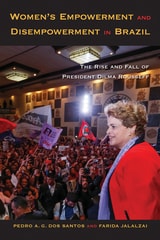
Women's Empowerment and Disempowerment in Brazil
The Rise and Fall of President Dilma RousseffPedro A. G. dos Santos and Farida Jalalzai
Temple University Press, 2021
In 2010, Dilma Rousseff was the first woman to be elected President in Brazil. She was re-elected in 2014 before being impeached in 2016 for breaking budget laws. Her popularity and controversy both energized and polarized the country. In Women’s Empowerment and Disempowerment in Brazil, dos Santos and Jalalzai examine Rousseff’s presidency and what it means for a woman to hold (and lose) the country’s highest power.
The authors examine the ways Rousseff exercised dominant authority and enhanced women’s political empowerment. They also investigate the extent her gender played a role in the events of her presidency, including the political and economic crises and her ensuing impeachment. Emphasizing women’s political empowerment rather than representation, the authors assess the effects of women executives to more directly impact female constituencies—how they can empower women by appointing them to government positions; make policies that advance women’s equality; and, through visibility, create greater support for female politicians despite rampant sexism.
Women’s Empowerment and Disempowerment in Brazil uses Rousseff’s presidency as a case study to focus on the ways she succeeded and failed in using her authority to empower women. The authors’ findings have implications throughout the world.
Women's Organizations and Democracy in South Africa
Contesting AuthorityShireen Hassim
University of Wisconsin Press, 2006
The transition to democracy in South Africa was one of the defining events in twentieth-century political history. The South African women’s movement is one of the most celebrated on the African continent. Shireen Hassim examines interactions between the two as she explores the gendered nature of liberation and regime change. Her work reveals how women’s political organizations both shaped and were shaped by the broader democratic movement. Alternately asserting their political independence and giving precedence to the democratic movement as a whole, women activists proved flexible and remarkably successful in influencing policy. At the same time, their feminism was profoundly shaped by the context of democratic and nationalist ideologies. In reading the last twenty-five years of South African history through a feminist framework, Hassim offers fresh insights into the interactions between civil society, political parties, and the state.
Hassim boldly confronts sensitive issues such as the tensions between autonomy and political dependency in feminists’ engagement with the African National Congress (ANC) and other democratic movements, and black-white relations within women’s organizations. She offers a historically informed discussion of the challenges facing feminist activists during a time of nationalist struggle and democratization.
Winner, Victoria Schuck Award for best book on women and politics, American Political Science Association
“An exceptional study, based on extensive research. . . . Highly recommended.”—Choice
“A rich history of women’s organizations in South African . . . . [Hassim] had observed at first hand, and often participated in, much of what she described. She had access to the informants and private archives that so enliven the narrative and enrich the analysis. She provides a finely balanced assessment.”—Gretchen Bauer, African Studies Review

Women, Politics and Change
Louise A. Tilly
Russell Sage Foundation, 1990
Women’s Political Representation in Central and Eastern Europe
Enduring Legacies and Complex Realities Amid the Promise of ProgressAnja Vojvodic
Central European University Press, 2026