Results by title
977 books match the query 'American literature' and 59 start with w
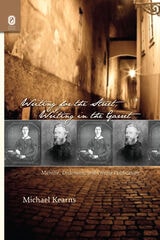
Writing for the Street, Writing in the Garret
Melville, Dickinson, and Private PublicationMichael Kearns
The Ohio State University Press, 2010
Although Herman Melville and Emily Dickinson differed dramatically in terms of their lives and writing careers, they shared not only a distaste for writing “for the street” (mass readership) but a preference for the intimate writer–reader relationship created by private publication, especially in the form of manuscripts. In Writing for the Street, Writing in the Garret: Melville, Dickinson, and Private Publication, Michael Kearns shows that this distaste and preference were influenced by American copyright law, by a growing tendency in America to treat not only publications but their authors as commodities, and by the romantic stereotype of the artist (usually suffering in a garret) living only for her or his own work.
Writing in America
Fischer, John
Rutgers University Press, 2018
In this newly reissued volume in the Rutgers University Press Classics Imprint, Writing in America proves to be as stimulating as it was in 1960. Here, writers including Robert Brustein, Stanley Kunitz, and C.P. Snow examine the state of writing in American novels, films, and television candidly and critically. The result is a collection of essays that showcase a first-rate and highly entertaining piece of reporting on the American literary scene that resonate in 2017.
Writing in the Margins
The Ethics of Expatriation from Lawrence to OndaatjeMarilyn Adler Papayanis
Vanderbilt University Press, 2005
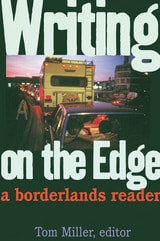
Writing on the Edge
A Borderlands ReaderEdited by Tom Miller
University of Arizona Press, 2003
This wide-ranging anthology—gathering short stories and essays, song lyrics and poems—offers readers a new appreciation of the border and its literature. Residents of the region may be startled to learn how many passers-by have been struck by this unruly slice of North America, while those living in other parts of the country may be surprised to find it more than a dateline for reports of smuggling and illegal immigration.
Collected here are both celebrated and underappreciated gems of American and Mexican literature depicting a region that for some writers represents an exotic land, for others home. Writing on the Edge juxtaposes passages by New Jersey poet William Carlos Williams and native songwriter Flaco Jiménez, British novelist Graham Greene and American poet Demetria Martínez, to show us the border from both sides and from a distance. In all of the selections, La Frontera looms larger than life—an energizing force that frames the lives of the characters living within its boundaries. Included in the book is a literary map of the border highlighting the sites with which each author is identified.
As editor Tom Miller observes, the very notion of literature in a region considered an "irrelevant nuisance" allows for more free-ranging creative output." Writing on the Edge sparkles with such creativity and invites readers to enjoy the best of two worlds—and of the world they share.
Print a literary map of the borderlands here!
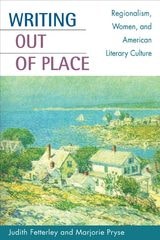
Writing out of Place
Regionalism, Women, and American Literary CultureJudith Fetterley and Marjorie Pryse
University of Illinois Press, 2002
Regionalist writers such as Alice Cary, Mary E. Wilkins Freeman, Sarah Orne Jewett, Grace King, Alice Dunbar–Nelson, Sui Sin Far, and Mary Austin present narrators who serve as cultural interpreters for persons often considered "out of place" by urban readers. Critiquing the approaches to regional subjects characteristic of local color, this book gives contemporary readers a vantage point from which to approach regions and regional people in the global economy of our own time.
Reclaiming the ground of "close" reading for texts that have been insufficiently read, Fetterley and Pryse situate textual analyses within larger questions such as the ideology of form, feminist standpoint epistemology, queer theory, intersections of race and class, and narrative empathy. In its combination of the critical and the visionary, Writing out of Place proposes regionalism as a model for narrative connection between texts and readers that has the potential to transform American literary culture. Arguing the need for other models for human development than those produced in heroic stories about men and boys, the authors offer regionalism as a source of unconventional and counterhegemonic fictions that should be passed on to future generations of readers.
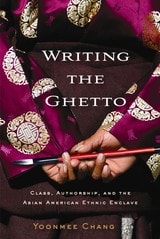
Writing the Ghetto
Class, Authorship, and the Asian American Ethnic EnclaveChang, Yoonmee
Rutgers University Press, 2010
Yoonmee Chang examines the class structure of Chinatowns, Koreatowns, Little Tokyos, and Little Indias, arguing that ghettoization in these spaces is disguised. She maintains that Asian American literature both contributes to and challenges this masking through its marginalization by what she calls the "ethnographic imperative." Chang discusses texts from the late nineteenth century to the present, including those of Sui Sin Far, Winnifred Eaton, Monica Sone, Fae Myenne Ng, Chang-rae Lee, S. Mitra Kalita, and Nam Le. These texts are situated in the contexts of the Chinese Exclusion Era, Japanese American internment during World War II, the globalization of Chinatown in the late twentieth century, the Vietnam War, the 1992 Los Angeles riots, and the contemporary emergence of the "ethnoburb."
Writing the Goodlife
Mexican American Literature and the EnvironmentPriscilla Solis Ybarra
University of Arizona Press, 2016
Goodlife writing has existed for at least the past century, Ybarra contends, but Chicana/o literary history’s emphasis on justice and civil rights eclipsed this tradition and hidden it from the general public’s view. Likewise, in ecocriticism, the voices of people of color most often appear in deliberations about environmental justice. The quiet power of goodlife writing certainly challenges injustice, to be sure, but it also brings to light the decolonial environmentalism heretofore obscured in both Chicana/o literary history and environmental literary studies.
Ybarra’s book takes on two of today’s most discussed topics—the worsening environmental crisis and the rising Latino population in the United States—and puts them in literary-historical context from the U.S.-Mexico War up to today’s controversial policies regarding climate change, immigration, and ethnic studies. This book uncovers 150 years’ worth of Mexican American and Chicana/o knowledge and practices that inspire hope in the face of some of today’s biggest challenges.
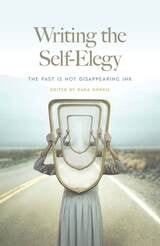
Writing the Self-Elegy
The Past Is Not Disappearing InkEdited by Kara Dorris
Southern Illinois University Press, 2023
Honest, aching, and intimate, self-elegies are unique poems focusing on loss rather than death, mourning versions of the self that are forgotten or that never existed. Within their lyrical frame, multiple selves can coexist—wise and naïve, angry and resigned—along with multiple timelines, each possible path stemming from one small choice that both creates new selves and negates potential selves. Giving voice to pain while complicating personal truths, self-elegies are an ideal poetic form for our time, compelling us to question our close-minded certainties, heal divides, and rethink our relation to others.
In Writing the Self-Elegy, poet Kara Dorris introduces us to this prismatic tradition and its potential to forge new worlds. The self-elegies she includes in this anthology mix autobiography and poetics, blending craft with race, gender, sexuality, ability and disability, and place—all of the private and public elements that build individual and social identity. These poems reflect our complicated present while connecting us to our past, acting as lenses for understanding, and defining the self while facilitating reinvention. The twenty-eight poets included in this volume each practice self-elegy differently, realizing the full range of the form. In addition to a short essay that encapsulates the core value of the genre and its structural power, each poet’s contribution concludes with writing prompts that will be an inspiration inside the classroom and out. This is an anthology readers will keep close and share, exemplifying a style of writing that is as playful as it is interrogative and that restores the self in its confrontation with grief.
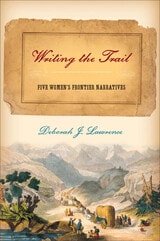
Writing the Trail
Five Women's Frontier NarrativesDeborah Lawrence
University of Iowa Press, 2006