Results by title
8113 books match the query 'Literary Criticism' and 363 start with w
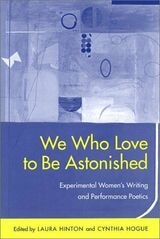
We Who Love to Be Astonished
Experimental Women's Writing and Performance PoeticsLaura Hinton
University of Alabama Press, 2001
The first critical volume devoted to the full range of women's postmodern works
We Who Love to Be Astonished collects a powerful group of previously unpublished essays to fill a gap in the critical evaluation of women's contributions to postmodern experimental writing. Contributors include Alan Golding, Aldon Nielsen, and Rachel Blau DuPlessis; discussions include analyses of the work of Kathleen Fraser, Harryette Mullen, and Kathy Acker, among others. The editors take as their title a line from the work of Lyn Hejinian, one of the most respected of innovative women poets writing today.
The volume is organized into four sections: the first two seek to identify, from two different angles, the ways women of different sociocultural backgrounds are exploring their relationships to their cultures' inherited traditions; the third section investigates the issue of visuality and the problems and challenges it creates; and the fourth section expands on the role of the body as material and performance.
The collection will breach a once irreconcilable divide between those who theorize about women's writing and those who focus on formalist practice. By embracing "astonishment" as the site of formalist-feminist investigation, the editors seek to show how form configures feminist thought, and, likewise, how feminist thought informs words and letters on a page. Students and scholars of avant-garde poetry, women's writing, and late-20th-century American literature will welcome this lively discussion.
We-Narratives
Collective Storytelling in Contemporary FictionNatalya Bekhta
The Ohio State University Press, 2020
Natalya Bekhta’s We-Narratives: Collective Storytelling in Contemporary Fiction analyzes a storytelling form shaped by the pronoun “we,” probing the tensions between individuality and collectivity in more recent narratives in English. Despite a growing interest in collective characters and the we-form in narratology and beyond, narrative theory has not yet done justice to the plural voice in fiction. In fact, the formulation of a poetics of collective expression needs clear theoretical conventions and a reassessment of established concepts in order to approach plural voices and agents on their own terms. We-Narratives addresses this demand by distinguishing between indicative and performative uses of the first-person plural pronoun in fiction and by identifying formal and rhetorical possibilities of stories told by group narrators.
What does it mean for a multitude to speak as one? How can a truly collective narrative voice be achieved or lost? What are its aesthetic and political repercussions? In order to tackle these questions, Bekhta reads a range of contemporary novels and short stories by Jeffrey Eugenides, Joshua Ferris, Toby Litt, Zakes Mda, Joyce Carol Oates, and Julie Otsuka. She also focuses on narrative innovation by Margaret Atwood, William Faulkner, and Susan Sontag. These narratives feature group protagonists and narrators and therefore offer insight into collective narrative discourse and focalization, construction of communal knowledge and unreliability. We-narrative, taken as a distinct storytelling form, illuminates fiction’s expressive potential and nuances models of narrative analysis.
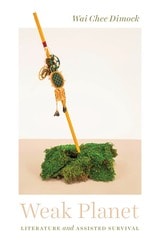
Weak Planet
Literature and Assisted SurvivalWai Chee Dimock
University of Chicago Press, 2020
Drawing on Native American studies, disability studies, and environmental humanities, Dimock shows how hope can be found not in heroic statements but in incremental and unspectacular teamwork. Reversing the usual focus on hegemonic institutions, she highlights instead incomplete gestures given an afterlife with the help of others. She looks at Louise Erdrich’s and Sherman Alexie’s user-amended captivity narratives; nontragic sequels to Moby-Dick by C. L. R. James, Frank Stella, and Amitav Ghosh; induced forms of Irishness in Henry James, Colm Tóibín, W. B. Yeats, and Gish Jen; and the experimentations afforded by a blurry Islam in works by Henri Matisse, James Joyce, Ezra Pound, and Langston Hughes. Celebrating literature’s durability as an assisted outcome, Weak Planet gives us new ways to think about our collective future.
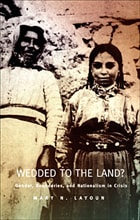
Wedded to the Land?
Gender, Boundaries, and Nationalism in CrisisMary N. Layoun
Duke University Press, 2001
Drawing on readings of literature and of official documents and decrees, songs, poetry, cinema, public monuments, journalism, and conversations with exiles, refugees, and public officials, Layoun uses each historical incident as a means of highlighting a recurring trope within constructs of nationalism. The displacement of the Greek refugees in the 1920s calls into question the very idea of home, as well as the desire for ethnic homogeneity within nations. She reads the Cypriot coup and invasion as an illustration of the gendering of nation and how the notion of the inviolable woman came to represent sovereignity. In her third example she shows how the Palestinian and PLO expulsion from Beirut highlights the ambiguity of the borders upon which many manifestations of nationalism putatively depend. These chapters are preceded and introduced by a discussion of “culturing the nation” and closed by a consideration of citizenship and silence in which Layoun discusses rights ostensibly possessed by all members of a political community.
This book will be of interest to scholars engaged in cultural and critical theory, Middle Eastern and Mediterranean history, literary studies, political science, postcolonial studies, and gender studies.
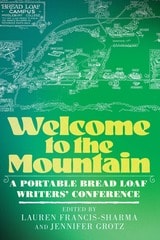
Welcome to the Mountain
A Portable Bread Loaf Writers' ConferenceLauren Francis-Sharma
Four Way Books, 2026
What do Truman Capote, Joan Didion, Archibald MacLeish, and Robert Hayden have in common? They are among the impressive array of American writers who have contributed to the legacy of the Bread Loaf Writers’ Conference in the last one hundred years.
To commemorate this esteemed institution’s centennial, Welcome to the Mountain recreates the experience of being in a writerly community that celebrates literature and invests in literary apprenticeship. This volume, edited by Lauren Francis-Sharma and Jennifer Grotz, comprises an extraordinary sampling of work from the historical to the contemporary, including lectures and readings first delivered at Bread Loaf. Its expansive range showcases everything from highly celebrated texts to rarer pieces and insightful musings by Toni Morrison, Brigit Pegeen Kelly, Randall Kenan, Czesław Miłosz, Julia Alvarez, and so many more.
Welcome to the Mountain tells the endless and thrilling stories of how writers become writers and how literary traditions evolve through our conversations with each other. Through this extraordinary book, we invite readers to make themselves at home in the rich landscape of American letters.
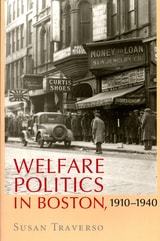
Welfare Politics in Boston, 1910-1940
Susan Traverso
University of Massachusetts Press, 2009
Between 1910 and 1940, Boston's growing immigrant population repeatedly clashed with the city's traditional elite over how to provide assistance to the needy. While Yankee politicians and the leaders of Protestant charities argued that relief should be delivered by private organizations, Irish politicians and officials at Catholic and Jewish charities advocated extensive public welfare programs. Competing views of gender roles further complicated these disagreements. The campaign for widows' pensions, for example, won wide popular support even as public welfare programs that would primarily benefit men-such as unemployment insurance and old age assistance-failed to gain acceptance.
In the 1920s, the debate over welfare shifted focus as prolonged periods of unemployment brought demands for aid to men who had lost their jobs, particularly those with families to support. Using the rhetoric of the Mothers' Aid campaign, Irish politicians broadened the idea of "acceptable dependency" to include men who needed jobs to provide for their own dependents. By lessening the stigma of male dependency on public welfare, these gendered arguments encouraged the expansion of public aid and set the stage for New Deal welfare programs of the 1930s. During that decade, Traverso contends, the idealized family headed by a male breadwinner became the basis for a shared vision of gender relations that mediated the political and ethnic debate over welfare policy.
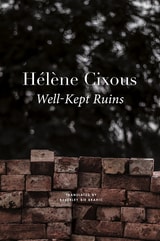
Well-Kept Ruins
Hélène Cixous
Seagull Books, 2022
In the Lower Saxony region of northwestern Germany sits the city of Osnabrück. This is where, in 1648, the Peace of Westphalia was signed, bringing the Thirty Years’ War and one of the most calamitous periods of European history to an end. But the city was later to witness another calamity.
Today, as one walks through Old Synagogue Street in a rich neighborhood of Osnabrück, one might miss noticing a pile of pale stones held together by chicken wire that sits between two fashionable homes. These are the well-kept ruins from behind which stares a gaping space—a place of memory and oblivion. Four polished plaques tell the tale of the horror-filled night of November 9, 1938—today known as Kristallnacht—when the synagogue that had stood on this spot was desecrated, looted, set on fire, and eventually demolished by Hitler’s forces. On the same day, ninety parishioners were imprisoned by the Gestapo and eventually sent to the Buchenwald concentration camp.
Osnabrück was also home to Eve Klein, a member of the city’s early-twentieth-century Jewish community and the mother of author Hélène Cixous. In Well-Kept Ruins, Cixous returns to the historic city in 2019 and reflects on the remains of the synagogue that “express the life lost, the life kept.” Walking the streets of the city, plumbing the depths of the past along with her own family’s history, looking deep into the future, and punctuating her poetic prose with haunting photographs, Cixous explores the ruins at the heart of humanity. Part memoir, part philosophical meditation, Well-Kept Ruins is a genre-defying and timely reflection of the contemporary human condition.
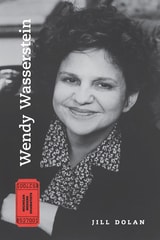
Wendy Wasserstein
Jill Dolan
University of Michigan Press, 2017
Wendy Wasserstein provides a critical introduction and a feminist reappraisal of the significant plays of one of the most famous contemporary American women playwrights. Following a biographical introduction, chapters address each of her important plays, situating Wasserstein’s work in the history of the US feminist movement and in a historical moment in which women artists continue to struggle for recognition.
West African Folktales
Translated by Jack Berry, Edited and with an introduction by Richard Spears
Northwestern University Press, 1991
West of the Border
The Multicultural Literature of the Western American FrontiersNoreen Groover Lape
Ohio University Press, 2000
Expanding the scope of American borderland and frontier literary scholarship, West of the Border examines the writings of nineteenth- and turn-of-the-century Native, African, Asian, and Anglo American frontier writers. This book views frontiers as “human spaces” where cultures make contact as it considers multicultural frontier writers who speak from “west of the border.”
James P. Beckwourth, a half-black fur trader; Sarah Winnemucca Hopkins, a Paiute translator; Salishan author Mourning Dove; Cherokee novelist John Rollin Ridge; Sui Sin Far, an Anglo-Chinese short story writer, and her sister, romance novelist Onoto Watanna; and Mary Austin, a white southwestern writer- each of these intercultural writers faces a rite of passage into a new social order. Their writings negotiate their various frontier ordeals: the encroachment of pioneers on the land; reservation life; assimilation; Christianity; battles over territories and resources; exclusion; miscegenation laws; and the devastation of the environment.
In West of the Border, Noreen Groover Lape raises issues inherent in American pluralism today by broaching timely concerns about American frontier politics, conceptualizing frontiers as intercultural contact zones, and expanding the boundaries of frontier literary studies by giving voice to minority writers.
Western Fictions, Black Realities
Meanings of Blackness and ModernitiesIsabel Soto
Michigan State University Press, 2012
This anthology interrogates two salient concepts in studying the black experience. Ushered in with the age of New World encounters, modernity emerged as brutal and complex, from its very definition to its manifestations. Equally challenging is blackness, which is forever dangling between the range of uplifting articulations and insidious degradation. The essays in Western Fictions address the conflicting confluences of these two terms. Questioning Eurocentric and mainstream American interpretations, they reveal the diverse meanings of modernities and blackness from a wide range of milieus of the black experience. Interdisciplinary and wide-ranging in thematic and epochal scope, they use theoretical and empirical studies of a range of subjects to demonstrate that, indeed, blackness is relevant for understanding modernities and vice versa.
Western Law, Russian Justice
Dostoevsky, the Jury Trial, and the LawGary Rosenshield
University of Wisconsin Press, 2005
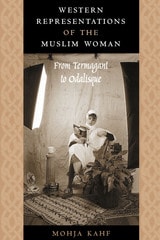
Western Representations of the Muslim Woman
From Termagant to OdalisqueBy Mohja Kahf
University of Texas Press, 1999
Veiled, secluded, submissive, oppressed—the "odalisque" image has held sway over Western representations of Muslim women since the Enlightenment of the eighteenth century. Yet during medieval and Renaissance times, European writers portrayed Muslim women in exactly the opposite way, as forceful queens of wanton and intimidating sexuality.
In this illuminating study, Mohja Kahf traces the process through which the "termagant" became an "odalisque" in Western representations of Muslim women. Drawing examples from medieval chanson de geste and romance, Renaissance drama, Enlightenment prose, and Romantic poetry, she links the changing images of Muslim women to changes in European relations with the Islamic world, as well as to changing gender dynamics within Western societies.
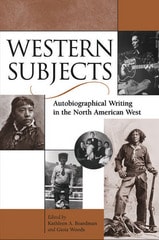
Western Subjects
Autobiographical Writing In North American WestGioia Woods
University of Utah Press, 2005
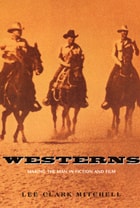
Westerns
Making the Man in Fiction and FilmLee Clark Mitchell
University of Chicago Press, 1996
Few genres are so closely identified with America as the Western. In this wide-ranging examination of the Western and its appeal, Lee Clark Mitchell ranges from the novels of James Fenimore Cooper to Louis L'Amour, and from classic films like Stagecoach to spaghetti Westerns like A Fistful of Dollar to show how Westerns helped assuage a series of crises in American culture. This landmark book shows that the Western owes its perennial appeal not to unchanging conventions but to the deftness with which it responds to the obsessions and fears of its audience. And no obsession, Lee Mitchell argues, has figured more prominently in the Western than what it means to be a man.

Whale
K.L. Evans
University of Minnesota Press, 2003
An entirely fresh approach to Moby Dick, by way of Ludwig Wittgenstein
The aim of this thoroughly unconventional work is to demonstrate that Herman Melville’s Moby Dick and Ludwig Wittgenstein’s Philosophical Investigations share the same projects and are, in effect, one and the same book. Confounding and improbable as such an enterprise might seem, Whale! not only successfully reveals the vital intersections between Melville and Wittgenstein but also, more important, makes a compelling argument for why such intersections are essential to understanding common political projects in literature and philosophy.
Written with grace, passion, and wit, Whale! manages to produce a startling and remarkably original reading of one of the most written-about and interpreted books in the American canon. K. L. Evans explores Melville’s vast work as a tale not of vengeance but of affection, and Ahab’s near-pathological agitation as indicative of his refusal to accept the world as unknowable. Between Ahab and the whale, Evans traces a longing for connection and meaning and finds a forceful response to the skeptical view that language is bankrupt and knowledge is uncertain. In Ahab’s hunt for Moby Dick, Whale! discovers a way to reconnect matter with meaning, object with knowledge.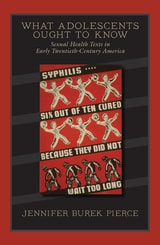
What Adolescents Ought to Know
Sexual Health Texts in Early Twentieth-Century AmericaJennifer Burek Pierce
University of Massachusetts Press, 2011
In 1901, Dr. Alfred Fournier committed an act both simple and revolutionary: he wrote ForOur Sons, When They Turn 18, a sexual and reproductive health treatise based on his clinical work at a leading Paris hospital. If this booklet aided adolescent understanding of health, it also encouraged reformers around the world to publish. By 1913, countless works on venereal disease prevention were available to adolescents.
During this period, authors wrestled with how to make still-developing scientific information available to a reader also in the process of maturing. What would convince a young person to avoid acting on desire? What norms should be employed in these arguments, when social and legal precedents warned against committing ideas about sex to print? How, in other words, could information about sex be made both decent and compelling? Health reformers struggled with these challenges as doctors' ability to diagnose diseases such as syphilis outpaced the production of medicines that could restore health. In this context, information represented the best and truest prophylactic. When publications were successful, from the perspective of information dissemination, they were translated and distributed worldwide.
What Adolescents Ought to Know explores the evolution of these printed materials—from a single tract, written by a medical researcher and given free to anyone, to a thriving commercial enterprise. It tells the story of how sex education moved from private conversation to purchased text in early twentieth-century America.
What Are Poets For?
An Anthropology of Contemporary Poetry and PoeticsGerald L. Bruns
University of Iowa Press, 2012
Conceptions and practices of poetry change not only from time to time and from place to place but also from poet to poet. This has never been more the case than in recent years. Gerald Bruns’s magisterial What Are Poets For? explores typographical experiments that distribute letters randomly across a printed page, sound tracks made of vocal and buccal noises, and holographic poems that recompose themselves as one travels through their digital space. Bruns surveys one-word poems, found texts, and book-length assemblies of disconnected phrases; he even includes descriptions of poems that no one could possibly write, but which are no less interesting (or no less poetic) for all of that. The purpose of the book is to illuminate this strange poetic landscape, spotlighting and describing such oddities as they appear, anomalies that most contemporary poetry criticism ignores.
What Became of Wystan?
Change and Continuity in Auden's PoetryAlan Jacobs
University of Arkansas Press, 1998
What Do Gay Men Want?
An Essay on Sex, Risk, and SubjectivityDavid M. Halperin
University of Michigan Press, 2010
“Compelling, timely, and provocative. The writing is sleek and exhilarating. It doesn’t waste time telling us what it will do or what it has just done—it just does it.”
—Don Kulick, Professor of Anthropology, New York University
How we can talk about sex and risk in the age of barebacking—or condomless sex—without invoking the usual bogus and punitive clichés about gay men’s alleged low self-esteem, lack of self-control, and other psychological “deficits”? Are there queer alternatives to psychology for thinking about the inner life of homosexuality? What Do Gay Men Want? explores some of the possibilities.
Unlike most writers on the topic of gay men and risky sex, David Halperin liberates gay male subjectivity from psychology, demonstrating the insidious ways in which psychology’s defining opposition between the normal and the pathological subjects homosexuality to medical reasoning and revives a whole set of unexamined moral assumptions about “good” sex and “bad” sex.
In particular, Halperin champions neglected traditions of queer thought, including both literary and popular discourses, by drawing on the work of well-known figures like Jean Genet and neglected ones like Marcel Jouhandeau. He shows how the long history of of gay men’s uses of “abjection” can offer an alternative, nonmoralistic model for thinking about gay male subjectivity, something which is urgently needed in the age of barebacking.
Anyone searching for nondisciplinary ways to slow the spread of HIV/AIDS among gay men—or interested in new modes of thinking about gay male subjectivity—should read this book.
David M. Halperin is W. H. Auden Collegiate Professor of the History and Theory of Sexuality, Professor of English, Professor of Women’s Studies, Professor of Comparative Literature, and Adjunct Professor of Classical Studies at the University of Michigan.
What Do Pictures Want?
The Lives and Loves of ImagesW. J. T. Mitchell
University of Chicago Press, 2005
According to W. J. T. Mitchell, we need to reckon with images not just as inert objects that convey meaning but as animated beings with desires, needs, appetites, demands, and drives of their own. What Do Pictures Want? explores this idea and highlights Mitchell's innovative and profoundly influential thinking on picture theory and the lives and loves of images. Ranging across the visual arts, literature, and mass media, Mitchell applies characteristically brilliant and wry analyses to Byzantine icons and cyberpunk films, racial stereotypes and public monuments, ancient idols and modern clones, offensive images and found objects, American photography and aboriginal painting. Opening new vistas in iconology and the emergent field of visual culture, he also considers the importance of Dolly the Sheep—who, as a clone, fulfills the ancient dream of creating a living image—and the destruction of the World Trade Center on 9/11, which, among other things, signifies a new and virulent form of iconoclasm.
What Do Pictures Want? offers an immensely rich and suggestive account of the interplay between the visible and the readable. A work by one of our leading theorists of visual representation, it will be a touchstone for art historians, literary critics, anthropologists, and philosophers alike.
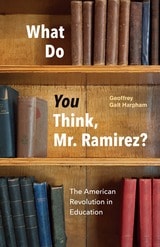
What Do You Think, Mr. Ramirez?
The American Revolution in EducationGeoffrey Galt Harpham
University of Chicago Press, 2017
That, says Harpham, was the midcentury promise of American education, the deep current of commitment and aspiration that undergirded the educational system that was built in the postwar years, and is under extended assault today. The United States was founded, he argues, on the idea that interpreting its foundational documents was the highest calling of opinion, and for a brief moment at midcentury, the country turned to English teachers as the people best positioned to train students to thrive as interpreters—which is to say as citizens of a democracy. Tracing the roots of that belief in the humanities through American history, Harpham builds a strong case that, even in very different contemporary circumstances, the emphasis on social and cultural knowledge that animated the midcentury university is a resource that we can, and should, draw on today.
What Every Novelist Needs to Know about Narrators
Wayne C. Booth
University of Chicago Press, 1961

What Happens in Literature
Edward W. Rosenheim Jr.
University of Chicago Press, 2000
What Is A Poet?
Hank Lazer
University of Alabama Press, 1987
This book discusses the extent of distrust and the extent of the misunderstandings that exist in the poetry world.
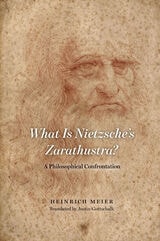
What Is Nietzsche's Zarathustra?
A Philosophical ConfrontationHeinrich Meier
University of Chicago Press, 2021
A masterful, nuanced, and novel examination of Nietzsche’s Zarathustra.
Thus Spoke Zarathustra is Nietzsche’s most famous and most puzzling work, one in which he makes the greatest use of poetry to explore the questions posed by philosophy. But in order to understand the movement of this drama, we must first understand the character of its protagonist: we must ask, What Is Nietzsche’s Zarathustra?
Heinrich Meier attempts to penetrate the core of the drama, following as a guiding thread the question of whether Zarathustra is a philosopher or a prophet, or, if he is meant to be both, whether Zarathustra is able to unite philosopher and prophet in himself. Via a close reading that uncovers the book’s hidden structure, Meier develops a highly stimulating and original interpretation of this much-discussed but still ill-understood masterwork of German poetic prose. In the process, he carefully overturns long-established canons in the academic discourse of Nietzsche interpretation. The result is a fresh and surprising grasp of Nietzsche’s well-known teachings of the overman, the will to power, and the eternal return.
What Is Pastoral?
Paul Alpers
University of Chicago Press, 1997
Ranging from Virgil's Eclogues to Sarah Orne Jewett's The Country of the Pointed Firs, from Shakespeare and Cervantes to Hardy and Frost, this work brings the story of the pastoral tradition, previously limited to classical and Renaissance literature, into the twentieth century. Pastoral reemerges in this account not as a vehicle of nostalgia for some Golden Age, nor of escape to idyllic landscapes, but as a mode bearing witness to the possibilities and problems of human community and shared experience in the real world.
A rich and engrossing book, What Is Pastoral? will soon take its place as the definitive study of pastoral literature.
"Alpers succeeds brilliantly. . . . [He] offers . . . a wealth of new insight into the origins, development, and flowering of the pastoral."—Ann-Maria Contarino, Renaissance Quarterly
What Is a World?
On Postcolonial Literature as World LiteraturePheng Cheah
Duke University Press, 2016
What Middletown Read
Print Culture in an American Small CityFrank Felsenstein
University of Massachusetts Press, 2015
The discovery of a large cache of circulation records from the Muncie, Indiana, Public Library in 2003 offers unprecedented detail about American reading behavior at the turn of the twentieth century. Frank Felsenstein and James J. Connolly have mined these records to produce an in-depth account of print culture in Muncie, the city featured in the famed “Middletown” studies conducted by Robert and Helen Lynd almost a century ago. Using the data assembled and made public through the What Middletown Read Database (www.bsu.edu/libraries/wmr), a celebrated new resource the authors helped launch, Felsenstein and Connolly analyze the borrowing choices and reading culture of social groups and individuals.
What Middletown Read is much more than a statistical study. Felsenstein and Connolly dig into diaries, meeting minutes, newspaper reports, and local histories to trace the library's development in relation to the city's cosmopolitan aspirations, to profile individual readers, and to explore such topics as the relationship between children's reading and their schooling and what books were discussed by local women's clubs. The authors situate borrowing patterns and reading behavior within the contexts of a rapidly growing, culturally ambitious small city, an evolving public library, an expanding market for print, and the broad social changes that accompanied industrialization in the United States. The result is a rich, revealing portrait of the place of reading in an emblematic American community.
What Proust Heard
Novels and the Ethnography of TalkMichael Lucey
University of Chicago Press, 2022
What happens when we talk? This deceptively simple question is central to Marcel Proust’s monumental novel In Search of Lost Time. Both Proust’s narrator and the novel that houses him devote considerable energy to investigating not just what people are saying or doing when they talk, but also what happens socioculturally through their use of language. Proust, in other words, is interested in what linguistic anthropologists call language-in-use.
Michael Lucey elucidates Proust’s approach to language-in-use in a number of ways: principally in relation to linguistic anthropology, but also in relation to speech act theory, and to Pierre Bourdieu’s sociology. The book also includes an interlude after each of its chapters that contextualizes Proust’s social-scientific practice of novel writing in relation to that of a number of other novelists, earlier and later, and from several different traditions, including Honoré de Balzac, George Eliot, Virginia Woolf, Nathalie Sarraute, and Rachel Cusk. Lucey is thus able to show how, in the hands of quite different novelists, various aspects of the novel form become instruments of linguistic anthropological analysis. The result introduces a different way of understanding language to literary and cultural critics and explores the consequences of this new understanding for the practice of literary criticism more generally.
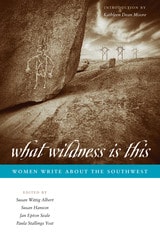
What Wildness Is This
Women Write about the SouthwestEdited by Susan Wittig Albert, Susan Hanson, Jan Epton Seale, and Paula Stallings Yost
University of Texas Press, 2007
Winner, WILLA Literary Award for Creative Nonfiction, 2008
How do women experience the vast, arid, rugged land of the American Southwest? The Story Circle Network, a national organization dedicated to helping women write about their lives, posed this question, and nearly three hundred women responded with original pieces of writing that told true and meaningful stories of their personal experiences of the land. From this deep reservoir of writing—as well as from previously published work by writers including Joy Harjo, Denise Chávez, Diane Ackerman, Naomi Shihab Nye, Leslie Marmon Silko, Gloria Anzaldua, Terry Tempest Williams, and Barbara Kingsolver—the editors of this book have drawn nearly a hundred pieces that witness both to the ever-changing, ever-mysterious life of the natural world and to the vivid, creative, evolving lives of women interacting with it.
Through prose, poetry, creative nonfiction, and memoir, the women in this anthology explore both the outer landscape of the Southwest and their own inner landscapes as women living on the land—the congruence of where they are and who they are. The editors have grouped the writings around eight evocative themes:
- The way we live on the land
- Our journeys through the land
- Nature in cities
- Nature at risk
- Nature that sustains us
- Our memories of the land
- Our kinship with the animal world
- What we leave on the land when we are gone
From the Gulf Coast of Texas to the Pacific Coast of California, and from the southern borderlands to the Great Plains and the Rocky Mountains, these intimate portraits of women's lives on the land powerfully demonstrate that nature writing is no longer the exclusive domain of men, that women bring unique and transformative perspectives to this genre.
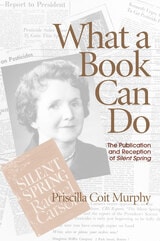
What a Book Can Do
The Publication and Reception of "Silent Spring"Priscilla Coit Murphy
University of Massachusetts Press, 2005
Murphy reviews the publishing history of the Houghton Mifflin edition and the prior New Yorker serialization, describing Carson's approach to her project as well as the views and expectations of her editors. She also documents the response of opponents to Carson's message, notably the powerful chemical industry, including efforts to undermine, delay, or stop publication altogether.
Murphy then investigates the media's role, showing that it went well beyond providing a forum for debate. In addition, she analyzes the perceptions and expectations of the public at large regarding the book, the debate, and the media. By probing all of these perspectives, Murphy sheds new light on the dynamic between newsmaking books, the media, and the public. In the process, she addresses a host of broader questions about the place of books in American culture, past, present, and future.
What a Library Means to a Woman
Edith Wharton and the Will to Collect BooksSheila Liming
University of Minnesota Press, 2020
Examining the personal library and the making of self
When writer Edith Wharton died in 1937, without any children, her library of more than five thousand volumes was divided and subsequently sold. Decades later, it was reassembled and returned to The Mount, her historic Massachusetts estate. What a Library Means to a Woman examines personal libraries as technologies of self-creation in modern America, focusing on Wharton and her remarkable collection of books.
Sheila Liming explores the connection between libraries and self-making in late nineteenth- and early twentieth-century American culture, from the 1860s to the 1930s. She tells the story of Wharton’s library in concert with Wharton scholarship and treatises from this era concerning the wider fields of book history, material and print culture, and the histories (and pathologies) of collecting. Liming’s study blends literary and historical analysis while engaging with modern discussions about gender, inheritance, and hoarding. It offers a review of the many meanings of a library collection, while reading one specific collection in light of its owner’s literary celebrity.
What a Library Means to a Woman was born from Liming’s ongoing work digitizing the Wharton library collection. It ultimately argues for a multifaceted understanding of authorship by linking Wharton’s literary persona to her library, which was, as she saw it, the site of her self-making.

What is Symbolism?
By Henri Peyre, translated by Emmett Parker
University of Alabama Press, 1980
"This splendid work is highly recommended." —Choice
Peyre's beautiful introduction to the Symbolist movement, which emerged in the late 19th century. A literary and artistic movement that sought to express the ineffable and the mysterious aspects of human experience, Symbolism originated in France and spread across Europe, influencing various forms of art, including poetry, painting, and music. Prominent figures in the Symbolist movement include poets like Charles Baudelaire, Stéphane Mallarmé, and Paul Verlaine, as well as artists like Gustave Moreau and Odilon Redon. The Symbolist movement had a profound impact on later artistic and literary movements, such as Modernism and Surrealism, shaping the way artists and writers approached the exploration of the human psyche and the mysteries of existence.
What the Mirror Said
The Necessity of Black Women in PoetryAshley M. Jones
University of Michigan Press, 2026
Part critical essay, part personal essay collection, What the Mirror Said traces the influence of nine Black women poets in Jones’s writing and life. She brings together historical biographical information, personal reflection, and close readings as she explores personal connections to poets from Phillis Wheatley to Patricia Smith. This book is expansive in its study, from classical metrical scansion to metaphorical explication. In offering new ways to interpret poems by important contemporary poets, What the Mirror Said makes the case for the need to study and celebrate Black women poets.
What's Your Road, Man?
Critical Essays on Jack Kerouac's On the RoadEdited by Hilary Holladay and Robert Holton
Southern Illinois University Press, 2008
The ten essays in this groundbreaking compilation cover a broad range of topics, employing a variety of approaches, including theoretical interpretations and textual and comparative analysis, to investigate such issues as race, class, gender, and sexuality, as well as the novel's historical and literary contexts. What's Your Road, Man? Critical Essays on Jack Kerouac's "On the Road" illustrates the richness of the critical work currently being undertaken on this vital American narrative.
Combining essays from renowned Kerouac experts and emerging scholars, What's Your Road, Man? draws on an enormous amount of research into the literary, social, cultural, biographical, and historical contexts of Kerouac's canonical novel. Since its publication in 1957, On the Road has remained in print and has continued to be one of the most widely read twentieth-century American novels.
Several essays enhance understanding of the book by comparing it with alternative versions of the text, like the original 1951 scroll manuscript and some of Kerouac's other novels, and with works by Kerouac's contemporaries such as Sylvia Plath's The Bell Jar. Further studies explore ethnicity, identity, and the novel's place in American literature as well as its relevance to twenty-first century readers.
On the Road has inspired readers for more than fifty years, and the new research included in What's Your Road, Man? introduces fresh perspectives on this classic work of American literature. Editors Hilary Holladay and Robert Holton have successfully woven little-known material with new understandings of familiar topics that will enlighten current and future generations of Kerouac enthusiasts and scholars for years to come.
Whatever Happened to Sherlock Holmes?
Detective Fiction, Popular Theology, and SocietyRobert S. Paul
Southern Illinois University Press, 1991
Robert S. Paul suggests that the reason detective fiction has won legions of readers may be that "the writer of detective fiction, without conscious intent, appeals directly to those moral and spiritual roots of society unconsciously affirmed and endorsed by the readers."
Because detective stories deal with crime and punishment they cannot help dealing implicitly with theological issues, such as the reality of good and evil, the recognition that humankind has the potential for both, the nature of evidence (truth and error), the significance of our existence in a rational order and hence the reality of truth, and the value of the individual in a civilized society.
Paul argues that the genre traces its true beginning to the Enlightenment and documents two related but different reactions to the theological issues involved: first, a line of writers who are generally positive in relation to their cultural setting, such as Edgar Allan Poe, Wilkie Collins, Conan Doyle; and second, a reactionary strain, critical of the prevailing culture, that begins in William Godwin’s Caleb Williams and continues through the anti-heroic writers like Arsène Lupin to Raymond Chandler, Dashiell Hammett, and John MacDonald.
When Brer Rabbit Meets Coyote
AFRICAN-NATIVE AMERICAN LITERATUREEdited by Jonathan Brennan
University of Illinois Press, 2003
Jonathan Brennan, in a sweeping historical and analytical introduction to this collection of essays, surveys several centuries of literature in the context of the historical and cultural exchange and development of distinct African-Native American traditions. Positing a new African-Native American literary theory, he illuminates the roles subjectivity, situational identities, and strategic discourse play in defining African-Native American literatures.
Brennan provides a thorough background to the literary tradition and a valuable overview to topics discussed in the essays. He examines African-Native American political and historical texts, travel narratives, and the Mardi Gras Indian tradition, suggesting that this evolving oral tradition parallels the development of numerous Black Indian literary traditions in the United States and Latin America.
When Cowboys Come Home
Veterans, Authenticity, and Manhood in Post–World War II AmericaAaron George
Rutgers University Press, 2024
When I Came to Die
Process and Prophecy in Thoreau's Vision of DyingAudrey Raden
University of Massachusetts Press, 2017
When I Came to Die suggests that throughout his writings, Thoreau communicated that knowing how to die properly is an art and a lifelong study, a perspective that informed his ideas about politics, nature, and individualism. With this insight, Raden opens a dialogue that will engage both Thoreauvians and those interested in American literature and thought.
When Russia Learned to Read
Literacy and Popular Literature, 1861-1917Jeffrey Brooks
Northwestern University Press, 2003
With a new introduction that underscores its relevance to a post-Soviet Russia, When Russia Learned to Read addresses the question of Russia's common heritage with the liberal democratic market societies of Western Europe and the United States. This prize-winning book also exposes the unsuspected complexities of a mass culture little known and less understood in the West. Jeffrey Brooks brings out the characteristically Russian aspect of the nation's popular writing as he ranges through chapbooks, detective stories, newspaper serials, and women's fiction, tracing the emergence of secular, rational, and cosmopolitan values along with newly minted notions of individual initiative and talent. He shows how crude popular tales and serials of the era find their echoes in the literary themes of Dostoevsky, Tolstoy, and other great Russian writers, as well as in the current renaissance of Russian detective stories and thrillers.
When Sex Changed
Birth Control Politics and Literature between the World WarsLayne Parish Craig
Rutgers University Press, 2013
In When Sex Changed, Layne Parish Craig analyzes the ways literary texts responded to the political, economic, sexual, and social values put forward by the birth control movements of the 1910s to the 1930s in the United States and Great Britain.
Discussion of contraception and related topics (including feminism, religion, and eugenics) changed the way that writers depicted women, marriage, and family life. Tracing this shift, Craig compares disparate responses to the birth control controversy, from early skepticism by mainstream feminists, reflected in Charlotte Perkins Gilman’s Herland, to concern about the movement’s race and class implications suggested in Nella Larsen’s Quicksand, to enthusiastic speculation about contraception’s political implications, as in Virginia Woolf’s Three Guineas.
While these texts emphasized birth control’s potential to transform marriage and family life and emancipate women from the “slavery” of constant childbearing, birth control advocates also used less-than-liberatory language that excluded the poor, the mentally ill, non-whites, and others. Ultimately, Craig argues, the debates that began in these early political and literary texts—texts that document both the birth control movement’s idealism and its exclusionary rhetoric—helped shape the complex legacy of family planning and women’s rights with which the United States and the United Kingdom still struggle.
When We Arrive
A New Literary History of Mexican AmericaJosé F. Aranda Jr.
University of Arizona Press, 2003
In this bold new look at the American canon, Aranda weaves the threads of Mexican American literature into the broader tapestry of Anglo American writing, especially its Puritan origins, by pointing out common ties that bind the two traditions: narratives of persecution, of immigration, and of communal crises, alongside chronicles of the promise of America. Examining texts ranging from María Amparo Ruiz de Burton's 1872 critique of the Civil War, Who Would Have Thought It?, through the contemporary autobiographies of Richard Rodriguez and Cherríe Moraga, he surveys Mexican American history, politics, and literature, locating his analyses within the context of Chicano/a cultural criticism of the last four decades.
When We Arrive integrates Early American Studies and Chicano/a Studies into a comparative cultural framework by using the Puritan connection to shed new light on dominant images of Chicano/a narrative, such as Aztlán and the borderlands. Aranda explores the influence of a nationalized Puritan ethos on nineteenth- and twentieth-century writers of Mexican descent, particularly upon constructions of ethnic identity and aesthetic values. He then frames the rise of contemporary Chicano/a literature within a critical body of work produced from the 1930s through the 1950s, one that combines a Puritan myth of origins with a literary history in which American literature is heralded as the product and producer of social and political dissent.
Aranda's work is a virtual sourcebook of historical figures, texts, and ideas that revitalizes both Chicano/a studies and American literary history. By showing how a comparative study of two genres can produce a more integrated literary history for the United States, When We Arrive enables critics and readers alike to see Mexican American literature as part of a broader tradition and establishes for its writers a more deserving place in the American literary imagination.
When We Imagine Grace
Black Men and Subject MakingSimone C. Drake
University of Chicago Press, 2016
In When We Imagine Grace, Drake borrows from Toni Morrison’s Beloved to bring imagination to the center of black masculinity studies—allowing individual black men to exempt themselves and their fates from a hateful, ignorant society and open themselves up as active agents at the center of their own stories. Against a backdrop of crisis, Drake brings forth the narratives of black men who have imagined grace for themselves. We meet African American cowboy, Nat Love, and Drake’s own grandfather, who served in the first black military unit to fight in World War II. Synthesizing black feminist and black masculinity studies, Drake analyzes black fathers and daughters, the valorization of black criminals, the black entrepreneurial pursuits of Marcus Garvey, Berry Gordy, and Jay-Z, and the denigration and celebration of gay black men: Cornelius Eady, Antoine Dodson, and Kehinde Wiley. With a powerful command of its subjects and a passionate dedication to hope, When We Imagine Grace gives us a new way of seeing and knowing black masculinity—sophisticated in concept and bracingly vivid in telling.
When the Devil Knocks
The Congo Tradition and the Politics of Blackness in Twentieth-Century PanamaRenée Alexander Craft
The Ohio State University Press, 2015
When the Devil Knocks analyzes the Congo tradition as a dynamic cultural, ritual, and identity performance that tells an important story about a Black cultural past while continuing to create itself in a Black cultural present. This book examines “Congo” within the history of twentieth century Panamanian etnia negra culture, politics, and representation, including its circulation within the political economy of contemporary tourism.

When the Ocean Holds the Stage
Moby-Dick and Archipelagic WorldsMaurya Wickstrom
University of Michigan Press, 2027
When the Ocean Holds the Stage is a work in which Moby-Dick and Melville’s ocean dramaturgy is the deep thru-current and archipelagic structure, forming his brilliant watery excavation of the forces of containment and continentalization, capitalization, racialization, enslavement, species destruction, and white Christian supremacism. As such, it is an original and challenging political and aesthetic engagement with Melville and Moby-Dick. Melville’s Benito Cereno, Homer’s The Odyssey, and Dereck Walcott’s Omeros are also central studies. Wickstrom argues that the ocean and the ship emerge in these texts as new kinds of performance stages on which there is a unique freedom to bring critical thought to bear on many harmful systems, and to offer visions of ways to live differently. Introducing new practices in academic writing, Wickstrom works against the constraints of linear argumentation and toward archipelagic and poetic openness. Gatherings replace chapters and, in addition to the main texts, bring many artists, historical situations, contemporary crises, and political proposals into loose, archipelagic correspondences. Finally, the book is an important contribution from Theatre and Performance Studies to the vital and broad coalition of scholars, artists, and activists whose focus is on water.
When the Yellow River Floods
Water, Technology, and Nation-Building in Early Twentieth-Century Chinese LiteratureHui-Lin Hsu
Hong Kong University Press, 2024
When the Yellow River Floods explores the relationship between environmental degradation, hydraulic engineering, and nation-building in the context of Liu E’s The Travels of Lao Can. This book provides a unique perspective on modern Chinese literary history that goes beyond conventional narratives that focus solely on political and cultural factors. The main areas covered include the role of water management in literary nation-building and the connections between the novel’s various themes, such as river engineering, medical and political discourses, national sentiment, and landscape description.
By offering a comprehensive analysis of The Travels of Lao Can, this book broadens the understanding of nation-building in early twentieth-century China, highlighting the impact of environmental crises and hydraulics on the formation of national literature and consciousness. When the Yellow River Floods provides a new perspective on the environmental roots of modern Chinese literature, making it an essential read for those seeking to understand the complex interplay between literature, the environment, and national identity in China. This book will be of interest to scholars and students of Chinese literature, history, and environmental studies.
When “I” Was Born
Women’s Autobiography in Modern ChinaJing M. Wang
University of Wisconsin Press, 2008
When “I” Was Born: Women’s Autobiography in Modern China reclaims the voices of these particular writers, voices that have been misinterpreted and overlooked for decades. Tracing women writers as they move from autobiographical fiction, often self-revelatory and personal, to explicit autobiographies that focused on women’s roles in public life, Jing M. Wang reveals the factors that propelled this literary movement, the roles that liberal translators and their renditions of Western life stories played, and the way in which these women writers redefined writing and gender in the stories they told. But Wang reveals another story as well: the evolving history and identity of women in modern Chinese society. When “I” Was Born adds to a growing body of important work in Chinese history and culture, women’s studies, and autobiography in a global context.
Writers discussed include Xie Bingying, Zhang Ailing, Yu Yinzi, Fei Pu, Lu Meiyen, Feng Heyi, Ye Qian, Bai Wei, Shi Wen, Fan Xiulin, Su Xuelin, and Lu Yin.
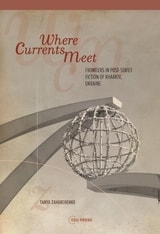
Where Currents Meet
Frontiers of Memory in Post-Soviet Fiction of Kharkiv, UkraineTanya Zaharchenko
Central European University Press, 2016
Where Currents Meet, Tanya Zaharchenko’s path-breaking study of literature and cultural memory, moves decisively beyond the simplistic view of a post-Soviet Ukraine divided between east and west. It positions the Ukrainian and Russian components of cultural experience in the country’s east as elements of a complex continuum. Combining insights from memory studies and border studies, Zaharchenko analyzes a generation of younger riters in the city of Kharkiv—a “doubletake generation” that came of age at the time of the Soviet Union’s collapse and now revisits this experience through fiction. In the works of Serhiy Zhadan, Andreĭ Krasniashchikh, Yuri Tsaplin, Oleh Kotsarev, and others the author reveals how borderlands and frontiers, both geographical and conceptual, acquire zonal qualities of their own as these writers navigate the historical legacy they have inherited.
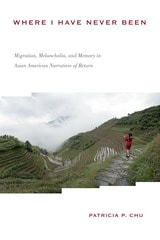
Where I Have Never Been
Migration, Melancholia, and Memory in Asian American Narratives of ReturnPatricia P. Chu
Temple University Press, 2019
In researching accounts of diasporic Chinese offspring who returned to their parents’ ancestral country, author Patricia Chu learned that she was not alone in the experience of growing up in America with an abstract affinity to an ancestral homeland and community. The bittersweet emotions she had are shared in Asian American literature that depicts migration-related melancholia, contests official histories, and portrays Asian American families as flexible and transpacific.
Where I Have Never Been explores the tropes of return, tracing both literal return visits by Asian emigrants and symbolic “returns”: first visits by diasporic offspring. Chu argues that these Asian American narratives seek to remedy widely held anxieties about cultural loss and the erasure of personal and family histories from public memory. In fiction, memoirs, and personal essays, the writers of return narratives—including novelists Lisa See, May-lee Chai, Lydia Minatoya, and Ruth Ozeki, and best-selling author Denise Chong, diplomat Yung Wing, scholar Winberg Chai, essayist Josephine Khu, and many others—register and respond to personal and family losses through acts of remembrance and countermemory.