Results by title
4917 books match the query 'Philosophy' and 132 start with w
When Maps Become the World
Rasmus Grønfeldt Winther
University of Chicago Press, 2020
This book is about the promises and perils of map thinking. Maps are purpose-driven abstractions, discarding detail to highlight only particular features of a territory. By preserving certain features at the expense of others, they can be used to reinforce a privileged position.
When Maps Become the World shows us how the scientific theories, models, and concepts we use to intervene in the world function as maps, and explores the consequences of this, both good and bad. We increasingly understand the world around us in terms of models, to the extent that we often take the models for reality. Winther explains how in time, our historical representations in science, in cartography, and in our stories about ourselves replace individual memories and become dominant social narratives—they become reality, and they can remake the world.
When Monsters Speak
A Susan Stryker ReaderSusan Stryker. Edited by McKenzie Wark
Duke University Press, 2024
When Spinoza Met Marx
Experiments in Nonhumanist ActivityTracie Matysik
University of Chicago Press, 2022
Karl Marx was a fiery revolutionary theorist who heralded the imminent demise of capitalism, while Spinoza was a contemplative philosopher who preached rational understanding and voiced skepticism about open rebellion. Spinoza criticized all teleological ideas as anthropomorphic fantasies, while Marxism came to be associated expressly with teleological historical development. Why, then, were socialists of the German nineteenth century consistently drawn to Spinoza as their philosophical guide? Tracie Matysik shows how the metaphorical meeting of Spinoza and Marx arose out of an intellectual conundrum around the meaning of activity. How is it, exactly, that humans can be fully determined creatures but also able to change their world? To address this paradox, many revolutionary theorists came to think of activity in the sense of Spinoza—as relating. Matysik follows these Spinozist-socialist intellectual experiments as they unfolded across the nineteenth century, drawing lessons from them that will be meaningful for the contemporary world.
When These Things Begin
Conversations with Michel TreguerRené Girard (Translated by Trevor Cribben Merrill)
Michigan State University Press, 2014
When Time Warps
The Lived Experience of Gender, Race, and Sexual ViolenceMegan Burke
University of Minnesota Press, 2019
An inquiry into the phenomenology of “woman” based in the relationship between lived time and sexual violence
Feminist phenomenologists have long understood a woman’s life as inhibited, confined, and constrained by sexual violence. In this important inquiry, author Megan Burke both builds and expands on this legacy by examining the production of normative womanhood through racist tropes and colonial domination. Ultimately, Burke charts a new feminist phenomenology based in the relationship between lived time and sexual violence.
By focusing on time instead of space, When Time Warps places sexualized racism at the center of the way “woman” is lived. Burke transports questions of time and gender outside the realm of the historical, making provocative new insights into how gendered individuals live time, and how their temporal existence is changed through particular experiences.
Providing a potent reexamination of the theory of Simone de Beauvoir—while also bringing to the fore important women of color theorists and engaging in the temporal aspects of #MeToo—When Time Warps makes a necessary, lasting contribution to our understanding of gender, race, and sexual violence.
When the Center Is on Fire
Passionate Social Theory for Our TimesBy Diane Harriford and Becky Thompson
University of Texas Press, 2008
In this lively and provocative book, two feminist public sociologists turn to classical social thinkers—W. E. B. Du Bois, Max Weber, Karl Marx, and Émile Durkheim—to understand a series of twenty-first century social traumas, including the massacre at Columbine High School, the 9/11 attacks, the torture at Abu Ghraib prison, and Hurricane Katrina. Each event was overwhelming in its own right, while the relentless pace at which they occurred made it nearly impossible to absorb and interpret them in any but the most superficial ways. Yet, each uncovered social problems that cry out for our understanding and remediation.
In When the Center Is on Fire, Becky Thompson and Diane Harriford assert that classical social theorists grappled with the human condition in ways that remain profoundly relevant. They show, for example, that the loss of "double consciousness" that Du Bois identified in African Americans enabled political elites to turn a blind eye to the poverty and vulnerability of many of New Orleans's citizens. The authors' compelling, sometimes irreverent, often searing interpretations make this book essential reading for students, activists, generations X, Y, and Z, and everybody bored by the 6 o'clock news.
When the House Burns Down
From the Dialect of ThoughtGiorgio Agamben
Seagull Books, 2022
“Which house is burning?” asks Giorgio Agamben. “The country where you live, or Europe, or the whole world? Perhaps the houses, the cities have already burnt down—who knows how long ago?—in a single immense blaze that we pretended not to see.” In this collection of four luminous, lyrical essays, Agamben brings his characteristic combination of philosophical acuity and poetic intensity to bear on a world in crisis. Whether surveying the burning house of our culture in the title essay, the architecture of pure exteriority in “Door and Threshold,” the language of prophecy in “Lessons in the Darkness,” or the word of the witness in “Testimony and Truth,” Agamben’s insights throw a revealing light on questions both timeless and topical. Written in dark times over the past year, and rich with the urgency of our moment, the essays in this volume also seek to show how what appears to be an impasse can, with care and attention, become the door leading to a way out.
Whenever Two or More Are Gathered
Relationship as the Heart of Ethical DiscourseMichael M. Harmon and O. C. McSwite
University of Alabama Press, 2011
A Scholarly Exploration of How Relationships Shape Moral Understanding.
Whenever Two or More Are Gathered focuses on the critical role of ethics and moral responsibility in the field of public administration. Michael M. Harmon and O. C. McSwite posit that administrative ethics, as presently conceived and practiced, is largely a failure, incapable of delivering on its original promise of effectively regulating official conduct in order to promote the public interest. They argue that administrative ethics is compromised at its very foundations by two core assumptions: that human beings act rationally and that language is capable of conveying clear, stable, and unambiguous principles of ethical conduct.
The result is the illusion that values, principles, and rules of ethical conduct can be specified in workably clear ways, in particular, through their formalization in official codes of ethics; that people are capable of comprehending and responding to them as they are intended; and that the rewards and punishments attached to them will be effective in structuring daily behavior.
In a series of essays that draw on both fiction and film, as well as the disciplines of pragmatism, organizational theory, psychoanalysis, structural linguistics, and economics, Harmon and McSwite make their case for human relationship as the proper foundation of administrative ethics. “Exercising responsible ethical practice requires attaining a special kind of relationship with other people. Relationship is how the pure freedom that resides in the human psyche—for ethical choice, creativity, or original action of any type—can be brought into the structured world of human social relations without damaging or destroying it.” Furthermore, they make the case for dropping the term “ethics” in favor of the term “responsibility,” as “responsibility accentuates the social [relational] nature of moral action.”
Where Writing Begins
A Postmodern ReconstructionMichael Carter
Southern Illinois University Press, 2003
Where Writing Begins: A Postmodern Reconstruction is an innovative approach to the postmodern dilemma in rhetoric and composition thatoffers a positive and postmodern pedagogy that redefines and revalues writing and the teaching of writing through reconstructive, postmodern thought. The result is a fresh understanding of both the field of composition and writing instruction.
Drawing on the rich potential of “beginning” as a philosophical concept, Michael Carter asks the simple question: Where does writing begin? His findings take readers first to a new view of what it means to begin, and then to a new understanding of writing and teaching writing based on the redefined beginning. Challenging conventional notions that posit “beginning” as a chronological and temporal concept, he instead advocates an ontological and philosophical approach, in which “beginning” embodies both deconstruction and reconstruction—and the very possibility of newness.
Adding to a growing body of rhetorical scholarship in postmodern reconstruction, Where Writing Begins illustrates that writing must be understood within the framework of deconstruction and reconstruction. Writing, then, may be newly defined and valued as beginning. Weaving together conceptual, structural, and methodological patterns, Carter’s study is also a journey through the history of philosophy and rhetoric that will leave readers feeling refreshed and teachers eager to return to their classes.
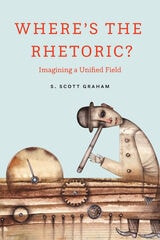
Where's the Rhetoric?
Imagining a Unified FieldS. Scott Graham
The Ohio State University Press, 2020
Building on this foundation, Graham then argues for a more unified approach to contemporary rhetorical inquiry—one that eschews disciplinary demarcations between rhetoric’s various subareas. Specifically, Graham uses his unified field theory to explore 1) the rise of the “tweetorial” as a parascientific genre, 2) inventional practices in new media design, 3) statistical approaches to understanding biomedical discourse, and 4) American electioneering rhetorics. The book overall demonstrates how seemingly disparate intellectual approaches within rhetoric can be made to speak productively to one another in the pursuit of shared scholarly goals around questions of genre, media, and political discourse—thereby providing a foundation for imagining a more unified field.
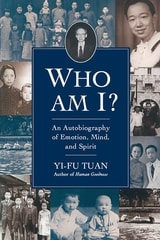
Who Am I?
An Autobiography of Emotion, Mind, and SpiritYi-Fu Tuan
University of Wisconsin Press, 1999
Who Am I? is the bittersweet memoir of a Chinese American who came to this country as a twenty-year-old graduate student and stayed to become one of America’s most innovative intellectuals, whose work has explored the aesthetic and moral dimensions of human relations with landscape, nature, and environment. This unusually introspective autobiography mixes Yi-Fu Tuan’s reflections on a life filled with recognition, accolades, and affection with what he deems moral failings, his lack of courage—including the courage to be open about his homosexuality.
Who Knows
From Quine to a Feminist EmpiricismLynn Hankinson Nelson
Temple University Press, 1992
In the past fifteen years, feminist science critics have, for the most part, rejected empiricism because of its identification with positivism. Various assumptions of both empiricists and feminists, including the "tenet" that individualism is an essential element of empiricism, have led to the belief that feminist science criticism is not a part of science. This view continues the myth that science is an autonomous and apolitical activity. Building on the work of W.V.0. Quine, Lynn Nelson clears away these obstacles and establishes a framework for a much-needed dialogue between feminist science critics and other scientists and scholars about the nature of science. She makes a case for a feminist empiricism that retains a crucial role for experience, but separates empiricism from individualism.
Following Quine, Nelson argues that empiricism is a theory of evidence and is distinct from empiricist accounts of science that have been built on it. She urges feminists and empiricists to work together to develop a feminist empiricism, a view of science that can account for its obvious success in explaining and predicting experience and can encompass feminist insights into relationships among gender, politics, and science.
Basing her arguments on Quine’s non-foundationalist view that theories are bridges of our own construction, the author insists, as does Quine, that the construction of these bridges is constrained by experience. She determines that individualism is inconsistent with key Quinean positions and that empiricism can survive the demise of individualism. Clearly diverging from Quine, Nelson proposes the view that the evolving network of our theories does and should incorporate political views, including those shaped by, and shaping in turn, our experiences of gender.
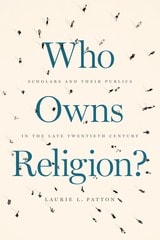
Who Owns Religion?
Scholars and Their Publics in the Late Twentieth CenturyLaurie L. Patton
University of Chicago Press, 2019
Taking the reader through several compelling case studies, Patton identifies two trends of the ’80s and ’90s that fueled that rise: the growth of multicultural identity politics, which enabled a form of volatile public debate she terms “eruptive public space,” and the advent of the internet, which offered new ways for religious groups to read scholarship and respond publicly. These controversies, she shows, were also fundamentally about something new: the very rights of secular, Western scholarship to interpret religions at all.
Patton’s book holds out hope that scholars can find a space for their work between the university and the communities they study. Scholars of religion, she argues, have multiple masters and must move between them while writing histories and speaking about realities that not everyone may be interested in hearing.

Who Says Anything about Winning?
Eight Exercises in Philosophical ResignationTereza Matejcková
Karolinum Press, 2026
A contemporary philosophical argument that boldly proposes resignation as the path to a fully realized self.
Traditional cultures have exercises that teach people discipline. Even modern philosophers, Hegel, Nietzsche, and Kierkegaard, paid special attention to striving for spirituality, although outside religious frameworks. However, if we are to grow, a more relaxed relationship to the self may be beneficial; hence the notion of resignation. A resigned will is not weak; it can resist itself and others. Such resignation is a man’s defense against becoming a mere element in a sequence of events. Art, philosophy, and mainly freedom all rely on the ability to create distance. In Who Says Anything about Winning?, Tereza Matejcková offers more than a history of a notion or a thematic reading of the legacy of respected thinkers; she offers a fresh view of self-acceptance and growth.
Who is my neighbor?
personalism and the foundations of human rightsThomas D. Williams
Catholic University of America Press, 2005

Wholehearted Librarianship
Finding Hope, Inspiration, and BalanceMichael Stephens
American Library Association, 2019
Why Are We Created
Increasing Our Understanding of Humanity's Purpose on EarthSir John Templeton
Templeton Press, 2003
While many books strive to stimulate thinking through provocative anecdotes and theories, Why Are We Created? takes a different path. It begins with a question and continues with a multitude of questions like these:
•What is the importance of recognizing the presence of the sacred within us and around us?•How can individuals create a purposeful and fruitful way of life?
•How does happiness relate to one's purpose?
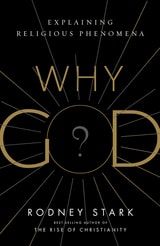
Why God?
Explaining Religious PhenomenaRodney Stark
Templeton Press, 2017
Defining religion over the past century has, ironically, led to theories that exclude belief in God, proposing that all systems of thought concerning the meaning of life are religions. Of course, this makes it impossible to distinguish the village priest from the village atheist, or Communism from Catholicism. Worse yet, it makes all religious behavior irrational, presuming that, for example, people knowingly pray to an empty sky.
Renowned sociologist of religion Rodney Stark offers a comprehensive, decisive, God-centered theory of religion in his book, Why God: Explaining Religious Phenomena. While his intent is not to insist that God exists, Stark limits religions to systems of thought based on belief in supernatural beings—to Gods. With this God-focused theory, Stark explores the entire range of religious topics, including the rise of monotheism, the discovery of sin, causes of religious hostility and conflict, and the role of revelations.
Each chapter of Why God? builds a comprehensive framework, starting with the foundations of human motivations and ending with an explanation of why most people are religious. Stark ultimately settles what religion is, what it does, and why it is a universal feature of human societies.
Why God? is a much needed guide for anyone who wants a thorough understanding of religion and our relationship to it, as well as a firm refutation to those who think religion can exist without the divine.
Why I Am Not a Secularist
William E. Connolly
University of Minnesota Press, 2000
Why Niebuhr Now?
John Patrick Diggins
University of Chicago Press, 2011
Barack Obama has called him “one of my favorite philosophers.” John McCain wrote that he is “a paragon of clarity about the costs of a good war.” Andrew Sullivan has said, “We need Niebuhr now more than ever.” For a theologian who died in 1971, Reinhold Niebuhr is maintaining a remarkably high profile in the twenty-first century.
In Why Niebuhr Now? acclaimed historian John Patrick Diggins tackles the complicated question of why, at a time of great uncertainty about America’s proper role in the world, leading politicians and thinkers are turning to Niebuhr for answers. Diggins begins by clearly and carefully working through Niebuhr’s theology, which focuses less on God’s presence than his absence—and the ways that absence abets the all-too-human sin of pride. He then shows how that theology informed Niebuhr’s worldview, leading him to be at the same time a strong opponent of fascism and communism and a leading advocate for humility and caution in foreign policy.
Turning to the present, Diggins highlights what he argues is a misuse of Niebuhr’s legacy on both the right and the left: while neoconservatives distort Niebuhr’s arguments to support their call for an endless war on terror in the name of stopping evil, many liberal interventionists conveniently ignore Niebuhr’s fundamental doubts about power. Ultimately, Niebuhr’s greatest lesson is that, while it is our duty to struggle for good, we must at the same time be wary of hubris, remembering the limits of our understanding.
The final work from a distinguished writer who spent his entire career reflecting on America’s history and promise, Why Niebuhr Now? is a compact and perceptive book that will be the starting point for all future discussions of Niebuhr.
Why Read Pascal?
Paul J. Griffiths
Catholic University of America Press, 2021
Why Read Pavel Florensky?
John Burgess
Catholic University of America Press, 2024

Why They Die
Civilian Devastation in Violent ConflictDaniel Rothbart and Karina V. Korostelina
University of Michigan Press, 2013
Why do civilians suffer most during times of violent conflict? Why are civilian fatalities as much as eight times higher, calculated globally for current conflicts, than military fatalities? In Why They Die, Daniel Rothbart and Karina V. Korostelina address these questions through a systematic study of civilian devastation in violent conflicts. Pushing aside the simplistic definition of war as a guns-and-blood battle between two militant groups, the authors investigate the identity politics underlying conflicts of many types. During a conflict, all those on the opposite side are perceived as the enemy, with little distinction between soldiers and civilians. As a result, random atrocities and systematic violence against civilian populations become acceptable.
Rothbart and Korostelina devote the first half of the book to case studies: deportation of the Crimean Tatars from the Ukraine, genocide in Rwanda, the Lebanon War, and the war in Iraq. With the second half, they present new methodological tools for understanding different types of violent conflict and discuss the implications of these tools for conflict resolution.
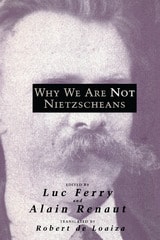
Why We Are Not Nietzscheans
Edited by Luc Ferry and Alain Renaut
University of Chicago Press, 1997
Though linked by no common dogma, these essays all argue that the "French Nietzsche" transmitted through the deconstructionists must be reexamined in light of the original context in which Nietzsche worked. Each essay questions the viability of Nietzsche's thought in the modern world, variously critiquing his philosophy of history as obsessed with hierarchy, his views on religion and art as myopic and irrational, and his stance on science as hopelessly reactionary.
Contending that we must abandon the Nietzsche propped up as patron saint by French deconstructionists in order to return to reason, these essays will stimulate debate not just among Nietzscheans but among all with a stake in modern French philosophy.
Contributors are Alain Boyer, André Compte-Sponville, Vincent Descombes, Luc Ferry, Robert Legros, Philippe Raynaud, Alain Renault, and Pierre-André Taguieff.
Why We Need Ordinary Language Philosophy
Sandra Laugier
University of Chicago Press, 2013
Sandra Laugier has long been a key liaison between American and European philosophical thought, responsible for bringing American philosophers such as Ralph Waldo Emerson, Henry David Thoreau, and Stanley Cavell to French readers—but until now her books have never been published in English. Why We Need Ordinary Language Philosophy rights that wrong with a topic perfect for English-language readers: the idea of analytic philosophy.
Wild Blue Media
Thinking through SeawaterMelody Jue
Duke University Press, 2020
Wild Experiment
Feeling Science and Secularism after DarwinDonovan O. Schaefer
Duke University Press, 2022
Wild Ideas
David Rothenberg
University of Minnesota Press, 1995
A new view of what’s “wild,” and a new path for environmentalism.
At the very heart of American respect for nature, historically and philosophically, is the notion of the wild. This notion comes under scrutiny in Wild Ideas, a collection of essays that bring a fresh and refreshing perspective to the wilderness paradoxically at the center of our civilization.
Blending well-known and new voices, the volume surveys classical and romantic concepts of wilderness, from the scary to the sublime, and shows why neither serves us anymore. Instead, the authors argue for a “wild culture,” in which nature is not opposed to humanity, a mere matter of resources and consumers. A cogent reassessment of the ideas that drive the conservation movement, Wild Ideas points out a new direction for future environmentalism.Among the topics discussed are the confluence of wilderness, empire, and race in the United States; the way the ecology movement uses language; gendered views of the wilderness; maps and topology, and how they affect our view of the wild; healing by the wilderness experience; and the idea of an urban wilderness. Contributors: David Abram; Douglas Buege, U of Wisconsin; Denis Cosgrove, U of London; Robert Greenway, Sonoma State U; Ed Grumbine, Sierra Institute; Marvin Henberg, Linfield College; Irene Klaver, Montana State U; Andrew Light, U of Alberta; Lois Lorentzen, U of San Francisco; Max Oelschlaeger, U of North Texas; R. Murray Schafer; Tom Wolf.
Wild Justice
The Moral Lives of AnimalsMarc Bekoff and Jessica Pierce
University of Chicago Press, 2009
Scientists have long counseled against interpreting animal behavior in terms of human emotions, warning that such anthropomorphizing limits our ability to understand animals as they really are. Yet what are we to make of a female gorilla in a German zoo who spent days mourning the death of her baby? Or a wild female elephant who cared for a younger one after she was injured by a rambunctious teenage male? Or a rat who refused to push a lever for food when he saw that doing so caused another rat to be shocked? Aren’t these clear signs that animals have recognizable emotions and moral intelligence? With Wild Justice Marc Bekoff and Jessica Pierce unequivocally answer yes.
Marrying years of behavioral and cognitive research with compelling and moving anecdotes, Bekoff and Pierce reveal that animals exhibit a broad repertoire of moral behaviors, including fairness, empathy, trust, and reciprocity. Underlying these behaviors is a complex and nuanced range of emotions, backed by a high degree of intelligence and surprising behavioral flexibility. Animals, in short, are incredibly adept social beings, relying on rules of conduct to navigate intricate social networks that are essential to their survival. Ultimately, Bekoff and Pierce draw the astonishing conclusion that there is no moral gap between humans and other species: morality is an evolved trait that we unquestionably share with other social mammals.
Sure to be controversial, Wild Justice offers not just cutting-edge science, but a provocative call to rethink our relationship with—and our responsibilities toward—our fellow animals.
Wild Thought
A New Translation of “La Pensée sauvage”Claude Lévi-Strauss
University of Chicago Press, 2021
Controversially titled The Savage Mind when it was first published in English in 1966, the original translation nevertheless sparked a fascination with Lévi-Strauss’s work among Anglophone readers. Wild Thought rekindles that spark with a fresh and accessible new translation. Including critical annotations for the contemporary reader, it restores the accuracy and integrity of the book that changed the course of intellectual life in the twentieth century, making it an indispensable addition to any philosophical or anthropological library.
Wilderness Tapestry
An Eclectic Approach To PreservationVause Zeveloff
University of Nevada Press, 1992
To further understanding of the meanings and values of wilderness, this volume explores wilderness and its significance to humans from myriad viewpoints, based on a meeting of the North American Interdisciplinary Wilderness Conference.
Wilfrid Sellars and Phenomenology
Intersections, Encounters, OppositionsDaniele De Santis
Ohio University Press, 2023
Wilfrid Sellars tackled the difficult problems of reconciling Pittsburgh school–style analytic thought, Husserlian phenomenology, and the Myth of the Given.
This collection of essays brings into dialogue the analytic philosophy of Wilfrid Sellars—founder of the Pittsburgh school of thought—and phenomenology, with a special focus on the work of Edmund Husserl. The book’s wide-ranging discussions include the famous Myth of the Given but also more traditional problems in the philosophy of mind and phenomenology such as the
- status of perception and imagination
- nature of intentionality
- concept of motivation
- relationship between linguistic and nonlinguistic experiences
- relationship between conceptual and preconceptual experiences
Moreover, the volume addresses the conflicts between Sellars’s manifest and scientific images of the world and Husserl’s ontology of the life-world. The volume takes as a point of departure Sellars’s criticism of the Myth of the Given, but only to show the many problems that label obscures. Contributors explain aspects of Sellars’s philosophy vis-à-vis Husserl’s phenomenology, articulating the central problems and solutions of each. The book is a must-read for scholars and students interested in learning more about Sellars and for those comparing Continental and analytic philosophical thought.
Contributors
Walter Hopp
Wolfgang Huemer
Roberta Lanfredini
Danilo Manca
Karl Mertens
Antonio Nunziante
Jacob Rump
Daniele De Santis
Michela Summa
Willful Subjects
Sara Ahmed
Duke University Press, 2014
William James and the Art of Popular Statement
Paul Stob
Michigan State University Press, 2013
William James at the Boundaries
Philosophy, Science, and the Geography of KnowledgeFrancesca Bordogna
University of Chicago Press, 2008
What was the goal of this unusual speech? Rather than an oddity, Francesca Bordogna asserts that the APA address was emblematic—it was just one of many gestures that James employed as he plowed through the barriers between academic, popular, and pseudoscience, as well as the newly emergent borders between the study of philosophy, psychology, and the “science of man.” Bordogna reveals that James’s trespassing of boundaries was an essential element of a broader intellectual and social project. By crisscrossing divides, she argues, James imagined a new social configuration of knowledge, a better society, and a new vision of the human self. As the academy moves toward an increasingly interdisciplinary future, William James at the Boundaries reintroduces readers to a seminal influence on the way knowledge is pursued.
William James's "Springs of Delight"
The Return to LifePhil Oliver
Vanderbilt University Press, 2000
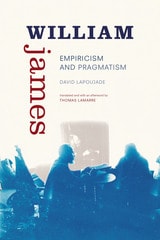
William James
Empiricism and PragmatismDavid Lapoujade
Duke University Press, 2020

William of Sherwood’s Treatise on Syncategorematic Words
Translated by Norman KretzmannIntroduction by Norman Kretzmann
University of Minnesota Press, 1968
William of Sherwood's Treatise on Syncategorematic Words was first published in 1968. Minnesota Archive Editions uses digital technology to make long-unavailable books once again accessible, and are published unaltered from the original University of Minnesota Press editions.
This is the first translation of an important medieval work in philosophy, an advanced treatise by the thirteenth-century English logician William of Sherwood. The treatise draws on doctrines developed in Sherwood's Introduction to Logic,which has also been translated by Professor Kretzmann.
William of Sherwood is an important figure in the development of the logica moderna,the distinctively medieval contribution to logic and semantics. As Professor Kretzmann explains, the logica moderna may have originally aimed only ad providing ad hoc rules regarding inferences that involve problematic locutions of ordinary discourse. But its principal aim soon became the development of a more or less general account of the ways in which words are used to stand for things or to affect the meanings of other words. In Sherwood's time the logica moderna seems to have been thought of as having two branches, an account of the "properties of terms" and an account of the signification and function of "syncategorematic words." Sherwood deals with the first branch in his Introduction to Logic and with the second branch in the treatise presented here.
The translation is copiously annotated to supply the kind of explanatory material a twentieth-century reader may need for an understanding of a thirteenth-century discussion. As Professor Kretzmann points out, many of the problems dealt with in this treatise closely resemble the problems of twentieth-century philosophical logic and philosophy of language.
Winnowing
Suzanne Matson
Duke University Press, 2026
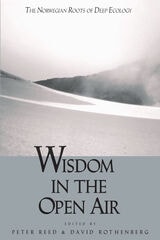
Wisdom In The Open Air
The Norwegian Roots of Deep EcologyPeter Reed
University of Minnesota Press, 1992
Wisdom in the Open Air traces the Norwegian roots of the strain of thinking called “deep ecology”—the search for the solutions to environmental problems by examining the fundamental tenets of our culture. Although Arne Naess coined the term in the 1970s, the insights of deep ecology actually reflect a tradition of thought that can be seen in the history of Norwegian culture, from ancient mountain myths to the radical ecoactivism of today.
Beginning with an introduction to Norway’s emphasis on nature and the wild, Reed and Rothenberg explore the birth of the environmental movement in the 1960s and 1970s. What follows is a collection of writings by prominent Norwegian thinkers on humanity and nature, most never before published in English. From Peter Wessel Zapffe, a twentieth-century Kierkegaardian figure, the list goes on to include Norwegian philosopher Arne Naess, activist-critic-artist Sigmund Kvaloy, wilderness educator Nils Faarland, novelist Finn Alneas, sociologist Johan Galtung, and social reformer Erik Dammann. Their fascinating points of view offer thoughts on the significance of modern life and what it means to be human in the face of the deteriorating global environment of the twentieth century. Wisdom in the Open Air asks and answers a fundamental question concerning the ecomovement: what is the role of deep, often abstract, thinking in the attempt to avert a very real ecological crisis?
Wisdom in Bonaventure's <i>Hexameron</i>
Philosophical Problems, Theological SolutionsBenjamin Winter
Catholic University of America Press, 2024
Wisdom's Apprentice
Thomistic Essays in Honor of Lawrence Dewan, O.P.Peter A. Kwasniewski
Catholic University of America Press, 2007
Wisecracks
Humor and Morality in Everyday LifeDavid Shoemaker
University of Chicago Press, 2024
A good sense of humor is key to the good life, but a joke taken too far can get anyone into trouble. Where to draw the line is not as simple as it may seem. After all, even the most innocent quips between friends rely on deception, sarcasm, and stereotypes and often run the risk of disrespect, meanness, and harm. How do we face this dilemma without taking ourselves too seriously?
In Wisecracks, philosopher David Shoemaker examines this interplay between humor and morality and ultimately argues that even morally suspect humor is an essential part of ethical life. Shoemaker shows how improvised “wisecracks” between family and friends—unlike scripted stand-up, sketches, or serials—help us develop a critical human skill: the ability to carry on and find the funny in tragedy. In developing a new ethics of humor in defense of questionable gibes, Wisecracks offers a powerful case for humor as a healing presence in human life.
With Bodies
Narrative Theory and Embodied CognitionMarco Caracciolo and Karin Kukkonen
The Ohio State University Press, 2021

With Nature
Nature Philosophy as Poetics through Schelling, Heidegger, Benjamin and NancyWarwick Mules
Intellect Books, 2014

With the World at Heart
Studies in the Secular TodayThomas A. Carlson
University of Chicago Press, 2019
Without Model
Parva AestheticaTheodor W. Adorno
Seagull Books, 2023
Essays by Theodor W. Adorno on art and cinema.
In Without Model, Theodor W. Adorno strikingly demonstrates the intellectual range for which he is known. Taking the premise of the title as his guiding principle, that artistic and philosophical thought must eschew preconceptions and instead adapt itself to its time, circumstances, and object, Adorno presents a series of essays reflecting on culture at different levels, from the details of individual products to the social conditions of their production. He shows his more nostalgic side in the childhood reminiscences of ‘Amorbach’, but also his acute sociocultural analysis of the central topic of the culture industry. He criticizes attempts to maintain tradition in music and visual art, arguing against a restorative approach by stressing the modernity and individuality of historical works in the context of their time. In all of these essays, available for the first time in English, Adorno displays the remarkable thinking of one both steeped in tradition and dedicated to seeing beyond it.
Without Offending Humans
A Critique of Animal RightsÉlisabeth de Fontenay
University of Minnesota Press, 2012
A central thinker on the question of the animal in continental thought, Élisabeth de Fontenay moves in this volume from Jacques Derrida’s uneasily intimate writing on animals to a passionate frontal engagement with political and ethical theory as it has been applied to animals—along with a stinging critique of the work of Peter Singer and Paola Cavalieri as well as with other “utilitarian” philosophers of animal–human relations.
Humans and animals are different from one another. To conflate them is to be intellectually sentimental. And yet, from our position of dominance, do we not owe them more than we often acknowledge? In the searching first chapter on Derrida, she sets out “three levels of deconstruction” that are “testimony to the radicalization and shift of that philosopher’s argument: a strategy through the animal, exposition to an animal or to this animal, and compassion toward animals.” For Fontenay, Derrida’s writing is particularly far-reaching when it comes to thinking about animals, and she suggests many other possible philosophical resources including Adorno, Leibniz, and Merleau-Ponty.
Fontenay is at her most compelling in describing philosophy’s ongoing indifference to animal life—shading into savagery, underpinned by denial—and how attempts to exclude the animal from ethical systems have in fact demeaned humanity. But Fontenay’s essays carry more than philosophical significance. Without Offending Humans reveals a careful and emotionally sensitive thinker who explores the unfolding of humans’ assessments of their relationship to animals—and the consequences of these assessments for how we define ourselves.
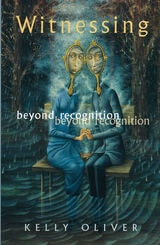
Witnessing
Beyond RecognitionKelly Oliver
University of Minnesota Press, 2001
A new, ethically based theory of identity by a major scholar.
Challenging the fundamental tenet of the multicultural movement-that social struggles turning upon race, gender, and sexuality are struggles for recognition-this work offers a powerful critique of current conceptions of identity and subjectivity based on Hegelian notions of recognition. The author’s critical engagement with major texts of contemporary philosophy prepares the way for a highly original conception of ethics based on witnessing.
Central to this project is Oliver’s contention that the demand for recognition is a symptom of the pathology of oppression that perpetuates subject-object and same-different hierarchies. While theorists across the disciplines of the humanities and social sciences focus their research on multiculturalism around the struggle for recognition, Oliver argues that the actual texts and survivors’ accounts from the aftermath of the Holocaust and slavery are testimonials to a pathos that is “beyond recognition.” Oliver traces many of the problems with the recognition model of subjective identity to a particular notion of vision presupposed in theories of recognition and misrecognition. Contesting the idea of an objectifying gaze, she reformulates vision as a loving look that facilitates connection rather than necessitates alienation. As an alternative, Oliver develops a theory of witnessing subjectivity. She suggests that the notion of witnessing, with its double meaning as either eyewitness or bearing witness to the unseen, is more promising than recognition for describing the onset and sustenance of subjectivity. Subjectivity is born out of and sustained by the process of witnessing-the possibility of address and response-which puts ethical obligations at its heart.
Wittgenstein & Critical Theory
Beyond Postmodern Criticism and Toward Descriptive InvestigationsSusan B. Brill
Ohio University Press, 1994
Brill’s work discusses at length the implications of Wittgenstein for literary criticism and theory. The volume specifically investigates the implications of Wittgenstein’s work for a number of contemporary critical orientations (notably poststructualism, feminism, and psychology). In addition, the research includes actual applications of Wittgenstein for literary criticism: diverse literary texts (including a number of poems and stories by Native American authors) are approached via a Wittgensteinian method as a means of discerning which critical approaches might be more or less efficacious. Not only does the book provide a solid introduction to Wittgensteinian philosophy for the critical scholars, but it also provides a clear methodology useful to critics seeking a means to navigate through the entanglement of contemporary criticism and theory.
Brill argues that a reliance upon the philosophy of Ludwig Wittgenstein can enable literary critics to escape the seemingly endless dialectic between modern and postmodern theory. Instead of debating which theory is theoretically best, we need to describe when theories work—and when they do not.