Results by title
2018 books match the query 'Political aspects' and 78 start with w

Wine, Wealth, and the State in Late Antique Egypt
The House of Apion at OxyrhynchusT. M. Hickey
University of Michigan Press, 2012
The "glorious house" of the senatorial family of the Flavii Apiones is the best documented economic entity of the Roman Empire during the fifth through seventh centuries, that critical period of transition between the classical world and the Middle Ages. For decades, the rich but fragmentary manuscript evidence that this large agricultural estate left behind, preserved for 1,400 years by the desiccating sands of Egypt, has been central to arguments concerning the agrarian and fiscal history of Late Antiquity, including the rise of feudalism.
Wine, Wealth, and the State in Late Antique Egypt is the most authoritative synthesis concerning the economy of the Apion estate to appear to date. T. M. Hickey examines the records of the family's wine production in the sixth century in order to shed light on ancient economic practices and economic theory, as well as on the wine industry and on estate management. Based on careful study of the original manuscripts, including unpublished documents from the estate archive, he presents controversial conclusions, much at odds with the "top down" models currently dominating the scholarship.
Winning Elections and Influencing Politicians for Library Funding
Patrick “PC” Sweeney
American Library Association, 2017
Wisconsin Sentencing in the Tough-on-Crime Era
How Judges Retained Power and Why Mass Incarceration Happened AnywayMichael O'Hear
University of Wisconsin Press, 2021
O'Hear tracks the effects of sentencing laws and politics in Wisconsin from the eve of the imprisonment boom in 1970 up to the 2010s. Drawing on archival research, original public-opinion polling, and interviews with dozens of key policymakers, he reveals important dimensions that have been missed by others. He draws out lessons from the Wisconsin experience for the United States as a whole, where mass incarceration has cost taxpayers billions of dollars and caused untold misery to millions of inmates and their families.
Witchcraft, Violence, and Democracy in South Africa
Adam Ashforth
University of Chicago Press, 2004
In Witchcraft, Violence, and Democracy in South Africa, Adam Ashforth examines how people in Soweto and other parts of post-apartheid South Africa manage their fear of 'evil forces' such as witchcraft. Ashforth examines the dynamics of insecurity in the everyday life of Soweto at the turn of the twenty-first century. He develops a new framework for understanding occult violence as a form of spiritual insecurity and documents new patterns of interpretation attributing agency to evil forces. Finally, he analyzes the response of post-apartheid governments to issues of spiritual insecurity and suggests how these matters pose severe long-term challenges to the legitimacy of the democratic state.
Within Reason
A Liberal Public Health for an Illiberal TimeSandro Galea
University of Chicago Press, 2023
A provocative chronicle of how US public health has strayed from its liberal roots.
The Covid-19 response was a crucible of politics and public health—a volatile combination that produced predictably bad results. As scientific expertise became entangled with political motivations, the public-health establishment found itself mired in political encampment.
It was, as Sandro Galea argues, a crisis of liberalism: a retreat from the principles of free speech, open debate, and the pursuit of knowledge through reasoned inquiry that should inform the work of public health.
Across fifty essays, Within Reason chronicles how public health became enmeshed in the insidious social trends that accelerated under Covid-19. Galea challenges this intellectual drift towards intolerance and absolutism while showing how similar regressions from reason undermined social progress during earlier eras. Within Reason builds an incisive case for a return to critical, open inquiry as a guiding principle for the future public health we want—and a future we must work to protect.
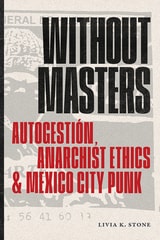
Without Masters
Autogestión, Anarchist Ethics, and Mexico City PunkLivia K. Stone
Duke University Press, 2026
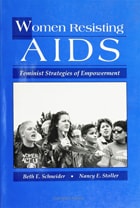
Women Resisting AIDS
Feminist Strategies of Empowermentedited by Beth E. Schneider and Nancy E. Stoller
Temple University Press, 1995
This collection of original essays discusses the increasingly rapid spread of AIDS among women, considering the varying experiences and responses of women of color, lesbians, and economically impoverished women. The essays range widely from policy assessments to case studies, focusing on women as sufferers, caretakers, policy activists, community organizers, and educators.

Women for President
Media Bias in Eight CampaignsErika Falk
University of Illinois Press, 2007
When Hillary Clinton announced her 2008 bid for president she was the Democratic front-runner. Despite this, she received less coverage than Barack Obama, who trailed her in the polls. Such a disparity is indicative of the gender bias the media has demonstrated in covering women candidates since the first woman ran for America’s highest office in 1872. Tracing the campaigns of eight women who ran for president through 2004--Victoria Woodhull, Belva Lockwood, Margaret Chase Smith, Shirley Chisholm, Patricia Schroeder, Lenora Fulani, Elizabeth Dole, and Carol Moseley Braun--Erika Falk finds little progress in the fair treatment of women candidates. A thorough comparison of the women’s campaigns to those of their male opponents reveals a worrisome trend of sexism in press coverage--a trend that still persists today.
While women have been elected to the highest offices in countries such as England, Germany, and India, the idea that a woman could be president of the United States provokes scoffs and ridicule. The press portrays female candidates as unviable, unnatural, and incompetent, and often ignores or belittles women instead of reporting their ideas and intent. Since voters learn most details about presidential candidates through media outlets, Falk asserts that this prevailing bias calls into question the modern democratic assumption that men and women have comparable access to positions of power.
Women for President
Media Bias in Nine CampaignsErika Falk
University of Illinois Press, 2010
Newly updated to examine Hillary Clinton's formidable 2008 presidential campaign, Women for President analyzes the gender bias the media has demonstrated in covering women candidates since the first woman ran for America's highest office in 1872. Tracing the campaigns of nine women who ran for president through 2008--Victoria Woodhull, Belva Lockwood, Margaret Chase Smith, Shirley Chisholm, Patricia Schroeder, Lenora Fulani, Elizabeth Dole, Carol Moseley Braun, and Hillary Clinton--Erika Falk finds little progress in the fair treatment of women candidates. The press portrays female candidates as unviable, unnatural, and incompetent, and often ignores or belittles women instead of reporting their ideas and intent. This thorough comparison of men's and women's campaigns reveals a worrisome trend of sexism in press coverage--a trend that still persists today.
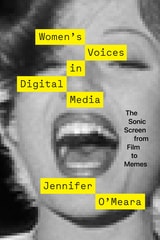
Women's Voices in Digital Media
The Sonic Screen from Film to MemesJennifer O'Meara
University of Texas Press, 2022
2023 Publication Award Honorable Mention, British Association for Film, Television and Screen Studies
An examination of the sound and silence of women in digital media.
In today’s digital era, women’s voices are heard everywhere—from smart home devices to social media platforms, virtual reality, podcasts, and even memes—but these new forms of communication are often accompanied by dated gender politics. In Women’s Voices in Digital Media, Jennifer O’Meara dives into new and well-established media formats to show how contemporary screen media and cultural practices police and fetishize women’s voices, but also provide exciting new ways to amplify and empower them.
As she travels through the digital world, O’Meara discovers newly acknowledged—or newly erased—female voice actors from classic films on YouTube, meets the AI and digital avatars in Her and The Congress, and hears women’s voices being disembodied in new ways via podcasts and VR voice-overs. She engages with dialogue that is spreading with only the memory of a voice, looking at how popular media like Clueless and The Simpsons have been mined for feminist memes, and encounters vocal ventriloquism on RuPaul’s Drag Race that queers and valorizes the female voice. Through these detailed case studies, O’Meara argues that the digital proliferation of screens alters the reception of sounds as much as that of images, with substantial implications for women’s voices.
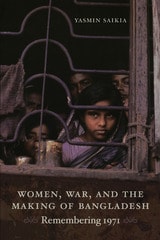
Women, War, and the Making of Bangladesh
Remembering 1971Yasmin Saikia
Duke University Press, 2011
Words and Worlds
A Lexicon for Dark TimesVeena Das and Didier Fassin, editors
Duke University Press, 2021
Contributors. Banu Bargu, Veena Das, Alex de Waal, Didier Fassin, Peter Geschiere, Behrooz Ghamari-Tabrizi, Caroline Humphrey, Ravi Kanbur, Julieta Lemaitre, Uday S. Mehta, Jan-Werner Müller, Jonathan Pugh, Elizabeth F. Sanders, Todd Sanders
Words in Motion
Toward a Global LexiconCarol Gluck and Anna Lowenhaupt Tsing, eds.
Duke University Press, 2009
Such words as security in Brazil, responsibility in Japan, community in Thailand, and hijāb in France changed the societies in which they moved even as the words were changed by them. Some words threatened to launch wars, as injury did in imperial Britain’s relations with China in the nineteenth century. Others, such as secularism, worked in silence to agitate for political change in twentieth-century Morocco. Words imposed or imported from abroad could be transformed by those who wielded them to oppose the very powers that first introduced them, as happened in Turkey, Indonesia, and the Philippines. Taken together, this selection of fourteen essays reveals commonality as well as distinctiveness across modern societies, making the world look different from the interdisciplinary and transnational perspective of “words in motion.”
Contributors. Mona Abaza, Itty Abraham, Partha Chatterjee, Carol Gluck, Huri Islamoglu, Claudia Koonz, Lydia H. Liu, Driss Maghraoui, Vicente L. Rafael, Craig J. Reynolds, Seteney Shami, Alan Tansman, Kasian Tejapira, Anna Lowenhaupt Tsing
Words in Space and Time
A Historical Atlas of Language Politics in Modern Central EuropeTomasz Kamusella
Central European University Press, 2022
With forty-two extensively annotated maps, this atlas offers novel insights into the history and mechanics of how Central Europe’s languages have been made, unmade, and deployed for political action. The innovative combination of linguistics, history, and cartography makes a wealth of hard-to-reach knowledge readily available to both specialist and general readers. It combines information on languages, dialects, alphabets, religions, mass violence, or migrations over an extended period of time.
The story first focuses on Central Europe’s dialect continua, the emergence of states, and the spread of writing technology from the tenth century onward. Most maps concentrate on the last two centuries. The main storyline opens with the emergence of the Western European concept of the nation, in accord with which the ethnolinguistic nation-states of Italy and Germany were founded. In the Central European view, a “proper” nation is none other than the speech community of a single language. The Atlas aspires to help users make the intellectual leap of perceiving languages as products of human history and part of culture. Like states, nations, universities, towns, associations, art, beauty, religions, injustice, or atheism—languages are artefacts invented and shaped by individuals and their groups.
Words like Water
Queer Mobilization and Social Change in ChinaFugazzola, Caterina
Temple University Press, 2023
Words like Water explores the nonconfrontational strategies the tongzhi movement uses in contemporary China. Caterina Fugazzola analyzes tongzhi organizers’ conceptualizations of, and approaches to, social change, explaining how they avoid the backlash that meets Western tactics, such as protests, confrontation, and language about individual freedoms. In contrast, the groups’ intentional use of community and family-oriented narratives, discourses, and understandings of sexual identity are more effective, especially in situations where direct political engagement is not possible.
Providing on-the-ground stories that examine the social, cultural, and political constraints and opportunities, Words like Water emphasizes the value of discursive flexibility that allows activists to adapt to changing social and political conditions.
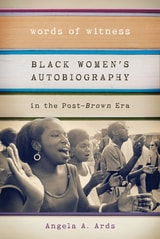
Words of Witness
Black Women's Autobiography in the Post-<i>Brown</i> EraAngela A. Ards
University of Wisconsin Press, 2015
Exploring works by the critically acclaimed June Jordan and Edwidge Danticat, as well as by popular and emerging authors such as Melba Beals, Rosemary Bray, and Eisa Davis, Ards demonstrates how each text asserts countermemories to official—and often nostalgic—understandings of the civil rights and Black Power movements. She situates each writer as activist-citizen, adopting and remaking particular roles—warrior, “the least of these,” immigrant, hip-hop head—to crystallize a range of black feminist responses to urgent but unresolved political issues.
Workers of the World, Enjoy!
Aesthetic Politics from Revolutionary Syndicalism to the Global Justice MovementKenneth H. Tucker, Jr.
Temple University Press, 2012
The aesthetic politics of social movements turn public life into a public stage, where mutual displays of performance often trump rational debate, and urban streets become sites of festivals and carnival. In his penetrating new book, Workers of the World, Enjoy!, Kenneth Tucker provides a new model for understanding social change in our image-saturated and aesthetically charged world. As emotional and artistic images inform our perceptions and evaluation of politics, art and performance often provide new and creative ways of understanding self and society.
Spanning the nineteenth, twentieth, and twenty-first centuries, Workers of the World, Enjoy! uses examples from major social movements that have dramatically changed the dominant capitalist society—often in the name of labor. Tucker investigates how class and culture develop as he raises questions about what it means for public life and social movements when politics and drama come together.
Tucker catalogues how aesthetic politics influences social movements—from French Revolutionary syndicalism and fascism to the selling of the President and the street theater of the contemporary global justice movement. He also discusses the work of political theorists including Jurgen Habermas, Jeffrey Alexander, and Nancy Fraser to critique the ways public sphere has been studied.

Working in Music on the Semiperiphery
Local Cultural Production and Global CapitalismEmília Barna
Central European University Press, 2025
This book embraces the widest possible range of workers in the music industry. It deals with all music genres from high-flying to commercial and observes various workers in the production chain beyond musicians. Niche segments of the sector, such as YouTube-based commercial hip hop, are given special treatment. Using a variety of empirical research methods, the study examines the trends as workers are pushed towards digital entrepreneurship and platform work, on the one hand, and live performance, on the other. The focus on domestic work and informality offers a feminist analysis of work in music. This approach sheds light on gendered divisions of labor and forms of (self-)exploitation that usually remain invisible. The book proposes a new model of cultural autonomy that takes account of the semiperipheral relationship of music industry workers and institutions to both the market and the state.
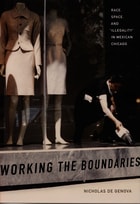
Working the Boundaries
Race, Space, and "Illegality" in Mexican ChicagoNicholas De Genova
Duke University Press, 2005
De Genova worked for two and a half years as a teacher of English in ten industrial workplaces (primarily metal-fabricating factories) throughout Chicago and its suburbs. In Working the Boundaries he draws on fieldwork conducted in these factories, in community centers, and in the homes and neighborhoods of Mexican migrants. He describes how the meaning of “Mexican” is refigured and racialized in relation to a U.S. social order dominated by a black-white binary. Delving into immigration law, he contends that immigration policies have worked over time to produce Mexicans as the U.S. nation-state’s iconic “illegal aliens.” He explains how the constant threat of deportation is used to keep Mexican workers in line. Working the Boundaries is a major contribution to theories of race and transnationalism and a scathing indictment of U.S. labor and citizenship policies.
Workplace Justice
Organizing Multi-Identity MovementsSharon Kurtz
University of Minnesota Press, 2002
An unheralded union battle offers new insight into identity politics.
In 1991, Columbia University’s one thousand clerical workers launched a successful campaign for justice in their workplace. This diverse union-two-thirds black and Latina, three-fourths women-was committed to creating an inclusive movement organization and to fighting for all kinds of justice. How could they address the many race and gender injustices members faced, avoid schism, and maintain the unity needed to win? Sharon Kurtz, an experienced union activist and former clerical worker herself, was welcomed into the union and pursued these questions. Using this case study and secondary studies of sister clerical unions at Yale and Harvard, she examines the challenges and potential of identity politics in labor movements.
With the Columbia strike as a point of departure, Kurtz argues that identity politics are valuable for mobilizing groups, but often exclude members and their experiences of oppression. However, Kurtz believes that identity politics should not be abandoned as a component in building movements, but should be reframed-as multi-identity politics. In the end she shows an approach to organizing with great potential impact not only for labor unions but for any social movement.
World War II and the Cold War
The Rhetoric of Hearts and Minds, Volume VIIIMartin J. Medhurst
Michigan State University Press, 2018
Wrecked
Deinstitutionalization and Partial Defenses in State Higher Education PolicyBarrett J. Taylor
Rutgers University Press, 2022
Writing Women's Communities
The Politics and Poetics of Contemporary Multi-Genre AnthologiesCynthia G. Franklin
University of Wisconsin Press, 1997
Beginning in the 1980s, a number of popular and influential anthologies organized around themes of shared identity—Nice Jewish Girls, This Bridge Called My Back, Home Girls, and others—have brought together women’s fiction and poetry with journal entries, personal narratives, and transcribed conversations. These groundbreaking multi-genre anthologies, Cynthia G. Franklin demonstrates, have played a crucial role in shaping current literary studies, in defining cultural and political movements, and in building connections between academic and other communities.
Exploring intersections and alliances across the often competing categories of race, class, gender, and sexuality, Writing Women’s Communities contributes to current public debates about multiculturalism, feminism, identity politics, the academy as a site of political activism, and the relationship between literature and politics.
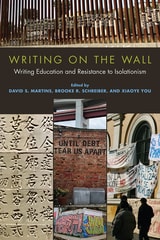
Writing on the Wall
Writing Education and Resistance to Isolationismedited by David S. Martins, Brooke R. Schreiber & Xiaoye You
Utah State University Press, 2022
The collection extends existing scholarship and research about the ways racist and colonial rhetorics impact writing education; the impact of translingual, transnational, and cosmopolitan ideologies on student learning and student writing; and the role international educational partnerships play in pushing back against isolationist ideologies. Established and early-career scholars who work in a broad range of institutional contexts highlight the historical connections among monolingualism, racism, and white nationalism and introduce community- and classroom-based practices that writing teachers use to resist isolationist beliefs and tendencies.
“Writing on the wall” serves as a metaphor for the creative, direct action writing education can provide and invokes border spaces as sites of identity expression, belonging, and resistance. The book connects transnational writing education with the fight for racial justice in the US and around the world and will be of significance to secondary and postsecondary writing teachers and graduate students in English, linguistics, composition, and literacy studies.
Contributors: Olga Aksakalova, Sara P. Alvarez, Brody Bluemel, Tuli Chatterji, Keith Gilyard, Joleen Hanson, Florianne Jimenez Perzan, Rebecca Lorimer Leonard, Layli Maria Miron, Tony D. Scott, Kate Vieira, Amy J. Wan
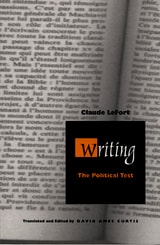
Writing
The Political TestClaude Lefort
Duke University Press, 2000
In Writing: The Political Test, France’s leading political philosopher, Claude Lefort, illuminates the process by which writers negotiate difficult path to free themselves from the ideological and contextual traps that would doom their attempts to articulate a new vision. Lefort examines writers whose works provide special insights into this problem of risk, both literary artists and political philosophers. Among them are Salman Rushdie, Sade, Tocqueville,m Machiavelli, Leo Strauss, Orwell, Kant, Robespierre, Guizot, and Pierre Clastres. In Tocqueville, for example, Lefort finds that the author’s improvisatory and open-ended expression represents the character of the democratic experience. Orwell’s work on totalitarianism shows up the totalitarian subject’s complicity in this political regime. And Rushdie is remarkable for his solid attack on relativism. With the character and fate of the political forms of modernity, democracy, and totalitarianism a central theme, Lefort concludes with some reflections on the collapse of the Soviet Union.
This intriguing and accessible exploration of literature’s political aspects and political philosophy’s literary ones will be welcomed by those who have been stymied by current efforts to bridge these two fields. Taken together, the essays in this volume also stand as an intellectual autobiography of Lefort, making it an excellent introduction to his work for less experience students of political theory or philosophy.

Written in Blood
Revolutionary Terrorism and Russian Literary Culture, 1861–1881Lynn Ellen Patyk
University of Wisconsin Press, 2017
Lynn Ellen Patyk contends that the prototype for the terrorist was the Russian writer, whose seditious word was interpreted as an audacious deed—and a violent assault on autocratic authority. The interplay and interchangeability of word and deed, Patyk argues, laid the semiotic groundwork for the symbolic act of violence at the center of revolutionary terrorism. While demonstrating how literary culture fostered the ethos, pathos, and image of the revolutionary terrorist and terrorism, she spotlights Fyodor Dostoevsky and his "terrorism trilogy"—Crime and Punishment (1866), Demons (1870–73), and The Brothers Karamazov (1878–80)—as novels that uniquely illuminate terrorism's methods and trajectory. Deftly combining riveting historical narrative with penetrating literary analysis of major and minor works, Patyk's groundbreaking book reveals the power of the word to spawn deeds and the power of literature to usher new realities into the world.

Written in Stone
Public Monuments in Changing SocietiesSanford Levinson
Duke University Press, 1998
In Written in Stone, legal scholar Sanford Levinson considers the tangled responses of ever-changing societies to the monuments and commemorations created by past regimes or outmoded cultural and political systems. Drawing on examples from Albania to Zimbabwe, from Moscow to Managua, and paying particular attention to examples throughout the American South, Levinson looks at social and legal arguments regarding the display, construction, modification, and destruction of public monuments. He asks what kinds of claims the past has on the present, particularly if the present is defined in dramatic opposition to its past values. In addition, he addresses the possibilities for responding to the use and abuse of public spaces and explores how a culture might memorialize its historical figures and events in ways that are beneficial to all its members.
Written in Stone is a meditation on how national cultures have been or may yet be defined through the deployment of public monuments. It adds a thoughtful and crucial voice into debates surrounding historical accuracy and representation, and will be welcomed by the many readers concerned with such issues.
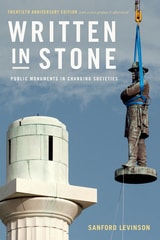
Written in Stone
Public Monuments in Changing SocietiesSanford Levinson
Duke University Press, 1998
From the removal of Confederate monuments in New Orleans in the spring of 2017 to the violent aftermath of the white nationalist march on the Robert E. Lee monument in Charlottesville later that summer, debates and conflicts over the memorialization of Confederate “heroes” have stormed to the forefront of popular American political and cultural discourse. In Written in Stone Sanford Levinson considers the tangled responses to controversial monuments and commemorations while examining how those with political power configure public spaces in ways that shape public memory and politics. Paying particular attention to the American South, though drawing examples as well from elsewhere in the United States and throughout the world, Levinson shows how the social and legal arguments regarding the display, construction, modification, and destruction of public monuments mark the seemingly endless confrontation over the symbolism attached to public space.
This twentieth anniversary edition of Written in Stone includes a new preface and an extensive afterword that takes account of recent events in cities, schools and universities, and public spaces throughout the United States and elsewhere. Twenty years on, Levinson's work is more timely and relevant than ever.