Results by title
2916 books match the query 'Politics and government' and 98 start with w

When the State Fails
Studies on Intervention in the Sierra Leone Civil WarTunde Zack-Williams
Pluto Press, 2012
Compared with Iraq, Afghanistan and Kosovo, the recent western intervention in Sierra Leone has been largely forgotten. When the State Fails rectifies this, providing a comprehensive and critical analysis of the intervention.
The civil war in Sierra Leone began in 1991 and was declared officially over in 2002 after UK, UN and regional African military intervention. Some claimed it as a case of successful humanitarian intervention. The authors in this collection provide an informed analysis of the impact of the intervention on democracy, development and society in Sierra Leone. The authors take a particularly critical view of the imposition of neoliberalism after the conflict.
As NATO intervention in Libya shows the continued use of external force in internal conflicts, When the State Fails is a timely book for all students and scholars interested in Africa and the question of ‘humanitarian intervention’.
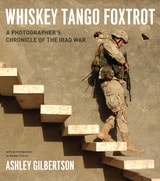
Whiskey Tango Foxtrot
A Photographer's Chronicle of the Iraq WarAshley Gilbertson
University of Chicago Press, 2007
Whiskey Tango Foxtrot gathers the best of Gilbertson’s photographs, chronicling America’s early battles in Iraq, the initial occupation of Baghdad, the insurgency that erupted shortly afterward, the dramatic battle to overtake Falluja, and ultimately, the country’s first national elections. No Western photojournalist has done as much sustained work in occupied Iraq as Gilbertson, and this wide-ranging treatment of the war from the viewpoint of a photographer is the first of its kind. Accompanying each section of the book is a personal account of Gilbertson’s experiences covering the conflict. Throughout, he conveys the exhilaration and terror of photographing war, as well as the challenges of photojournalism in our age of embedded reporting. But ultimately, and just as importantly, Whiskey Tango Foxtrot tells the story of Gilbertson’s own journey from hard-drinking bravado to the grave realism of a scarred survivor. Here he struggles with guilt over the death of a marine escort, tells candidly of his own experience with post-traumatic stress, and grapples with the reality that Iraq—despite the sacrifice in Iraqi and American lives—has descended into a civil war with no end in sight.
A searing account of the American experience in Iraq, Whiskey Tango Foxtrot is sure to become one of the classic war photography books of our time.
Whispering Truth to Power
Everyday Resistance to Reconciliation in Postgenocide RwandaSusan Thomson
University of Wisconsin Press, 2013
“Reveals the lengths [to which] the current government has gone to restructure all spaces of Rwandan society, and how Rwandans continue to resist this state interference in their everyday lives.”—Ethnic and Racial Studies
“Thomson’s elegant research is praiseworthy and her arguments are forthright. . . . This important publication will be of great value to scholars of Rwanda and genocide as well as students of reconciliation politics and transitional justice.”—Human Rights Quarterly
“Sobering and disturbing. . . . The peasant peoples’ resistance to official policies of national unity and reconciliation emerged because these national schemes do not reflect the peasants’ own lived realities and experiences of state power, genocide, and day-to-day living within their communities. Instead, these official policies disrupt everyday life and endanger existing networks of mutual support and dependence.”—Canadian Journal of Development Studies
Outstanding Academic Title, Choice Magazine
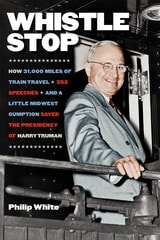
Whistle Stop
How 31,000 Miles of Train Travel, 352 Speeches, and a Little Midwest Gumption Saved the Presidency of Harry TrumanPhilip White
University Press of New England, 2015
White House Operations
The Johnson PresidencyBy Emmette S. Redford; and Richard T. McCulley
University of Texas Press, 1986
The relation of White House assistants to the president, their appropriate role in the governmental process, and the most effective means for organizing and managing the White House have been subjects of both public concern and academic dispute. White House Operations addresses these and related questions by providing the first thorough analysis of how the thirty-sixth president managed his staff. By grounding their study in original documents from the Lyndon B. Johnson Presidential Library, the authors lift the veil of secrecy that clouds the inner workings of the White House. The result is an insightful elaboration of the complex, extensive, and diverse roles of White House aides—and av fascinating look at such key White House figures as McGeorge Bundy, Joseph Califano, Bill Moyers, George Reedy, Walt Rostow, Lawrence O’Brien, and Johnson himself.
This exploration of Johnson’s highly personalized White House operations provides far-reaching implications for the nature of effective presidential management. The comprehensive analysis of the range of work done under Johnson and the unique nature of White House assistance leads the authors to a strong and vigorous assertion for a positive role for the White House staff that clashes sharply with the thrust of many recommendations for reorganizing the presidency. Redford and McCulley convincingly demonstrate that management of the White House staff and other parts of the president’s advisory system will remain crucial for successful presidential performance.
The book is the fifth volume in a series designed to provide a comprehensive administrative history of the Johnson presidency. The book will be of interest to the informed general reader, presidential scholars, political scientists, U.S. historians, and students of public management and will be an important addition to academic library collections.
White Man's Paper Trail
Grand Councils and Treaty-Making on the Central PlainsStan Hoig
University Press of Colorado, 2006
Stan Hoig shows how treaty-making - once considered a viable method of peaceably resolving conflicts - degenerated into a deeply flawed system sullied by political deceptions and broken promises.
White Man's Paper Trail illuminates the pivotal role of treaty negotiations in the buildup to the Plains Indian wars, in American Indians' loss of land and self-determination, and in Euro-American westward expansion.
Whither China?
Intellectual Politics in Contemporary ChinaXudong Zhang, ed.
Duke University Press, 2001
The contributors to Whither China? describe how, instead of spearheading the popular-mandated and state-sanctioned project of modernization, intellectuals now find themselves caught amid rapidly changing structures of economic, social, political, and cultural relations that are both global in nature and local in an irreducibly political sense. Individual essays interrogate the space of Chinese intellectual production today, lay out the issues at stake, and cover major debates and discursive interventions from the 1990s. Those who write within the Chinese context are joined by Western observers of contemporary Chinese cultural and intellectual life. Together, these two groups undertake a truly international intellectual struggle not only to interpret but to change the world.
Contributors. Rey Chow, Zhiyuan Cui, Michael Dutton, Gan Yang, Harry Harootunian, Peter Hitchcock, Rebecca Karl, Louisa Schein, Wang Hui, Wang Shaoguang, Xudong Zhang
Who Can Stop the Drums?
Urban Social Movements in Chávez's VenezuelaSujatha Fernandes
Duke University Press, 2010
Fernandes portrays everyday life and politics in the shantytowns of Caracas through accounts of community-based radio, barrio assemblies, and popular fiestas, and the many interviews she conducted with activists and government officials. Most of the barrio activists she presents are Chávez supporters. They see the leftist president as someone who understands their precarious lives and has made important changes to the state system to redistribute resources. Yet they must balance receiving state resources, which are necessary to fund their community-based projects, with their desire to retain a sense of agency. Fernandes locates the struggles of the urban poor within Venezuela’s transition from neoliberalism to what she calls “post-neoliberalism.” She contends that in contemporary Venezuela we find a hybrid state; while Chávez is actively challenging neoliberalism, the state remains subject to the constraints and logics of global capital.

Who Counts?
The Mathematics of Death and Life after GenocideDiane M. Nelson
Duke University Press, 2015
Who Deliberates?
Mass Media in Modern DemocracyBenjamin I. Page
University of Chicago Press, 1996
Page shows how the New York Times presented a restricted set of opinions on whether to go to war with Iraq, shutting out discussion of compromises favored by many Americans. He then examines the media's negative reaction to the Bush administration's claim that riots in Los Angeles were caused by welfare programs. Finally, he shows how talk shows overcame the elite media's indifference to widespread concern about Zoe Baird's hiring of illegal aliens. Page's provocative conclusion identifies the conditions under which media outlets become political actors and actively shape and limit the ideas and information available to the public.
Arguing persuasively that a diversity of viewpoints is essential to true public deliberation, this book will interest students of American politics, communications, and media studies.
Who Governs?
Presidents, Public Opinion, and ManipulationJames N. Druckman and Lawrence R. Jacobs
University of Chicago Press, 2015
Melding big debates about democratic theory with existing research on American politics and innovative use of the archives of three modern presidents—Johnson, Nixon, and Reagan—Druckman and Jacobs deploy lively and insightful analysis to show that the conventional model of representative democracy bears little resemblance to the actual practice of American politics. The authors conclude by arguing that polyarchy and the promotion of accelerated citizen mobilization and elite competition can improve democratic responsiveness. An incisive study of American politics and the flaws of representative government, this book will be warmly welcomed by readers interested in US politics, public opinion, democratic theory, and the fecklessness of American leadership and decision-making.
Who Killed George Polk?
The Press Covers Up a Death in the FamilyElias Vlanton
Temple University Press, 1996
Just weeks after CBS correspondent George Polk was murdered in Greece in 1948, his peers created the "George Polk Award" to honor the best in American journalism. Polk would have been bitterly disappointed, however, had he known that the "best in American journalism" accepted, largely without protest, an investigation into his death in which evidence was not only ignored but manufactured to convict innocent men—an investigation in which politics played a bigger role than the truth.
Reconstructing the murder, investigation, trial, and aftermath, Who Killed George Polk? offers a penetrating analysis of the willingness of the American media—including CBS and a committee of prominent journalists headed by Walter Lippmann—to accept the government's version of events despite numerous inconsistencies. The book also explores the fate of the handful of journalists who had questioned the original coverup and shows that even when additional developments turned the official version on its head, they were no longer in a position to press for a new investigation. All had become victims of anticommunist witchhunts.
Arguing that this mainstream media and the U.S. government were so blinded by cold war political considerations that they overlooked the most obvious culprits for the Polk murder, Elias Vlanton proves that Polk was likely killed neither by the communists, as originally charged, nor by corrupt Greek government officials, as claimed by a recent book and in a CBS "Sixty Minutes" broadcast. Instead, based on evidence uncovered during Vlanton's 19-year investigation, the author presents the only plausible scenario of how and why Polk was murdered.
At its core, this perceptive interrogation explores how the press served U.S. national interests at the expense of the truth and journalistic integrity.
Who Killed John Clayton?
Political Violence and the Emergence of the New South, 1861-1893Kenneth C. Barnes
Duke University Press, 1998
More than a description of this particular event, however, Who Killed John Clayton? traces patterns of political violence in this section of the South over a three-decade period. Using vivid courtroom-type detail, Barnes describes how violence was used to define and control the political system in the post-Reconstruction South and how this system in turn produced Jim Crow. Although white Unionists and freed blacks had joined under the banner of the Republican Party and gained the upper hand during Reconstruction, during these last decades of the nineteenth century conservative elites, first organized as the Ku Klux Klan and then as the revived Democratic Party, regained power—via such tactics as murdering political opponents, lynching blacks, and defrauding elections.
This important recounting of the struggle over political power will engage those interested in Southern and American history.
Why Kosovo Matters
Denis MacShane
Haus Publishing, 2011
Why Parties Matter
Political Competition and Democracy in the American SouthJohn H. Aldrich and John D. Griffin
University of Chicago Press, 2017
With Why Parties Matter, John H. Aldrich and John D. Griffin make a compelling case that competition between political parties is an essential component of a democracy that is responsive to its citizens and thus able to address their concerns. Tracing the history of the parties through four eras—the Democratic-Whig party era that preceded the Civil War; the post-Reconstruction period; the Jim Crow era, when competition between the parties virtually disappeared; and the modern era—Aldrich and Griffin show how and when competition emerged between the parties and the conditions under which it succeeded and failed. In the modern era, as party competition in the South has come to be widely regarded as matching that of the North, the authors conclude by exploring the question of whether the South is poised to become a one-party system once again with the Republican party now dominant.
Why Parties?
A Second LookJohn H. Aldrich
University of Chicago Press, 2011
Since its first appearance fifteen years ago, Why Parties? has become essential reading for anyone wishing to understand the nature of American political parties. In the interim, the party system has undergone some radical changes. In this landmark book, now rewritten for the new millennium, John H. Aldrich goes beyond the clamor of arguments over whether American political parties are in resurgence or decline and undertakes a wholesale reexamination of the foundations of the American party system.
Surveying critical episodes in the development of American political parties—from their formation in the 1790s to the Civil War—Aldrich shows how they serve to combat three fundamental problems of democracy: how to regulate the number of people seeking public office, how to mobilize voters, and how to achieve and maintain the majorities needed to accomplish goals once in office. Aldrich brings this innovative account up to the present by looking at the profound changes in the character of political parties since World War II, especially in light of ongoing contemporary transformations, including the rise of the Republican Party in the South, and what those changes accomplish, such as the Obama Health Care plan. Finally, Why Parties? A Second Look offers a fuller consideration of party systems in general, especially the two-party system in the United States, and explains why this system is necessary for effective democracy.
Why Parties?
The Origin and Transformation of Political Parties in AmericaJohn H. Aldrich
University of Chicago Press, 1995
Surveying three critical episodes in the development of American political parties—from their formation in the 1790s to the Civil War—Aldrich shows how parties serve to combat three fundamental problems of democracy: how to regulate the number of people seeking public office; how to mobilize voters; and how to achieve and maintain the majorities needed to accomplish goals once in office. Overcoming these obstacles, argues Aldrich, is possible only with political parties.
Aldrich brings this innovative account up to date by looking at the profound changes in the character of political parties since World War II. In the 1960s, he shows, parties started to become candidate-centered organizations that are servants to their office seekers and officeholders. Aldrich argues that this development has revitalized parties, making them stronger, and more vital, with well-defined cleavages and highly effective governing ability.
Why Washington Won't Work
Polarization, Political Trust, and the Governing CrisisMarc J. Hetherington and Thomas J. Rudolph
University of Chicago Press, 2015
In Why Washington Won’t Work, Marc J. Hetherington and Thomas J. Rudolph argue that a contemporary crisis of trust—people whose party is out of power have almost no trust in a government run by the other side—has deadlocked Congress. On most issues, party leaders can convince their own party to support their positions. In order to pass legislation, however, they must also create consensus by persuading some portion of the opposing party to trust in their vision for the future. Without trust, consensus fails to develop and compromise does not occur. Up until recently, such trust could still usually be found among the opposition, but not anymore. Political trust, the authors show, is far from a stable characteristic. It’s actually highly variable and contingent on a variety of factors, including whether one’s party is in control, which part of the government one is dealing with, and which policies or events are most salient at the moment.
Political trust increases, for example, when the public is concerned with foreign policy—as in times of war—and it decreases in periods of weak economic performance. Hetherington and Rudolph do offer some suggestions about steps politicians and the public might take to increase political trust. Ultimately, however, they conclude that it is unlikely levels of political trust will significantly increase unless foreign concerns come to dominate and the economy is consistently strong.
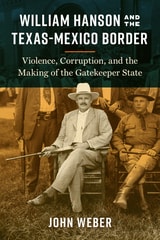
William Hanson and the Texas-Mexico Border
Violence, Corruption, and the Making of the Gatekeeper StateJohn Weber
University of Texas Press, 2024
An examination of the career of Texas Ranger and immigration official William Hanson illustrating the intersections of corruption, state-building, and racial violence in early twentieth century Texas.
At the Texas-Mexico border in the 1910s and 1920s, William Hanson was a witness to, and an active agent of, history. As a Texas Ranger captain and then a top official in the Immigration Service, he helped shape how US policymakers understood the border, its residents, and the movement of goods and people across the international boundary. An associate of powerful politicians and oil company executives, he also used his positions to further his and his patrons' personal interests, financial and political, often through threats and extralegal methods.
Hanson’s career illustrates the ways in which legal exclusion, white-supremacist violence, and official corruption overlapped and were essential building blocks of a growing state presence along the border in the early twentieth century. In this book, John Weber reveals Hanson’s cynical efforts to use state and federal power to proclaim the border region inherently dangerous and traces the origins of current nativist politics that seek to demonize the border population. In doing so, he provides insight into how a minor political appointee, motivated by his own ambitions, had lasting impacts on how the border was experienced by immigrants and seen by the nation.
William Massey
New ZealandJames Watson
Haus Publishing, 2010
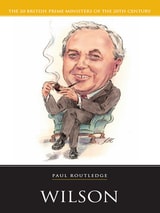
Wilson
Paul Routledge
Haus Publishing, 2006
Wine, Wealth, and the State in Late Antique Egypt
The House of Apion at OxyrhynchusT. M. Hickey
University of Michigan Press, 2012
The "glorious house" of the senatorial family of the Flavii Apiones is the best documented economic entity of the Roman Empire during the fifth through seventh centuries, that critical period of transition between the classical world and the Middle Ages. For decades, the rich but fragmentary manuscript evidence that this large agricultural estate left behind, preserved for 1,400 years by the desiccating sands of Egypt, has been central to arguments concerning the agrarian and fiscal history of Late Antiquity, including the rise of feudalism.
Wine, Wealth, and the State in Late Antique Egypt is the most authoritative synthesis concerning the economy of the Apion estate to appear to date. T. M. Hickey examines the records of the family's wine production in the sixth century in order to shed light on ancient economic practices and economic theory, as well as on the wine industry and on estate management. Based on careful study of the original manuscripts, including unpublished documents from the estate archive, he presents controversial conclusions, much at odds with the "top down" models currently dominating the scholarship.

Winners and Losers
Social and Political Polarities in AmericaIrving Louis Horowitz
Duke University Press, 1984
Winston Churchill
Resolution, Defiance, Magnanimity, Good WillEdited by R. Crosby Kemper III
University of Missouri Press, 1995
In 1946 Winston Churchill shook the world with his famous "Iron Curtain" speech on the campus of Westminster College in Fulton, Missouri, now the site of the Winston Churchill Memorial and Library. Inscribed on the pediment of his statue at the memorial is the epigraph from Churchill's History of the Second World War:
In War: Resolution
In Defeat: DefianceIn Victory: MagnanimityIn Peace: Good WillNo other words provide so poignant a summary of the principles that sustained Churchill's life's work.
Under the auspices of the Winston Churchill Memorial and Library, the Crosby Kemper Lectureship was established in 1979 by the Enid and Crosby Kemper Foundation of Kansas City, Missouri. Lectures have been delivered annually, or biennially, at the Winston Churchill Memorial and Library on the campus of Westminster College by authorities on British history and on Sir Winston Churchill. The essays included in this volume constitute the first dozen Crosby Kemper lectures, most by individuals who were personally acquainted with Churchill and all by individuals who had studied his life and his work.
Lord Robert Blake discusses Churchill's ambivalence toward the Conservative party during his political career. Philip S. Ziegler, Earl Mountbatten's biographer, examines whether Britain should have granted independence to India in 1947, taking as his departure Churchill's unequivocal belief that Britain's imperial rule there was a sacred trust not to be betrayed. Martin Gilbert, Churchill's biographer, carefully examines the origins of the Cold War and the famous Iron Curtain speech. Sir Michael Howard, Lovett Professor and Naval Historian at Yale University, further examines Churchill's role during the Cold War and the formulation of his "two-track" strategy that pushed for military strength while persistently striving for peace with the Soviets. Sir John Colville, Churchill's private secretary, ponders the extent to which great men are made by circumstances, citing Churchill's peccadilloes and strengths. Churchill's daughter Mary Soames and granddaughter, the sculptor Edwina Sandys, also give moving portraits of a much-loved family man.
All bring this illustrious leader to life in the process of interpreting his political actions, reviewing his historical contributions, and sharing anecdotes about his personal life.
Winthrop Rockefeller, Philanthropist
A Life of ChangeJohn Ward
University of Arkansas Press, 2004
Winthrop Rockefeller
From New Yorker to Arkansawyer, 1912-1956John A. Kirk
University of Arkansas Press, 2022
Winner, 2024 J. G. Ragsdale Book Award, Arkansas Historical Association
Winner, 2024 Booker Worthen Literary Prize
Why did Winthrop Rockefeller, scion of one of the most powerful families in American history, leave New York for an Arkansas mountaintop in the 1950s? In this richly detailed biography of the former Arkansas governor, John A. Kirk delves into the historical record to fully unravel that mystery for the first time. Kirk pursues clues threaded throughout Rockefeller’s life, tracing his family background, childhood, and education; his rise in the oil industry from roustabout to junior executive; his military service in the Pacific during World War II, including his involvement in the battles of Guam, Leyte, and Okinawa; his postwar work in race relations, health, education, and philanthropy; his marriage to and divorce from Barbara “Bobo” Sears; and the birth of his only child, future Arkansas lieutenant governor Win Paul Rockefeller. This careful examination of Winthrop Rockefeller’s first forty-four years casts a powerful new light on his relationship with his adopted state, where his legacy continues to be felt more than half a century after his governorship.
Wisconsin for Kennedy
The Primary That Launched a President and Changed the Course of HistoryB. J. Hollars
Wisconsin Historical Society Press, 2024
When John F. Kennedy ran for president in 1960, he did something no candidate had done before: he leveraged the power of state primaries to win his party’s nomination. Kennedy’s first battleground state? Wisconsin—a state that would prove more arduous, more exhausting, and more crucial to winning the presidency than any other.
Wisconsin for Kennedy brings to life the stories behind JFK’s history-making 1960 Wisconsin primary campaign, and how Kennedy’s team managed to outmaneuver his politically seasoned opponent, Hubert Humphrey. From Jackie Kennedy commandeering a supermarket loudspeaker in Kenosha, to the Wisconsin forklift driver who planned President Kennedy’s final trip to Dallas, this captivating book places readers at the heart of the action.
Author B.J. Hollars chronicles JFK’s nail-biting Wisconsin win by drawing on rarely cited oral histories from the eclectic team of people who worked together to make it happen: a cranberry farmer, a union leader, a mayor, an architect, and others. Wisconsin for Kennedy explores how Wisconsin helped propel JFK all the way to the White House in a riveting historical account that reads like a work of rollicking, page-turning fiction.
“In the spirit of Theodore H. White’s The Making of The President: 1960, B.J. Hollars offers a vivid account of the Wisconsin primary that launched JFK’s successful presidential campaign, inspiring voters to pass the torch to a new generation of leadership for our country. Anyone mesmerized by JFK’s legacy will enjoy this great read.”
—Former US Representative Ron Kind
“For generations, my family has had the great privilege of serving the people of Wisconsin. In Wisconsin for Kennedy, B.J. Hollars performs his own act of service, recounting the riveting and untold story of Wisconsin’s politically perilous 1960 primary. A poignant contribution to political history that reads like a page-turner.”
—Former Wisconsin Governor James Doyle Jr.
"A hopeful quality . . . pervades Wisconsin for Kennedy, written about a time and place when politics was conducted in a less severe and divisive way than it is now. Hollars further succeeds in showing how political history is made by a wide range of citizens. Wisconsinites, Midwesterners, and indeed Americans of all political persuasions can be grateful to B.J. Hollars for these important reminders."
— Middle West Review

With Distance in His Eyes
The Environmental Life and Legacy of Stewart UdallScott Raymond Einberger
University of Nevada Press, 2018
What can we learn from this farsighted individual?
In a day and age of partisan politics, poor congressional approval ratings, and global warming and climate change, this captivating biography offers a profound and historical record into Udall’s life-long devotion to environmental issues he cared about most deeply—issues more relevant today than they were then. Intimate moments include Udall’s learning of the Kennedy assassination, his push for civil rights for African Americans, his meeting in the U.S.S.R. with Nikita Khrushchev—the first Kennedy cabinet member to do so—and his warnings about global warming 50 years prior to Al Gore’s Nobel Prize-winning film.
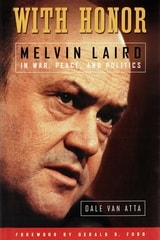
With Honor
Melvin Laird in War, Peace, and PoliticsVan Atta
University of Wisconsin Press, 2008
The first book ever to focus on Laird’s legacy, this authorized biography reveals his central and often unrecognized role in managing the crisis of national identity sparked by the Vietnam War—and the challenges, ethical and political, that confronted him along the way. Drawing on exclusive interviews with Laird, Henry Kissinger, Gerald Ford, and numerous others, author Dale Van Atta offers a sympathetic portrait of a man striving for open government in an atmosphere fraught with secrecy. Van Atta illuminates the inner workings of high politics: Laird’s behind-the-scenes sparring with Kissinger over policy, his decisions to ignore Nixon’s wilder directives, his formative impact on arms control and health care, his key role in the selection of Ford for vice president, his frustration with the country’s abandonment of Vietnamization, and, in later years, his unheeded warning to Donald Rumsfeld that “it’s a helluva lot easier to get into a war than to get out of one.”
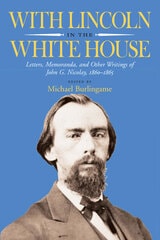
With Lincoln in the White House
Letters, Memoranda, and other Writings of John G. Nicolay, 1860-1865Edited by Michael Burlingame
Southern Illinois University Press, 2000
From the time of Lincoln’s nomination for the presidency until his assassination, John G. Nicolay served as the Civil War president’s chief personal secretary. Nicolay became an intimate of Lincoln and probably knew him as well as anyone outside his own family. Unlike John Hay, his subordinate, Nicolay kept no diary, but he did write several memoranda recording his chief’s conversation that shed direct light on Lincoln. In his many letters to Hay, to his fiancée, Therena Bates, and to others, Nicolay often describes the mood at the White House as well as events there. He also expresses opinions that were almost certainly shaped by the president
For this volume, Michael Burlingame includes all of Nicolay’s memoranda of conversations, all of the journal entries describing Lincoln’s activities, and excerpts from most of the nearly three hundred letters Nicolay wrote to Therena Bates between 1860 and 1865. He includes letters and portions of letters that describe Lincoln or the mood at the White House or that give Nicolay’s personal opinions. He also includes letters written by Nicolay while on troubleshooting missions for the president.
An impoverished youth, Nicolay was an unlikely candidate for the important position he held during the Civil War. It was only over the strong objections of some powerful people that he became Lincoln’s private secretary after Lincoln’s nomination for the presidency in 1860. Prominent Chicago Republican Herman Kreismann found the appointment of a man so lacking in savoir faire
Lacking charm, Nicolay became known at the White House as the “bulldog in the ante-room” with a disposition “sour and crusty.” California journalist Noah Brooks deemed Nicolay a “grim Cerberus of Teutonic descent who guards the last door which opens into the awful presence.” Yet in some ways he was perfectly suited for the difficult job. William O. Stoddard, noting that Nicolay was not popular and could “say 'no'about as disagreeably as any man I ever knew,” still granted that Nicolay served Lincoln well because he was devoted and incorruptible. Stoddard concluded that Nicolay “deserves the thanks of all who loved Mr. Lincoln.”
For his part, Nicolay said he derived his greatest satisfaction “from having enjoyed the privilege and honor of being Mr. Lincoln’s intimate and official private secretary, and of earning his cordial friendship and perfect trust.”
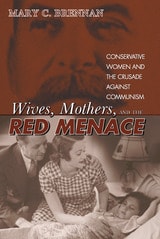
Wives, Mothers, and the Red Menace
Conservative Women and the Crusade against CommunismMary Brennan
University Press of Colorado, 2027
Brennan details the actions and experiences of prominent anti-communists Jean Kerr McCarthy, Margaret Chase Smith, Freda Utley, Doloris Thauwald Bridges, Elizabeth Churchill Brown, and Phyllis Stewart Schlafly. She describes the Cold War context in which these women functioned and the ways in which women saw communism as a very real danger to domestic security and American families. Millions of women, Brennan notes, expanded their notions of household responsibilities to include the crusade against communism. From writing letters and hosting teas to publishing books and running for political office, they campaigned against communism and, incidentally, discovered the power they had to effect change through activism.
Brennan reveals how the willingness of these deeply conservative women to leave the domestic sphere and engage publicly in politics evinces the depth of America's postwar fear of communism. She further argues that these conservative, anti-communist women pushed the boundaries of traditional gender roles and challenged assumptions about women as political players by entering political life to publicly promote their ideals.Wives, Mothers, and the Red Menace offers a fascinating analysis of gender and politics at a critical point in American history. Brennan's work will instigate discussions among historians, political scientists, and scholars of women's studies.

Wizards
David Duke, America's Wildest Election, and the Rise of the Far RightBrian Fairbanks
Vanderbilt University Press, 2022
A surging Republican populist.
The Democrat, hounded by corruption allegations; the Republican, dogged by business failures and ties to white supremacists.
The Republican turned out thousands of screaming supporters for speeches blaming illegal immigrants and crime on the Democrats, and the Democrat plummeted in the polls.
Sound familiar?
The '91 Louisiana Governor's race was supposed to be forgettable. But when former KKK Grand Wizard David Duke shocked the nation by ousting incumbent Republican Governor Buddy Roemer in the primary, the world took notice. Democrat Edwin Edwards, a former three-term governor and two-time corruption defendant, was left alone to face Duke in the general election—and he was going to lose.
Then a little-known state committeewoman stepped in with evidence of Duke's nefarious past. Could her evidence be enough to sway the minds of fired-up voters, or would Louisiana welcome a far-right radical into the highest office in the state?
Journalist Brian Fairbanks explores how the final showdown between Duke and Edwards in November 1991 led to a major shift in our national politics, as well as the rise of the radical right and white supremacist groups, and how history repeated itself in the 2016 presidential election. The story of these political "wizards," almost forgotten by history, remains eerily prescient and disturbingly relevant, and a compulsive page-turner.
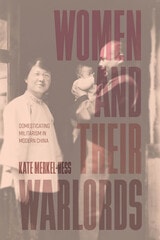
Women and Their Warlords
Domesticating Militarism in Modern ChinaKate Merkel-Hess
University of Chicago Press, 2024
In Women and Their Warlords, historian Kate Merkel-Hess examines the lives and personalities of the female relatives of the military rulers who governed regions of China from 1916 to 1949. Posing for candid photographs and sitting for interviews, these women did not merely advance male rulers’ agendas. They advocated for social and political changes, gave voice to feminist ideas, and shaped how the public perceived them. As the first publicly political partners in modern China, the wives and concubines of Republican-era warlords changed how people viewed elite women’s engagement in politics. Drawing on popular media sources, including magazine profiles and gossip column items, Merkel-Hess draws unexpected connections between militarism, domestic life, and state power in this insightful new account of gender and authority in twentieth-century China.
Women in Contemporary Mexican Politics
By Victoria E. Rodríguez
University of Texas Press, 2003
Since the mid-1980s, a dramatic opening in Mexico's political and electoral processes, combined with the growth of a new civic culture, has created unprecedented opportunities for women and other previously repressed or ignored groups to participate in the political life of the nation. In this book, Victoria Rodríguez offers the first comprehensive analysis of how Mexican women have taken advantage of new opportunities to participate in the political process through elected and appointed office, nongovernmental organizations, and grassroots activism.
Drawing on scores of interviews with politically active women conducted since 1994, Rodríguez looks at Mexican women's political participation from a variety of angles. She analyzes the factors that have increased women's political activity: from the women's movement, to the economic crises of the 1980s and 1990s, to increasing democratization, to the victory of Vicente Fox in the 2000 presidential election. She maps out the pathways that women have used to gain access to public life and also the roadblocks that continue to limit women's participation in politics, especially at higher levels of government. And she offers hopeful, yet realistic predictions for women's future participation in the political life of Mexico.
Women in the Club
Gender and Policy Making in the SenateMichele L. Swers
University of Chicago Press, 2013
In the run-up to the 2012 presidential election, Democrats and Republicans were locked in a fierce battle for the female vote. Democrats charged Republicans with waging a “war on women,” while Republicans countered that Democratic policies actually undermined women’s rights. The women of the Senate wielded particular power, planning press conferences, appearing on political programs, and taking to the Senate floor over gender-related issues such as workplace equality and reproductive rights.
The first book to examine the impact of gender differences in the Senate, Women in the Club is an eye-opening exploration of how women are influencing policy and politics in this erstwhile male bastion of power. Gender, Michele L. Swers shows, is a fundamental factor for women in the Senate, interacting with both party affiliation and individual ideology to shape priorities on policy. Women, for example, are more active proponents of social welfare and women’s rights. But the effects of gender extend beyond mere policy preferences. Senators also develop their priorities with an eye to managing voter expectations about their expertise and advancing their party’s position on a given issue. The election of women in increasing numbers has also coincided with the evolution of the Senate as a highly partisan institution. The stark differences between the parties on issues pertaining to gender have meant that Democratic and Republican senators often assume very different roles as they reconcile their policy views on gender issues with the desire to act as members of partisan teams championing or defending their party’s record in an effort to reach various groups of voters.
Women in the South African Parliament
FROM RESISTANCE TO GOVERNANCEHannah Evelyn Britton
University of Illinois Press, 2005
Although the international press closely chronicled the dismantling of South Africa's apartheid policies, it paid little attention to the unique role women from a variety of political parties played in establishing the new government. Utilizing interviews, participant observation, and archival research, Women in the South African Parliament tells an inspiring story of liberation, showing how these women achieved electoral success, learned to work with lifelong enemies, and began to transform Parliament by creating more space for women's voices during a critical time in the life of their democracy.
Arguing from her detailed analysis of the strategies and political tactics used by these South African women, both individually and collectively, Hannah Britton contends that, contrary claims in earlier studies of the developing world, mobilization by women prior to a transition to democracy can lead to gains after the transition--including improvements in constitutional mandates, party politics, and representation. At the same time, Britton demonstrates that not even national leadership can ensure power for all women and that many who were elected to South Africa's first democratic parliament declined to run again, feeling they could have a greater impact working in their own communities.
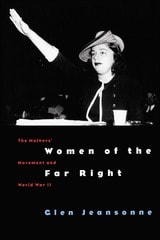
Women of the Far Right
The Mothers' Movement and World War IIGlen Jeansonne
University of Chicago Press, 1996
Unlike leftist antiwar movements, the mothers' movement was not pacifist; its members opposed the war on Germany because they regarded Hitler as an ally against the spread of atheistic communism. They also differed from leftist women in their endorsement of patriarchy and nationalism. God, they believed, wanted them to fight the New Deal liberalism that imperiled their values and the internationalists, communists, and Jews, whom they saw as subjugating Christian America.
Jeansonne examines the motivations of these women, the political and social impact of their movement, and their collaborations with men of the far right and also with mainstream isolationists such as Charles Lindbergh. Drawing on files kept by the FBI and other confidential documents, this book sheds light on the history of the war era and on women's place within the far right.
Women's Organizations and Democracy in South Africa
Contesting AuthorityShireen Hassim
University of Wisconsin Press, 2006
The transition to democracy in South Africa was one of the defining events in twentieth-century political history. The South African women’s movement is one of the most celebrated on the African continent. Shireen Hassim examines interactions between the two as she explores the gendered nature of liberation and regime change. Her work reveals how women’s political organizations both shaped and were shaped by the broader democratic movement. Alternately asserting their political independence and giving precedence to the democratic movement as a whole, women activists proved flexible and remarkably successful in influencing policy. At the same time, their feminism was profoundly shaped by the context of democratic and nationalist ideologies. In reading the last twenty-five years of South African history through a feminist framework, Hassim offers fresh insights into the interactions between civil society, political parties, and the state.
Hassim boldly confronts sensitive issues such as the tensions between autonomy and political dependency in feminists’ engagement with the African National Congress (ANC) and other democratic movements, and black-white relations within women’s organizations. She offers a historically informed discussion of the challenges facing feminist activists during a time of nationalist struggle and democratization.
Winner, Victoria Schuck Award for best book on women and politics, American Political Science Association
“An exceptional study, based on extensive research. . . . Highly recommended.”—Choice
“A rich history of women’s organizations in South African . . . . [Hassim] had observed at first hand, and often participated in, much of what she described. She had access to the informants and private archives that so enliven the narrative and enrich the analysis. She provides a finely balanced assessment.”—Gretchen Bauer, African Studies Review

Women, Gender, and the Palace Households in Ottoman Tunisia
By Amy Aisen Kallander
University of Texas Press, 2013
In this first in-depth study of the ruling family of Tunisia in the eighteenth and nineteenth centuries, Kallander investigates the palace as a site of familial and political significance. Through extensive archival research, she elucidates the domestic economy of the palace as well as the changing relationship between the ruling family of Tunis and the government, thus revealing how the private space of the palace mirrored the public political space.
“Instead of viewing the period as merely a precursor to colonial occupation and the nation-state as emphasized in precolonial or nationalist histories, this narrative moves away from images of stagnation and dependency to insist upon dynamism,” Kallander explains. She delves deep into palace dynamics, comparing them to those of monarchies outside of the Ottoman Empire to find persuasive evidence of a global modernity. She demonstrates how upper-class Muslim women were active political players, exerting their power through displays of wealth such as consumerism and philanthropy. Ultimately, she creates a rich view of the Husaynid dynastic culture that will surprise many, and stimulate debate and further research among scholars of Ottoman Tunisia.
Work, Race, and the Emergence of Radical Right Corporatism in Imperial Germany
Dennis Sweeney
University of Michigan Press, 2010
---Andrew Zimmerman, George Washington University
Workers against the City
The Fight for Free Speech in Hague v. CIODonald W. Rogers
University of Illinois Press, 2020
Clear-eyed and comprehensive, Workers against the City revises the view of a milestone case that continues to impact Americans' constitutional rights today.
Working on the Railroad, Walking in Beauty
Navajos, Hozho, and Track WorkJay Youngdahl
Utah State University Press, 2011
For over one hundred years, Navajos have gone to work in significant numbers on Southwestern railroads. As they took on the arduous work of laying and anchoring tracks, they turned to traditional religion to anchor their lives.
Jay Youngdahl, an attorney who has represented Navajo workers in claims with their railroad employers since 1992 and who more recently earned a master's in divinity from Harvard, has used oral history and archival research to write a cultural history of Navajos' work on the railroad and the roles their religious traditions play in their lives of hard labor away from home.
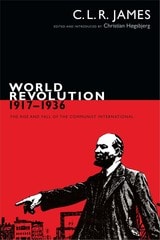
World Revolution, 1917–1936
The Rise and Fall of the Communist InternationalC. L. R. James
Duke University Press, 2017

Wounded Warrior
The Rise and Fall of Michigan Governor John SwainsonLawrence M. Glazer
Michigan State University Press, 2010
Few people today remember John Swainson. As a teenage soldier he lost both legs in a WWII landmine explosion. Back in the United States, following a meteoric political rise in the Michigan State Senate, Swainson was elected as Michigan's youngest governor since Stevens T. Mason.
In 1970 Swainson was elected to the Michigan Supreme Court, becoming one of the few public officials to have served in the legislative, executive, and judicial branches of state government. Then, in 1957, he was indicted on federal charges of bribery and perjury, and convicted of lying to a federal grand jury. Forced to leave the state Supreme Court and disbarred from practicing law, he became a pariah, sinking into depression and alcoholism. He virtually disappeared from public view.
Lawrence M. Glazer re-examines the FBI's investigation of Swainson and delves into his 1975 trial in detail. He reveals new information from eye-witnesses who never testified and, in a poignant coda, relates the little-known story of Swainson's rehabilitation and return to public life as a historian.
Wrecked
Deinstitutionalization and Partial Defenses in State Higher Education PolicyBarrett J. Taylor
Rutgers University Press, 2022
Writing Revolution
Hispanic Anarchism in the United StatesEdited by Christopher J. Castañeda and Montse Feu
University of Illinois Press, 2019
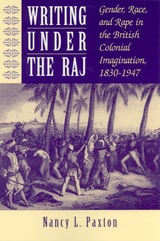
Writing Under the Raj
Gender, Race, and Rape in the British Colonial Imagination, 1830-1947Nancy L. Paxton
Rutgers University Press, 1999
Writing Under the Raj is the first study to challenge the long-held critical assumption that the rape of colonizing women by colonized men was the first, or the only, rape script in British colonial literature. Nancy Paxton asks why rape disappears in British literature about English domestic life in the 1790s and charts its reappearance in British literature about India written between 1830 and 1947. Paxton displays the hybrid qualities of familiar novels like Kipling’s Kim and Forster’s A Passage to India by situating them in a richly detailed cultural context that reveals the dynamic relationship between metropolitan British literature and novels written by men and women who lived in the colonial contact zone of British India throughout this period.
Drawing on current feminist and gender theory as well as a wide range of historical and cultural sources, Paxton identifies four different “scripts” about interracial and intraracial rape that appear in novels about India during the period of British rule. Surveying more than thirty canonized and popular Anglo-Indian novels, Paxton shows how the treatment of rape reflects basic conflicts in the social and sexual contracts defining British and Indian women’s relationship to the nation state throughout the period. This study reveals how and why novels written after the Indian Uprising of 1857 popularized the theme of English women victimized by Indian men. Paxton demonstrates how all these novels reflect unresolved ideological and symbolic conflicts in British ideas about sex, violence, and power.

Writing and the West German Protest Movements
The Textual RevolutionMererid Puw Davies
University of London Press, 2016