Results by title
2285 books match the query 'Women' and 321 start with w
Whose School Is It?
Women, Children, Memory, and Practice in the CityBy Rhoda H. Halperin
University of Texas Press, 2006
Whose School Is It?: Women, Children, Memory, and Practice in the City is a success story with roadblocks, crashes, and detours. Rhoda Halperin uses feminist theorist and activist Gloria Anzaldúa's ideas about borderlands created by colliding cultures to deconstruct the creation and advancement of a public community charter school in a diverse, long-lived urban neighborhood on the Ohio River. Class, race, and gender mix with age, local knowledge, and place authenticity to create a page-turning story of grit, humor, and sheer stubbornness. The school has grown and flourished in the face of daunting market forces, class discrimination, and an increasingly unfavorable national climate for charter schools. Borderlands are tense spaces. The school is a microcosm of the global city.
Many theoretical strands converge in this book—feminist theory, ideas about globalization, class analysis, and accessible narrative writing—to present some new approaches in urban anthropology. The book is multi-voiced and nuanced in ways that provide authenticity and texture to the real circumstances of urban lives. At the same time, identities are threatened as community practices clash with rules and regulations imposed by outsiders.
Since it is based on fifteen years of ethnographic fieldwork in the community and the city, Whose School Is It? brings unique long-term perspectives on continuities and disjunctures in cities. Halperin's work as researcher and advocate also provides insider perspectives that are rare in the literature of urban anthropology.

Why Do They Kill?
Men Who Murder Their Intimate PartnersDavid Adams
Vanderbilt University Press, 2007
Key turning points of these relationships include the first emergence of the man's violence, his blaming of the victim, her attempts to resist, his escalation, her attempts to end the relationship, and his punishment for her defiance. Critical perspective on the men's accounts comes from interviews with victims of attempted homicide (standing in for the murder victims) who survived shootings, stabbings, and strangulation. These women detail their partner's escalating patterns of child abuse, sexual violence, terroristic threats, and stalking. The section on help-seeking patterns of victims helps to dispel notions of learned helplessness among victims.
Widow City
Gender, Emotion, and Community in the Italian RenaissanceAnna Wainwright
University of Delaware Press, 2025

Widows by the Thousand
The Civil War Correspondence of Theophilus and Harriet Perry, 1862–1864M. Jane Johansson
University of Arkansas Press, 2000
Widows' Words
Women Write on the Experience of Grief, the First Year, the Long Haul, and Everything in BetweenRutgers University Press, 2019
Some were widowed young, while others were married for decades. Some cared for their late partners through long terminal illnesses, while others lost their partners suddenly. Some had male partners, while others had female partners. Yet each of these women faced the same basic dilemma: how to go on living when a part of you is gone.
Widows’ Words is arranged chronologically, starting with stories of women preparing for their partners’ deaths, followed by the experiences of recent widows still reeling from their fresh loss, and culminating in the accounts of women who lost their partners many years ago but still experience waves of grief. Their accounts deal honestly with feelings of pain, sorrow, and despair, and yet there are also powerful expressions of strength, hope, and even joy. Whether you are a widow yourself or have simply experienced loss, you will be sure to find something moving and profound in these diverse tales of mourning, remembrance, and resilience.
Wife and Widow in Medieval England
Sue Sheridan Walker, Editor
University of Michigan Press, 1993

Wild One
The Literary Life of Selma LagerlöfAnna Nordlund
University of Minnesota Press, 2027
The definitive English-language biography of Sweden’s most celebrated novelist
Wild One details the captivating life of Selma Lagerlöf (1858–1940), the most celebrated Swedish novelist of her time and the first woman to win the Nobel Prize for Literature. Best known for her classic books The Saga of Gösta Berling and The Wonderful Adventures of Nils, Lagerlöf wrote dozens of acclaimed works and used her fame to advocate for women’s rights, humanitarian causes, and international peace. During her lifetime, however, even though she introduced Neo-Romanticism to Scandinavian literature, the male-dominated literary establishment strategically tried to downplay her as a modest spinster who reworked old stories and folktales from her rural Swedish province of Värmland.
Anna Nordlund and Jennifer Watson describe how, behind the old-fashioned public image placed on her, Lagerlöf was always on the front line, a forward-looking innovator whose writing is distinguished by inventive structures and a deep understanding of modern psychology. A savvy promoter of her own career, she utilized the new medium of radio, invested in the nascent Swedish film industry as adaptations of her novels became international sensations, and closely tracked translations of her work. After winning the Nobel Prize in 1909, Lagerlöf became even more vocal in her support for women’s rights and suffrage.
Drawing on a wide range of sources, including private letters, Nordlund and Watson offer new insights into Lagerlöf’s remarkable personal life, including her passionate love for her frequent traveling companion, Sophie Elkan, and for fellow suffragette Valborg Olander. As Wild One makes clear, through her written works and social activism Lagerlöf embodied her own famous quotation: “I want to set the world in motion.”
Retail e-book files for this title are screen-reader friendly with images accompanied by short alt text and/or extended descriptions.
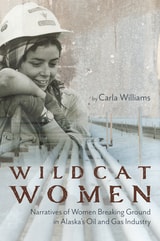
Wildcat Women
Narratives of Women Breaking Ground in Alaska's Oil and Gas IndustryCarla Williams
University of Alaska Press, 2018

Wind–Mountain–Oak
The Poems of SapphoDan Beachy-Quick
Tupelo Press, 2023

Winifred Sanford
The Life and Times of a Texas WriterBetty Holland Wiesepape
University of Texas Press, 2013
Winifred Sanford is generally regarded by critics as one of the best and most important early twentieth-century Texas women writers, despite publishing only a handful of short stories before slipping into relative obscurity. First championed by her mentor, H. L. Mencken, and published in his magazine, The American Mercury, many of Sanford’s stories were set during the Texas oil boom of the 1920s and 1930s and offer a unique perspective on life in the boomtowns during that period. Four of her stories were included in The Best American Short Stories of 1926.
Questioning the sudden end to Sanford’s writing career, Wiesepape, a leading literary historian of Texas women writers, delved into the author’s previously unexamined private papers and emerged with an insightful and revealing study that sheds light on both Sanford’s abbreviated career and the domestic lives of women at the time. The first in-depth account of Sanford’s life and work, Wiesepape’s biography discusses Sanford’s fiction through the lens of the sociohistorical contexts that shaped and inspired it. In addition, Wiesepape has included two previously unpublished stories as well as eighteen previously unpublished letters to Sanford from Mencken.
Winifred Sanford is an illuminating biography of one of the state’s unsung literary jewels and an important and much-needed addition to the often overlooked field of Texas women’s writing.
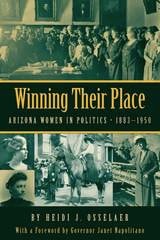
Winning Their Place
Arizona Women in Politics, 1883-1950Heidi J. Osselaer
University of Arizona Press, 2009
This landmark book chronicles for the first time the participation of Arizona women in the state’s early politics. Incorporating impressive original research, Winning Their Place traces the roots of the political participation of women from the territorial period to after World War II. Although women in Arizona first entered politics for traditional reasons—to reform society and protect women and children—they quickly realized that male politicians were uninterested in their demands. Most suffrage activists were working professional women, who understood that the work place discriminated against them. In Arizona they won the vote because they demanded rights as working women and aligned with labor unions and third parties that sympathized with their cause. After winning the vote, the victorious suffragists ran for office because they believed men could not and would not represent their interests.
Through this process, these Arizona women became excellent politicians. Unlike women in many other states, women in Arizona quickly carved out a place for themselves in local and state politics, even without the support of the reigning Democratic Party, and challenged men for county office, the state legislature, state office, Congress, and even for governor. This fascinating book reveals how they shattered traditional notions about “a woman’s place” and paved the way for future female politicians, including the “Fab Five” and countless others who have changed the course of Arizona history.
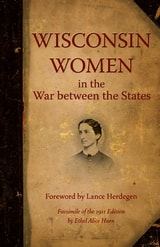
Wisconsin Women in the War between the States
Ethel Hurn
Wisconsin Historical Society Press, 2013
“There was too much to be done by the most of us, to keep the wolf from the door, to give way to our feelings, and it was better so. It gave us the feeling that we, too, although not enlisted in the ranks South, had a battle to fight at home on more than one line, and the worst of all was to keep up hope against hope, that our loved ones would be spared to come back to us…”
As the fiftieth anniversary of the American Civil War neared, the Wisconsin History Commission was established to develop and publish a series of “original papers” on Wisconsin’s role in what was officially called the War of Rebellion. Picked as the sixth selection and published in May 1911 was Wisconsin Women in the War between the States by Ethel Alice Hurn. In many ways it was a landmark effort. It was one of the first formal recognitions—not only in Wisconsin but nationally—of the overlooked and almost forgotten role Northern women played in 1861–1865.
The author of the study was Ethel Hurn of Oshkosh, then a student at the University of Wisconsin. Gathering the material for the book proved a daunting task. During the Civil War era women could not vote, hold bank accounts, or take a direct role in business. Nevertheless, in the time of national crisis, women took over farms and shops and other endeavors, and some left quiet family hearths to move onto the public stage. They prepared food, sewed and laundered, knitted socks and gloves, and organized campaigns and fairs as relief efforts that raised millions of dollars to aid wounded soldiers and assist war widows and orphans. However, these women’s work was generally undertaken without thought of keeping a formal record. It could be found only in scattered collections of letters, newspaper files, several interviews, and the brief reports and pamphlets of soldier fairs and soldiers’ aid societies.
Wisconsin Women in the War between the States is just as significant today as it was a century ago because it documented an important turning point in the changing role of women in American society. Other scholars have added to the record in the passing years, but Hurn’s groundbreaking book is welcomed back in print during this 150th anniversary of the American Civil War to be discovered and enjoyed as well as to enlighten a new generation of readers.
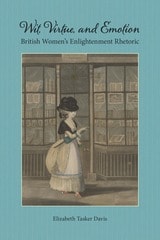
Wit, Virtue, and Emotion
British Women's Enlightenment RhetoricElizabeth Tasker Davis
Southern Illinois University Press, 2022
Women’s persuasion and performance in the Age of Enlightenment
Over a century before first-wave feminism, British women’s Enlightenment rhetoric prefigured nineteenth-century feminist arguments for gender equality, women’s civil rights, professional opportunities, and standardized education. Author Elizabeth Tasker Davis rereads accepted histories of seventeenth- and eighteenth-century British rhetoric, claiming a greater variety and power of women’s rhetoric. This recovery of British women’s performative and written roles as speakers, spectators, authors, and readers in diverse venues counters the traditional masculine model of European Enlightenment rhetoric. Davis broadens women’s Enlightenment rhetorics to include highly public venues such as theaters, clubs, salons, and debating societies, as well as the mediated sites of the periodical essay, the treatise on rhetorical theory, and women’s written proposals, plans, defenses and arguments for education. Through these sites, women’s rhetorical postures diverged from patriarchal prescriptions rather to deliver protofeminist persuasive performances of wit, virtue, and emotion.
Davis examines context, the effects of memory and gendering, and the cultural sites and media of women’s rhetoric to reveal a fuller ecology of British Enlightenment rhetoric. Each chapter covers a cultural site of women’s rhetorical practice—the court, the stage, the salon, and the printed page. Applying feminist rhetorical theory, Davis documents how women grasped their rhetorical ability in this historical moment and staged a large-scale transformation of British women from subalterns to a vocal counterpublic in British society.
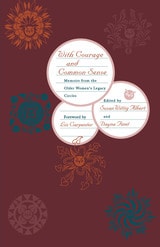
With Courage and Common Sense
Memoirs from the Older Women's Legacy CirclesEdited by Susan Wittig Albert and Dayna Finet
University of Texas Press, 2003
Women who were sixty or older at the turn of the twenty-first century have lived through some of recent history's most momentous moments—and yet these women often believe that their personal lives and stories are insignificant, not worthy of being recorded for future generations. To change that perception and capture some of these life stories before they are lost, the Story Circle Network, a national organization dedicated to helping women write about their lives, developed the Older Women's Legacy (OWL) Circle Memoir Workshops. During the first two years of the project (1998-2000), nearly 500 older women participated in workshops that offered them the opportunity and encouragement to reflect on and create written records of their lives.
With Courage and Common Sense presents an extensive selection of memoirs from the OWL Circle project. Organized thematically, they describe women's experiences of identity, place, work, family life, love and marriage, loss and healing, adventures great and small, major historical events, and legacies to keep and pass along. Taken as a whole, the memoirs chronicle far-reaching changes in the ways that women participated in the world during the twentieth century. They show how women learned to surmount obstacles, to courageously make the most of the opportunities that came their way, and to move quietly and wisely beyond the limits that were imposed upon them.
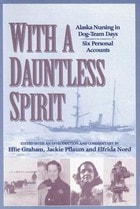
With a Dauntless Spirit
Alaska Nursing in Dog-Team Days.Effie Graham
University of Alaska Press, 2003
With a Dauntless Spirit compiles a unique collection of journals, letters, and memoirs that give immediacy and vitality to the lives of these women. They ventured with a sense of duty and compassion to deliver much-needed medical services before the technical, medical, and social changes brought to Alaska by World War II and later by statehood. Despite physical hardships and emotional isolation, the spirit of these women is reflected in the adventurous, dramatic, and even joyous tone of their narratives. The arctic tests the character of many newcomers, and the nurses recount the very personal challenges that demanded choices and actions that ran contrary to their earlier socialization. Their personal sagas also have significant historical dimensions. They depict the major cultural encounters of their era that were to have such a profound impact on Alaska's future-with Native peoples, prospectors, aviation pioneers, and arctic explorers.
This collection was selected from personal and archival sources by Alaska nurse educators and historians, who provide background and commentary, a brief biography of each person, and historical photos and maps of the nurses' lives and work. With a Dauntless Spirit is a readable and engrossing account that makes an important and overdue contribution to Alaska history and women's history.
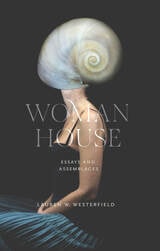
Woman House
Essays and AssemblagesLauren W. Westerfield
University of Massachusetts Press, 2026
Winner of the National Indie Excellence Award in Memoir and the National Indie Excellence Awards Juror's Choice Prize
A compelling and inventive memoir exploring how pain and pleasure are passed down through generations of women
For years, Lauren W. Westerfield looked back at her childhood as an imaginative playscape lovingly crafted by her artist mother. But in truth, theirs was always a fraught relationship, close yet turbulent. It wouldn’t be until her mid-twenties that Westerfield would learn that her mother was assaulted while living as a single woman in 1970s Los Angeles, or until her mid-thirties when caretaking for her now chronically ill mother during pandemic lockdown would reveal how that earlier incident and its ripple effects had shaped both their lives.
The essays and assemblages in this book plumb the depths of two women’s experiences, exploring the pain and pleasure they find in their bodies, in culture, and in their own art. Violence, beauty, and love reverberate and dissipate and shape the forms and psyches of these two profoundly connected family members. At once raw and refined, narrative and lyrical, nostalgic and blunt, the stories and images presented here explore Westerfield’s life—from childhood to adulthood—passing through innocence, self-discovery and familial tethers. In unpacking her mother’s history and the complexities of their relationship, Westerfield finds herself confronted with her own story: one grounded in a yearning for agency and individuation, of a body and mind groomed to be at odds with one another, of a feminist politics examining deeply rooted patriarchal understandings of beauty, control, and power.
Part memoir, part critical sense-making, part reckoning with family, identity, illness, addiction, art, and inheritance, Woman House draws on diverse inspirations in an attempt to recontextualize the female body—in danger, in pleasure, in portraiture, in proximity, in resistance—and challenge the structures that silence and restrict female expression.
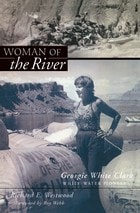
Woman Of The River
Georgie White Clark, Whitewater PioneerRichard Westwood
Utah State University Press, 1997
Georgie White Clark-adventurer, raconteur, eccentric--first came to know the canyons of the Colorado River by swimming portions of them with a single companion. She subsequently hiked and rafted portions of the canyons, increasingly sharing her love of the Colorado River with friends and acquaintances. At first establishing a part-time guide service as a way to support her own river trips, she went on to become perhaps the canyons' best-known river guide, introducing their rapids to many others-on the river, via her large-capacity rubber rafts, and across the nation, via magazine articles and movies. Georgie Clark saw the river and her sport change with the building of Glen Canyon Dam, enormous increases in the popularity of river running, and increased National Park Service regulation of rafting and river guides. Adjusting, though not always easily, to the changes, she helped transform an elite adventure sport into a major tourist activity.
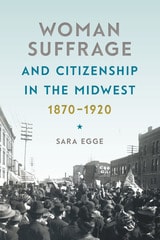
Woman Suffrage and Citizenship in the Midwest, 1870-1920
Sara Egge
University of Iowa Press, 2018
Winner of the 2019 Gita Chaudhuri Prize
Winner of the 2019 Benjamin F. Shambaugh Award
Historian Sara Egge offers critical insights into the woman suffrage movement by exploring how it emerged in small Midwestern communities—in Clay County, Iowa; Lyon County, Minnesota; and Yankton County, South Dakota. Examining this grassroots activism offers a new approach that uncovers the sophisticated ways Midwestern suffragists understood citizenship as obligation.
These suffragists, mostly Yankees who migrated from the Northeast after the Civil War, participated enthusiastically in settling the region and developing communal institutions such as libraries, schools, churches, and parks. Meanwhile, as Egge’s detailed local study also shows, the efforts of the National American Women’s Suffrage Association did not always succeed in promoting the movement’s goals. Instead, it gained support among Midwesterners only when local rural women claimed the right to vote on the basis of their well-established civic roles and public service.
By investigating civic responsibility, Egge reorients scholarship on woman suffrage and brings attention to the Midwest, a region overlooked by most historians of the movement. In doing so, she sheds new light onto the ways suffragists rejuvenated the cause in the twentieth century.
Woman and Chinese Modernity
The Politics of Reading between West and EastRey Chow
University of Minnesota Press, 1991
Examines the relationship of “woman” to issues of non-western culture.
Examines the relationship of "woman" to issues of non-Western culture: ethnic spectatorship, popular literature, the construction of literary history, and the revolutionary production and emotional reception of national literature.

Woman at Work
The Autobiography of Mary Anderson as told to Mary N. WinslowMary Anderson
University of Minnesota Press, 1951
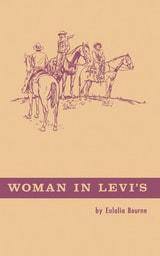
Woman in Levi's
Eulalia Bourne
University of Arizona Press, 1967
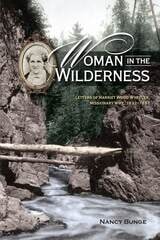
Woman in the Wilderness
Letters of Harriet Wood Wheeler, Missonary Wife, 1832-1892Nancy Bunge
Michigan State University Press, 2010
Harriet's letters reveal her experiences with actors and institutions that played pivotal roles in the history of American women: the nascent literate female work force at the mills in Lowell, Massachusetts; the Ipswich Female Seminary, which was one of the first schools for women teachers; women's associations, especially in churches; and the close and enduring ties that characterized women's relationships in the late nineteenth century.
Harriet's letters also provide an intimate view of the relationships between American Indians and Euro-Americans in the Great Lakes region, where she settled with her Christian missionary husband.
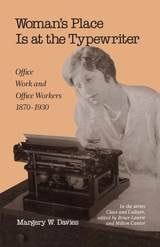
Woman'S Place Is At The Typewriter
Margery W. Davies
Temple University Press, 1984
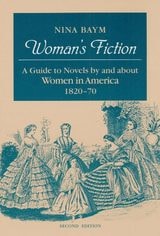
Woman's Fiction
A Guide to Novels by and about Women in America, 1820-70Nina Baym. With a New Introduction and Supplementary Bibliography
University of Illinois Press, 1993
This reissue of the pioneering and standard book on antebellum women's domestic novels contains a new introduction situating the book in the context of important recent developments in the study of women's writing. Nina Baym considers 130 novels by 48 women, focusing on the works of a dozen especially productive and successful writers.
Woman's Fiction is a major-work in nineteenth-century literature, reexamining changes in the literary canon and the meaning of sentimentalism, while responding to current critical discussions of 'the body' in literary texts.
Wombs and Alien Spirits
Women, Men, and the Zar Cult in Northern SudanJanice Boddy
University of Wisconsin Press, 1989
Based on nearly two years of ethnographic fieldwork in a Muslim village in northern Sudan, Wombs and Alien Spirits explores the zâr cult, the most widely practiced traditional healing cult in Africa. Adherents of the cult are usually women with marital or fertility problems, who are possessed by spirits very different from their own proscribed roles as mothers. Through the woman, the spirit makes demands upon her husband and family and makes provocative comments on village issues, such as the increasing influence of formal Islam or encroaching Western economic domination. In accommodating the spirits, the women are able metaphorically to reformulate everyday discourse to portray consciousness of their own subordination.
Janice Boddy examines the moral universe of the village, discussing female circumcision, personhood, kinship, and bodily integrity, then describes the workings of the cult and the effect of possession on the lives of men as well as women. She suggests that spirit possession is a feminist discourse, though a veiled and allegorical one, on women's objectification and subordination. Additionally, the spirit world acts as a foil for village life in the context of rapid historical change and as such provides a focus for cultural resistance that is particularly, though not exclusively, relevant to women.
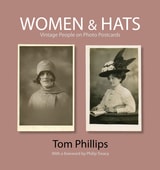
Women & Hats
Vintage People on Photo PostcardsTom Phillips
Bodleian Library Publishing, 2010
To celebrate the acquisition of the archive of distinguished artist Tom Phillips, the Bodleian Library asked the artist to assemble and design a series of books drawing on his themed collection of over 50,000 photographic postcards. These encompass the first half of the twentieth century, a period in which, thanks to the ever cheaper medium of photography, ordinary people could afford to own portraits of themselves. Each of the books in the series contains two hundred images chosen from a visually rich vein of social history. Their covers also feature thematically linked paintings, specially created for each title, from Phillips’s signature work, A Humument.
Women & Hats explores the remarkable range found in the world of millinery, from outrageous Edwardian creations to the inventive austerities of World War II. Each of these unique and visually stunning books give a rich glimpse of forgotten times and will be greatly valued by art and history lovers alike.
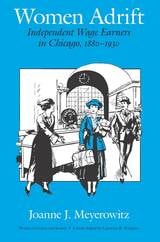
Women Adrift
Independent Wage Earners in Chicago, 1880-1930Joanne J. Meyerowitz
University of Chicago Press, 1988
"Brilliant. . . . Gracefully written, and mercifully free from the jargon that often plagues social history, this book is a welcome addition to literature in women's, urban, and black history."—Ann Schofield, American Historical Review
"Meyerowitz provides a splendid portrait of her subjects. . . . She deserves praise for her demographic spadework, sensitive analysis, and engaging style. This is a valuable and rewarding book."—Nancy Woloch, Journal of American History
"A state-of-the-art product of the new women's history. . . . Meyerowitz's work is an extremely useful contribution, a corrective to over-concentration on women in family, an opening to new ways of looking at single women."—Linda Gordon, Women's Review of Books
"Women Adrift not only brings together many of the most exciting insights of women's history in recent years, but Meyerowitz's particular angle on issues of work, family, sexuality, mass culture and relationships among women also encourages us to rethink these insights."—Ileen A. DeVault, Historian
Women Artists, Women Exiles
"Miss Grief" and Other Stories by Constance Fenimore WoolsonEdited by Joan Myers Weimar
Rutgers University Press, 1988
Woolson's early stories are witty and incisive critiques of those conventions of literary Romanticism that encode women's marginality. Set in the wilderness that surrounded the Great Lakes, these stories revise male literary texts to clear a space where women's voices can be heard.
In a group of stories set in the post-Civil War south, women artists are shown as exiles both away from their homes and from themselves. One superb tale, "Felipa," pairs a repressed woman artist with a wild child who rejects both patriarchal religion and approved heterosexual behavior. Woolson here explores the possibility of a collaboration between female wildness and female form of control.
Stories written during Woolson's years in Europe confront woman artists with successful male writers and critics who resemble Henry James. These carefully crafted stories reflect James's mixed impact on women artists: as a model literary realist and as a subtle denigrator of women's talent.
Joan Weimar's introduction uses unpublished letters to reconstruct and interpret Wool's life and her probable suicide. It places Woolson in the male and female literary traditions of her time and offers extended analysis of the stories.
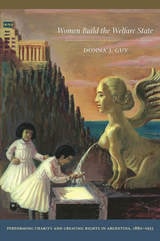
Women Build the Welfare State
Performing Charity and Creating Rights in Argentina, 1880–1955Donna J. Guy
Duke University Press, 2009
Drawing on extensive research in Argentine archives, Guy reveals significant continuities in Argentine history, including the rise of a liberal state that subsidized all kinds of women’s and religious groups. State and private welfare efforts became more organized in the 1930s and reached a pinnacle under Juan Perón, when men took over the welfare state and philanthropic and feminist women’s influence on child-welfare activities and policy declined. Comparing the rise of Argentina’s welfare state with the development of others around the world, Guy considers both why women’s child-welfare initiatives have not received more attention in historical accounts and whether the welfare state emerges from the top down or from the bottom up.
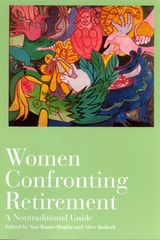
Women Confronting Retirement
A Nontraditional GuideEdited by Nan Bauer-Maglin and Alice Radosh
Rutgers University Press, 2003
Women Confronting Retirement showcases the voices of thirty-eight women from a wide range of professions, ages, and life situations as they confront the need to redefine who they are when they leave the workplace behind them. The women of the Baby Boom generation were the first to enter the professional world in large numbers, and the first to encounter the hazards of retirement. The contributors urge us to reach for new approaches to this major stage of life, to find new self-images, to balance meaningful work and creative play, and to work for the new public policies that support enhanced opportunities for retirement. Many of these women were involved in the key activist movements of the sixties and seventies, and their work often has been an extension of their social commitment. Defining themselves through their careers, they have challenged traditional models at every stage of their lives and are now being challenged by their own negative stereotypes about retirement.
The stories in this book compellingly chronicle the fears and hopes of women who have only begun to think about retirement, those who are in the process of retiring, some who have been retired for many years, and a few who have decided that retirement is not for them. They address issues such as identity, aging, creativity, family, and community. Unlike traditional “how-to” books, Women Confronting Retirement makes clear how individual the choices are, how there are no right and wrong answers to the many questions this uncharted stage of life poses for women of the Baby Boom generation, and those who follow. These women help us to explore the next steps with the same courage and questioning attitudes that they have brought to every aspect of their lives before they reached retirement age.
Women Employment & Family
In The International Division Of LaborSharon Stichter
Temple University Press, 1990
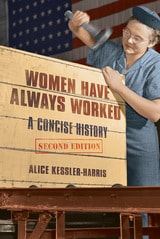
Women Have Always Worked
A Concise HistoryAlice Kessler-Harris
University of Illinois Press, 2018
Women In Latin America
Christine Bose
Temple University Press, 1995
Women In Utah History
Paradigm Or Paradox?Patricia Lyn Scott & Linda Thatcher
Utah State University Press, 2005
A Comparison of Utah Mormon Polygamous and Monogamous Women Jessie L. Embry and Lois Kelley
Women Living With Self-Injury
Jane Wegscheider Hyman
Temple University Press, 1999
In this book, author Jane Wegschneider sheds light on this misunderstood condition. Fifteen women talk about their battle with self-injury and explain how and why they repeatedly and deliberately injure themselves. Most admit they do it because it makes them feel high or safe. They also describe living with ceaseless shame, secrecy, and fear of discovery which could make them unemployable and ostracized. Candidly discussing their attempted and successful recoveries, they reveal the impact living with self-injury has on their day-to-day lives -- where they are competent workers, partners, friends, and mothers.
Hear the voices of these women as they speak to a public that generally sees self-injury as frightening, senseless, and repulsive. Concealing scars or other signs of injury is crucial for them and partly dictates their daily routines, choice of clothes, and the lies they tell to excuse any traces of injury. For these productive women who work outside of the home and often raise children, hiding self-injury is of paramount importance during their workdays and in their relationships with partners, families, and friends.
Hyman's approach is unique in that she not only talked to these women but also really listened to their stories -- something rare in the misunderstood realm of self-injury. Professionals, perplexed by self-injury, have not always tolerated its complexity. As a result those who injure themselves have remained shrouded in secrecy, isolation, and shame -- until now.
This book offers compassion as well as encouragement for recovery by making available the emotional experiences of sufferers in their own words. It is an important book for those who self-injure, their loved ones, anyone who knows of or suspects self-injury in a friend, and mental care professionals.
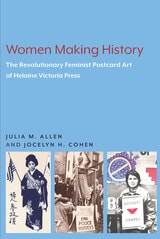
Women Making History
The Revolutionary Feminist Postcard Art of Helaine Victoria PressJulia M. Allen and Jocelyn H. Cohen
Lever Press, 2023
Nourished by the cultural exuberance of second wave feminism, Helaine Victoria Press was a home-grown effort of two young women, Jocelyn Cohen and Nancy Poore, who learned how to print, established a printshop, and became the first publishers of women’s history postcards. The authors of Women Making History demonstrate that by creating postcards, Helaine Victoria Press aimed to do more than provide a convenient writing surface or even affect collective memory. Instead, they argue, the press generated feminist memory. The cards, each with the picture of a woman or group of women from history, were multimodal. Pictures were framed in colors and borders appropriate to the era and subject. Lengthy captions offered details about the lives of the women pictured. Unlike other memorials, the cards were mobile: they traveled through the postal system, viewed along the way by the purchasers, mail sorters, mail carriers, and recipients. Upon arriving at their destinations, cards were often posted on office bulletin boards or refrigerators at home, where surroundings shaped their meanings.
This is the first book to demonstrate the relationships between the feminist art movement, the women in print movement, and the scholars studying women’s history. Readers will be drawn to both the large quantity of illustrative materials and the theoretical framework of the book, as it provides an expanded understanding of rhetorical multimodality.
Women Making War
Female Confederate Prisoners and Union Military JusticeThomas F. Curran
Southern Illinois University Press, 2020
During the American Civil War, more than four hundred women were arrested and imprisoned by the Union Army in the St. Louis area. The majority of these women were fully aware of the political nature of their actions and had made conscious decisions to assist Confederate soldiers in armed rebellion against the U.S. government. Their crimes included offering aid to Confederate soldiers, smuggling, spying, sabotaging, and, rarely, serving in the Confederate army. Historian Thomas F. Curran’s extensive research highlights for the first time the female Confederate prisoners in the St. Louis area, and his thoughtful analysis shows how their activities affected Federal military policy.
Early in the war, Union officials felt reluctant to arrest women and waited to do so until their conduct could no longer be tolerated. The war progressed, the women’s disloyal activities escalated, and Federal response grew stronger. Some Confederate partisan women were banished to the South, while others were held at Alton Military Prison and other sites. The guerilla war in Missouri resulted in more arrests of women, and the task of incarcerating them became more complicated.
The women’s offenses were seen as treasonous by the Federal government. By determining that women—who were excluded from the politics of the male public sphere—were capable of treason, Federal authorities implicitly acknowledged that women acted in ways that had serious political meaning. Nearly six decades before U.S. women had the right to vote, Federal officials who dealt with Confederate partisan women routinely referred to them as citizens. Federal officials created a policy that conferred on female citizens the same obligations male citizens had during time of war and rebellion, and they prosecuted disloyal women in the same way they did disloyal men.
The women arrested in the St. Louis area are only a fraction of the total number of female southern partisans who found ways to advance the Confederate military cause. More significant than their numbers, however, is what the fragmentary records of these women reveal about the activities that led to their arrests, the reactions women partisans evoked from the Federal authorities who confronted them, the impact that women’s partisan activities had on Federal military policy and military prisons, and how these women’s experiences were subsumed to comport with a Lost Cause myth—the need for valorous men to safeguard the homes of defenseless women.

Women March for Peace
Black Radical Women’s Anti-Korean War ActivismDenise Lynn
University of Massachusetts Press, 2025
The Korean War is commonly known as the “forgotten war” because it supposedly had little impact on American culture in comparison to World War II or the American War in Vietnam. Yet from 1950–1953, the conflict produced vigorous anti-war activism, particularly among Black radical women. Informed by their experiences with racism and misogyny within the US, these women were convinced that peace was not just the absence of military aggression, but that it required the liberation of the most oppressed, including the end of capitalist exploitation of women and People of Color and the return of self-determination to colonized peoples—themes that later anti-war activists would echo and develop. Whether or not the Korean War has ever truly been forgotten, the visionary activism of these women has been largely overlooked.
In Women March for Peace, Denise Lynn examines the lives of seven Black women—Louise Thompson Patterson, Claudia Jones, Charlotta Bass, Shirley Graham Du Bois, Eslanda Robeson, Lorraine Hansberry, and Beulah Richardson—and their resistance to domestic and foreign US policies during the height of anticommunist hysteria. While much peace scholarship focuses on the threat of nuclear conflict, Lynn instead explores how these women connected issues of civil rights at home with international military campaigns, highlights the hypocrisy of containment policies that sought to secure the freedom and rights for Koreans when US citizens were still oppressed. Lynn traces their peace advocacy through their personal papers, local and national articles, Progressive Party documents, and global conventions. Women March for Peace recovers the radical activism of these Black women to understand a crucial chapter in the fight against American imperialism and white supremacy.
Women Of Japan & Korea
Continuity and Changeedited by Joyce Gelb and Marian Lief Palley
Temple University Press, 1994
Women Of The Apache Nation
Voices Of TruthH. Henrietta Stockel
University of Nevada Press, 1993
Stockel sheds light on some of the mysteries surrounding traditional and contemporary Chiricahua Apache culture. Each of the women interviewed emphasizes the importance of storytelling and ritual in preserving Apache heritage. Many ceremonies are still practiced today. In this book, the voices of the Chiricahua women are heard, individually and collectively, describing their history, its effects on them today, and their lives and their hopes for the future.
Women Of Vision
Histories in Feminist Film and VideoAlexandra Juhasz
University of Minnesota Press, 2001
Legends and rising stars of feminist film and video tell their stories.
Alexandra Juhasz asked twenty-one women to tell their stories-women whose names make up a who is (and who will be) who of independent and experimental film and video. What emerged in the resulting conversations is a compelling (and previously underdocumented) history of feminism and feminist film and video, from its origins in the fifties and sixties to its apex in the seventies, to today.
Women of Vision is a companion piece to Juhasz’s 1998 documentary of the same name. The book presents the complete interviews, allowing readers to hear directly the voices of these articulate, passionate women in an interactive remembering of feminist media history. Juhasz’s introduction provides a historical, theoretical, and aesthetic context for the interviews. These subjects have all shaped late twentieth-century film and video in fundamental ways, either as artists, producers, distributors, critics, or scholars, and they all believe that media are the most powerful tools for effecting change. Yet they are a very diverse group, with widely varying personal and professional backgrounds. By presenting their interviews together, Juhasz shows the differences among those involved in feminist media, but also the connections among them, and the way in which the field has been enriched by their sharing of knowledge and power. In the end, Juhasz not only records these women’s careers, she broadens our understanding of feminism and shows how feminist history and documentary are made.Interviewees: Pearl Bowser; Margaret Caples; Michelle Citron; Megan Cunningham; Cheryl Dunye; Vanalyne Green; Barbara Hammer; Kate Horsfield; Carol Leigh; Susan Mogul; Juanita Mohammed; Frances Negrón-Muntaner; Eve Oishi; Constance Penley; Wendy Quinn; Julia Reichert; Carolee Schneemann; Valerie Soe; Victoria Vesna; and Yvonne Welbon.
Women Pilots Of World War II
Wendy Cole
University of Utah Press, 1992
Women Politics And Empowerment
Ann Bookman
Temple University Press, 1987
Women Remember the War, 1941-1945
Michael E. Stevens
Wisconsin Historical Society Press, 1993
Women Remember the War, 1941-1945 offers a brief introduction to the experiences of Wisconsin women in World War II through selections from oral history interviews in which women addressed issues concerning their wartime lives.
In this volume, more than 30 women describe how they balanced their more traditional roles in the home with new demands placed on them by the biggest global conflict in history. This book provides a rich mix of insights, incorporating the perspectives of workers in factories, in offices, and on farms as well as those of wives and mothers who found their work in the home. In addition, the volume contains accounts by women who served overseas in the military and the Red Cross. These accounts provide readers with a vivid picture of how women coped with the stresses created by their daily lives and by the additional burden of worrying about loved ones fighting overseas.
Women Resisting AIDS
Feminist Strategies of Empowermentedited by Beth E. Schneider and Nancy E. Stoller
Temple University Press, 1995
This collection of original essays discusses the increasingly rapid spread of AIDS among women, considering the varying experiences and responses of women of color, lesbians, and economically impoverished women. The essays range widely from policy assessments to case studies, focusing on women as sufferers, caretakers, policy activists, community organizers, and educators.

Women Rethinking Genres in Early Modern Europe
Simona Lorenzini
University of Delaware Press, 2027
Women Rethinking Genres in Early Modern Europe brings together research rooted in both gender and genre as categories of analysis to illustrate how the two frameworks are inextricably linked in how we understand the experiences of European women who wrote between the fifteenth and seventeenth centuries. Rather than considering genres as prescriptive, in this collection we emphasize that genres can take different forms and are central to the ways in which authors and readers understand and perceive the world. Together, these essays in this volume demonstrate that women authors not only experimented with genres in different ways but also contributed significantly to the development and circulation of ideas in early modern Europe. This volume includes a variety of case studies from different geographical areas within Western Europe that explore the role of gender in the dissemination of genres such as dialogue, poetry, pastoral, novellas, devotional literature, epic poems, account books, scientific treatises, and fictional romances. In doing so, the essays here contribute to scholarship on marginalized and less studied aspects of early modern female culture.
Women Shaping Islam
Reading the Qu'ran in IndonesiaPieternella van Doorn-Harder
University of Illinois Press, 2006
In Women Shaping Islam, Pieternella van Doorn-Harder explores the work of these contemporary women leaders, examining their attitudes toward the rise of radical Islamists; the actions of the authoritarian Soeharto regime; women's education and employment; birth control and family planning; and sexual morality. Ultimately, van Doorn-Harder reveals the many ways in which Muslim women leaders understand and utilize Islam as a significant force for societal change; one that ultimately improves the economic, social, and psychological condition of women in Indonesian society.
Women Shaping the South
Creating and Confronting ChangeEdited by Angela Boswell & Judith N. McArthur
University of Missouri Press, 2006
Shifting the focus to the local level, the authors demonstrate how women participated in creating change, even as they confronted conditions over which they had little power. In addition to exploring southern women’s lives, this collection shows how women shaped southern history. Using new and extensive primary research, each of these authors presents a new perspective on the important roles that women of different races and classes have played in transforming the South at some of its most crucial turning points, including post-Revolution, Civil War, Jim Crow era, World War I, and the civil rights movement.
Expanded from papers presented at the Sixth Southern Conference on Women’s History in Athens, Georgia, these essays reflect the depth and breadth of current vibrant research in southern women’s history and contribute exciting and important new scholarship to the field. Just as significant, the volume highlights the trends in southern women’s historical scholarship and points toward new directions for future scholars.
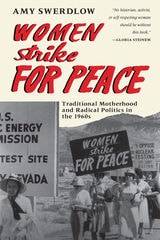
Women Strike for Peace
Traditional Motherhood and Radical Politics in the 1960sAmy Swerdlow
University of Chicago Press, 1993
Women Strike for Peace began on November 1, 1961, when thousands of white, middle-class women walked out of their kitchens and off their jobs in a one-day protest against Soviet and American nuclear policies. The protest led to a national organization of women who fought against nuclear arms and U.S. intervention in Vietnam. While maintaining traditional maternal and feminine roles, members of WSP effectively challenged national policies—defeating a proposal for a NATO nuclear fleet, withstanding an investigation by the House Committee on Un-American Activities, and sending one of its leaders to Congress as a peace candidate.
As a study of a dissident group grounded in prescribed female culture, and the struggle of its members to avoid being trapped within that culture, this book adds a crucial new dimension to women's studies. In addition, this account of WSP's success as a grass roots, nonhierarchical movement will be of great interest to historians, political scientists, and anyone interested in peace studies or conflict resolution.
"Swerdlow has re-created a unique piece of American political history, a chapter of the international peace movement, and an origin of the modern feminist movement. No historian, activist, or self-respecting woman should be without Women Strike for Peace. It shows not only how one group of women created change, but also how they inevitably changed themselves."—Gloria Steinem
Women Surrounded by Water
A MemoirPatricia Coral
The Ohio State University Press, 2024