Results by title
991 books match the query 'Writing' and 149 start with w
Writing Center Administrators as Campus Leaders
Candis Bond
Utah State University Press, 2026
Writing Center Administrators as Campus Leaders challenges the current erasure of the WCA role within discourse on campus leadership by highlighting the various ways these leaders have had transformative impacts on their institutions, emphasizing the wide range of knowledge, skills, and added value that WCAs bring to the university ecosystem.
Contributors from diverse institutions, institutional contexts, identity formations, and career paths theorize different forms of leadership from within and beyond writing centers. The first section brings together perspectives on leadership theory and practice, focusing on the practical gains offered and challenges afforded via writing center professional pathways. The second section emphasizes partnerships and networks forged through intentional and creative leadership models. In the final section, contributors consider the emotional and affective dimensions of WCA labor, offering multiple roadmaps for WCAs to transition their experiences into more recognition, resources, and broader administrative roles while underscoring the potential of inclusive, community-focused leadership for current and aspiring WCAs.
Providing key insights and practical examples, Writing Center Administrators as Campus Leaders validates and inspires current and future WCAs and informs university administrators on the ways that WCAs can and do impact higher education as true campus leaders.
Writing Centers and Learning Commons
Staying Centered While Sharing Common GroundSteven J. Corbett
Utah State University Press, 2022
The chapters comprehensively examine the ways writing centers make the most of sharing common ground. Directors, coordinators, administrators, and stakeholders draw on past and present attention to writing center studies to help shape the future of the learning commons and narrate their substantial collective experience with collaborative efforts to stay centered while empowering colleagues and student writers at their institutions. The contributors explore what is gained and lost by affiliating writing centers with learning commons, how to create sound pedagogical foundations that include writing center philosophies, how writing center practices evolved or have been altered by learning center affiliations, and more.
Writing Centers and Learning Commons is for all stakeholders of writing in and across campuses collaborating on (by choice or edict), or wishing to explore the possibilities of, a learning commons enterprise.
Contributors: Alice Batt, Cassandra Book, Charles A. Braman, Elizabeth Busekrus Blackmon, Virginia Crank, Celeste Del Russo, Patricia Egbert, Christopher Giroux, Alexis Hart, Suzanne Julian, Kristen Miller, Robby Nadler, Michele Ostrow, Helen Raica-Klotz, Kathleen Richards, Robyn Rohde, Nathalie Singh-Corcoran, David Stock
Writing Centers and Racial Justice
A Guidebook for Critical PraxisTalisha Haltiwanger Morrison
Utah State University Press, 2023
In five thematically organized sections—Countering Racism and Colonialism in Higher Education; Recruitment, Hiring, and Retention; Tutor Education and Professional Development; Engaging with Campus and Community; and Holding Our Professional Organizations Accountable—scholars from a variety of institutions, both large and small, public and private, present critical reflection and concrete guidance on anti-racist writing center administrative policies and practices. Several chapters include sample materials, such as course syllabi, consultant education activities, and recruitment materials, to help current and aspiring writing center administrators implement changes in their own contexts.
Writing Centers and Racial Justice is the first book to offer clear and actionable advice on how writing centers and their staff can take up racial or social justice work that will result in real sustainable change. Writing center directors, professionals, and tutors, as well as administrators and decision makers at the institutional level, will benefit from this thoughtful and effective text.
Writing Centers and the New Racism
A Call for Sustainable Dialogue and ChangeLaura Greenfield and Karen Rowan
Utah State University Press, 2011
Laura Greenfield and Karen Rowan have created a rich resource for writing center tutors, administrators, and scholars. Motivated by a scholarly interest in race, literacy, and pedagogy, and by an ethical commitment to antiracism work, contributors address a series of related questions: How does institutionalized racism in American education shape the culture of literacy and language education in the writing center? How does racism operate in the discourses of writing center scholarship and lore, and in what ways are writing centers unwittingly complicit in racist practices? How can they meaningfully operationalize antiracist work? How do they persevere through the difficulty and messiness of negotiating race and racism in their daily practice?
The conscientious, nuanced attention to race in Writing Centers and the New Racism is meant to model what it means to be bold in engagement with these hard questions and to spur the kind of sustained, productive, multivocal, and challenging dialogue that, with a few important exceptions, has been absent from the field.
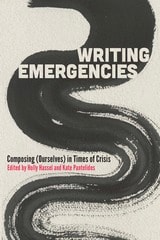
Writing Emergencies
Composing (Ourselves) in Times of CrisisHolly Hassel
Utah State University Press, 2026
Despite the adage “there are no writing emergencies,” at times situations invite or require immediate written response. In a modern era of social media and with the constancy of “crisis,” knowing when, how, and why to respond quickly is increasingly important. In Writing Emergencies, a diverse group of authors contribute scholarly, narrative-based discussions of writing emergencies, descriptions of more and less successful strategies, and a reflective conclusion that offers implications for writing studies praxis and theory.
In this collection, contributors demonstrate the reality of writing emergencies—in their own writing lives, classrooms, and programs—and they offer both self- and community-focused approaches for response. Chapters focus on discernment and prioritization, recognizing that all stressors are not necessarily emergencies. Instead, expanding our vocabulary for (and subsequent understanding) of the kinds of difficulties we come across can build our professional capacity and support greater career sustainability. The volume also illustrates the role of coalitions in navigating writing emergencies and how purposefully building and activating these coalitions subverts some challenges before they become emergencies, particularly those that are recurrent or manufactured.
Writing Emergencies both names and grapples with writing emergencies and offers insights for capacity-building in the acts of filtering and prioritizing competing urgent demands. The findings are meaningful for all leaders, students, and teachers who center care in their relationships with others.
Writing Ethnographic Fieldnotes, Second Edition
Robert M. Emerson, Rachel I. Fretz, and Linda L. Shaw
University of Chicago Press, 2011
Writing Expertise
A Research-Based Approach to Writing and Learning Across DisciplinesLinda Adler-Kassner
University Press of Colorado, 2023
In Writing Expertise, Linda Adler-Kassner and Elizabeth Wardle address the question, “How can instructors across disciplines best help students write well?” Drawing on research about how disciplines use writing to engage in shared ways of thinking, practicing, and demonstrating knowledge, the authors offer an approach that helps faculty across the disciplines invite students to bring new ideas and identities to their work. Throughout the book, Adler-Kassner and Wardle help instructors explore what it means to write well in their courses, fields, or disciplines and offer strategies and activities that can help them improve their assignments by infusing research-based writing activities into their courses.
Writing Expertise provides an innovative, equity- and research-based approach to writing in the disciplines that will enrich instructor and student thinking. Thoughtful discussions and well-designed activities provide the support needed to help instructors put disciplinary thinking into written form, develop systematic aways of learning about the students who write in their courses, and ultimately develop more effective, inclusive courses.
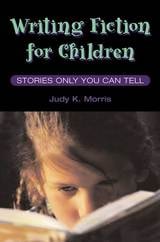
Writing Fiction for Children
STORIES ONLY YOU CAN TELLJudy K. Morris
University of Illinois Press, 2001
A published author of both fiction and nonfiction for children, Morris draws on extensive experience teaching children how to write and teaching adults how to write for children. Here she combines concrete methods and step-by-step techniques with succinct rules of thumb: work at making your novel whole from the start; never underestimate the power of the plain truth; personality quirks are no substitute for character; doing a good job of writing usually means doing a good job of rewriting.
Using judiciously chosen examples from successful children's literature, Writing Fiction for Children covers the building blocks of plot, characters, and setting and addresses common problems such as awkward plotting, oversimplifying, and taking a preachy or self-conscious tone. Pragmatic exercises stimulate writers to scour their experiences, sharpen their powers of observation, and capture the details, voice, and narrative energy that can bring stories vividly to life and keep readers submerged in make-believe. Loaded with practical advice and helpful exercises, Writing Fiction for Children is especially useful for anyone who aspires to write for children in the "middle ages" of eight to twelve.
Children's books should be hopeful, thrilling, funny, interesting, touching, and a pleasure to read, Morris says. Above all, they must have something at stake that matters. While conceding that only the author can provide the spark of a story to tell, Morris offers invaluable guidance on the daily work of crafting, shaping, refining, revising, and publishing a children's novel.
Writing Fiction, Tenth Edition
A Guide to Narrative CraftJanet Burroway, with Elizabeth Stuckey-French, and Ned Stuckey-French
University of Chicago Press, 2019
A creative writer’s shelf should hold at least three essential books: a dictionary, a style guide, and Writing Fiction. Janet Burroway’s best-selling classic is the most widely used creative writing text in America, and for more than three decades it has helped hundreds of thousands of students learn the craft. Now in its tenth edition, Writing Fiction is more accessible than ever for writers of all levels—inside or outside the classroom.
This new edition continues to provide advice that is practical, comprehensive, and flexible. Burroway’s tone is personal and nonprescriptive, welcoming learning writers into the community of practiced storytellers. Moving from freewriting to final revision, the book addresses “showing not telling,” characterization, dialogue, atmosphere, plot, imagery, and point of view. It includes new topics and writing prompts, and each chapter now ends with a list of recommended readings that exemplify the craft elements discussed, allowing for further study. And the examples and quotations throughout the book feature a wide and diverse range of today’s best and best-known creators of both novels and short stories.
This book is a master class in creative writing that also calls on us to renew our love of storytelling and celebrate the skill of writing well. There is a very good chance that one of your favorite authors learned the craft with Writing Fiction. And who knows what future favorite will get her start reading this edition?
Writing From The Heart
Young People Share Their WisdomPeggy Veljkovic
Templeton Press, 2000
Writing from the Heart offers us a unique window into what young people have learned about life. This collection of essays captures the values that matter most to teens—values such as love, perseverance, family, and helping others—in their own words. As the young writers reflect on their own experience, readers of all ages will be inspired by their wisdom and hope.
Writing Genres
Amy J. Devitt
Southern Illinois University Press, 2008
In Writing Genres, Amy J. Devitt examines genre from rhetorical, social, linguistic, professional, and historical perspectives and explores genre's educational uses, making this volume the most comprehensive view of genre theory today.
Writing Genres does not limit itself to literary genres or to ideas of genres as formal conventions but additionally provides a theoretical definition of genre as rhetorical, dynamic, and flexible, which allows scholars to examine the role of genres in academic, professional, and social communities.
Writing Genres demonstrates how genres function within their communities rhetorically and socially, how they develop out of their contexts historically, how genres relate to other types of norms and standards in language, and how genres nonetheless enable creativity. Devitt also advocates a critical genre pedagogy based on these ideas and provides a rationale for first-year writing classes grounded in teaching antecedent genres.
Writing Groups in the Writing Center
Negotiating Authority and Expertise in Collaborative LearningSara Wilder
Utah State University Press, 2025
As many higher education institutions strive to create spaces and systems that increase equity, accessibility, and diversity, they recognize the need for improved mentorship across academic levels. This book analyzes the significant benefits as well as the challenges faced by writing groups in providing such support. Wilder presents a nuanced account of how facilitators scaffold group practice, how members use and build genre knowledge across disciplines, and how institutional contexts shape emotional labor requirements.
For educators and tutors, the book provides an in-depth examination of the facilitator role, describing essential logistical, emotional, and intellectual practices, and addresses common conflicts and challenges. Administrators can find valuable material for training tutor-facilitators and frameworks for conceptualizing writing group functions on campus. For researchers, the book extends scholarship on writing groups, writing transfer, and collaborative learning, bridging writing center and broader writing studies research.
In an era of concern about generative AI’s role in writing education, Writing Groups in the Writing Center extends research on group facilitation, collaborative learning, and authority negotiation in writing center communities of practice and emphasizes the human connections that make collaborative writing meaningful and valuable for student writers.
Writing Groups
History, Theory, and ImplicationsAnne Ruggles Gere
Southern Illinois University Press, 1987
Drawing upon previously unpublished archival materials as well as historical accounts, Gere traces the history of writing groups in America, from their origins over a century ago to their recent reappearance in the works of Macrorie, Elbow, Murray, and others.
From this historical perspective Gere examines the theoretical foundations of writing groups, challenging the traditional concept of writing as an individual performance. She offers instead a broader view of authorship that includes both individual and social dimensions, with implications not only for the teaching of composition but also for theories of rhetoric and literacy.
Writing Home
A Literacy AutobiographyEli Goldblatt
Southern Illinois University Press, 2012
Writing Instruction in Nineteenth-Century American Colleges
James A. Berlin. Foreword by Donald C. Stuart
Southern Illinois University Press, 1984
Defining a rhetoric as a social invention arising out of a particular time, place, and set of circumstances, Berlin notes that “no rhetoric—not Plato’s or Aristotle’s or Quintilian’s or Perelman’s—is permanent.” At any given time several rhetorics vie for supremacy, with each attracting adherents representing various views of reality expressed through a rhetoric.
Traditionally rhetoric has been seen as based on four interacting elements: “reality, writer or speaker, audience, and language.” As emphasis shifts from one element to another, or as the interaction between elements changes, or as the definitions of the elements change, rhetoric changes. This alters prevailing views on such important questions as what is appearance, what is reality.
In this interpretive study Berlin classifies the three 19th-century rhetorics as classical, psychological-epistemological, and romantic, a uniquely American development growing out of the transcendental movement. In each case studying the rhetoric provides insight into society and the beliefs of the people.
Writing Majors
Eighteen Program ProfilesGreg Giberson
Utah State University Press, 2015
The writing major is among the most exciting scenes in the evolving American university. Writing Majors is a collection of firsthand descriptions of the origins, growth, and transformations of eighteen different programs. The chapters provide useful administrative insight, benchmark information, and even inspiration for new curricular configurations from a range of institutions.
A practical sourcebook for those who are building, revising, or administering their own writing majors , this volume also serves as a historical archive of a particular instance of growth and transformation in American higher education. Revealing bureaucratic, practical, and institutional matters as well as academic ideals and ideologies, each profile includes sections providing a detailed program review and rationale, an implementation narrative, and reflection and prospection about the program.
Documenting eighteen stories of writing major programs in various stages of formation, preservation, and reform and exposing the contingencies of their local and material constitution, Writing Majors speaks as much to the “how to” of building writing major programs as to the larger “what,” “why,” and “how” of institutional growth and change.
Writing New Media
Theory and Applications for Expanding the Teaching of CompositionAnne Frances Wysocki, Johndan Johnson-Eilola, Cynthia L. Selfe, & Geoffrey Sirc
Utah State University Press, 2004
As new media mature, the changes they bring to writing in college are many and suggest implications not only for the tools of writing, but also for the contexts, personae, and conventions of writing. An especially visible change has been the increase of visual elements-from typographic flexibility to the easy use and manipulation of color and images. Another would be in the scenes of writing-web sites, presentation "slides," email, online conferencing and coursework, even help files, all reflect non-traditional venues that new media have brought to writing. By one logic, we must reconsider traditional views even of what counts as writing; a database, for example, could be a new form of written work.
The authors of Writing New Media bring these ideas and the changes they imply for writing instruction to the audience of rhetoric/composition scholars. Their aim is to expand the college writing teacher's understanding of new media and to help teachers prepare students to write effectively with new media beyond the classroom. Each chapter in the volume includes a lengthy discussion of rhetorical and technological background, and then follows with classroom-tested assignments from the authors' own teaching.
Writing Opportunities
Writing, Learning, and Rightful Presence in College TransitionsBrad Jacobson
Utah State University Press, 2026
Writing Opportunities presents in-depth text histories illustrating the interrelationship of writing, identities, and belonging in college writing transitions. Drawing on more than two years of research with three Latinx/a/o students transitioning from the same high school class to the local university, Brad Jacobson brings together analyses of interview transcripts, student writing, classroom genres, and institutional policies to foreground a sense of belonging as central to writing development and learning.
Including interviews with students and their instructors, Jacobson traces writing opportunities that Hercules, Jain, and Lucy were afforded as they transitioned from high school to college writing, particularly in general education courses. Chapters attend to multiple levels of interaction to show how policies, practices, and social histories can impact opportunities for learning. With attention to dominant discourses of writing that narrow what counts as good writing as well as positive opportunity structures that extend possibilities for identification, engagement, and deep learning, Jacobson also posits writing as an opportunity for writers to explore possibilities for who we are and who we may become.
Jacobson’s humanizing research invites readers to consider opportunity from multiple perspectives and shows how subtle shifts in relationships among students, instructors, and institutions can increase meaningful learning and provide a sense of belonging in educational contexts.
Writing Philosophy
A Guide to Professional Writing and PublishingRichard A. Watson
Southern Illinois University Press, 1992
Richard A. ("Red") Watson has published fiction, general nonfiction, and scholarly books. His essay "On the Zeedijk," about Descartes in Holland and first published in The Georgia Review, was the lead essay in The Pushcart Prize XV, 1990–1991: Best of the Small Presses. Red knows writing.
He also knows academe and has written Writing Philosophy as a kind of survival manual for undergraduates, graduate students, and junior faculty members in philosophy. Also helpful to those in the humanities and the social sciences, the book is a guide to the professional writing and publishing that are essential to an active participation in the conversation and discussion that constitute these professional fields. To the extent that publication is the crucial factor in tenure decisions, it will help the beginning scholar meet tenure criteria.
Despite the importance of the oral tradition in philosophy and the influence of the dialogue, many philosophical points are so intricate and complex that they can be advanced, followed, and criticized only if they are written as stepwise arguments for study and contemplation at length and at leisure. Watson provides a set of basic principles and a plan for writing argumentative papers of 1,500 to 15,000 words (3 to 30 printed pages) and books containing a sequence of sustained arguments of 70,000 to 150,000 words (200 to 300 printed pages).
Because the first book of most professional philosophers is a revised dissertation, Watson presents a plan for writing that dissertation in such a way that its chapters will serve as publishable articles and the dissertation itself will need very little rewriting as a book. His discussion of the principles of reason, clarity, and argument ranges from such topics as dangling participles and the proper usage of ellipses to matters of categorization and univocity.
Writing Placement in Two-Year Colleges
The Pursuit of Equity in Postsecondary EducationJessica Nastal
University Press of Colorado, 2023
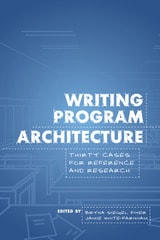
Writing Program Architecture
Thirty Cases for Reference and ResearchBryna Siegel Finer
Utah State University Press, 2017
Writing Program Architecture offers an unprecedented abundance of information concerning the significant material, logistical, and rhetorical features of writing programs. Presenting the realities of thirty diverse and award-winning programs, contributors to the volume describe reporting lines, funding sources, jurisdictions, curricula, and other critical programmatic matters and provide insight into their program histories, politics, and philosophies.
Each chapter opens with a program snapshot that includes summary demographic and historical information and then addresses the profile of the WPA, program conception, population served, funding, assessment, technology, curriculum, and more. The architecture of the book itself makes comparison across programs and contexts easy, not only among the programs described in each chapter but also between the program in any given chapter and the reader’s own program. An online web companion to the book includes access to the primary documents that have been of major importance to the development or sustainability of the program, described in a “Primary Document” section of each chapter.
The metaphor of architecture allows us to imagine the constituent parts of a writing program as its foundation, beams, posts, scaffolding—the institutional structures that, alongside its people, anchor a program to the ground and keep it standing. The most extensive resource on program structure available to the field, Writing Program Architecture illuminates structural choices made by leaders of exemplary programs around the United States and provides an authoritative source of standard practice that a WPA might use to articulate programmatic choices to higher administration.
Contributors: Susan Naomi Bernstein, Remica Bingham-Risher, Brent Chappelow, Malkiel Choseed, Angela Clark-Oates, Patrick Clauss, Emily W. Cosgrove, Thomas Deans, Bridget Draxler, Leigh Ann Dunning, Greg A. Giberson, Maggie Griffin Taylor, Paula Harrington, Sandra Jamieson, Marshall Kitchens, Michael Knievel, Amy Lannin, Christopher LeCluyse, Sarah Liggett, Deborah Marrott, Mark McBeth, Tim McCormack, John McCormick, Heather McGrew, Heather McKay, Heidi A. McKee, Julianne Newmark, Lori Ostergaard, Joannah Portman-Daley, Jacqueline Preston, James P. Purdy, Ben Rafoth, Dara Regaignon, Nedra Reynolds, Shirley Rose, Bonnie Selting, Stacey Sheriff, Steve Simpson, Patricia Sullivan, Kathleen Tonry, Sanford Tweedie, Meg Van Baalen-Wood, Shevaun Watson, Christy I. Wenger, Lisa Wilkinson, Candace Zepeda
Writing Science in Plain English
Anne E. Greene
University of Chicago Press, 2013
Writing Science in Plain English, Second Edition
Anne E. Greene
University of Chicago Press, 2025
Scientific writing is often dry, wordy, and difficult to understand. But, as biologist and experienced teacher of scientific writing Anne E. Greene shows in Writing Science in Plain English, writers from all scientific disciplines can learn to produce clear, concise prose by mastering just a few simple principles. This short, focused guide presents roughly a dozen such principles based on what readers need to understand complex information, including concrete subjects, strong verbs, consistent terms, organized paragraphs, and correct sentence structure. Greene illustrates each principle with real-life examples of both good and bad writing and shows how bad writing might be improved. She ends each chapter with revision exercises (and provides suggested answers in a separate key) so that readers can come away with new writing skills after just one sitting. To help readers understand the grammatical terms used in the book, an appendix offers a refresher course on basic grammar.
For this second edition, Greene has incorporated the latest research on what makes writing effective and engaging and has revised or replaced exercises and exercise keys where needed. She has also added new features that make it easier to navigate the book. A new resource for instructors who use Writing Science in Plain English in their classes is a free, online teacher’s guide. Drawn from Greene’s long experience teaching students how to write science clearly, the teacher’s guide provides additional lectures, assignments, and activities that will inform and enliven any class.
Writing Studies Research in Practice
Methods and MethodologiesEdited by Lee Nickoson and Mary P. Sheridan, Foreword by Gesa E. Kirsch
Southern Illinois University Press, 2012
An essential reference for students and scholars exploring the methods and methodologies of writing research.
What does it mean to research writing today? What are the practical and theoretical issues researchers face when approaching writing as they do? What are the gains or limitations of applying particular methods, and what might researchers be overlooking? These questions and more are answered by the writing research field’s leading scholars in Writing Studies Research in Practice: Methods and Methodologies.
Editors Nickoson and Sheridan gather twenty chapters from leaders in writing research, spanning topics from ethical considerations for researchers, quantitative methods, and activity analysis to interviewing and communitybased and Internet research. While each chapter addresses a different subject, the volume as a whole covers the range of methodologies, technologies, and approaches—both old and new—that writing researchers use, and examines the ways in which contemporary writing research is understood, practiced, and represented.
An essential reference for experienced researchers and an invaluable tool to help novices understand research methods and methodologies, Writing Studies Research in Practice includes established methods and knowledge while addressing the contemporary issues, interests, and concerns faced by writing researchers today.
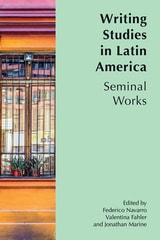
Writing Studies in Latin America
Seminal WorksFederico Navarro
University Press of Colorado, 2026
This edited collection arises from the belief that the field of writing studies, with its deep engagement in the power of language, is uniquely positioned to open new pathways for international scholarly dialogue in writing studies and beyond. Integrating diverse theoretical traditions—including discourse studies, language pedagogy, educational psychology, educational management, and critical sociolinguistics—the editors have brought together work from key Latin American scholars published over the past two decades. The result is a book that points to future directions for the increasingly global field of writing studies. The collection includes work by Natalia Ávila Reyes, Charles Bazerman, Paula Carlino, Valentina Fahler, Ivone Inés Jakob, Judith Kalman, Angela B. Kleiman, Vera Lúcia Lopes Cristovão, Anna Rachel Machado, Jonathan Marine, Juan David Martínez Hincapié, Paulina Meza, Violate Molina Natera, Désirée Motta-Roth, Estela I. Moyano, Elvira Narvaja de Arnoux, Lucía Natale, Federico Navarro, Giovanni Parodi, Luisa Pelizza, María Cecilia Pereira, Pablo Rosales, Daniela Paula Stagnaro, Alicia Vázquez, René Venegas, and Virginia Zavala.
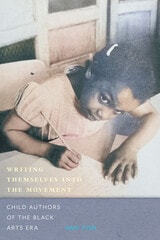
Writing Themselves into the Movement
Child Authors of the Black Arts EraAmy Fish
University of Massachusetts Press, 2024
Between 1967 and 1972, a previously obscure group of authors entered the US cultural spotlight. During this five-year period, at least thirty anthologies of poetry and prose by African American, Latinx, Asian American, and Native American children came out of adult-led workshops, classrooms, and sites of juvenile incarceration. Mass-market publishers, independent imprinters, and local mimeograph machines produced volumes with titles such as I Am Somebody! and The Me Nobody Knows: Children’s Voices from the Ghetto. These young writers actively participated in the Black Arts Movement, and some collaborated with well-known adult authors, most prominently June Jordan. Their anthologies gained national media coverage, occasionally became bestsellers, were quoted by James Baldwin, and even inspired a hit Broadway musical. While writings by children had long attracted adult attention, this flurry of youth writing and publishing was distinguished by the widespread belief that children of color from poor and working-class neighborhoods were uniquely able to speak truth about American racism and inequality.
Focusing on Black and Latinx youth authorship within New York City, and using deep archival research and elegant close readings, Amy Fish examines child-authored texts of this era within the context of their literary production and reception. These young writers were often supervised and edited by white adults, raising concerns about the authenticity and agency of their voices. Fish contends that young authors themselves shared these concerns and that they employed savvy rhetorical strategies of address, temporality, and trope to self-consciously interrogate the perils and possibilities of their adult-influenced work. Young writers thus contributed to the era’s important debates about the nature of authorship and readership within a racist society, while also using their writing as an intimate occasion of self-discovery.
Writing Together
Building Social Writing Opportunities for Graduate StudentsRachael Cayley, Fiona Coll, and Daniel Aureliano Newman
University of Michigan Press, 2025
Writing Together gathers accounts from graduate writing professionals about how social writing programs are imagined and delivered. It surveys the motivations, rationales, evaluation strategies, and structures that underpin these initiatives in order to create a practical resource for writing professionals who wish to establish or refine their own offerings. Rather than presenting “how to” approaches, the book presents “how we” accounts that enable readers to learn from the creative practices and experiences of others. By capturing a range of experiences, institutional models, and forms of social writing support, Writing Together explains the thinking behind social writing initiatives and the processes through which those initiatives have been assessed. It demonstrates that social writing practices are not just a means to an end, but an end in themselves—that writing together is a great way to write and a promising basis for graduate writing pedagogy and professional development.
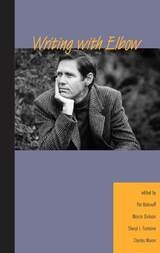
Writing With Elbow
edited by Pat Belanoff, Marcia Dickson, Sheryl I. Fontaine, & Charles Moran
Utah State University Press, 2002
Writing with Elbow is a must-read collection for composition scholars, teachers, English educationists, and graduate students.
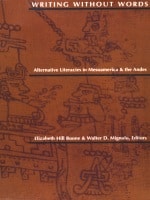
Writing Without Words
Alternative Literacies in Mesoamerica and the AndesElizabeth Hill Boone and Walter D. Mignolo, eds.
Duke University Press, 1994
The contributors--who include art historians, anthropologists, and literary theorists--examine the ways in which ancient Mesoamerican and Andean peoples conveyed meaning through hieroglyphic, pictorial, and coded systems, systems inseparable from the ideologies they were developed to serve. We see, then, how these systems changed with the European invasion, and how uniquely colonial writing systems came to embody the post-conquest American ideologies. The authors also explore the role of these early systems in religious discourse and their relation to later colonial writing.
Bringing the insights from Mesoamerica and the Andes to bear on a fundamental exchange among art history, literary theory, semiotics, and anthropology, the volume reveals the power contained in the medium of writing.
Contributors. Elizabeth Hill Boone, Tom Cummins, Stephen Houston, Mark B. King, Dana Leibsohn, Walter D. Mignolo, John Monaghan, John M. D. Pohl, Joanne Rappaport, Peter van der Loo
Writing Workplace Cultures
An Archaeology of Professional WritingJim Henry
Southern Illinois University Press, 2000
In Writing Workplace Cultures: An Archaeology of Professional Writing, Jim Henry analyzes eighty-three workplace writing ethnographies composed over seven years in a variety of organizations. He views the findings as so many shards in an archaeology on professional writing at the beginning of the twenty-first century.
These ethnographies were composed by either practicing or aspiring writers participating in a Master’s program in professional writing and editing. Henry solicited the writers' participation in "informed intersubjective research" focused on issues and questions of their own determination. Most writers studied their own workplace, composing "auto-ethnographies" that problematize these workplaces' local cultures even as they depict writing practices within them.
Henry establishes links between current professional writing practices and composition instruction as both were shaped by national economic development and local postsecondary reorganization throughout the twentieth century. He insists that if we accept basic principles of social constructionism, the text demonstrates ways in which writers "write" workplace cultures to produce goods and services whose effects go far beyond the immediate needs of its clients.
Writing Your Journal Article in Twelve Weeks, Second Edition
A Guide to Academic Publishing SuccessWendy Laura Belcher
University of Chicago Press, 2019
With this new edition, Belcher expands her advice to reach beginning scholars in even more disciplines. She builds on feedback from professors and graduate students who have successfully used the workbook to complete their articles. A new chapter addresses scholars who are writing from scratch. This edition also includes more targeted exercises and checklists, as well as the latest research on productivity and scholarly writing.
Writing Your Journal Article in Twelve Weeks is the only reference to combine expert guidance with a step-by-step workbook. Each week, readers learn a feature of strong articles and work on revising theirs accordingly. Every day is mapped out, taking the guesswork and worry out of writing. There are tasks, templates, and reminders. At the end of twelve weeks, graduate students, recent PhDs, postdoctoral fellows, adjunct instructors, junior faculty, and international faculty will feel confident they know that the rules of academic publishing and have the tools they need to succeed.
Writing a Usable Past
Russian Literary Culture, 1917-1937Angela Brintlinger
Northwestern University Press, 2008
In <i>Writing a Usable Past</i>, Brintlinger considers the interactions of post-Revolutionary Russian and emigre culture with the genre of biography in its various permutations, arguing that in the years after the Revolution, Russian writers looked to the great literary figures of the past to help them construct a post-Revolutionary present. In detailed looks at the biographical writing of Yuri Tynianov, Vladislav Khodasevich, and Mikhail Bulgakov, Brintlinger follows each author's successful biography/ies and their failed attempts at biographies of Alexander Pushkin on the centennial anniversary of his death. Brintlinger compares the Pushkin biographies to the other biographies examined, and in a concluding chapter she considers other, more successful commemorations of the great poet's death. She argues that popular commemorations--exhibits, concerts, special issues of journals--were a more fitting biography than the genre of the "usable past." For post-revolutionary cultural actors, including Tynianov, Khodasevich, and Bulgakov, Pushkin was a symbol rather than a model for constructing that usable past.
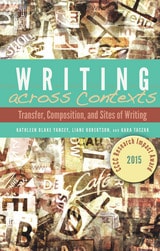
Writing across Contexts
Transfer, Composition, and Sites of WritingKathleen Yancey
Utah State University Press, 2014
Addressing how composers transfer both knowledge about and practices of writing, Writing across Contexts explores the grounding theory behind a specific composition curriculum called Teaching for Transfer (TFT) and analyzes the efficacy of the approach. Finding that TFT courses aid students in transfer in ways that other kinds of composition courses do not, the authors demonstrate that the content of this curriculum, including its reflective practice, provides a unique set of resources for students to call on and repurpose for new writing tasks.
The authors provide a brief historical review, give attention to current curricular efforts designed to promote such transfer, and develop new insights into the role of prior knowledge in students' ability to transfer writing knowledge and practice, presenting three models of how students respond to and use new knowledge—assemblage, remix, and critical incident.
A timely and significant contribution to the field, Writing across Contexts will be of interest to graduate students, composition scholars, WAC and writing-in-the-disciplines scholars, and writing program administrators.
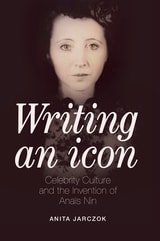
Writing an Icon
Celebrity Culture and the Invention of Anaïs NinAnita Jarczok
Ohio University Press, 2017
Anaïs Nin, the diarist, novelist, and provocateur, occupied a singular space in twentieth-century culture, not only as a literary figure and voice of female sexual liberation but as a celebrity and symbol of shifting social mores in postwar America. Before Madonna and her many imitators, there was Nin; yet, until now, there has been no major study of Nin as a celebrity figure.
In Writing an Icon, Anita Jarczok reveals how Nin carefully crafted her literary and public personae, which she rewrote and restyled to suit her needs and desires. When the first volume of her diary was published in 1966, Nin became a celebrity, notorious beyond the artistic and literary circles in which she previously had operated. Jarczok examines the ways in which the American media appropriated and deconstructed Nin and analyzes the influence of Nin’s guiding hand in their construction of her public persona.
The key to understanding Nin’s celebrity in its shifting forms, Jarczok contends, is the Diary itself, the principal vehicle through which her image has been mediated. Combining the perspectives of narrative and cultural studies, Jarczok traces the trajectory of Nin’s celebrity, the reception of her writings. The result is an innovative investigation of the dynamic relationships of Nin’s writing, identity, public image, and consumer culture.
Writing and Difference
Jacques Derrida
University of Chicago Press, 1978
The second half of the book contains some of Derrida's most compelling analyses of why and how metaphysical thinking must exclude writing from its conception of language, finally showing metaphysics to be constituted by this exclusion. These essays on Artaud, Freud, Bataille, Hegel, and Lévi-Strauss have served as introductions to Derrida's notions of writing and différence—the untranslatable formulation of a nonmetaphysical "concept" that does not exclude writing—for almost a generation of students of literature, philosophy, and psychoanalysis.
Writing and Difference reveals the unacknowledged program that makes thought itself possible. In analyzing the contradictions inherent in this program, Derrida foes on to develop new ways of thinking, reading, and writing,—new ways based on the most complete and rigorous understanding of the old ways. Scholars and students from all disciplines will find Writing and Difference an excellent introduction to perhaps the most challenging of contemporary French thinkers—challenging because Derrida questions thought as we know it.
Writing and Difference
Jacques Derrida
University of Chicago Press, 1980
The second half of the book contains some of Derrida's most compelling analyses of why and how metaphysical thinking must exclude writing from its conception of language, finally showing metaphysics to be constituted by this exclusion. These essays on Artaud, Freud, Bataille, Hegel, and Lévi-Strauss have served as introductions to Derrida's notions of writing and différence—the untranslatable formulation of a nonmetaphysical "concept" that does not exclude writing—for almost a generation of students of literature, philosophy, and psychoanalysis.
Writing and Difference reveals the unacknowledged program that makes thought itself possible. In analyzing the contradictions inherent in this program, Derrida foes on to develop new ways of thinking, reading, and writing,—new ways based on the most complete and rigorous understanding of the old ways. Scholars and students from all disciplines will find Writing and Difference an excellent introduction to perhaps the most challenging of contemporary French thinkers—challenging because Derrida questions thought as we know it.
Writing and Literacy in the World of Ancient Israel
Epigraphic Evidence from the Iron AgeChristopher A. Rollston
SBL Press, 2010

Writing and Muslim Identity
Representations of Islam in German and English Transcultural Literature, 1990-2006Frauke Matthes
University of London Press, 2012

Writing and Publishing
The Librarian's HandbookCarol Smallwood
American Library Association, 2009
Writing and Renunciation in Medieval Japan
The Works of the Poet-Priest Kamo no ChomeiRajyashree Pandey
University of Michigan Press, 1998
Writing and Rewriting National Theatre Histories
S.E. Wilmer
University of Iowa Press, 2004
Writing and School Reform
Writing Instruction in the Age of Common Core and Standardized TestingJoanne Addison
University Press of Colorado, 2017
Writing and the West German Protest Movements
The Textual RevolutionMererid Puw Davies
University of London Press, 2016
Writing as Exorcism
The Personal Codes of Pushkin, Lermontov, and GogolIlya Kutik
Northwestern University Press, 2005
A remarkable literary performance in its own right, this interpretive essay brings a highly original poetic sensibility to bear on the lives and works of three major Russian writers. It is Ilya Kutik's contention that many writers are tormented by secret fears and desires that only writing—in particular, the use of certain words and images—can exorcise. Making this biographical approach peculiarly his own—and susceptible to the nuances of comedy, tragedy, and critical equanimity—Kutik reads works of Alexander Pushkin, Mikhail Lermontov, and Nikolai Gogol, three Russian writers who were demonstrably subject to the whims, superstitions, and talismans that Kutik identifies. Exposing the conjunction of literary effort and private act in writings such as "The Queen of Spades," Dead Souls, and A Hero of Our Time, Kutik's work gives us a new way of understanding these masterpieces of Russian literature and their authors, and a new way of reading the mysteries of life and literature as mutually enriching.
Writing as Punishment in Schools, Courts, and Everyday Life
Spencer Schaffner
University of Alabama Press, 2019
Writing tends to be characterized as a positive aspect of literacy that helps us to express our thoughts, to foster interpersonal communication, and to archive ideas. However, there is a vast array of evidence that emphasizes the counterbelief that writing has the power to punish, shame, humiliate, control, dehumanize, fetishize, and transform those who are subjected to it. In Writing as Punishment in Schools, Courts, and Everyday Life, Spencer Schaffner looks at many instances of writing as punishment, including forced tattooing, drunk shaming, court-ordered letters of apology, and social media shaming, with the aim of bringing understanding and recognition to the coupling of literacy and subjection.
Writing as Punishment in Schools, Courts, and Everyday Life is a fascinating inquiry into how sinister writing can truly be and directly questions the educational ideal that powerful writing is invariably a public good. While Schaffner does look at the darker side of writing, he neither vilifies nor supports the practice of writing as punishment. Rather, he investigates the question with humanistic inquiry and focuses on what can be learned from understanding the many strange ways that writing as punishment is used to accomplish fundamental objectives in everyday life.
Through five succinct case studies, we meet teachers, judges, parents, sex traffickers, and drunken partiers who have turned to writing because of its presumed power over writers and readers. Schaffner provides careful analysis of familiar punishments, such as schoolchildren copying lines, and more bizarre public rituals that result in ink-covered bodies and individuals forced to hold signs in public.
Schaffner argues that writing-based punishment should not be dismissed as benign or condemned as a misguided perversion of writing, but instead should be understood as an instrument capable of furthering both the aims of justice and degradation.
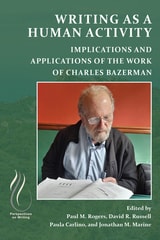
Writing as a Human Activity
Implications and Applications of the Work of Charles BazermanPaul M. Rogers
University Press of Colorado, 2023
Writing at the State U
Instruction and Administration at 106 Comprehensive UniversitiesEmily Isaacs
Utah State University Press, 2017
Writing at the State U presents a comprehensive, empirical examination of writing programs at 106 universities. Rather than using open survey calls and self-reporting, Emily Isaacs uses statistical analysis to show the extent to which established principles of writing instruction and administration have been implemented at state comprehensive universities, the ways in which writing at those institutions has differed from writing at other institutions over time, and how state institutions have responded to major scholarly debates concerning first-year composition and writing program administration.
Isaacs’s findings are surprising: state university writing programs give lip service to important principles of writing research, but many still emphasize grammar instruction and a skills-based approach, classes continue to be outsized, faculty development is optional, and orientation toward basic writing is generally remedial. As such, she considers where a closer match between writing research and writing instruction might help to expose and remedy these difficulties and identifies strategies and areas where faculty or writing program administrators are empowered to enact change.
Unique in its wide scope and methodology, Writing at the State U sheds much-needed light on the true state of the writing discipline at state universities and demonstrates the advantages of more frequent and rigorous quantitative studies of the field.
Writing for Social Scientists, Third Edition
How to Start and Finish Your Thesis, Book, or ArticleHoward S. Becker
University of Chicago Press, 2020
This is not a book about sociological writing. Instead, Becker applies his sociologist’s eye to some of the common problems all academic writers face, including trying to get it right the first time, failing, and therefore not writing at all; getting caught up in the trappings of “proper” academic writing; writing to impress rather than communicate with readers; and struggling with the when and how of citations. He then offers concrete advice, based on his own experiences and those of his students and colleagues, for overcoming these obstacles and gaining confidence as a writer.
While the underlying challenges of writing have remained the same since the book first appeared, the context in which academic writers work has changed dramatically, thanks to rapid changes in technology and ever greater institutional pressures. This new edition has been updated throughout to reflect these changes, offering a new generation of scholars and students encouragement to write about society or any other scholarly topic clearly and persuasively.
As Becker writes in the new preface, “Nothing prepared me for the steady stream of mail from readers who found the book helpful. Not just helpful. Several told me the book had saved their lives; less a testimony to the book as therapy than a reflection of the seriousness of the trouble writing failure could get people into.” As academics are being called on to write more often, in more formats, the experienced, rational advice in Writing for Social Scientists will be an important resource for any writer’s shelf.
Writing for Social Scientists
How to Start and Finish Your Thesis, Book, or Article: Second EditionHoward S. Becker
University of Chicago Press, 2007
Sociologist Howard S. Becker has written the classic book on how to conquer these pressures and simply write. First published nearly twenty years ago, Writing for Social Scientists has become a lifesaver for writers in all fields, from beginning students to published authors. Becker’s message is clear: in order to learn how to write, take a deep breath and then begin writing. Revise. Repeat.
It is not always an easy process, as Becker wryly relates. Decades of teaching, researching, and writing have given him plenty of material, and Becker neatly exposes the foibles of academia and its “publish or perish” atmosphere. Wordiness, the passive voice, inserting a “the way in which” when a simple “how” will do—all these mechanisms are a part of the social structure of academic writing. By shrugging off such impediments—or at the very least, putting them aside for a few hours—we can reform our work habits and start writing lucidly without worrying about grades, peer approval, or the “literature.”
In this new edition, Becker takes account of major changes in the computer tools available to writers today, and also substantially expands his analysis of how academic institutions create problems for them. As competition in academia grows increasingly heated, Writing for Social Scientists will provide solace to a new generation of frazzled, would-be writers.
Writing from the Edge of the World
The Memoirs of Darien, 1514-1527Gonzalo Fernandez de Oviedo
University of Alabama Press, 2006