Results by title
3785 books match the query 'Poetry' and 184 start with w
White Summer
Joelle Biele
Southern Illinois University Press, 2002
In White Summer, Joelle Biele investigates the problems of personal and cultural memory. Rich with images of flight and displacement, Biele’s poems show a love for words, their music and physicality. In lyric addresses, historical meditations, and autobiographical narratives, she takes readers on a journey that includes stops at a dinner party in ancient Rome, a market square in Germany, an Italian feast in the Bronx, and the main concourse of Manhattan’s Grand Central Station. She shows a sharp eye for the telling detail whether she is studying the migrations of birds or sketching portraits of people wishing to escape the confines of their lives. Throughout her first collection, Biele reveals and revels in the power of language to shape and create experience.
Whiteout
Jessica Goodfellow
University of Alaska Press, 2017
Although her poems begin with a missing body, they are not an elegy. Instead, Goodfellow struggles with the absence of cultural ritual for the uncontainable loss of a beloved one whose body is never recovered and whose final story is unknowable. There is no solace here, no possible reconciliation. Instead, Whiteout is a defiant gaze into a storm that engulfs both the wildness of Alaska and of familial mourning.
Whitman East and West
New Contexts for Reading Walt WhitmanEd Folsom
University of Iowa Press, 2002
Confirming the growing international spirit of American studies, the essays in Whitman East and West developed out of a landmark conference in Beijing, the first major conference in China to focus on an American poet. Scholars from Asia, Europe, and North America set out to track the ways in which Whitman's poetry has become part of China's cultural landscape as well as the literary landscapes of other countries. By describing his assimilation into other cultures and his resulting transformation into a hybrid poet, these essayists celebrate Whitman's multiple manifestations in other languages and contexts.
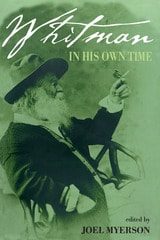
Whitman in His Own Time
A Biographical Chronicle of His Own Life, Drawn from Recollections, Memoirs, and Interviews by Friends and AssociatesJoel Myerson
University of Iowa Press, 2000
Few American writers were as concerned with their public image as was Walt Whitman. He praised his own work in unsigned reviews; he included engravings or photographs of himself in numerous editions of his work; and he assisted in the writing of two biographies of himself. Whitman was also written about extensively by others throughout his lifetime. Whitman in His Own Time is a collection of these contemporary accounts of the "good gray poet."
The interviews with and recollections of Whitman collected by Joel Myerson represent a wide spectrum of accounts—visitors from America and abroad; newspaper interviewers; Whitman's doctor and nurse during his final illness; his literary executors; a student from his early schoolteaching days; and such well-known authors as Bronson Alcott, John Burroughs, and Henry David Thoreau. The selections also paint a well-rounded picture of Whitman, from his early days as a schoolteacher to the moment of his death, and demonstrate a varying range of attitudes toward the poet. Yet throughout the entire collection, Whitman himself holds center stage, and he is seen as vividly today as he was over one hundred years ago. Myerson's introduction to this expanded edition places these accounts of Whitman within the context of the time and discusses new scholarship on Whitman's life.
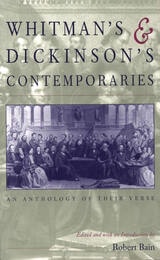
Whitman's & Dickinson's Contemporaries
An Anthology of their VerseEdited and with an Introduction by Robert Bain
Southern Illinois University Press, 1996
Emily Dickinson and Walt Whitman were not the poetic stars of their day; only a few friends knew that Dickinson wrote, and Whitman’s following was minuscule, if influential. But the contemporaries who eclipsed these major poets now have largely disappeared from our literary landscape.
In this distinctive anthology, Robert Bain gathers together thirteen other scholars to re-present the poetry of these former luminaries, allowing readers to rediscover them, reconstruct the poetic contexts of their age, and better understand why Whitman and Dickinson now overshadow other poets of their time.
Arranged chronologically according to the birth dates of the poets, this anthology introduces each poet’s work, providing biographical information and discussing the major forms and themes of the work. Each introduction places the poet in a literary and historical context with Whitman and Dickinson and provides a bibliography of secondary sources.
This remarkable book recovers a part of our literary heritage that has been lost.

Whitman's Drama of Consensus
Kerry C. Larson
University of Chicago Press, 1988
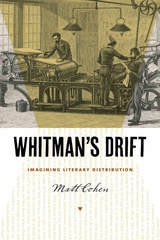
Whitman's Drift
Imagining Literary DistributionMatt Cohen
University of Iowa Press, 2017
Still, as the budding poet learned, books neither sell themselves nor move themselves: without an efficient set of connections to get books to readers, the democratic media-saturated future Whitman imagined would have remained warehoused. Whitman’s works sometimes ran through the “many-cylinder’d steam printing press” and were carried in bulk on “the strong and quick locomotive.” Yet during his career, his publications did not follow a progressive path toward mass production and distribution. Even at the end of his life, in the 1890s as his fame was growing, the poet was selling copies of his latest works by hand to visitors at his small house in Camden, New Jersey. Mass media and centralization were only one part of the rich media world that Whitman embraced.
Whitman’s Drift asks how the many options for distributing books and newspapers shaped the way writers wrote and readers read. Writers like Whitman spoke to the imagination inspired by media transformations by calling attention to connectedness, to how literature not only moves us emotionally, but moves around in the world among people and places. Studying that literature and how it circulated can help us understand not just how to read Whitman’s works and times, but how to understand what is happening to our imaginations now, in the midst of the twenty-first century media explosion.
Who Follow the Gleam
PoemsChristian Wessels
University of Massachusetts Press, 2026
A dazzling debut that blends folklore with the everyday
Drifting between the past and present, the material and the otherworldly, Who Follow the Gleam melts lore and magic with history to shape distinctive narratives of childhood, fatherhood, and personhood. In his debut poetry collection, Christian Wessels crosses centuries and takes his readers with him to Germany’s Black Forest, burning hotels, chromatic casinos, and Long Island’s dazing Sound. Uncanny elements of folklore and dreamlike stories are grounded in the atmosphere of the natural world as Wessels turns the sun, moss, and clouds into characters connecting his poems: “maybe I myself am the sun; am / the brilliant silence engraved / in stone; am the arc / through which the future becomes / legible.”
In the world of this collection, intuition, feelings, dreams, and spells mimic cycles, patterns, rules, and structure as the speaker disappears in the magic of language, only to resurface in the everyday. In four sections, Wessels reckons with a changing world, evolving and sometimes unfamiliar, while coming to terms with the uncertain future: “The cloud looks / like me, it looks like me because / the present moves, the present moves.” This collection is a sensitive meditation on the power of passed-down knowledge—personal and collective, factual and mythical—and how such knowledge finds its embodiment in the world.
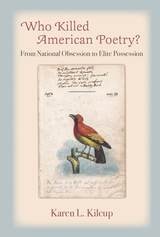
Who Killed American Poetry?
From National Obsession to Elite PossessionKaren L. Kilcup
University of Michigan Press, 2019
Conceptually and methodologically unique among studies of 19th-century American poetry, Who Killed American Poetry? not only charts changing attitudes toward American poetry, but also applies these ideas to the work of representative individual poets. Closely analyzing hundreds of reviews and critical essays, Karen L. Kilcup tracks the century’s developing aesthetic standards and highlights the different criteria reviewers used to assess poetry based on poets’ class, gender, ethnicity, and location. She shows that, as early as the 1820s, critics began to marginalize some kinds of emotional American poetry, a shift many scholars have attributed primarily to the late-century emergence of affectively restrained modernist ideals. Mapping this literary critical history enables us to more readily apprehend poetry’s status in American culture—both in the past and present—and encourages us to scrutinize the standards of academic criticism that underwrite contemporary aesthetics and continue to constrain poetry’s appeal.
Who American Killed Poetry? enlarges our understanding of American culture over the past two hundred years and will interest scholars in literary studies, historical poetics, American studies, gender studies, canon criticism, genre studies, the history of criticism, and affect studies. It will also appeal to poetry readers and those who enjoy reading about American cultural history.
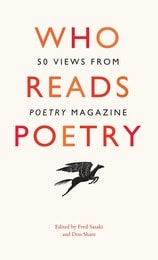
Who Reads Poetry
50 Views from “Poetry” MagazineEdited by Fred Sasaki and Don Share
University of Chicago Press, 2017
In one essay, musician Neko Case calls poetry “a delicate, pretty lady with a candy exoskeleton on the outside of her crepe-paper dress.” In another, anthropologist Helen Fisher turns to poetry while researching the effects of love on the brain, “As other anthropologists have studied fossils, arrowheads, or pot shards to understand human thought, I studied poetry. . . . I wasn’t disappointed: everywhere poets have described the emotional fallout produced by the brain’s eruptions.” Even film critic Roger Ebert memorized the poetry of e. e. cummings, and the rapper Rhymefest attests here to the self-actualizing power of poems: “Words can create worlds, and I’ve discovered that poetry can not only be read but also lived out. My life is a poem.” Music critic Alex Ross tells us that he keeps a paperback of The Palm at the End of the Mind by Wallace Stevens on his desk next to other, more utilitarian books like a German dictionary, a King James Bible, and a Macintosh troubleshooting manual.
Who Reads Poetry offers a truly unique and broad selection of perspectives and reflections, proving that poetry can be read by everyone. No matter what you’re seeking, you can find it within the lines of a poem.
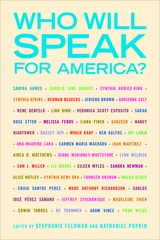
Who Will Speak for America?
Stephanie Feldman and Nathaniel Popkin
Temple University Press, 2018
The editors and contributors to Who Will Speak for America? are passionate and justifiably angry voices providing a literary response to today’s political crisis. Inspired by and drawing from the work of writers who participated in nationwide Writers Resist events in January 2017, this volume provides a collection of poems, stories, essays, and cartoons that wrestle with the meaning of America and American identity. The contributions—from established figures including Eileen Myles, Melissa Febos, Jericho Brown, and Madeleine Thien, as well as rising new voices, such as Carmen Maria Machado, Ganzeer, and Liana Finck—confront a country beset by racial injustice, poverty, misogyny, and violence.
Contributions reflect on the terror of the first days after the 2016 Presidential election, but range well beyond it to interrogate the past and imagine possible American futures.
Who Will Speak for America? inspires readers by emphasizing the power of patience, organizing, resilience and community. These moving works advance the conversation the American colonists began, and that generations of activists, in their efforts to perfect our union, have elevated and amplified.
All royalties will benefit the Southern Poverty Law Center.
Who is Buried in Chaucer's Tomb?
Studies in the Reception of Chaucer's BookJoseph A. Dane
Michigan State University Press, 1998
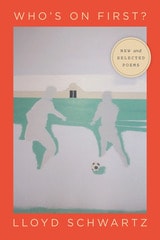
Who's on First?
New and Selected PoemsLloyd Schwartz
University of Chicago Press, 2021
For more than four decades, readers and critics have found Lloyd Schwartz’s poems unlike anyone else’s—a rare combination of the heartbreaking and the hilarious. With his ear for the poetry of the vernacular, Schwartz offers us a memorable cast of characters—both real and imagined, foolish and oracular. Readers experience his mother’s piercing flashes of memory, the perverse comic wisdom of Gracie Allen, the uninhibited yet loving exhibitionists of antique pornography, and eager travelers crossing America in a club-car or waiting in a Brazilian airport. Schwartz listens to these people without judging—understanding that they are all trying to live their lives, whenever possible, with tenderness, humor, and grace.
Who’s on First? brings together a selection of poems from all of Schwartz’s previous collections along with eagerly awaited new poems, highlighting his formal inventiveness in tangling and untangling the yarn of comedy and pathos. Underlying all of these poems is the question of what it takes and what it costs to make art.
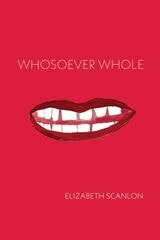
Whosoever Whole
Elizabeth Scanlon
Omnidawn, 2024
The poetry in Elizabeth Scanlon’s Whosoever Whole asks how we arrive at and nurture a sense of self amid a culture that wants us only to consume. Navigating the fractal and often fractured experiences of a citizen, a parent in the time of climate change, and a woman in an embattled era, Scanlon invites the reader into an interior space filled with anger, joy, wonder, and hope. Employing metaphor and metonymy, these poems portray a series of courageous portraits of the many faces a woman must wear to survive in today’s culture. Whosoever Whole is an anti-capitalist love song to all who refuse to be torn apart by the market valuation of their lives.
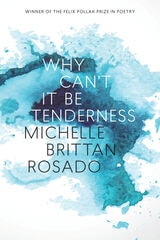
Why Can't It Be Tenderness
Michelle Brittan Rosado
University of Wisconsin Press, 2018
bring me back
to the in-between
where my breath
has always lived,
without containment,
like two legs pointing
toward the ocean, or these arms
reaching into sky
—excerpt from "Ode to the Double 'L'" Michelle Brittan Rosado. All rights reserved.
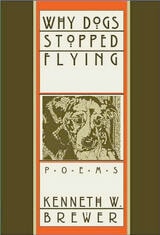
Why Dogs Stopped Flying
Kenneth Brewer
Utah State University Press, 2006
self-ironic. Yet, in this collection perhaps more than his earlier work, the particularity of the poet’s insight into the physical world and the warmth of his affection for it combine
to create an unexpected transcendence. Beasts and bodies are transformed in his lines, and our dim, unremarkable lives on this shadowed earth become somehow more
luminous—small words to the moon, small suns opening in the dark.

Why Misread A Cloud
Emily Carlson
Tupelo Press, 2022
— from the Judge’s Citation by Kimiko Hahn
Why Misread a Cloud takes its name from clouds of ash and smoke in wartime which appear to the author as a “storm, blown over the sea.” Both an exploration of the mind’s ability to turn what is into something else, in order to survive, and the mind’s ability to resist the effects of psychosocial warfare—imposed by the military and the police. “Who wants you to be afraid” the poet’s friend asks as he “added sugar to his tea.” The realization this question brings enables the poet to explore forces that separate us from one another and ways we rise up within ourselves to move through fear toward love.
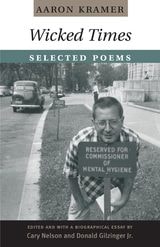
Wicked Times
SELECTED POEMSAaron Kramer
University of Illinois Press, 2004
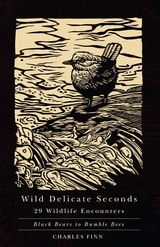
Wild Delicate Seconds
29 Wildlife EncountersCharles Finn
Oregon State University Press, 2012
In Wild Delicate Seconds, Charles Finn captures twenty-nine chance encounters with the everyday—and not so everyday—animals, birds, and insects of North America.
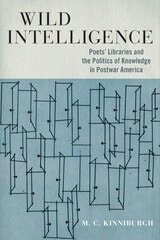
Wild Intelligence
Poets' Libraries and the Politics of Knowledge in Postwar AmericaM. C. Kinniburgh
University of Massachusetts Press, 2022
Information science was a burgeoning field in the early years of the Cold War, and while public and academic libraries acted as significant sites for the information boom, it is unsurprising that McCarthyism and censorship would shape what they granted readers access to and acquired. Wild Intelligence traces a different history of information management, examining the privately assembled collections of poets and their knowledge-building practices at midcentury.
Taking up case studies of four poets who began writing during the 1950s and 1960s, including Charles Olson (1910–1970), Diane di Prima (1934–2020), Gerrit Lansing (1928–2018), and Audre Lorde (1934–1992), M. C. Kinniburgh shows that the postwar American poet’s library should not just be understood according to individual books within their collection but rather as an archival resource that reveals how poets managed knowledge in a growing era of information overload. Exploring traditions and systems that had been overlooked, buried, occulted, or censored, these poets sought to recover a sense of history and chart a way forward.

Wilhelm Tell
Friedrich von Schiller
University of Chicago Press, 1973
Schiller based his play on chronicles of the Swiss liberation movement, in which Wilhelm Tell played a major role. Since Tell's existence has never been proven, Schiller, a historian by profession, felt he had to devise a figure who would bring the uncertainties and contradictions of the various Swiss chronicles into focus. Respected for his courage and skill with a bow, for his peaceable nature and his integrity, Schiller's archer—while always ready to aid his fellows—habitually seeks solitude. In the midst of political turmoil Wilhelm Tell is the nonpolitical man of action.
Keenly interested in the problematic interplay of history and legend, Schiller turned it to be dramatic advantage. He constructed his play to illustrate the greatest possible development of the character traits suggested for Tell by the chronicles. The result of Schiller's supreme achievement in historical drama.
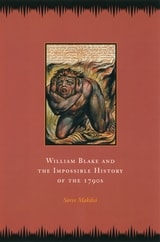
William Blake and the Impossible History of the 1790s
Saree Makdisi
University of Chicago Press, 2003

William Collins and Eighteenth-Century English Poetry
Richard Wendorf
University of Minnesota Press, 1981
William Collins and Eighteenth-Century English Poetry was first published in 1981. Minnesota Archive Editions uses digital technology to make long-unavailable books once again accessible, and are published unaltered from the original University of Minnesota Press editions.
William Collins (1721–1759) is one of several eighteenth-century poets who have received more attention for what they are said to have anticipated—the full-blooded Romanticism of Wordsworth and Coleridge—than for what they have achieved. Collins's career as a poet was brief, but the handful of major poems that he wrote in the mid -1740s has stirred interest among critics intrigued by the complexity and obscurity of his work and by the illness and possible madness that prematurely ended his life. Combining historical scholarship with close readings of all Collins's poems, Richard Wendorf provides the most comprehensive and detailed study to be devoted to the work of this enigmatic figure and to the forces that shaped his literary career. In doing so, he places Collins within an eighteenth-century poetic context and shows that his gift for myth-making makes him a vital link between the mythic poetry of Shakespeare and Spenser and that of the Romantics.
Wendorf's opening and closing chapters examine the relationship between Collins's life and his work, providing an authoritative discussion of his supposed madness and of the myths of insanity that clouded his reputation in the eighteenth and nineteenth centuries. Wendorf argues that Collins's madness is problematical at best, and that much recent criticism is a distortion of his major work, which explores the transcendent powers of the irrational forces within us but is not necessarily the product of madness itself. The book's central chapters trace Collins's development as a poet and offer fresh approaches to his major odes. In these mature poems he turned from his early interest in Augustan poetry to very different sources of inspiration and came to reject the ordered and unified natural world of Pope and Thompson.
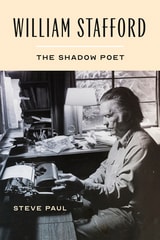
William Stafford
The Shadow PoetSteve Paul
Oregon State University Press, 2027
From the Kansas outdoors to Oregon classrooms, William Stafford (1914–1993) led a vibrantly original life navigated with ambition and mission. In poetry crafted in everyday language, a conversational tone, and richly accessible introspection, he invited readers to question and explore nature, humanity, and the American West. After he won the National Book Award in poetry and the Shelley Memorial Award from the Poetry Society of America and served as the Consultant in Poetry to the Library of Congress (a role known today as US Poet Laureate), his talent became recognized around the world. The accolades and achievements continued, including Stafford later spending fifteen years as the Poet Laureate of Oregon.
A character shaped by duty, adventure, a sharp sense of humor, and a strong moral compass, Stafford remains a beloved American poet. In William Stafford: The Shadow Poet, the first comprehensive biography, Steve Paul shares fascinating stories and frequently surprising accounts of Stafford’s life and work. The book traces Stafford from his humble origins through periods of social courage, the complications of his wartime alternative service, dedication to writing, and family tragedy. It explores how his pacifist world views and eco-consciousness continue to inspire those returning to his work or discovering it for the first time. Paul uncovers various layers of the poet’s life—through his philosophy, friends, family, teaching, and writing—and contemplates how Stafford’s metaphoric shadows, found frequently in his poems, figure into his life and career.
Willow Hammer
Patrick Donnelly
Four Way Books, 2025
In response to this crime, Donnelly traces the consequences of ignorance, denial, bargaining, complicity, and finally revelation that reverberated through his and his loved ones’ lives for five decades. His discovery of this catalyzing violation not only recontextualizes the siblings’ shared history, but inflects the present as—finding analogues of his sister’s abuse in the classical canon—he remembers his escape from home into spiritual disciplines and the study of dead languages. Revisiting the evolution of his own sexuality, he remembers singing a Byrd Mass after a night at a gay bathhouse, characterizing the tenor and bass as “two wrestling saints,” “lowest of the four voices— / once I thought I saw them kiss each other’s faces.”
And that—recovering glimpses of his sister’s unknowable interiority, reckoning with a truth that is unbearable and inescapable—is this book’s difficult and endless work. In the wake of a particular kind of harm, Willow Hammer seems to suggest, justice may be a wishful concept—but that doesn’t preclude testimony and salvage. “Now” documents the poet’s arrival at this compromise: “I remember my / little sister that was, / little willow of glass / upon whom he laid / his hammer hands.” There is no revocation of the hands, but with tenderness, wit, and fury, Donnelly’s lyrics refuse to let their shadow obscure his sister’s recovery of her own agency.
Win These Posters and Other Unrelated Prizes Inside
Norma Cole
Omnidawn, 2012
Windows and Doors
A Poet Reads Literary TheoryNatasha Saje
University of Michigan Press, 2014
Winds of Will
Emily Dickinson and the Sovereignty of Democratic ThoughtPaul Crumbley
University of Alabama Press, 2010
A sophisticated literary analysis positioning Emily Dickinson’s poetry within the framework of democratic thought and individual sovereignty.
In this study, Paul Crumbley asserts that, contrary to popular opinion, Emily Dickinson consistently communicated political views through her poetry. Dickinson’s life of self-isolation—today her most notable personal characteristic—by no means extended into the political sphere, he argues. While she rarely addressed political issues directly and was curiously disengaged from the liberal causes and female reform movements of her time, Dickinson’s poems are deeply rooted both in matters of personal sovereignty and reader choice. The significant choices Dickinson extends to the reader underscore the democratic dimensions of reading her work, and of reading itself as a political act.
Crumbley employs close readings of Dickinson’s poems and letters, highlighting the many changing—and often contradictory—voices in her work, both throughout her oeuvre and in individual poems themselves. In Dickinson’s letters Crumbley finds just as many unique and conflicting voices; thus, both her personal correspondence and the poems make political demands by placing the burden of interpretation on the reader.
Rather than reflecting explicit political values, Dickinson’s work chronicles an ongoing decision-making process that magnifies the role of individual choice, not the advocacy of specific outcomes. In the end, Dickinson’s readers must either accept an isolated lyric subjectivity or invest that subjectivity with the substance necessary for engagement with the larger world.
Wind–Mountain–Oak
The Poems of SapphoDan Beachy-Quick
Tupelo Press, 2023
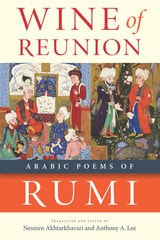
Wine of Reunion
Arabic Poems of RumiNesreen Rumi
Michigan State University Press, 2017
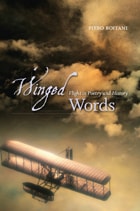
Winged Words
Flight in Poetry and HistoryPiero Boitani
University of Chicago Press, 2007
Flight has always fascinated human minds, but until a century ago it remained a dream—the exclusive domain of birds, gods, and mythological heroes. From the myths of the ancients to the poetry of Pindar and Yeats, Winged Words traces the imprint of the human impulse to fly from premodern times to the age of terrorism in both literature and history.
Piero Boitani begins his analysis with an account of the way the myths of Pegasus and Icarus have persisted from classical to twentieth-century politics and literature. He then takes up the figure of Hermes; the roles of halcyons and eagles in classical, biblical, and later literatures; and literary response to Pieter Brueghel’s The Fall of Icarus. Honing in on modern figures and concerns, Boitani also offers a fascinating discussion of author-pilot Antoine de Saint-Exupéry and concludes with a meditation on the flight of the hijacked airliners on 9/11. Throughout, Winged Word brings a remarkable range of men of action, politicians, theologians, writers, and artists into dialogue with each other: Shakespeare with T. S. Eliot, Horace with Ovid, Leonardo with Milton, Leopardi with Mallarmé, Saint-Exupéry with Faulkner and Rilke, and the Ulysses of Homer with the Ulysses of Dante. Ultimately, by showing how writers and fliers have looked to the ancients for inspiration, Boitani testifies to the modern relevance of poetry and the classics.
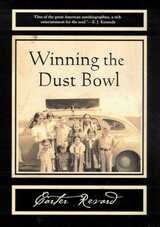
Winning the Dust Bowl
Carter Revard
University of Arizona Press, 2001
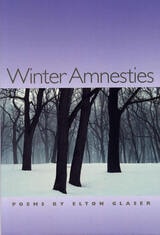
Winter Amnesties
Elton Glaser
Southern Illinois University Press, 2000
Winter Amnesties is a book of origins and endings, griefs and reconciliations. Each poem addresses the dilemma posed by G. K. Chesterton: “One must somehow find a way of loving the world without trusting it.” The poems revisit the past, assess the present, and stare hard into the future. At middle age, Glaser remembers his youth in Louisiana and settles into the long stretch of his adult years in Ohio; he makes his peace with “the life that allows.” As son, as father, as poet, he looks to his legacy, whatever dim remnant of himself might continue after “all flesh falls back to salt and cinder.”
But these are poems of brio and bitter wit, not of self-pity and surrender. They take a jaunty stance towards life and welcome whatever the days may bring, confident that, like crows in the harvest cornfield, we can live on “the shocks and waste of this world” and “wring gold grain from the ruin.”
Winter Dialogue
Tomas Venclova
Northwestern University Press, 1999
Winter Morning Walks
100 Postcards to Jim HarrisonTed Kooser
Carnegie Mellon University Press, 2001
In the late 1990s, when poet Ted Kooser was recovering from cancer surgery, he started sending postcards to his friend Jim Harrison, a novelist known for Legends of the Fall and numerous other books. On each postcard, he wrote a poem. Harrison did the same in return. In 2001, Kooser turned his half of the exchange into Winter Morning Walks: 100 Postcards to Jim Harrison, a collection of engaging, witty, clever, insightful poems that serve simultaneously as snapshots of a friendship and a view into a poet's daily observations.
Wintering
PoemsMegan Snyder-Camp
Tupelo Press, 2016

Winterkill
Todd Davis
Michigan State University Press, 2016
With Strings
Charles Bernstein
University of Chicago Press, 2001
Charles Bernstein is perhaps best known as one of the founders of the L=A=N=G=U=A=G=E poetry movement of the 1970s. He remains one of America's liveliest advocates and practitioners of radically inventive poetry. The title of his new collection, With Strings, suggests the lush arrangement of a musical work as well as the unacknowledged implications of our everyday agreements. Just as language binds us together with its associated meanings, With Strings bounces against the ties that rend us apart as they fasten us together. From his samplings of everyday life, to his demented yet sonorous iambic beats, Bernstein has once again created a poetry of our time, for our time, and by our time.
With This Night
By Leah Goldberg
University of Texas Press, 2011
When she arrived in Palestine in 1935 at the age of twenty-four, Leah Goldberg was already known as a significant emerging poet in contemporary Hebrew literature. Today, mention of her name is apt to evoke a nostalgic sigh among Israelis who have grown up hearing her poems read, quoted, recollected, and—having been set to some four hundred melodies—sung on the radio. In the wake of overwhelming new attention on Goldberg's work in Israel, With This Night makes available for the first time in English the final collection of poetry that Goldberg published during her lifetime.
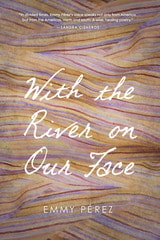
With the River on Our Face
Emmy Pérez
University of Arizona Press, 2016
Pérez reveals the strengths and nuances of a universe where no word is “foreign.” Her fast-moving, evocative words illuminate the prayers, gasps, touches, and gritos born of everyday discoveries and events. Multiple forms of reference enrich the poems in the form of mantra: ecologist’s field notes, geopolitical and ecofeminist observations, wildlife catalogs, trivia, and vigil chants.
“What is it to love / within viewing distance of night / vision goggles and guns?” is a question central to many of these poems.
The collection creates a poetic confluence of the personal, political, and global forces affecting border lives. Whether alluding to El Valle as a place where toxins now cross borders more easily than people or wildlife, or to increased militarization, immigrant seizures, and twenty-first-century wall-building, Pérez’s voice is intimate and urgent. She laments, “We cannot tattoo roses / On the wall / Can’t tattoo Gloria Anzaldúa’s roses / On the wall”; yet, she also reaffirms Anzaldúa’s notions of hope through resilience and conocimiento.
With the River on Our Face drips deep like water, turning into amistad—an inquisition into human relationships with planet and self.

Within the Sweet Noise of Life
Selected PoemsSandro Penna
Seagull Books, 2020
Juggling traditional Italian prosody and subject matter with their gritty urban opposites in taut, highly concentrated poems, Penna’s lyrics revel in love and the eruption of Eros together with the extraordinary that can be found within simple everyday life. There is something ancient in Penna’s poetry, and something Etruscan or Greek about the poems, though the landscape is most often of Rome: sensual yet severe, sinuous yet solid, inscrutable, intangible, and languorous, with a Sphinx-like and sun-soaked smile. Penna’s city is eternal—a mythically decadent Rome that brings to mind Paris or Alexandria. And though the echoes resound—from Rimbaud, Verlaine, and Baudelaire to Leopardi, D’Annunzio, and Cavafy—the voice is always undeniably and wonderfully Penna’s own.
Wittgenstein's Ladder
Poetic Language and the Strangeness of the OrdinaryMarjorie Perloff
University of Chicago Press, 1996
"This book has the lucidity and the intelligence we have come to expect from Marjorie Perloff.—Linda Munk, American Literature
"[Perloff] has brilliantly adapted Wittgenstein's conception of meaning and use to an analysis of contemporary language poetry."—Linda Voris, Boston Review
"Wittgenstein's Ladder offers significant insights into the current state of poetry, literature, and literary study. Perloff emphasizes the vitality of reading and thinking about poetry, and the absolute necessity of pushing against the boundaries that define and limit our worlds."—David Clippinger, Chicago Review
"Majorie Perloff has done more to illuminate our understanding of twentieth century poetic language than perhaps any other critic. . . . Entertaining, witty, and above all highly original."—Willard Bohn, Sub-Stance
Wolf Lake, White Gown Blown Open
PoemsDiane Seuss
University of Massachusetts Press, 2010
Diane Seuss's poems grow out of the fertile soil of southwest Michigan, bursting any and all stereotypes of the Midwest and turning loose characters worthy of Faulkner in their obsession, their suffering, their dramas of love and sex and death. The first section of this collection pays homage to the poet's roots in a place where the world hands you nothing and promises less, so you are left to invent yourself or disappear. From there these poems both recount and embody repeated acts of defiant self-creation in the face of despair, loss, and shame, and always in the shadow of annihilation.
With darkly raucous humor and wrenching pathos, Seuss burrows furiously into liminal places of no dimension— state lines, lakes' edges, the space “between the m and the e in the word amen.” From what she calls “this place inbetween” come profane prayers in which "the sound of hope and the sound of suffering" are revealed to be “the same music played on the same instrument.”
Midway through this book, a man tells the speaker that beauty is that which has not been touched. This collection is a righteous and fierce counterargument: in the world of this imagination, beauty spills from that which has been crushed, torn, and harrowed. “We receive beauty,” Seuss writes, “as a nail receives / the hammer blow.” This is the poetry that comes only after the white dress has been blown open—the poetry of necessity, where a wild imagination is the only hope.
Woman Prime
PoemsGail C. DiMaggio
University of Alaska Press, 2018
Like many women, the speaker believed that leaving her parent’s home, falling in love, and raising children would reveal the essential core of herself. Instead, she learns that those she loves can fail her and that she must embrace a world full of flickering and conflicting expectations for women. Woman Prime is about every woman and no woman—a mutable voice that will still resonate with anyone trying to reconcile their flawed and complicated selves.
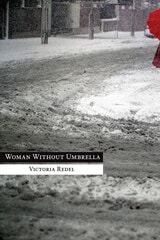
Woman Without Umbrella
Victoria Redel
Four Way Books, 2012
Women Poets on Mentorship
Efforts and AffectionsArielle Greenberg
University of Iowa Press, 2008
The poets in this collection describe a new kind of influence, one less hierarchical, less patriarchal, and less anxious than forms of mentorship in the past. Vivid and intelligent, these twenty-four essays explore the complicated nature of the mentoring relationship, with all its joys and difficulties, and show how this new sense of writing out of female experience and within a community of writers has fundamentally changed women’s poetry.
Includes:
Jenny Factor on Marilyn Hacker
Beth Ann Fennelly on Denise Duhamel
Miranda Field on Fanny Howe
Katie Ford on Jorie Graham
Joy Katz on Sharon Olds
Valerie Martínez on Joy Harjo
Erika Meitner on Rita Dove
Aimee Nezhukumatathil on Naomi Shihab Nye
Eleni Sikelianos on Alice Notley
Tracy K. Smith on Lucie Brock-Broido
Crystal Williams on Lucille Clifton
Rebecca Wolff on Molly Peacock
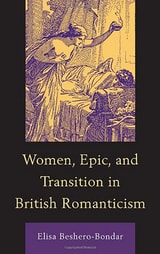
Women, Epic, and Transition in British Romanticism
Elisa Beshero-Bondar
University of Delaware Press, 2011
Women, Epic, and Transition in British Romanticism argues that early nineteenth-century women poets contributed some of the most daring work in modernizing the epic genre. The book examines several long poems to provide perspective on women poets working with and against men in related efforts, contributing together to a Romantic movement of large-scale genre revision. Women poets challenged longstanding categorical approaches to gender and nation in the epic tradition, and they raised politically charged questions about women’s importance in moments of historical crisis.
While Romantic epics did not all engage in radical questioning or undermining of authority, this study calls attention to some of the more provocative poems in their approach to gender, culture, and history. This study prioritizes long poems written by and about women during the Romantic era, and does so in context with influential epics by male contemporaries. The book takes its cue from a dramatic increase in the publication of epics in the early nineteenth-century. At their most innovative, Romantic epics provoked questions about the construction of ideological meaning and historical memory, and they centralized women’s experiences in entirely new ways to reflect on defeat, loss, and inevitable transition. For the first time the epic became an attractive genre for ambitious women poets.
The book offers a timely response to recent groundbreaking scholarship on nineteenth-century epic by Herbert Tucker and Simon Dentith, and should be of interest to Romanticists and scholars of 18th- and 19th-century literature and history, gender and genre, and women’s studies.
Published by University of Delaware Press. Distributed worldwide by Rutgers University Press.
Wonder Cabinet
PoemsDavid Barber
Northwestern University Press, 2006
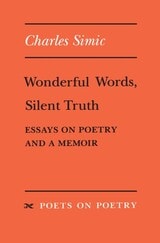
Wonderful Words, Silent Truth
Essays on Poetry and a MemoirCharles Simic
University of Michigan Press, 1990
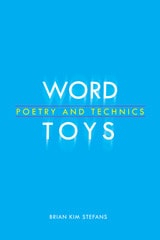
Word Toys
Poetry and TechnicsBrian Kim Stefans
University of Alabama Press, 2017
With the ascent of digital culture, new forms of literature and literary production are thriving that include multimedia, networked, conceptual, and other as-yet-unnamed genres while traditional genres and media—the lyric, the novel, the book—have been transformed. Word Toys: Poetry and Technics is an engaging and thought-provoking volume that speculates on a range of poetic, novelistic, and programmed works that lie beyond the language of the literary and which views them instead as technical objects.
Brian Kim Stefans considers the problems that arise when discussing these progressive texts in relation to more traditional print-based poetic texts. He questions the influence of game theory and digital humanities rhetoric on poetic production, and how non-digital works, such as contemporary works of lyric poetry, are influenced by the recent ubiquity of social media, the power of search engines, and the public perceptions of language in a time of nearly universal surveillance.
Word Toys offers new readings of canonical avant-garde writers such as Ezra Pound and Charles Olson, major successors such as Charles Bernstein, Alice Notley, and Wanda Coleman, mixed-genre artists including Caroline Bergvall, Tan Lin, and William Poundstone, and lyric poets such as Harryette Mullen and Ben Lerner. Writers that trouble the poetry/science divide such as Christian Bök, and novelists who have embraced digital technology such as Mark Z. Danielewski and the elusive Toadex Hobogrammathon, anchor reflections on the nature of creativity in a world where authors collaborate, even if unwittingly, with machines and networks. In addition, Stefans names provocative new genres—among them the nearly formless “undigest” and the transpacific “miscegenated script”—arguing by example that interdisciplinary discourse is crucial to the development of scholarship about experimental work.