Results by title
5550 books match the query 'Biography & Autobiography' and 258 start with w
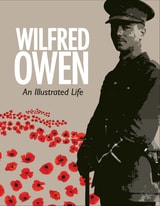
Wilfred Owen
An Illustrated LifeJane Potter
Bodleian Library Publishing, 2014
This generously illustrated book tells the story of Owen’s life and work, from his birth in 1893 to his tragic death just one week before the signing of the armistice that would end the war. The shocking realism of poems such as “Strange Meeting” and the angry disillusionment of “Anthem for Doomed Youth” reveal Owen’s transformation from a romantic youth steeped in the poetry of Keats to a mature soldier awakened to the horrors of the Western Front.
Drawing on numerous manuscripts, artifacts, and family photographs, this book gives a comprehensive view of the relationship between the poet’s lived experience and his writing that will appeal equally to both those well-versed in Owen’s work and those seeking a well-researched, accessible introduction.
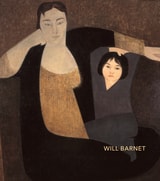
Will Barnet
Will Barnet
The Artist Book Foundation, 2024
The first monograph on Will Barnet in nearly 40 years, this title reflect's the artist's unique interpretation of the world's evolving genres.
Will Barnet’s artistic career as a painter and printmaker spanned nearly eight decades of continuous creativity. Few artists, other than perhaps Picasso or Monet, can claim such an extended period of uninterrupted and innovative art making. From the darkness of the Great Depression to the opening decade of the twenty-first century, his oeuvre reflects his unique interpretation of the art world’s evolving genres: Social Realism, Modernism, Abstract Expressionism, and ultimately representational Minimalism with the human figure as his primary subject.
This book is the first comprehensive monograph on Will Barnet in nearly 40 years. With scholarly essays by the four distinguished authors, an extensive plate section, a comprehensive chronology, lists of awards and exhibitions, and a detailed bibliography, this monograph is a thorough presentation of Barnet's iconic images and consistently evolving style while celebrating his unquenchable joie de vivre.
Barnet was devoted to making art every day and worked diligently even at the very end of his life. "The Old Masters are still alive after 400 years, and that's what I want to be," he once said. "At the age of 10 or 12, I discovered that being an artist would give me an ability to create something which would live on after death." Live on it does; in addition to his acclaimed body of work, he influenced a broad spectrum of artists such as Jackson Pollock, Mark Rothko, James Rosenquist, Cy Twombly, and Ethel Fisher.
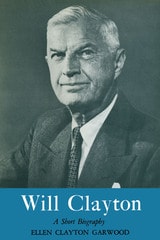
Will Clayton
A Short BiographyBy Ellen Clayton Garwood
University of Texas Press, 1959
Will Clayton left his mark on world commerce through the development of Anderson, Clayton & Co., the world's largest cotton marketing firm; he made an equally important impress on international economics and politics through special and vital service in the State Department during three crucial years of world history.
The politico-economic philosophy that Will Clayton developed as cotton merchant to the world provided the basis for his distinguished service as Assistant Secretary of State and as Undersecretary of State for Economic Affairs and influenced the course of international events far more than is generally realized.
"When the full story of the genesis of the Marshall Plan is told, it will become evident that the inspiration was Will Clayton's; which means he will have a firm niche in history, for this, if for nothing else," wrote John Dalgleish in Everybody's Weekly (London) in 1947. Dalgleish's opinion is supported by documentary evidence and the statements of others whose views are given in this short biography.
The principal events in Will Clayton's background that shaped his character and developed his personal philosophy are here portrayed by one who had a unique opportunity to view her subject at close range during the main periods of his careers in government and business. In this brief biography, his eldest daughter, Ellen Clayton Garwood, intimately but objectively traces the evolution of Clayton's realistic internationalism. The effectiveness of his governmental service in a fast-shrinking world had its roots in his early struggles in international cotton marketing. His marked ability to gain the support of Congress for government proposals—extension of the Reciprocal Trade Agreements Act, the British Loan, the Marshall Plan—is foreshadowed in his triumphant defense of his own business before a Senate investigating committee in the early twentieth century, and by his championship of Southern delivery on futures contracts on the New York Cotton Exchange.
But the story is not all one of success. Will Clayton wanted more than anything to see his country assume membership in an International Trade Organization, for the charter of which he had worked so hard. His disappointment here—partially offset by the success of the General Agreement on Tariffs and Trade—finds counterpart throughout these pages in the obstacles he had to overcome in his development as a human being.
And human being he emerges—son, husband, and father; businessman and statesman—whose measure, with its shadow and its highlights, should serve as strong encouragement for those who would serve their country and their world with equally intelligent devotion.
This book, therefore, brings a note of definite optimism. Will Clayton started out as a poor boy among the bewildered people of the reconstructed South. He emerged a statesman who drew out of still worse confusion in the world a program of hopeful and uplifting clarity. His own words, in a cable from Geneva, August 15, 1947, describe the challenge he met—a challenge that recurs in different form today: "A great opportunity to help Europe lift herself permanently out of a morass of bilateralism and restrictionism has floated in to us on a floodtide of destruction. If we fail to seize this opportunity now it will probably never return except possibly after a third World War."

Willa Cather - American Writers 36
University of Minnesota Pamphlets on American WritersDorothy Van Ghent
University of Minnesota Press, 1964
Willa Cather - American Writers 36 was first published in 1964. Minnesota Archive Editions uses digital technology to make long-unavailable books once again accessible, and are published unaltered from the original University of Minnesota Press editions.
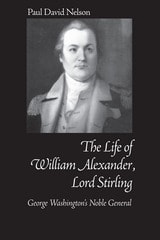
William Alexander Lord Stirling
George Washington's Noble GeneralPaul David Nelson
University of Alabama Press, 1987
At the beginning of the Revolutionary War Stirling was appointed a colonel in the New Jersey Continental Line and from there rose to the rank of Major General. A brave and loyal soldier, he greatly impressed General George Washington, who made him commander of one of the five divisions of the Continental Army. Serving in this capacity, Stirling made his reputation as a military man fighting in the battles of Long Island, White Plains, Trenton, Brandywine, Germantown, and Monmouth. He spent the winter of 1777-78 with Washington at Valley Forge. From time to time he carried out independent military operations, most notably a raid against Staten Island in January 1780. Stirling’s buoyant optimism and reckless enthusiasm for any task led one military comrade to state that his high birth and good humor provided him with many more opportunities in life than his skill and intelligence would have permitted. He died while in command of the Northern Department on January 15, 1783, full of military glory and, according to one cynic, “good liquor.”
William Carlos Williams - American Writers 24
University of Minnesota Pamphlets on American WritersJohn Malcolm Brinnin
University of Minnesota Press, 1963
William Carlos Williams - American Writers 24 was first published in 1963. Minnesota Archive Editions uses digital technology to make long-unavailable books once again accessible, and are published unaltered from the original University of Minnesota Press editions.
William D. Howells - American Writers 63
University of Minnesota Pamphlets on American WritersWilliam M. Gibson
University of Minnesota Press, 1967
William D. Howells - American Writers 63 was first published in 1967. Minnesota Archive Editions uses digital technology to make long-unavailable books once again accessible, and are published unaltered from the original University of Minnesota Press editions.
William Faulkner - American Writers 3
University of Minnesota Pamphlets on American WritersWilliam Van O’Connor
University of Minnesota Press, 1959
William Faulkner - American Writers 3 was first published in 1959. Minnesota Archive Editions uses digital technology to make long-unavailable books once again accessible, and are published unaltered from the original University of Minnesota Press editions.
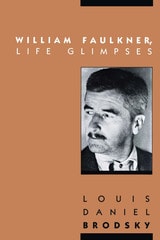
William Faulkner, Life Glimpses
By Louis Daniel Brodsky
University of Texas Press, 1990
During thirty years of literary collecting, Louis Daniel Brodsky has acquired some of the most important source materials on the life and work of William Faulkner anywhere available. Indeed, the Brodsky Collection, now owned by Southeast Missouri State University, has been characterized by Robert Penn Warren as "stupendous." In William Faulkner, Life Glimpses, Brodsky mines this storehouse of previously unpublished material, using interviews, letters, speeches, movie scripts, and notes to enrich our understanding of this well-known Southern writer. The result is a highly readable biography that is thematic and episodic rather than chronological in its organization.
Building on specific documents in the collection, Brodsky opens new windows on the parallel development of Faulkner's literary career and personal life. New material on the early poems ''Elder Watson in Heaven" and "Pregnancy" gives insight into Faulkner's developing literary and personal aesthetics during the 1920s and 1930s.
Faulkner's metamorphosis from self-doubting, isolated artist to confident public spokesman during the 1940s and 1950s forms the central core of the study. Through previously unavailable screenplays written for Warner Bros. during World War II and an interview with Faulkner's fellow screenwriter Albert I. "Buzz" Bezzerides, Brodsky charts the decline in Faulkner's literary output and his corresponding discovery of a public voice. He shows how Faulkner's astonishingly positive 1950 Nobel Prize acceptance speech was not a sudden about-face from the bleak outlook that had produced The Sound and the Fury. Rather, Faulkner's years in Hollywood showed him that words, even screenplays, could shape the way people think and react. Faulkner's lifelong quest for a "manly" role ended, Brodsky declares, when he took up the mantle of public spokesmanship.
In the final chapter, a revealing interview with Faulkner's granddaughter, Victoria Fielden Johnson, paints an insider's portrait of life at the Faulkner home, Rowan Oak. A copy of Faulkner's recipe for curing pork, included in the appendix, emphasizes his longterm struggle to produce fine literature while supplying the everyday needs of a large family.
These and other materials, previously unavailable to scholars and the reading public, will broaden and enrich our understanding of one of America's most celebrated writers.
William Gibson
Gary Westfahl
University of Illinois Press, 2013
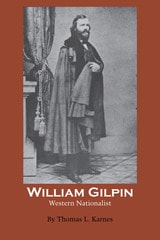
William Gilpin
Western NationalistBy Thomas L. Karnes
University of Texas Press, 1970
William Gilpin (1815–1894) has been called “America’s first geopolitician.” Regarded today as both scientist and quack, Gilpin was in his own time a recognized authority whose maps were accepted by Congress as the most accurate available, and his description of trails and land in the West were read by pioneer and scientist alike as inspiration and guide.
His writings first introduced to the American public the treasures of the Great Plains (to Gilpin probably belongs the credit for introducing this well-known term) and the mountain plateaus of the Rockies. He advertised the future of the lush valleys of Oregon and the mineral riches that, he was sure, the American West contained.
Gilpin was a cultured, educated man; his studies and his hours of lonely observation on many trips across the American prairies had resulted in the theory—in part true, in part fallacious—about the importance of the Mississippi Valley to world trade and world peace. To his contemporaries and a few later historians he was “a man of rare genius and advanced thought, a prophet and pioneer of civilization,” “one of the wonderful and gifted men of the age, and to him are the citizens of the Republic, in general, and the West, in particular, immeasurably indebted.”
In this biography Thomas L. Karnes traces the life of William Gilpin from the quiet comfort of his wealthy Quaker boyhood home through an exciting and turbulent career as Indian fighter, pioneer, newspaper editor, explorer, land promoter, and first governor of Colorado Territory. But throughout his varied career there was one task to which Gilpin was always devoted: he was a publicizer of the West, first in letters to family and friends; then in newspaper articles, books, and speeches; and finally in reports that became part of the Congressional Record and that influenced the actions of Presidents.
William Godwin
A Political LifeRichard Gough Thomas
Pluto Press, 2019
William Godwin was the first major anarchist thinker in the Anglophone world, and his thought rocked the establishment at the beginning of the nineteenth century. Famously married to Mary Wollstonecraft, father to Mary Shelley, and inspiration to Lord Byron, he lived a life and created a body of work that lie at the heart of British radicalism and romanticism.
In this biography, Richard Gough Thomas reads Godwin afresh, drawing on newly discovered letters and journals. He situates Godwin’s early life in the counterculture of eighteenth-century religious dissent, before moving on to exploring the ideas of the French Revolution. As Godwin's groundbreaking works propelled him from Whig party hack to celebrity philosopher, his love affair with Mary Wollstonecraft saw him ostracized in both liberal and conservative circles.
Godwin's anarchism always remained at the center of his work, Thomas shows, inspiring libertarians, both left- and right-wing. This biography places Godwin alongside the other members of his famous family as a major political, ethical, and educational writer and shows why a reappraisal of his ideas is pertinent today.
William Grant Still
Catherine Parsons Smith
University of Illinois Press, 2008
Catherine Parsons Smith’s biography tracks the composer's interrelated careers in popular and concert music. Still’s artistic journey took him from conservatory study with George W. Chadwick to collaborating with Langston Hughes, working as a commercial arranger and composer on Broadway and radio, arranging for artists like Sophie Tucker and Artie Shaw, and serving as the recording director for the first Black-owned record label. But despite his prolific production and multidimensional talents, Still endured financial struggles and declining attention to his work.
William H. Emory
Soldier-ScientistL. David Norris, James C. Milligan, and Odie B. Faulk
University of Arizona Press, 1998
Born in Maryland in 1811, Emory was a West Point graduate who resigned his commission to become a civil engineer and join the newly formed Corps of Topographical Engineers. After working along the Canadian boundary, he was selected to accompany Stephen Watts Kearny and the Army of the West in their trek to California in 1846, and his map from that expedition helped guide Forty-Niners bound for the goldfields.
Emory worked for nine years on the new border between the United States and Mexico after the Treaty of Guadalupe Hidalgo and the Gadsden Purchase and was responsible for the survey and marking of the boundary. When the Civil War broke out, Emory refused a commission in the Confederate Army, instead commanding a regiment defending Washington, D.C. Later he saw action at Manassas, in the Red River campaign, and in the Shenandoah Valley, where he served under Phil Sheridan.
This biography draws on Emory’s personal papers to reveal other significant episodes of his life. While commanding a cavalry unit in Indian Territory, he was the only officer to bring an entire command out of insurrectionary territory. In hostile action of a different kind, he was a major witness in the impeachment trial of Andrew Johnson and offered testimony that helped save the president.
William H. Emory: Soldier-Scientist is an important resource for scholars of western expansion and the Civil War. More than that, it is a rousing story of an unsung but distinguished hero of his time.
William Hickling Prescott
A BiographyBy C. Harvey Gardiner
University of Texas Press, 1969
This biography of a distinguished historian and man of letters is the first study of William Hickling Prescott (1796–1859) to be written by a historian who has worked with the very themes explored by Prescott. And it is the first to treat him not only as creative historian but also as family man, as traveler and clubman, as investor and humanitarian, and as private citizen with strong political preferences.
Prescott the socialite and Prescott the introvert writer emerge in the round as the magnificent amateur who helped establish canons that have enriched American historical scholarship ever since. Blending history and literature, his multivolume works won Prescott the first significant international reputation to be accorded to an American historian.
Working despite persistent obstacles of health and against a penchant for society and leisure that was always part of his personality, Prescott came to be considered the finest interpreter of the Hispanic world produced by the Anglo-Saxon world. His Conquest of Mexico and Conquest of Peru were pronounced classics.
C. Harvey Gardiner takes the reader back to the nineteenth century in style and in subject to present William Hickling Prescott, gentleman and scholar, firmly fixed in relationship to his community and his times. But Gardiner's Victorian stance and respect for nineteenth-century historiography do not prevent his presenting Prescott as a whole man, viewed in retrospect, stripped of myth, and evaluated for moderns.
William Hughes
AustraliaCarl Bridge
Haus Publishing, 2010
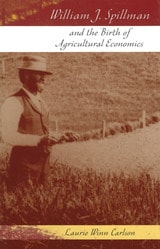
William J. Spillman and the Birth of Agricultural Economics
Laurie Winn Carlson
University of Missouri Press, 2005
William James - American Writers 88
University of Minnesota Pamphlets on American WritersGay Wilson Allen
University of Minnesota Press, 1970
William James - American Writers 88 was first published in 1970. Minnesota Archive Editions uses digital technology to make long-unavailable books once again accessible, and are published unaltered from the original University of Minnesota Press editions.
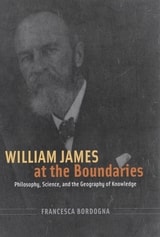
William James at the Boundaries
Philosophy, Science, and the Geography of KnowledgeFrancesca Bordogna
University of Chicago Press, 2008
What was the goal of this unusual speech? Rather than an oddity, Francesca Bordogna asserts that the APA address was emblematic—it was just one of many gestures that James employed as he plowed through the barriers between academic, popular, and pseudoscience, as well as the newly emergent borders between the study of philosophy, psychology, and the “science of man.” Bordogna reveals that James’s trespassing of boundaries was an essential element of a broader intellectual and social project. By crisscrossing divides, she argues, James imagined a new social configuration of knowledge, a better society, and a new vision of the human self. As the academy moves toward an increasingly interdisciplinary future, William James at the Boundaries reintroduces readers to a seminal influence on the way knowledge is pursued.
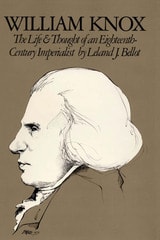
William Knox
The Life and Thought of an Eighteenth-Century ImperialistBy Leland J. Bellot
University of Texas Press, 1977
Colonial expert and pamphleteer William Knox has received attention in virtually every major study of the American Revolution, yet this is the first biography of Knox ever written.
Knox is best known as undersecretary of state in the American Department of the British government from 1770 to 1782. A prolific and candid commentator, he also made a reputation as a pamphleteer, defending the imperial cause during the decade preceding the Revolution. It had been his experience as provost marshal in Georgia from 1757 to 1762 that convinced Knox of the danger to the empire of the growing "democratic" forces in the American colonies.
While numerous historical works have focused on this or that aspect of Knox's career and thought, such treatment has produced at best a jigsaw portrait. Bellot's comprehensive narrative reveals Knox as a person—one whose Calvinist heritage and Scots-Irish upbringing profoundly influenced his view of empire—and as a historical actor and witness. Here is a look at the events of the revolutionary period through the eyes of a British bureaucrat who had a significant role in both the formation and the execution of British policy. This perspective also provides an excellent case study of the operation of the eighteenth-century British bureaucracy.
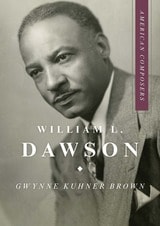
William L. Dawson
Gwynne Kuhner Brown
University of Illinois Press, 2024
Born in 1899, Dawson studied at the Tuskegee Institute in Alabama. He worked as a church, jazz, and orchestral musician in Kansas City and Chicago in the 1920s while continuing his education as a composer. He then joined the Tuskegee faculty, where for 25 years he led the Tuskegee Institute Choir to national prominence through performances of spirituals at the opening of Radio City Music Hall, on radio and television, and at the White House. The Philadelphia Orchestra conducted by Leopold Stokowski premiered Dawson’s Negro Folk Symphony in 1934.
Engaging and long overdue, William L. Dawson celebrates a pioneering Black composer whose contributions to African American music, history, and education inspire performers and audiences to this day.
William Massey
New ZealandJames Watson
Haus Publishing, 2010
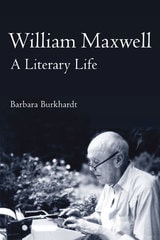
William Maxwell
A Literary LifeBarbara A. Burkhardt
University of Illinois Press, 2004
Known as a beloved, longtime fiction editor at The New Yorker, William Maxwell worked closely with such legendary writers as Vladimir Nabokov, John Updike, Mary McCarthy, and John Cheever. His own novels include They Came Like Swallows and the American Book Award-winning So Long, See You Tomorrow, and many consider him to be one of the twentieth century's most important writers. Barbara Burkhardt's William Maxwell: A Literary Life represents the first major critical study of this Illinois writer's life and work.
Writing with an economy and elegance befitting her subject, Burkhardt addresses Maxwell's highly autobiographical fiction by skillfully interweaving his biography with her own critical interpretations. She contextualizes his fiction in terms of events including his mother's early death from influenza, his marriage, and the role of his psychoanalysis under the guidance of Theodor Reik. Drawing on a wide range of previously unavailable material, Burkhardt includes letters Maxwell received from authors such as Eudora Welty and Louise Bogan, excerpts from his unpublished manuscripts and correspondence, and her own interviews with Maxwell and key figures from his life, including John Updike, Roger Angell, New Yorker fiction editor Robert Henderson, and Maxwell's family and friends.
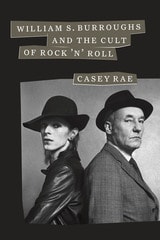
William S. Burroughs and the Cult of Rock 'n' Roll
By Casey Rae
University of Texas Press, 2019
William S. Burroughs's fiction and essays are legendary, but his influence on music's counterculture has been less well documented—until now. Examining how one of America's most controversial literary figures altered the destinies of many notable and varied musicians, William S. Burroughs and the Cult of Rock 'n' Roll reveals the transformations in music history that can be traced to Burroughs.
A heroin addict and a gay man, Burroughs rose to notoriety outside the conventional literary world; his masterpiece, Naked Lunch, was banned on the grounds of obscenity, but its nonlinear structure was just as daring as its content. Casey Rae brings to life Burroughs's parallel rise to fame among daring musicians of the 1960s, '70s, and '80s, when it became a rite of passage to hang out with the author or to experiment with his cut-up techniques for producing revolutionary lyrics (as the Beatles and Radiohead did). Whether they tell of him exploring the occult with David Bowie, providing Lou Reed with gritty depictions of street life, or counseling Patti Smith about coping with fame, the stories of Burroughs's backstage impact will transform the way you see America's cultural revolution—and the way you hear its music.
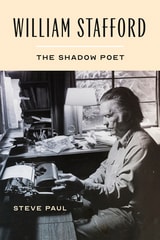
William Stafford
The Shadow PoetSteve Paul
Oregon State University Press, 2027
From the Kansas outdoors to Oregon classrooms, William Stafford (1914–1993) led a vibrantly original life navigated with ambition and mission. In poetry crafted in everyday language, a conversational tone, and richly accessible introspection, he invited readers to question and explore nature, humanity, and the American West. After he won the National Book Award in poetry and the Shelley Memorial Award from the Poetry Society of America and served as the Consultant in Poetry to the Library of Congress (a role known today as US Poet Laureate), his talent became recognized around the world. The accolades and achievements continued, including Stafford later spending fifteen years as the Poet Laureate of Oregon.
A character shaped by duty, adventure, a sharp sense of humor, and a strong moral compass, Stafford remains a beloved American poet. In William Stafford: The Shadow Poet, the first comprehensive biography, Steve Paul shares fascinating stories and frequently surprising accounts of Stafford’s life and work. The book traces Stafford from his humble origins through periods of social courage, the complications of his wartime alternative service, dedication to writing, and family tragedy. It explores how his pacifist world views and eco-consciousness continue to inspire those returning to his work or discovering it for the first time. Paul uncovers various layers of the poet’s life—through his philosophy, friends, family, teaching, and writing—and contemplates how Stafford’s metaphoric shadows, found frequently in his poems, figure into his life and career.
William Styron - American Writers 98
University of Minnesota Pamphlets on American WritersRichard Pearce
University of Minnesota Press, 1971
William Styron - American Writers 98 was first published in 1971. Minnesota Archive Editions uses digital technology to make long-unavailable books once again accessible, and are published unaltered from the original University of Minnesota Press editions.
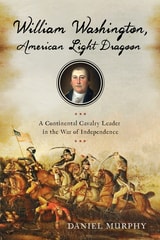
William Washington, American Light Dragoon
A Continental Cavalry Leader in the War of IndependenceDaniel Murphy
Westholme Publishing, 2014
William Washington began the war as a captain of Virginia Militia, was commissioned a junior officer in the Continental Infantry, and slowly rose to field command in the Continental Light Dragoons where he built one of the hardest hitting cavalry regiments to serve in the war. His chief adversary Lord Cornwallis commented, “There could be no more formidable antagonist in a charge, at the head of his cavalry, than Colonel William Washington.” Despite his connection to the commander-in-chief, he suffered his fair share of setbacks, and his relationships varied with not only his legendary cousin George, but many well-known figures of the Revolution including, Henry Lee, Casimir Pulaski, Nathanael Greene, and Daniel Morgan. Relying largely on firsthand accounts and period letters, in William Washington: American Light Dragoon: A Continental Cavalry Leader in the War of Independence, author and avid equestrian Daniel Murphy blends these primary sources with his own working knowledge of period drill, tactics, and terrain to deliver a more complete view of William Washington’s actions throughout the conflict. This perspective traces the often overlooked role of cavalry in the American Revolution and sheds new light on many pivotal battles in of the war, including Trenton, Cowpens, Guilford Courthouse, Hobkirk’s Hill, and William Washington’s final action at Eutaw Springs.
William Watts Folwell
The Autobiography and Letters of a Pioneer of CultureWilliam Folwell
University of Minnesota Press, 1933
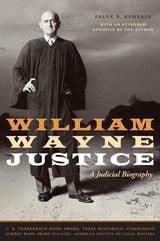
William Wayne Justice
A Judicial BiographyBy Frank Kemerer, with an extended epilogue by the author
University of Texas Press, 2008
In his forty years on the federal bench in Texas, William Wayne Justice has been a formidable force for change. His rulings have prompted significant institutional reforms in education, prisons, and racial relations, to name only a few areas of society in Texas and beyond that have been affected by Justice's work. For his labors, Judge Justice has received numerous awards, including the Outstanding Federal Trial Judge Award, the Thurgood Marshall Award from the Section on Individual Rights and Responsibilities of the American Bar Association, and the Morris Dees Justice Award from the University of Alabama School of Law.
This paperback reprint of William Wayne Justice chronicles his judicial career and the decisions he reached. It includes a new epilogue that describes Justice's move to Austin as a judge on senior status yet with a full caseload, tracks the long-running institutional reform cases to their conclusion, and examines the legacy of this remarkable and controversial jurist.

William Z. Foster and the Tragedy of American Radicalism
James R. Barrett
University of Illinois Press, 1999
A self-educated wage earner raised in the slums of a large industrial city, William Z. Foster became a brilliant union organizer who helped build the American Federation of Labor and, later, radical Trade Union Educational League. Embracing socialism, syndicalism, and communism in turn, Foster rose through the ranks of the American Communist Party to stand at the forefront of labor politics throughout the 1920s. Yet by the time he died in 1961, in a Moscow hospital far from the meat-packing plants and steel mills where he had built his reputation, Foster's political marginalism stood as a symbol for the isolation of American labor radicalism in the postwar era.
Integrating both the indigenous and the international factors that determined the fate of American communism, William Z. Foster and the Tragedy of American Radicalism provides a new understanding of the basis for radicalism among twentieth-century American workers.
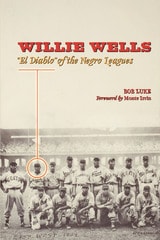
Willie Wells
El Diablo of the Negro LeaguesBy Bob Luke
University of Texas Press, 2007
2008 — Robert Peterson Recognition Award
Willie Wells was arguably the best shortstop of his generation. As Monte Irvin, a teammate and fellow Hall of Fame player, writes in his foreword, "Wells really could do it all. He was one of the slickest fielding shortstops ever to come along. He had speed on the bases. He hit with power and consistency. He was among the most durable players I've ever known." Yet few people have heard of the feisty ballplayer nicknamed "El Diablo." Willie Wells was black, and he played long before Jackie Robinson broke baseball's color barrier. Bob Luke has sifted through the spotty statistics, interviewed Negro League players and historians, and combed the yellowed letters and newspaper accounts of Wells's life to draw the most complete portrait yet of an important baseball player.
Wells's baseball career lasted thirty years and included seasons in Cuba, Puerto Rico, Mexico, and Canada. He played against white all-stars as well as Negro League greats Satchel Paige, Josh Gibson, and Buck O'Neill, among others. He was beaned so many times that he became the first modern player to wear a batting helmet.
As an older player and coach, he mentored some of the first black major leaguers, including Jackie Robinson and Don Newcombe. Willie Wells truly deserved his induction into the Baseball Hall of Fame, but Bob Luke details how the lingering effects of segregation hindered black players, including those better known than Wells, long after the policy officially ended. Fortunately, Willie Wells had the talent and tenacity to take on anything—from segregation to inside fastballs—life threw at him. No wonder he needed a helmet.
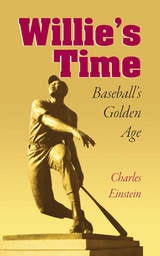
Willie's Time
Baseball's Golden AgeCharles Einstein
Southern Illinois University Press, 2004
To a generation of fans, Willie Mays was the greatest ballplayer they had ever seen. The prowess and speed of the Say Hey Kid were unmatched on the diamond before his time, prompting Joe DiMaggio to label him, “the closest you can come to perfection.” He was the first player to hit fifty home runs and steal twenty bases in a single season. Mays played for the New York Giants (1951–1957), San Francisco Giants (1958–1972), and New York Mets (1972–1973), and in his glory days with the Giants he not only set the major league mark for consecutive seasons by appearing in 150 games or more but by winning his two MVP awards a record twelve seasons apart. When Mays retired, he ranked third in career home runs (behind Aaron and Ruth), a record of 660 soon to be surpassed by Mays’s godson, Barry Bonds.
This twenty-fifth anniversary edition of the only ballplayer biography ever named a finalist for the Pulitzer Prize, Willie’s Time: Baseball’s Golden Age, restores to print Charles Einstein’s vivid biography of one of the game’s foremost legends. With a new preface from the author, this volume replays the most dramatic moments of the Say Hey Kid’s career—from the 1951 Miracle Giants to the Amazing Mets of 1973—and takes us inside the lives of Ruth, DiMaggio, Aaron, Durocher, and others along the way. Einstein offers a compelling and complete look at Mays: as a youth in racist Birmingham, a triumphant symbol of African American success, a sports hero lionized by fans, and yet all the while, still a very human figure destined to play for two decades amid baseball’s Golden Age.
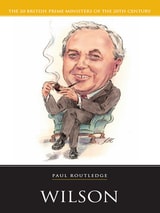
Wilson
Paul Routledge
Haus Publishing, 2006

Wineskin
Freakin’ Jesus in the ‘60s and ‘70sMichael Hicks
Signature Books, 2022
Michael Hicks’s story is a tale studded with awkward episodes of sex, drugs, and rock and roll (not necessarily in that order), along with alcohol, sci-fi, theft, radical politics, cartooning, halfway houses, and the musical avant-garde. The one constant is the brooding figure of Jesus Christ behind Hicks’s various personal reclamations and metamorphoses, often via methods admittedly off the books. While many readers know Hicks as a Mormon academic—thirty-five years a professor of music at Brigham Young University—Wineskin excavates the path, from boyhood to a PhD, that led him toward a faith that is both primitively Christian and highmindedly Mormon.
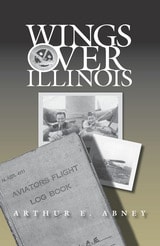
Wings Over Illinois
Arthur E. Abney
Southern Illinois University Press, 2007
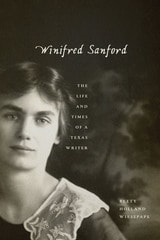
Winifred Sanford
The Life and Times of a Texas WriterBetty Holland Wiesepape
University of Texas Press, 2013
Winifred Sanford is generally regarded by critics as one of the best and most important early twentieth-century Texas women writers, despite publishing only a handful of short stories before slipping into relative obscurity. First championed by her mentor, H. L. Mencken, and published in his magazine, The American Mercury, many of Sanford’s stories were set during the Texas oil boom of the 1920s and 1930s and offer a unique perspective on life in the boomtowns during that period. Four of her stories were included in The Best American Short Stories of 1926.
Questioning the sudden end to Sanford’s writing career, Wiesepape, a leading literary historian of Texas women writers, delved into the author’s previously unexamined private papers and emerged with an insightful and revealing study that sheds light on both Sanford’s abbreviated career and the domestic lives of women at the time. The first in-depth account of Sanford’s life and work, Wiesepape’s biography discusses Sanford’s fiction through the lens of the sociohistorical contexts that shaped and inspired it. In addition, Wiesepape has included two previously unpublished stories as well as eighteen previously unpublished letters to Sanford from Mencken.
Winifred Sanford is an illuminating biography of one of the state’s unsung literary jewels and an important and much-needed addition to the often overlooked field of Texas women’s writing.
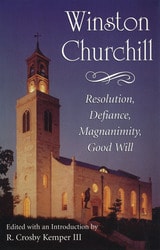
Winston Churchill
Resolution, Defiance, Magnanimity, Good WillEdited by R. Crosby Kemper III
University of Missouri Press, 1995
In 1946 Winston Churchill shook the world with his famous "Iron Curtain" speech on the campus of Westminster College in Fulton, Missouri, now the site of the Winston Churchill Memorial and Library. Inscribed on the pediment of his statue at the memorial is the epigraph from Churchill's History of the Second World War:
In War: Resolution
In Defeat: DefianceIn Victory: MagnanimityIn Peace: Good WillNo other words provide so poignant a summary of the principles that sustained Churchill's life's work.
Under the auspices of the Winston Churchill Memorial and Library, the Crosby Kemper Lectureship was established in 1979 by the Enid and Crosby Kemper Foundation of Kansas City, Missouri. Lectures have been delivered annually, or biennially, at the Winston Churchill Memorial and Library on the campus of Westminster College by authorities on British history and on Sir Winston Churchill. The essays included in this volume constitute the first dozen Crosby Kemper lectures, most by individuals who were personally acquainted with Churchill and all by individuals who had studied his life and his work.
Lord Robert Blake discusses Churchill's ambivalence toward the Conservative party during his political career. Philip S. Ziegler, Earl Mountbatten's biographer, examines whether Britain should have granted independence to India in 1947, taking as his departure Churchill's unequivocal belief that Britain's imperial rule there was a sacred trust not to be betrayed. Martin Gilbert, Churchill's biographer, carefully examines the origins of the Cold War and the famous Iron Curtain speech. Sir Michael Howard, Lovett Professor and Naval Historian at Yale University, further examines Churchill's role during the Cold War and the formulation of his "two-track" strategy that pushed for military strength while persistently striving for peace with the Soviets. Sir John Colville, Churchill's private secretary, ponders the extent to which great men are made by circumstances, citing Churchill's peccadilloes and strengths. Churchill's daughter Mary Soames and granddaughter, the sculptor Edwina Sandys, also give moving portraits of a much-loved family man.
All bring this illustrious leader to life in the process of interpreting his political actions, reviewing his historical contributions, and sharing anecdotes about his personal life.
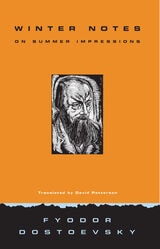
Winter Notes on Summer Impressions
Fyodor Dostoevsky
Northwestern University Press, 1997
In June 1862, Dostoevsky left Petersburg on his first excursion to Western Europe. Ostensibly making the trip to consult Western specialists about his epilepsy, he also wished to see firsthand the source of the Western ideas he believed were corrupting Russia. Over the course of his journey he visited a number of major cities, including Berlin, Paris, London, Florence, Milan, and Vienna. He recorded his impressions in Winter Notes on Summer Impressions, which were first published in the February 1863 issue of Vremya (Time), the periodical of which he was the editor.
Among other themes, Dostoevsky reveals his Pan-Slavism, rejecting European culture as corrupt and exhorting Russians to resist the temptation to emulate or adopt European ways of life.
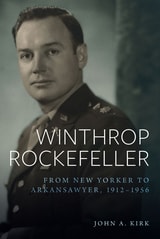
Winthrop Rockefeller
From New Yorker to Arkansawyer, 1912-1956John A. Kirk
University of Arkansas Press, 2022
Winner, 2024 J. G. Ragsdale Book Award, Arkansas Historical Association
Winner, 2024 Booker Worthen Literary Prize
Why did Winthrop Rockefeller, scion of one of the most powerful families in American history, leave New York for an Arkansas mountaintop in the 1950s? In this richly detailed biography of the former Arkansas governor, John A. Kirk delves into the historical record to fully unravel that mystery for the first time. Kirk pursues clues threaded throughout Rockefeller’s life, tracing his family background, childhood, and education; his rise in the oil industry from roustabout to junior executive; his military service in the Pacific during World War II, including his involvement in the battles of Guam, Leyte, and Okinawa; his postwar work in race relations, health, education, and philanthropy; his marriage to and divorce from Barbara “Bobo” Sears; and the birth of his only child, future Arkansas lieutenant governor Win Paul Rockefeller. This careful examination of Winthrop Rockefeller’s first forty-four years casts a powerful new light on his relationship with his adopted state, where his legacy continues to be felt more than half a century after his governorship.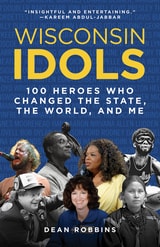
Wisconsin Idols
100 Heroes Who Changed the State, the World, and MeDean Robbins
Wisconsin Historical Society Press, 2025
Discover intriguing true tales of legends and trailblazers with Wisconsin connections who left their mark on the world, including the Beatles, Georgia O’Keeffe, Kareem Abdul-Jabbar, Harrison Ford, Joni Mitchell, Abraham Lincoln, Oprah Winfrey, Bob Dylan, Jackie Robinson, Orson Welles, and many more. Marvel at Elvis Presley’s miracle on the streets of Madison, applaud the award-winning acting of Reedsburg’s Agnes Moorehead, follow fearless quarterback Bart Starr to the gates of hell in Green Bay, and join Joshua Glover in Racine on his daring escape from enslavers. These brief narratives—whether poignant or humorous—also offer personal reflections on the impact of each featured idol.
Author Dean Robbins has spent a lifetime researching and revering these prominent figures and visiting exhibits, shrines, historic homes, and other sites dedicated to their achievements. Wisconsin Idols gathers all of Robbins’s obsessions into one collection, enhanced by dozens of photographs. Taken together, these stories of musicians, activists, artists, athletes, actors, and great thinkers irrefutably establish Wisconsin as a crossroads for extraordinary people who changed the world.
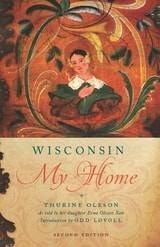
Wisconsin My Home
Thurine Oleson; As told to her daughter Erna Oleson Xan; Introduction by Odd Lovoll
University of Wisconsin Press, 2012

Wisconsin Riffs
Jazz Profiles from the HeartlandKurt Dietrich
Wisconsin Historical Society Press, 2018
Although New York City, Los Angeles, and Chicago are often considered the epicenters of American jazz, this extensive, upbeat compilation of jazz musician biographies details Wisconsin’s rich association the genre since its the inception of the genre in the early 1900s. Iconic musicians Bunny Berigan, Woody Herman, Les Paul, and Al Jarreau all hailed from Wisconsin, as have many other influential players, composers, and teachers. Wisconsin Riffs features these musicians side-by-side—from the world-renowned to obscure regional artists—to portray a comprehensive history of jazz in Wisconsin.
Through meticulous research and more than a hundred interviews, author Kurt Dietrich has assembled a group of musicians who represent a wide range of backgrounds, ages, stylistic schools, and experiences—from leaders of swing-era big bands to legendary Wisconsin Conservatory instructors to today’s up-and-coming practitioners of contemporary jazz and jazz rock. For aspiring musicians, jazz enthusiasts, and fans of Wisconsin culture alike, Wisconsin Riffs presents a compelling, complex, and multi-layered concoction—just like jazz itself.
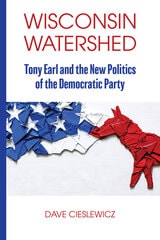
Wisconsin Watershed
Tony Earl and the New Politics of the Democratic PartyDave Cieslewicz
Michigan State University Press, 2027
In 1982, Tony Earl stormed into the Wisconsin governorship with a sweeping victory, rallying blue-collar Democrats around a progressive political platform. Four years later, observers were stunned when he was soundly defeated by conservative Republican Tommy Thompson—not because of any failure as governor, but because, as Dave Cieslewicz notes, the Democratic Party and American politics had undergone a dramatic transformation.
Wisconsin Watershed traces Earl’s journey from Michigan’s Upper Peninsula and the U.S. Navy, through his years in Wisconsin politics and his single, controversial term as Wisconsin’s governor. Earl tackled acid rain, comparable worth, AIDS policy, and tax reform with equal force; he kept American Motors in the state and pulled Wisconsin from a fiscal crisis. Yet voters could not connect his name with his accomplishments. The progressivism that energized new constituencies also alienated the working-class Catholics who had formed the Democratic Party’s backbone. “It’s not the taxes,” one legislator explained. “It’s the desks”—the name for Earl’s symbolic offices to advocate for Native Americans, African Americans, and women.
Earl refused negative campaigning, and he believed that good policy would ultimately prove good politics. His defeat marked the beginning of the end of an era of civility. Through Earl’s story, we witness the Democratic Party’s evolution from New Deal coalition to the emergence of a modern campaign culture that values image and anger over good governance.
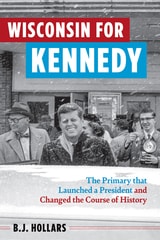
Wisconsin for Kennedy
The Primary That Launched a President and Changed the Course of HistoryB. J. Hollars
Wisconsin Historical Society Press, 2024
When John F. Kennedy ran for president in 1960, he did something no candidate had done before: he leveraged the power of state primaries to win his party’s nomination. Kennedy’s first battleground state? Wisconsin—a state that would prove more arduous, more exhausting, and more crucial to winning the presidency than any other.
Wisconsin for Kennedy brings to life the stories behind JFK’s history-making 1960 Wisconsin primary campaign, and how Kennedy’s team managed to outmaneuver his politically seasoned opponent, Hubert Humphrey. From Jackie Kennedy commandeering a supermarket loudspeaker in Kenosha, to the Wisconsin forklift driver who planned President Kennedy’s final trip to Dallas, this captivating book places readers at the heart of the action.
Author B.J. Hollars chronicles JFK’s nail-biting Wisconsin win by drawing on rarely cited oral histories from the eclectic team of people who worked together to make it happen: a cranberry farmer, a union leader, a mayor, an architect, and others. Wisconsin for Kennedy explores how Wisconsin helped propel JFK all the way to the White House in a riveting historical account that reads like a work of rollicking, page-turning fiction.
“In the spirit of Theodore H. White’s The Making of The President: 1960, B.J. Hollars offers a vivid account of the Wisconsin primary that launched JFK’s successful presidential campaign, inspiring voters to pass the torch to a new generation of leadership for our country. Anyone mesmerized by JFK’s legacy will enjoy this great read.”
—Former US Representative Ron Kind
“For generations, my family has had the great privilege of serving the people of Wisconsin. In Wisconsin for Kennedy, B.J. Hollars performs his own act of service, recounting the riveting and untold story of Wisconsin’s politically perilous 1960 primary. A poignant contribution to political history that reads like a page-turner.”
—Former Wisconsin Governor James Doyle Jr.
"A hopeful quality . . . pervades Wisconsin for Kennedy, written about a time and place when politics was conducted in a less severe and divisive way than it is now. Hollars further succeeds in showing how political history is made by a wide range of citizens. Wisconsinites, Midwesterners, and indeed Americans of all political persuasions can be grateful to B.J. Hollars for these important reminders."
— Middle West Review
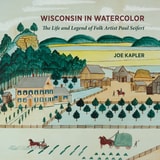
Wisconsin in Watercolor
The Life and Legend of Folk Artist Paul SeifertJoe Kapler
Wisconsin Historical Society Press, 2018
In 1867, German immigrant Paul Seifert settled in the Driftless Area of southwestern Wisconsin and began capturing the distinctive farms and landscapes of his new home in vivid, detailed watercolors. Today, these paintings are coveted by American folk art collectors across the country, but Seifert’s life remains shrouded in mystery.
In this first book written about Paul Seifert, author Joe Kapler examines the life of this enigmatic artist and provides context for his extraordinary art. The book features high-quality reproductions of twenty-two Seifert watercolors (more than half of which have never been published) and many close-ups of his characteristic details, from horses and hay wagons to dogs and dinner bells. Part art history treatment, part coffee table book, part research memoir, and part love letter to the Driftless Area, Wisconsin in Watercolor shines a long-awaited light on Seifert and the land he so carefully rendered over a hundred years ago.
Wisconsin, My Home
The Story of Thurine Oleson as Told to Her DaughterErna Oleson Xan
University of Wisconsin Press, 1975

With Courage and Common Sense
Memoirs from the Older Women's Legacy CirclesEdited by Susan Wittig Albert and Dayna Finet
University of Texas Press, 2003
Women who were sixty or older at the turn of the twenty-first century have lived through some of recent history's most momentous moments—and yet these women often believe that their personal lives and stories are insignificant, not worthy of being recorded for future generations. To change that perception and capture some of these life stories before they are lost, the Story Circle Network, a national organization dedicated to helping women write about their lives, developed the Older Women's Legacy (OWL) Circle Memoir Workshops. During the first two years of the project (1998-2000), nearly 500 older women participated in workshops that offered them the opportunity and encouragement to reflect on and create written records of their lives.
With Courage and Common Sense presents an extensive selection of memoirs from the OWL Circle project. Organized thematically, they describe women's experiences of identity, place, work, family life, love and marriage, loss and healing, adventures great and small, major historical events, and legacies to keep and pass along. Taken as a whole, the memoirs chronicle far-reaching changes in the ways that women participated in the world during the twentieth century. They show how women learned to surmount obstacles, to courageously make the most of the opportunities that came their way, and to move quietly and wisely beyond the limits that were imposed upon them.

With Distance in His Eyes
The Environmental Life and Legacy of Stewart UdallScott Raymond Einberger
University of Nevada Press, 2018
What can we learn from this farsighted individual?
In a day and age of partisan politics, poor congressional approval ratings, and global warming and climate change, this captivating biography offers a profound and historical record into Udall’s life-long devotion to environmental issues he cared about most deeply—issues more relevant today than they were then. Intimate moments include Udall’s learning of the Kennedy assassination, his push for civil rights for African Americans, his meeting in the U.S.S.R. with Nikita Khrushchev—the first Kennedy cabinet member to do so—and his warnings about global warming 50 years prior to Al Gore’s Nobel Prize-winning film.
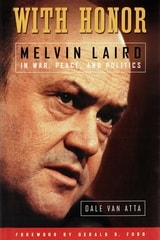
With Honor
Melvin Laird in War, Peace, and PoliticsVan Atta
University of Wisconsin Press, 2008
The first book ever to focus on Laird’s legacy, this authorized biography reveals his central and often unrecognized role in managing the crisis of national identity sparked by the Vietnam War—and the challenges, ethical and political, that confronted him along the way. Drawing on exclusive interviews with Laird, Henry Kissinger, Gerald Ford, and numerous others, author Dale Van Atta offers a sympathetic portrait of a man striving for open government in an atmosphere fraught with secrecy. Van Atta illuminates the inner workings of high politics: Laird’s behind-the-scenes sparring with Kissinger over policy, his decisions to ignore Nixon’s wilder directives, his formative impact on arms control and health care, his key role in the selection of Ford for vice president, his frustration with the country’s abandonment of Vietnamization, and, in later years, his unheeded warning to Donald Rumsfeld that “it’s a helluva lot easier to get into a war than to get out of one.”
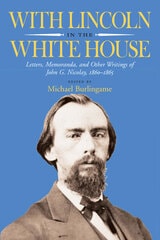
With Lincoln in the White House
Letters, Memoranda, and other Writings of John G. Nicolay, 1860-1865Edited by Michael Burlingame
Southern Illinois University Press, 2000
From the time of Lincoln’s nomination for the presidency until his assassination, John G. Nicolay served as the Civil War president’s chief personal secretary. Nicolay became an intimate of Lincoln and probably knew him as well as anyone outside his own family. Unlike John Hay, his subordinate, Nicolay kept no diary, but he did write several memoranda recording his chief’s conversation that shed direct light on Lincoln. In his many letters to Hay, to his fiancée, Therena Bates, and to others, Nicolay often describes the mood at the White House as well as events there. He also expresses opinions that were almost certainly shaped by the president
For this volume, Michael Burlingame includes all of Nicolay’s memoranda of conversations, all of the journal entries describing Lincoln’s activities, and excerpts from most of the nearly three hundred letters Nicolay wrote to Therena Bates between 1860 and 1865. He includes letters and portions of letters that describe Lincoln or the mood at the White House or that give Nicolay’s personal opinions. He also includes letters written by Nicolay while on troubleshooting missions for the president.
An impoverished youth, Nicolay was an unlikely candidate for the important position he held during the Civil War. It was only over the strong objections of some powerful people that he became Lincoln’s private secretary after Lincoln’s nomination for the presidency in 1860. Prominent Chicago Republican Herman Kreismann found the appointment of a man so lacking in savoir faire
Lacking charm, Nicolay became known at the White House as the “bulldog in the ante-room” with a disposition “sour and crusty.” California journalist Noah Brooks deemed Nicolay a “grim Cerberus of Teutonic descent who guards the last door which opens into the awful presence.” Yet in some ways he was perfectly suited for the difficult job. William O. Stoddard, noting that Nicolay was not popular and could “say 'no'about as disagreeably as any man I ever knew,” still granted that Nicolay served Lincoln well because he was devoted and incorruptible. Stoddard concluded that Nicolay “deserves the thanks of all who loved Mr. Lincoln.”
For his part, Nicolay said he derived his greatest satisfaction “from having enjoyed the privilege and honor of being Mr. Lincoln’s intimate and official private secretary, and of earning his cordial friendship and perfect trust.”