Results by title
18284 books match the query 'United States' and 882 start with w
What History Tells
George L. Mosse and the Culture of Modern EuropeEdited by Stanley G. Payne, David J. Sorkin, and John S. Tortorice
University of Wisconsin Press, 2004
The contributors include Walter Laqueur, David Sabean, Johann Sommerville, Emilio Gentile, Roger Griffin, Saul Friedländer, Jay Winter, Rudy Koshar, Robert Nye, Janna Bourke, Shulamit Volkov, and Steven E. Aschheim.
What Is College Reading?
Alice S. Horning
University Press of Colorado, 2017
What Is Happening to News
The Information Explosion and the Crisis in JournalismJack Fuller
University of Chicago Press, 2010
Across America, newspapers that have defined their cities for over a century are rapidly failing, their circulations plummeting even as opinion-soaked web outlets like the Huffington Post thrive. Meanwhile, nightly news programs shock viewers with stories of horrific crime and celebrity scandal, while the smug sarcasm and shouting of pundits like Glenn Beck and Keith Olbermann dominate cable television. Is it any wonder that young people are turning away from the news entirely, trusting comedians like Jon Stewart as their primary source of information on current events?
In the face of all the problems plaguing serious news, What Is Happening to News explores the crucial question of how journalism lost its way—and who is responsible for the ragged retreat from its great traditions. Veteran editor and newspaperman Jack Fuller locates the surprising sources of change where no one has thought to look before: in the collision between a revolutionary new information age and a human brain that is still wired for the threats faced by our prehistoric ancestors. Drawing on the dramatic recent discoveries of neuroscience, Fuller explains why the information overload of contemporary life makes us dramatically more receptive to sensational news, while rendering the staid, objective voice of standard journalism ineffective. Throw in a growing distrust of experts and authority, ably capitalized on by blogs and other interactive media, and the result is a toxic mix that threatens to prove fatal to journalism as we know it.
For every reader troubled by what has become of news—and worried about what the future may hold—What Is Happening to News not only offers unprecedented insight into the causes of change but also clear guidance, strongly rooted in the precepts of ethical journalism, on how journalists can adapt to this new environment while still providing the information necessary to a functioning democracy.
What Middletown Read
Print Culture in an American Small CityFrank Felsenstein
University of Massachusetts Press, 2015
The discovery of a large cache of circulation records from the Muncie, Indiana, Public Library in 2003 offers unprecedented detail about American reading behavior at the turn of the twentieth century. Frank Felsenstein and James J. Connolly have mined these records to produce an in-depth account of print culture in Muncie, the city featured in the famed “Middletown” studies conducted by Robert and Helen Lynd almost a century ago. Using the data assembled and made public through the What Middletown Read Database (www.bsu.edu/libraries/wmr), a celebrated new resource the authors helped launch, Felsenstein and Connolly analyze the borrowing choices and reading culture of social groups and individuals.
What Middletown Read is much more than a statistical study. Felsenstein and Connolly dig into diaries, meeting minutes, newspaper reports, and local histories to trace the library's development in relation to the city's cosmopolitan aspirations, to profile individual readers, and to explore such topics as the relationship between children's reading and their schooling and what books were discussed by local women's clubs. The authors situate borrowing patterns and reading behavior within the contexts of a rapidly growing, culturally ambitious small city, an evolving public library, an expanding market for print, and the broad social changes that accompanied industrialization in the United States. The result is a rich, revealing portrait of the place of reading in an emblematic American community.
What Process is Due?
Courts and Science-Policy DisputesDavid M. O'Brien
Russell Sage Foundation, 1987
What Remains
Searching for the Memory and Lost Grave of John Paul JonesRobert Hornick
University of Massachusetts Press, 2017
John Paul Jones is now considered a Revolutionary War hero and the father of the American Navy, his defiant words “I have not yet begun to fight!” the epitome of courage under fire. It has not always been so. When the Revolutionary War ended, Jones's celebrity vanished. His death in Paris a decade later went unnoticed; he was buried in a foreign grave and forgotten by his fellow Americans.
In What Remains, Robert Hornick explores why Jones was forgotten, the subsequent recovery of his memory and remains, and the much delayed commemoration of his achievement. The book chronicles the efforts of the men and women who, in the nineteenth and early twentieth centuries, reconstructed Jones's legacy, searched for and finally found his lost grave, and returned both his physical remains and his memory to a place of honor. It also recounts the extraordinary moment when Theodore Roosevelt utilized Jones's commemoration to proclaim America a global power. What Remains offers a fascinating story of opportunists and evangelists: of politicians who needed Jones to advance their agendas, but also of fellow warriors committed to recovering one of their own from obscurity and shame.
What Saves Us
Poems of Empathy and Outrage in the Age of TrumpEdited by Martín Espada
Northwestern University Press, 2019
This is an anthology of poems in the Age of Trump—and much more than Trump. These are poems that either embody or express a sense of empathy or outrage, both prior to and following his election, since it is empathy the president lacks and outrage he provokes.
There is an extraordinary diversity of voices here. The ninety-three poets featured include Elizabeth Alexander, Julia Alvarez, Richard Blanco, Carolyn Forché, Aracelis Girmay, Donald Hall, Juan Felipe Herrera, Yusef Komunyakaa, Naomi Shihab Nye, Marge Piercy, Robert Pinsky, Danez Smith, Patricia Smith, Brian Turner, Ocean Vuong, Bruce Weigl, and Eleanor Wilner. They speak of persecuted and scapegoated immigrants. They bear witness to violence: police brutality against African Americans, mass shootings in a school or synagogue, the rage inflicted on women everywhere. They testify to poverty: the waitress surviving on leftovers at the restaurant, the battles of a teacher in a shelter for homeless mothers, the emergency-room doctor listening to the heartbeats of his patients. There are voices of labor, in the factory and the fields. There are prophetic voices, imploring us to imagine the world we will leave behind in ruins lest we speak and act.
However, this is not merely a collection of grievances. The poets build bridges. One poet steps up to translate in Arabic at the airport; another walks through the city and sees her immigrant past in the immigrant present; another declaims a musical manifesto after the hurricane that devastated his island; another evokes a demonstration in the street, shouting in an ecstasy of defiance. The poets take back the language, resisting the demagogic corruption of words themselves. They assert our common humanity in the face of dehumanization.
What Soldiers Do
Sex and the American GI in World War II FranceMary Louise Roberts
University of Chicago Press, 2013
That’s not the picture of the Greatest Generation that we’ve been given, but it’s the one Mary Louise Roberts paints to devastating effect in What Soldiers Do. Drawing on an incredible range of sources, including news reports, propaganda and training materials, official planning documents, wartime diaries, and memoirs, Roberts tells the fascinating and troubling story of how the US military command systematically spread—and then exploited—the myth of French women as sexually experienced and available. The resulting chaos—ranging from flagrant public sex with prostitutes to outright rape and rampant venereal disease—horrified the war-weary and demoralized French population. The sexual predation, and the blithe response of the American military leadership, also caused serious friction between the two nations just as they were attempting to settle questions of long-term control over the liberated territories and the restoration of French sovereignty.
While never denying the achievement of D-Day, or the bravery of the soldiers who took part, What Soldiers Do reminds us that history is always more useful—and more interesting—when it is most honest, and when it goes beyond the burnished beauty of nostalgia to grapple with the real lives and real mistakes of the people who lived it.
What That Pig Said to Jesus
On the Uneasy Permanence of Immigrant LifePhilip Garrison
University of Utah Press, 2017
Philip Garrison says his book of essays is “in praise of mixed feelings,” particularly the mixed feelings he and his neighbors have toward the places they came from. His neighborhood is the Columbia Plateau, one of many North American nodes of immigration. Following a meandering, though purposeful trail, Garrison catches hillbillies and newer Mexican arrivals in ambiguous, wary encounters on a set four hundred years in the making, built on a foundation of Native American displacement. Garrison is the product of the earlier surge of new arrivals: from the 1930s to the 1970s, those he calls hillbillies left such mid-nation states as Arkansas, Missouri, Oklahoma, Kansas, and the Dakotas for the West. The more recent wave, from 1990 to 2010, came mostly from the central plateau of Mexico. These are folks with whom Garrison communes in multiple ways. Anecdotes from sources as varied as pioneer diaries, railroad promotions, family Bibles, Wikipedia, and local gossip “portray the region's immigration as a kind of identity makeover, one that takes the form first of breakdown, then of reassembly, and finally of renewal.” Garrison’s mix of slangy memoir and anthropological field notes shines light on the human condition in today’s West.
What They Stole
A Familicide Rooted in Intercountry AdoptionPaige Towers
University of Iowa Press, 2026
The Sueppels were among the families profoundly shaped by the legacy of the Holt Adoption Program. To their suburban Iowa City community, Steven and Sheryl Sueppel were kind and charitable, humble yet magnetic—seemingly ideal candidates to adopt. But in 2008, when Steven found himself facing federal embezzlement and money laundering charges, he murdered Sheryl and their adopted children before ending his own life.
Paige Towers traces the interwoven histories of the Holts and the Sueppels, exploring the deeper, often hidden complexities of intercountry adoption: the ethical gray zones, the influences of religion and race, and the global inequalities that made such large-scale child migration possible. Meticulously researched and sensitive with its storytelling, What They Stole examines how good intentions can coexist with systemic harm—and how the consequences of systems like the Holts’ can reverberate across generations.
What We Are Becoming
Developments in Undergraduate Writing MajorsGreg Giberson and Thomas A. Moriarty
Utah State University Press, 2010
Contributors to the volume address a range of vital questions for undergraduate programs, including such issues as the competition for majors within departments, the job market for undergraduates, varying focuses and curricula of such majors, and the formation of them in departments separate from English. Other chapters discuss the importance of flexibility, consider arguments for a rhetorical or civic discourse core for the writing major, address the relationship between rhetoric and composition majors, and review the role of multiliteracies in the major.
The field of composition has not come to a consensus on the shape, content, or focus of the undergradutate major. But as individual programs develop and refine their curricula, one thing has become clear: we must think about them in ways that go beyond our particular circumstances, theorize them in ways that secure their place on our campuses and in our discipline for years to come. What We Are Becoming is an effort to do just that.
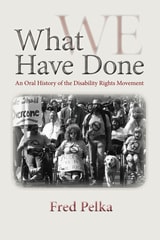
What We Have Done
An Oral History of the Disability Rights MovementFred Pelka
University of Massachusetts Press, 2012
“Nothing about us without us” has been a core principle of American disability rights activists for more than half a century. It represents a response by people with disabilities to being treated with scorn and abuse or as objects of pity, and to having the most fundamental decisions relating to their lives—where they would live; if and how they would be educated; if they would be allowed to marry or have families; indeed, if they would be permitted to live at all—made by those who were, in the parlance of the movement, “temporarily able-bodied.”
In What We Have Done: An Oral History of the Disability Rights Movement, Fred Pelka takes that slogan at face value. He presents the voices of disability rights activists who, in the period from 1950 to 1990, transformed how society views people with disabilities, and recounts how the various streams of the movement came together to push through the Americans with Disabilities Act of 1990, the most sweeping civil rights legislation since passage of the Civil Rights Act of 1964. Beginning with the stories of those who grew up with disabilities in the 1940s and '50s, the book traces how disability came to be seen as a political issue, and how people with disabilities—often isolated, institutionalized, and marginalized—forged a movement analogous to the civil rights, women's rights, and gay rights movements, and fought for full and equal participation in American society.
What We Hold in Trust
Rediscovering the Purpose of Catholic Higher EducationDon Briel
Catholic University of America Press, 2021
What We Know, What We Wish
Maine Statehood, Historical Commemoration, and the Urgency of Public HistoryEdited by Liam Riordan and Richard W. Judd
University of Massachusetts Press, 2025
Cities, states, and nations are grappling with how best to commemorate historical events and anniversaries in ways that are fair, accurate, and open public dialogue about the often contested past. This volume springs from varied approaches to the historical commemoration of Maine’s state bicentennial in 2020 that involved academics, independent scholars, local and statewide cultural organizations, sovereign Wabanaki nations, and the state itself in the form of the Maine State Bicentennial Commission. While wide-ranging in their goals and values, all sought to take advantage of opportunities for collaboration to contribute to a dynamic and multi-faceted practice of public history. These new essays use Maine’s bicentennial as a focal point to put public history theory into action. Its diverse contributors share stories about the past that move beyond celebration to reflect crucial ways that the past shapes our understanding of the present and our aspirations for the future.
This volume’s core argument is that academics need to collaborate more fully with independent scholars, history-based cultural institutions, and the general public in order for public history to thrive and to improve the quality of civic life. What We Know, What We Wish does this through wide ranging essays that discuss the long statehood era in Maine from the 1770s to 1820s as well as its legacies in the state centennial commemoration of 1920 and museum exhibits from the 2020 bicentennial. The occupational and cultural diversity of the collection’s contributors together with the content of their essays offer a model for how to put public history principles into practice to foreground meaningful historical reflection that is urgently needed in divided communities around the world.
Contributors include the volume editors, as well as Maulian Bryant, Osihkiyol (Zeke) Crofton-Macdonald, Charles H. Lagerbom, Ryan LaRochelle, Stuart Kestenbaum, Michael McVaugh, Kevin D. Murphy, Micah A. Pawling, Jessica Skwire Routhier, Donald Soctomah, Laura Fecych Sprague, Alan Taylor, and Laurel Thatcher Ulrich.
What Were They Thinking?
Crisis Communication: The Good, the Bad, and the Totally CluelessSteve Adubato, Ph.D.
Rutgers University Press, 2008
Nationally recognized communication coach and four-time Emmy Awardûwinning broadcaster Steve Adubato has been teaching, writing, and thinking about comm¡unication, leadership, and crisis communication for nearly two decades. In What Were They Thinking? Adubato examines twenty-two controversial and complex public relations and media mishaps, many of which were played out in public. Among cases and people discussed are:
- The Johnson & Johnson Tylenol scare: Perhaps the best crisis management ever
- Don Imus: Sometimes saying "sorry" is too little too late
- Former Attorney General Alberto Gonzales: Authority does not put you above questioning
- Bill O'Reilly: Know when to stop defending yourself and save face
- Former EPA Administrator Christie Whitman: Proof that your written words can come back to haunt you
- Hurricane Katrina: A natural disaster that led to a larger governmental disaster
- The Catholic Church's pedophilia scandal: Denial won't get rid of the skeletons in your closet
Arranged in short chapters detailing each case individually, the book provides a brief history of the topics and answers the questions: Who got it right? Who got it wrong? What can the rest of us learn from them?
What Women Want
Gender and Voting in Britain, Japan and the United StatesGill Steel
University of Michigan Press, 2022
What Women Want analyzes decades of voting preferences, values, and policy preferences to debunk some of the media and academic myths about gender gaps in voting and policy preferences. Findings show that no single theory explains when differences in women’s and men’s voting preferences emerge, when they do not, or when changes—or the lack thereof—occur over time. Steel extends existing theories to create a broader framework for thinking about gender and voting behavior to provide more analytical purchase in understanding gender and its varying effects on individual voters’ preferences. She incorporates the long-term effects of party identification and class politics on political decision-making, particularly in how they influence preferences on social provision and on expectations of the state. She also points to the importance of symbolic politics
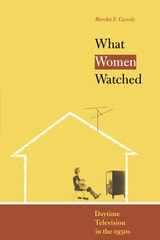
What Women Watched
Daytime Television in the 1950sBy Marsha F. Cassidy
University of Texas Press, 2005
In this pathfinding book, based on original archival research, Marsha F. Cassidy offers the first thorough analysis of daytime television's earliest and most significant women's genres, appraising from a feminist perspective what women watched before soap opera rose to prominence.
After providing a comprehensive history of the early days of women's programming across the nation, Cassidy offers a critical discussion of the formats, programs, and celebrities that launched daytime TV in America—Kate Smith's variety show and the famed singer's unsuccessful transition from patriotic radio star to 1950s TV idol; the "charm boys" Garry Moore, Arthur Godfrey, and Art Linkletter, whose programs honored women's participation but in the process established the dominance of male hosts on TV; and the "misery shows" Strike It Rich and Glamour Girl and the controversy, both critical and legal, they stirred up.
Cassidy then turns to NBC's Home show, starring the urbane Arlene Francis, who infused the homemaking format with Manhattan sophistication, and the ambitious daily anthology drama Matinee Theater, which strove to differentiate itself from soap opera and become a national theater of the air. She concludes with an analysis of four popular audience participation shows of the era—the runaway hit Queen for a Day; Ralph Edwards's daytime show of surprises, It Could Be You; Who Do You Trust?, starring a youthful Johnny Carson; and The Big Payoff, featuring Bess Myerson, the country's first Jewish Miss America. Cassidy's close feminist reading of these shows clearly demonstrates how daytime TV mirrored the cultural pressures, inconsistencies, and ambiguities of the postwar era.
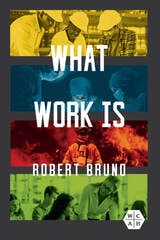
What Work Is
Robert Bruno
University of Illinois Press, 2024
For more than twenty years, Robert Bruno has taught labor history and labor studies to union members from a wide range of occupations and demographic groups. In the class, he asked his students to finish the question “Work is—?” in six words or less. The thousands of responses he collected provide some of the rich source material behind What Work Is. Bruno draws on the thoughts and feelings experienced by workers in the present day to analyze how we might design a future of work. He breaks down perceptions of work into five categories: work and time; the space workers occupy; the impact of work on our lives; the sense of purpose that motivates workers; and the people we work for, in all senses of the term.
Far-seeing and sympathetic, What Work Is merges personal experiences with research, poetry, and other diverse sources to illuminate workers’ lives in the present and envision what work could be in the future.
What Workers Say
Decades of Struggle and How to Make Real Opportunity NowRoberta Rehner Iversen
Temple University Press, 2022
What have jobs really been like for the past 40 years and what do the workers themselves say about them? In What Workers Say, Roberta Iversen shows that for employees in labor market industries—like manufacturing, construction, printing—as well as those in service-producing jobs, like clerical work, healthcare, food service, retail, and automotive—jobs are often discriminatory, are sometimes dangerous and exploitive, and seldom utilize people’s full range of capabilities. Most importantly, they fail to provide any real opportunity for advancement.
What Workers Say takes its cue from Studs Terkel’s Working, as Iversen interviewed more than 1,200 workers to present stories about their labor market jobs since 1980. She puts a human face on the experiences of a broad range of workers indicating what their jobs were and are truly like. Iversen reveals how transformations in the political economy of waged work have shrunk or eliminated opportunity for workers, families, communities, and productivity. What Workers Say also offers an innovative proposal for compensated civil labor that could enable workers, their communities, labor market organizations, and the national infrastructure to actually flourish.
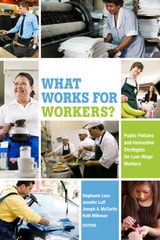
What Works for Workers?
Public Policies and Innovative Strategies for Low-Wage WorkersStephanie Luce
Russell Sage Foundation, 2014
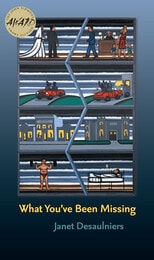
What You've Been Missing
Janet Desaulniers
University of Iowa Press, 2004
Vividly portraying the possible horrors and detours that can mark anyone’s life, Desaulniers beautifully captures the vast and often conflicting emotions that humans endure at times of loss and sorrow—loneliness, pain, desperation, desire. Yet this balletic push and pull of emotions will challenge, wound, and ultimately enlighten her characters, transporting them to a place beyond individual sorrow.
At times unbearably heartbreaking, What You’ve Been Missing is not just another set of stories about bad things happening to good people. At its heart, this award-winning collection is about people continuing to talk—rather than shutting down—as bad things happen to them. As the recently divorced Liza thinks in “The Good Fight”: “Words do ease us. They comfort us. Maybe they protect us in a way, rescue us from the agony of what our bodies feel.”
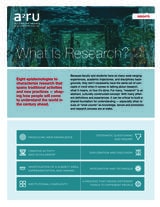
What is Research?
Gabriel Harp
A2RU Intervals, 2018
Because faculty and students have so many wide-ranging experiences, academic trajectories, and disciplinary backgrounds, they don’t necessarily have the same set of concepts in mind when it comes to talking about research, what it means, or how it’s done. For many, “research” is an abstract, culturally constructed concept. With many different definitions and experiences, it can be critical to build a shared foundation for understanding — especially when issues of “what counts” as knowledge, tenure and promotion, and research process are at stake.
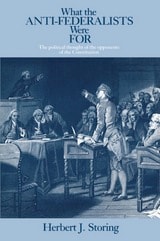
What the Anti-Federalists Were For
The Political Thought of the Opponents of the ConstitutionHerbert J. Storing
University of Chicago Press, 1981
Storing here offers a brilliant introduction to the thought and principles of the Anti-Federalists as they were understood by themselves and by other men and women of their time. His comprehensive exposition restores to our understanding the Anti-Federalist share in the founding its effect on some of the enduring themes and tensions of American political life. The concern with big government and infringement of personal liberty one finds in the writings of these neglected Founders strikes a remarkably timely note.

What the Anti-Federalists Were For
The Political Thought of the Opponents of the ConstitutionHerbert J. Storing
University of Chicago Press, 1981
The Anti-Federalists, in Herbert J. Storing's view, are somewhat paradoxically entitled to be counted among the Founding Fathers and to share in the honor and study devoted to the founding. "If the foundations of the American polity was laid by the Federalists," he writes, "the Anti-Federalist reservations echo through American history; and it is in the dialogue, not merely in the Federalist victory, that the country's principles are to be discovered." It was largely through their efforts, he reminds us, that the Constitution was so quickly amended to include a bill of rights.
Storing here offers a brilliant introduction to the thought and principles of the Anti-Federalists as they were understood by themselves and by other men and women of their time. His comprehensive exposition restores to our understanding the Anti-Federalist share in the founding its effect on some of the enduring themes and tensions of American political life. The concern with big government and infringement of personal liberty one finds in the writings of these neglected Founders strikes a remarkably timely note.

What's Black and White and Reid All Over?
Something Hilarious Happened at the LibraryRob Reid
American Library Association, 2012
What's Fair on the Air?
Cold War Right-Wing Broadcasting and the Public InterestHeather Hendershot
University of Chicago Press, 2011
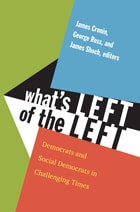
What's Left of the Left
Democrats and Social Democrats in Challenging TimesJames Cronin, George Ross, and James Shoch, eds.
Duke University Press, 2011
Contributors. Sheri Berman, James Cronin, Jean-Michel de Waele, Arthur Goldhammer, Christopher Howard, Jane Jenson, Gerassimos Moschonas, Sofia Pérez, Jonas Pontusson, George Ross, James Shoch, Sorina Soare, Ruy Teixeira

What's Nature Worth
Terre Satterfield
University of Utah Press, 2004
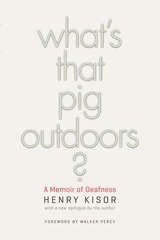
What's That Pig Outdoors?
A Memoir of DeafnessHenry Kisor
University of Illinois Press, 2010
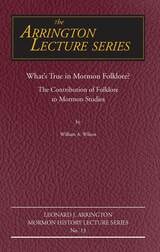
What's True in Mormon Folklore?
The Contribution of Folklore to Mormon StudiesWilliam Wilson
Utah State University Press, 2008
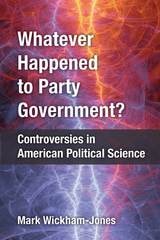
Whatever Happened to Party Government?
Controversies in American Political ScienceMark Wickham-Jones
University of Michigan Press, 2018
In 1950, the Committee on Political Parties of the American Political Science Association (APSA) published its much-anticipated report, Toward a More Responsible Two-Party System. Highly critical of the existing state of affairs, the report became extremely controversial: before publication, scholars attacked the committee’s draft and suggested it should be suppressed. When released it received a barrage of criticisms. Most academics concluded it was an ill-conceived and mistaken initiative.
Mark Wickham-Jones provides the first full, archival-based assessment of the arguments within APSA about political parties and the 1950 report. He details the report’s failure to generate wider discussion between media, politicians, and the White House. He examines whether it was dominated by a dogmatic attachment to “party government,” and charts the relationship between behavioralists and institutionalists. He also discusses the political dimension to research during the McCarthyite years, and reflects on the nature of American political science in the years after 1945, the period in which behavioralism (which privileges the influence of individuals over institutions) became dominant.
Detailing APSA’s most direct and significant intervention in the political process, Wickham-Jones makes an important contribution to debates that remain in the forefront of discussions about American politics.
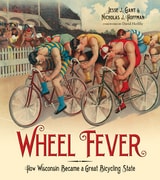
Wheel Fever
How Wisconsin Became a Great Bicycling StateJesse J. Gant
Wisconsin Historical Society Press, 2013
Many early riders embraced the bicycle as a solution to the age-old problem of how to get from here to there in the quickest and easiest way possible. Yet for every supporter of the “poor man’s horse,” there were others who wanted to keep the rights and privileges of riding to an elite set. Women, the working class, and people of color were often left behind as middle- and upper-class white men benefitted from the “masculine” sport and all-male clubs and racing events began to shape the scene. Even as bikes became more affordable and accessible, a culture defined by inequality helped create bicycling in its own image, and these limitations continue to haunt the sport today.
Wheel Fever is about the origins of bicycling in Wisconsin and why those origins still matter, but it is also about our continuing fascination with all things bicycle. From “boneshakers” to high-wheels, standard models to racing bikes, tandems to tricycles, the book is lushly illustrated with never-before-seen images of early cycling, and the people who rode them: bloomer girls, bicycle jockeys, young urbanites, and unionized workers.
Laying the foundations for a much-beloved recreation, Wheel Fever challenges us to imagine anew the democratic possibilities that animated cycling’s early debates.
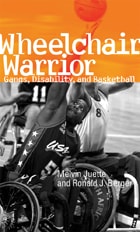
Wheelchair Warrior
Gangs, Disability, and BasketballMelvin Juette and Ronald J. Berger
Temple University Press, 2008
Melvin Juette has said that becoming paralyzed in a gang-related shooting was “both the worst and best thing that happened” to him. The incident, he believes, surely spared the then sixteen year-old African American from prison and/or an early death. It transformed him in other ways, too. He attended college and made wheelchair basketball his passion—ultimately becoming a star athlete and playing on the U.S. National Wheelchair Basketball Team.
In Wheelchair Warrior, Juette reconstructs the defining moments of his life with the assistance of sociologist Ronald Berger. His poignant memoir is bracketed by Berger’s thoughtful introduction and conclusion, which places this narrative of race, class, masculinity and identity into proper sociological context, showing how larger social structural forces defined his experiences. While Juette’s story never gives into despair, it does challenge the idea of the “supercrip.”
Wheeling's Polonia
Reconstructing Polish Community in a West Virginia Steel TownWilliam Hal Gorby
West Virginia University Press, 2020
Wheeling was a center of West Virginia’s labor movement, and Polish immigrants became a crucial element within the city’s active working-class culture. Arriving at what was also the center of the state’s Roman Catholic Diocese, Poles built religious and fraternal institutions to support new arrivals and to seek solace in times of economic strain and family hardship. The city’s history of crime and organized vice also affected new immigrants, who often lived in neighborhoods targeted for selective enforcement of Prohibition.
At once a deeply textured evocation of the city’s ethnic institutions and an engagement with larger questions about belonging, change, and justice, Wheeling’s Polonia is an inspiring account of a diverse working-class culture and the immigrants who built it.
When America Became Suburban
Robert A. Beauregard
University of Minnesota Press, 2006
When America Turned
Reckoning with 1968David Wyatt
University of Massachusetts Press, 2013
Wyatt explores these questions as he retraces the decisive moments of 1968—the Tet Offensive, the McCarthy campaign, the assassinations of Martin Luther King Jr. and Robert Kennedy, the student revolt at Columbia, the "police riot" at the Democratic Convention in Chicago, Lyndon Johnson's capitulation, and Richard Nixon's ascendency to power. Seeking to recover the emotions surrounding these events as well as analyze their significance, Wyatt draws on the insights of what Michael Herr has called "straight" and "secret" histories. The first category consists of work by professional historians, traditional journalists, public figures, and political operatives, while the second includes the writings of novelists, poets, New Journalists, and memoirists.
The aim of this parallel approach is to uncover two kinds of truth: a "scholarly truth" grounded in the documented past and an "imaginative truth" that occupies the more ambiguous realm of meaning. Only by reckoning with both, Wyatt believes, can Americans come to understand the true legacy of the 1960s.
When Are You Coming Home?
How Young Children Cope When Parents Go to JailHilary Cuthrell
Rutgers University Press, 2023
When Bad Things Happen to Privileged People
Race, Gender, and What Makes a Crisis in AmericaDara Z. Strolovitch
University of Chicago Press, 2023
A deep and thought-provoking examination of crisis politics and their implications for power and marginalization in the United States.
From the climate crisis to the opioid crisis to the Coronavirus crisis, the language of crisis is everywhere around us and ubiquitous in contemporary American politics and policymaking. But for every problem that political actors describe as a crisis, there are myriad other equally serious ones that are not described in this way. Why has the term crisis been associated with some problems but not others? What has crisis come to mean, and what work does it do?
In When Bad Things Happen to Privileged People, Dara Z. Strolovitch brings a critical eye to the taken-for-granted political vernacular of crisis. Using systematic analyses to trace the evolution of the use of the term crisis by both political elites and outsiders, Strolovitch unpacks the idea of “crisis” in contemporary politics and demonstrates that crisis is itself an operation of politics. She shows that racial justice activists innovated the language of crisis in an effort to transform racism from something understood as natural and intractable and to cast it instead as a policy problem that could be remedied. Dominant political actors later seized on the language of crisis to compel the use of state power, but often in ways that compounded rather than alleviated inequality and injustice. In this eye-opening and important book, Strolovitch demonstrates that understanding crisis politics is key to understanding the politics of racial, gender, and class inequalities in the early twenty-first century.
When Boys Become Parents
Adolescent Fatherhood in AmericaMark S. Kiselica
Rutgers University Press, 2011
In this informative book, Mark S. Kiselica draws on his many years of counseling teenage fathers to offer a compassionate look at the difficult life circumstances and the complicated hardships these young men experience. He dispels many of the myths surrounding teenage fatherhood and shows that, contrary to popular belief, these young men are often emotionally and physically involved in relationships with their partner and their child. But without support and guidance from adults, these relationships often deteriorate in the first year of the child-'s life. Kiselica offers advice for how professionals and policy makers can assist these young men and improve services for them.
When Boys Become Parents provides a moving portrait of teenage fathers to any reader who wants to understand and help these young men to become more competent and loving parents during their journey to adulthood.
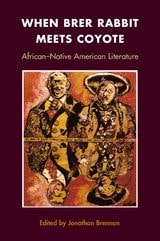
When Brer Rabbit Meets Coyote
AFRICAN-NATIVE AMERICAN LITERATUREEdited by Jonathan Brennan
University of Illinois Press, 2003
Jonathan Brennan, in a sweeping historical and analytical introduction to this collection of essays, surveys several centuries of literature in the context of the historical and cultural exchange and development of distinct African-Native American traditions. Positing a new African-Native American literary theory, he illuminates the roles subjectivity, situational identities, and strategic discourse play in defining African-Native American literatures.
Brennan provides a thorough background to the literary tradition and a valuable overview to topics discussed in the essays. He examines African-Native American political and historical texts, travel narratives, and the Mardi Gras Indian tradition, suggesting that this evolving oral tradition parallels the development of numerous Black Indian literary traditions in the United States and Latin America.
When Care is Conditional
Immigrants and the U.S. Safety NetDani Carrillo
Russell Sage Foundation, 2024
Through in-depth interviews with Latinx immigrants in northern California, Carrillo examines three circumstances—place, gender, and immigration status—that intersect to influence an individual’s access to health care, food assistance, and other benefits. She demonstrates that place of residence affects undocumented immigrants’ ability to get care since more services are available in urban areas, where many immigrants cannot afford to live, than suburban areas, where public transportation is limited. She also shows that while both men and women who are undocumented have difficulty obtaining care, men often confront more challenges. Undocumented women who are pregnant or mothers are eligible for some government safety net programs and rely on informal coethnic networks or a “guiding figure”—a relative, friend, neighbor, or coworker—who explains how to get care and makes them feel confident in accessing it. Most undocumented men, in contrast, are not eligible for public programs except in a medical emergency and often lack someone to guide them directly to care. Men sometimes steer one another to jobs through worker centers—where they may learn about various services and take advantage of those that increase their employability, like English or computer classes—but a culture of masculinity leads them to downplay medical problems and seek health care only in a crisis.
As undocumented immigrants navigate this exclusionary system, Carrillo finds that they resist the rhetoric stigmatizing them as lawbreakers. Dismissing the importance of “papers” and highlighting their work ethic, they question the fairness of U.S. immigration policies and challenge ideas about who deserves care.
Carrillo offers concrete recommendations, such as improving labor conditions and reexamining benefit eligibility, to increase access to care for not only undocumented immigrants but also people who have been excluded because of their race, criminal record, gender identity, sexual orientation, or disability. She argues that working with and across populations creates a powerful form of solidarity in advocating for inclusive care.
When Care Is Conditional provides compelling insights into how safety net and immigration policies intersect to affect people’s everyday lives and calls for a cultural shift so that the United States can provide unconditional care for all.
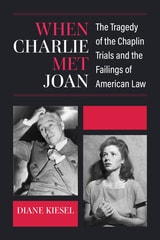
When Charlie Met Joan
The Tragedy of the Chaplin Trials and the Failings of American LawDiane Kiesel
University of Michigan Press, 2025
A 2026 PROSE Award Category Winner for Biography and Autobiography
Charlie Chaplin, the silent screen’s “Little Tramp,” was beloved by millions of movie fans until he starred in a series of salacious, real-life federal courtroom dramas. The 1944 trial was described by ace New York Daily News reporter Florabel Muir as “the best show in town.” The leading lady was a woman under contract to his studio—red-haired ingénue Joan Barry, Chaplin’s protégée and former mistress. Although he beat the federal criminal trial, Chaplin lost a paternity case and had to pay child support despite blood type evidence that proved he was not the child’s father.
A decade later during the Cold War, the U.S. government used the Barry trials as an excuse to bar the left-leaning, sexually adventurous, British-born comic from the country he had called home for forty years. Not only did these trials have a lasting impact on law; they also raise concerns about the power of celebrity, Cold War politics, the media frenzy surrounding high-profile court proceedings, and the sorry history of the casting couch. When Charlie Met Joan examines these trials from the perspective of both parties, asking whether Chaplin was unfairly persecuted by the government because of his left-leaning political beliefs, or if he should have been held more accountable for his cavalier treatment of Barry and other women in his life.
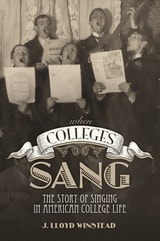
When Colleges Sang
The Story of Singing in American College LifeJ. Lloyd Winstead
University of Alabama Press, 2013
When Courts and Congress Collide
The Struggle for Control of America's Judicial SystemCharles Gardner Geyh
University of Michigan Press, 2009
"This is quite simply the best study of judicial independence that I have ever read; it is erudite, historically aware, and politically astute."
-Malcolm M. Feeley, Claire Sanders Clements Dean's Professor, Boalt Hall School of Law, University of California at Berkeley
"Professor Geyh has written a wise and timely book that is informed by the author's broad and deep experience working with the judicial and legislative branches, by the insights of law, history and political science, and by an appreciation of theory and common sense."
-Stephen B. Burbank, David Berger Professor for the Administration of Justice, University of Pennsylvania Law School
With Congress threatening to "go nuclear" over judicial appointments, and lawmakers accusing judges of being "arrogant, out of control, and unaccountable," many pundits see a dim future for the autonomy of America's courts. But do we really understand the balance between judicial independence and Congress's desire to limit judicial reach? Charles Geyh's When Courts and Congress Collide is the most sweeping study of this question to date, and an unprecedented analysis of the relationship between Congress and our federal courts.
Efforts to check the power of the courts have come and gone throughout American history, from the Jeffersonian Congress's struggle to undo the work of the Federalists, to FDR's campaign to pack the Supreme Court, to the epic Senate battles over the Bork and Thomas nominations. If legislators were solely concerned with curbing the courts, Geyh suggests, they would use direct means, such as impeaching uncooperative judges, gerrymandering their jurisdictions, stripping the bench's oversight powers, or slashing judicial budgets. Yet, while Congress has long been willing to influence judicial decision-making indirectly by blocking the appointments of ideologically unacceptable nominees, it has, with only rare exceptions, resisted employing more direct methods of control. When Courts and Congress Collide is the first work to demonstrate that this balance is governed by a "dynamic equilibrium": a constant give-and-take between Congress's desire to control the judiciary and its respect for historical norms of judicial independence.
It is this dynamic equilibrium, Geyh says, rather than what the Supreme Court or the Constitution says about the separation of powers, that defines the limits of the judiciary's independence. When Courts and Congress Collide is a groundbreaking work, requiring all of us to consider whether we are on the verge of radically disrupting our historic balance of governance.
Charles Gardner Geyh is Professor of Law and Charles L. Whistler Faculty Fellow at Indiana University at Bloomington. He has served as director of the American Judicature Society's Center for Judicial Independence, reporter to the American Bar Association Commission on Separation of Powers and Judicial Independence, and counsel to the Judiciary Committee of the U.S. House of Representatives.
When Cowboys Come Home
Veterans, Authenticity, and Manhood in Post–World War II AmericaAaron George
Rutgers University Press, 2024
When Democrats Won the Heartland
Progressive Populism in the Age of Reagan, 1978-1992Cory Haala
University of Illinois Press, 2026
This left-oriented movement resurrected the imagery and policies of twentieth-century radical parties like the Minnesota Farmer-Labor Party and Robert La Follette’s Wisconsin Idea. Delving into progressive populist ideas and tactics, Haala illuminates the work of the activists and politicians who led protests, founded a congressional caucus, and backed presidential campaigns that sought to advance their cause. Haala’s account moves from Iron Range union halls to Iowa farmhouses to South Dakota reservations to revise views of Democratic Party history, the Midwest’s political culture, and populism’s role in US politics.
A counter to established political narratives, When Democrats Won the Heartland takes readers into the history of an unexpected political moment.
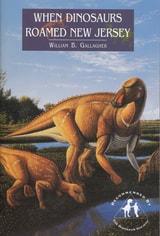
When Dinosaurs Roamed New Jersey
William B. Gallagher
Rutgers University Press, 1997
Did you know that Benjamin Franklin examined the first dinosaur bone in America from Woodbury, Gloucester County, in 1787--decades before the word dinosaur was even coined? Or that when the first reasonably complete dinosaur skeleton in the world was unearthed in Haddonfield, Camden County, in 1858, it was a major scientific breakthrough which forced paleontologists to completely revise their picture of dinosaur anatomy? Few people know that New Jersey is the nursery of American vertebrate paleontology!
When Dinosaurs Roamed New Jersey provides a succinct and readable history of the geology and paleontology of New Jersey from the time the region was covered by Cambrian seas, 543 million years ago, to the Pleistocene Ice Age only 10-15,000 years ago. William Gallagher tells the stories of professional and amateur fossil hunters, their discoveries, and their impact on the history of paleontological thought. He points out places in New Jersey and nearby where specimens characteristic of each era were found. He shows how fossil evidence found in the state is helping paleontologists uncover the ecological interactions and behavior of dinosaurs, and discusses such ongoing scientific controversies as the reason for the extinction of the dinosaurs.
From tracking dinosaur footprints across the Newark basin, to digging for the last dinosaurs in the greensands of South Jersey, to finding a mushroom in ancient amber in East Brunswick, this book is the ideal introduction to the Garden State's fossils and prehistory.
When Diversity Drops
Race, Religion, and Affirmative Action in Higher EducationPark, Julie J.
Rutgers University Press, 2013
The story documents IVCF’s evolution from a predominantly white group that rarely addressed race to the most racially diverse campus fellowship at the university. However, its ability to maintain its multiethnic membership was severely hampered by the drop in black enrollment at California University following the passage of Proposition 209, a statewide affirmative action ban.
Park demonstrates how the friendships that students have—or do not have—across racial lines are not just a matter of personal preference or choice; they take place in the contexts that are inevitably shaped by the demographic conditions of the university. She contends that a strong organizational commitment to diversity, while essential, cannot sustain racially diverse student subcultures. Her work makes a critical contribution to our understanding of race and inequality in collegiate life and is a valuable resource for educators and researchers interested in the influence of racial politics on students’ lives.
When Evil Came to Good Hart
Mardi Link
University of Michigan Press, 2008
"The murder mystery that has confounded and fascinated people for over forty years has been given a whole new life. When Evil Came to Good Hart is a well-researched and well-written piece of nonfiction that holds the reader in its spell, just as it has the many writers, reporters, and law officers who have puzzled over it. My highest praise for Mardi Link's book is to say that it reads like a good novel, a real page-turner."
—Judith Guest, author of Ordinary People and The Tarnished Eye
In this page-turning true-life whodunit, author Mardi Link details all the evidence to date. She crafts her book around police and court documents and historical and present-day statements and interviews, in addition to exploring the impact of the case on the community of Good Hart and the stigma that surrounds the popular summer getaway. Adding to both the sense of tragic history and the suspense, Link laces her tale with fascinating bits of local and Indian lore, while dozens of colorful characters enter and leave the story, spicing the narrative.
During the years of investigation of the murders, officials considered hundreds of tips and leads as well as dozens of sources, among them former secretaries who worked for murder victim Dick Robison; Robison's business associates; John Norman Collins, perpetrator of the "Co-Ed Murders" that took place in Washtenaw County between 1967 and 1969; and an inmate in federal prison in Leavenworth, Kansas, who said he knew who killed the Robison family.
Despite the exhaustive investigative efforts of numerous individuals, decades later the case lies tantalizingly out of reach. It is still an unsolved cold case, yielding, in Link's words, forty years worth of "dead-end leads, anonymous tips, a few hard facts, and countless cockamamie theories."
When Evil Came to Good Hart, 10th Anniversary Edition
Mardi Link
University of Michigan Press, 2018
In this page-turning true-life whodunit, author Mardi Link looks into the cold-case files of the murders of a wealthy Detroit-area family in their northern Michigan cabin in 1968, detailing and reviewing all the evidence to date. She crafts her book around police and court documents and historical and present-day statements and interviews, in addition to exploring the impact of the case on the community of Good Hart and the stigma that surrounds the popular summer getaway. Adding to both the sense of tragic history and the suspense, Link laces her tale with fascinating bits of local and Indian lore, while dozens of colorful characters enter and leave the story, spicing the narrative.
During the years of investigation of the murders, officials considered hundreds of tips and leads as well as dozens of sources, among them former secretaries who worked for murder victim Dick Robison; Robison's business associates; John Norman Collins, perpetrator of the "Co-Ed Murders" that took place in Washtenaw County between 1967 and 1969; and an inmate in federal prison in Leavenworth, Kansas, who said he knew who killed the Robison family. Despite the exhaustive investigative efforts of numerous individuals, decades later the case lies tantalizingly out of reach as an unsolved cold case.
This edition, published at the 50th anniversary of the murder, includes a new Afterword by Mardi Link. In it, Link discusses information that’s come to light since the book’s original publication and reflects on how the Robison murders might have been handled differently today.