Results by title
2285 books match the query 'Women' and 321 start with w
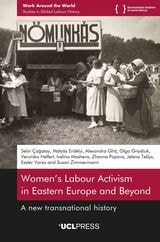
Women’s Labour Activism in Eastern Europe and Beyond
A New Transnational historySelin Çagatay, et al.
University College London, 2025
So often, theories of activism and social change neglect acts of resistance in informal, community, and domestic contexts. This collaborative investigation from a transnational team of scholars addresses two related shortcomings: the lack of class analysis in gender history and the neglect of gender dynamics in labor history. Women’s Labour Activism in Eastern Europe and Beyond highlights understudied topics in both of these fields, such as radical, grassroots, and interclass women’s labor activism on behalf of lower-income and working-class women and communities; women’s participation in trade unions on both sides of the Iron Curtain; and the heretofore neglected presence of Eastern European women in international organizations, including the cooperative movement.
Women’s Perspectives on Human Security
Violence, Environment, and SustainabilityRichard Matthew; Patricia A. Weitsman; Gunhild Hoogensen Gjørv; Nora Davis; Tera Dornfeld
Ohio University Press, 2020
Violent conflict, climate change, and poverty present distinct threats to women worldwide. Importantly, women are leading the way creating and sharing sustainable solutions.
Women’s security is a valuable analytical tool as well as a political agenda insofar as it addresses the specific problems affecting women’s ability to live dignified, free, and secure lives. First, this collection focuses on how conflict impacts women’s lives and well-being, including rape and gendered constructions of ethnicity, race, and religion. The book’s second section looks beyond the scope of large-scale violence to examine human security in terms of environmental policy, food, water, health, and economics.
Multidisciplinary in scope, these essays from new and established contributors draw from gender studies, international relations, criminology, political science, economics, sociology, biological and ecological sciences, and planning.
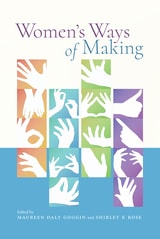
Women’s Ways of Making
Maureen Daly Goggin
Utah State University Press, 2021
Since the Enlightenment, embodied knowledge creation has been overlooked, ignored, or disparaged as inferior to other forms of expression or thinking that seem to leave the material world behind. Privileging the hand over the eye, as the work in this collection does, thus problematizes the way in which the eye has been co-opted by thinkers as the mind’s tool of investigation. Contributors to this volume argue that other senses—touch, taste, smell, hearing—are keys to knowing one’s materials. Only when all these ways of knowing are engaged can making be understood as a rhetorical practice.
In Women’s Ways of Making contributors explore ideas of making that run the gamut from videos produced by beauty vloggers to zine production and art programs at women’s correctional facilities. Bringing together senior scholars, new voices, and a fresh take on material rhetoric, this book will be of interest to a broad range of readers in composition and rhetoric.
Contributors: Angela Clark-Oates, Jane L. Donawerth, Amanda Ellis, Theresa M. Evans, Holly Fulton-Babicke, Bre Garrett, Melissa Greene, Magdelyn Hammong Helwig, Linda Hanson, Jackie Hoermann, Christine Martorana, Aurora Matzke, Jill McCracken, Karen S. Neubauer, Daneryl Nier-Weber, Sherry Rankins-Roberson, Kathleen J. Ryan, Rachael Ryerson, Andrea Severson, Lorin Shellenberger, Carey Smitherman-Clark, Emily Standridge, Charlese Trower, Christy I. Wenger, Hui Wu, Kathleen Blake Yancey
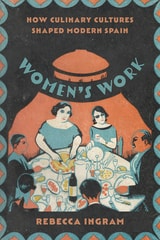
Women’s Work
How Culinary Cultures Shaped Modern SpainRebecca Ingram
Vanderbilt University Press, 2022
We are living in a moment in which famous chefs, Michelin stars, culinary techniques, and gastronomical accolades attract moneyed tourists to Spain from all over the world. This has prompted the Spanish government to declare its cuisine as part of Spanish patrimony. Even with this widespread global attention, we know little about how Spanish cooking became a litmus test for demonstrating Spain's modernity and, relatedly, the roles ascribed to the modern Spanish women responsible for daily cooking.
Efforts to articulate a new, modern Spain infiltrated writing in multiple genres and media. Women's Work offers a sharp reading of diverse sources, placed in their historical context, that yields a better understanding of the roles of food within an inherently uneven modernization process. Further, author Rebecca Ingram's perceptive critique reveals the paradoxical messages women have navigated, even in texts about a daily practice that shaped their domestic and work lives. Women's Work posits that this is significant because of the degree to which domestic activities, including cooking, occupied women's daily lives, even while issues like their fitness as citizens and participation in the public sphere were hotly debated. At the same time, progressive intellectuals from diverse backgrounds began to invoke Spanish cooking and eating as one measure of Spanish modernity.
Women's Work shows how culinary writing engaged these debates and reached women at the site of much of their daily labor—the kitchen—and, in this way, shaped their thinking about their roles in modernizing Spain.
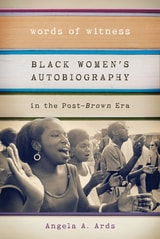
Words of Witness
Black Women's Autobiography in the Post-<i>Brown</i> EraAngela A. Ards
University of Wisconsin Press, 2015
Exploring works by the critically acclaimed June Jordan and Edwidge Danticat, as well as by popular and emerging authors such as Melba Beals, Rosemary Bray, and Eisa Davis, Ards demonstrates how each text asserts countermemories to official—and often nostalgic—understandings of the civil rights and Black Power movements. She situates each writer as activist-citizen, adopting and remaking particular roles—warrior, “the least of these,” immigrant, hip-hop head—to crystallize a range of black feminist responses to urgent but unresolved political issues.

Workfare or Fair Work
Women, Welfare, and Government Work ProgramsNancy E Rose
Rutgers University Press, 1995
Can the welfare system in the United States accord people dignity? That question is often left out of the current debates over welfare and workfare. In this provocative book, Nancy Rose argues that the United States has been successful in the past––notably during the New Deal and in the 1970s––at shaping programs that gave people “fair work.”
However, as Rose documents, those innovative job creation programs were voluntary and were mainly directed at putting men back to work. Women on welfare, and especially women of color, continue to be forced into a very different kind of program: mandatory, punitive, and demeaning. Such workfare programs are set up for failure. They rarely train women for jobs with futures, they ignore the needs of the women’s families, and they do not pay an honest wage. They perpetuate poverty rather than prevent it.
Rose uses the history of U.S. job creation programs to show alternatives to mandatory workfare. Any effort to redesign welfare in America needs to pay close attention to the lessons drawn from this perceptive analysis of the history of women, welfare, and work. This is an indispensable book for students, scholars, policymakers, politicians, and activists––for everyone who knows the system is broken and wants to fix it.
Working Difference
Women's Working Lives in Hungary and Austria, 1945-1995Éva Fodor
Duke University Press, 2003
Fodor brings qualitative and quantitative analyses to bear, combining statistical analyses of survey data, interviews with women managers in both countries, and archival materials including those from the previously classified archives of the Hungarian communist party and transcripts from sessions of the Austrian Parliament. She shows how women's access to power varied in degree and operated through different principles and mechanisms in accordance with the stratification systems of the respective countries. In Hungary women's mobility was curtailed by political means (often involving limited access to communist party membership), while in Austria women's professional advancement was affected by limited access to educational institutions and the labor market. Fodor discusses the legacies of Austria's and Hungary's "gender regimes" following the demise of state socialism and during the process of integration into the European Union.
Working Women in Jordan
Education, Migration, and AspirationFida J. Adely
University of Chicago Press, 2024
Jordan has witnessed tremendous societal transformation in its relatively short history. Today it has one of the most highly educated populations in the region, and women have outnumbered and outperformed their male counterparts for more than a decade. Yet, despite their education and professional status, many women still struggle to build a secure future and a life befitting of their aspirations.
In Working Women in Jordan anthropologist Fida J. Adely turns to college-educated women in Jordan who migrate from rural provinces to Amman for employment opportunities. Building on twelve years of ethnographic research and extensive interviews with dozens of women, as well as some of their family members, Adely analyzes the effects of developments such as expanded educational opportunities, urbanization, privatization, and the restructuring of the labor market on women’s life trajectories, gender roles, the institution of marriage, and kinship relations. Through these rich narrative accounts and the analysis of broader socio-economic shifts, Adely explains how educational structures can act as both facilitators and obstacles to workforce entry—along with cascading consequences for family and social life. Deeply thorough and compelling, Working Women in Jordan asks readers to think more critically about what counts as development, and for whom.
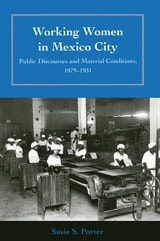
Working Women in Mexico City
Public Discourses and Material Conditions, 1879-1931Susie S. Porter
University of Arizona Press, 2003
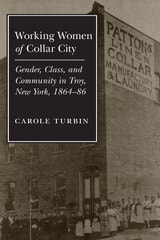
Working Women of Collar City
Gender, Class, and Community in Troy, 1864-86Carole Turbin
University of Illinois Press, 1992
Why have some working women succeeded at organizing in spite of obstacles to labor activity? Under what circumstances were they able to form alliances with male workers?
Carole Turbin explores these and other questions by examining the case of Troy, New York. In the 1860s, Troy produced nearly all the nation's detachable shirt collars and cuffs. The city's collar laundresses were largely Irish immigrants. Their union was officially the nation's first women's labor organization, and one of the best organized. Turbin provides a new perspective on gender and shows that women's family ties are not necessarily a conservative influence but may encourage women's and men's collective action.
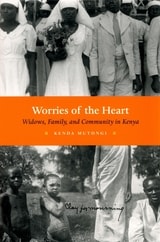
Worries of the Heart
Widows, Family, and Community in KenyaKenda Mutongi
University of Chicago Press, 2007
Throughout the twentieth century and into the twenty-first, rates of widowhood have been remarkably high in Kenya. Yet despite their numbers, widows and their families exist at the margins of society, and their lives act as a barometer for the harsh realities of rural Kenya. Mutongi here argues that widows survive by publicly airing their social, economic, and political problems, their “worries of the heart.” Initially aimed at the men in their community, and then their colonial rulers, this strategy changed after independence as widows increasingly invoked the language of citizenship to demand their rights from the new leaders of Kenya—leaders whose failure to meet the needs of ordinary citizens has led to deep disenchantment and altered Kenyans’ view of their colonial past. An innovative blend of ethnography and historical research, Worries of the Heart is a poignant narrative rich with insights into postcolonial Africa.
Worship, Women and War
Essays in Honor of Susan NiditchJohn J. Collins
SBL Press, 2015
Celebrate the career of an inspirational scholar and teacher concerned with revealing voices from the margins
This volume of essays honors Susan Niditch, author of War in the Hebrew Bible: A Study in the Ethics of Violence (1993), “My Brother Esau Is a Hairy Man”: Hair and Identity in Ancient Israel (2008), and most recently, The Responsive Self: Personal Religion in Biblical Literature of the Neo-Babylonian and Persian Periods (forthcoming), among other influential publications. Essays touch on topics such as folklore, mythology, and oral history, Israelite religion, ancient Judaism, warfare, violence, and gender.
Features:
- Essays from nineteen scholars, all experts in their fields
- Exploration of texts from Mesopotamia, the Hebrew Bible, and the New Testament
- Bibliography of Niditch's scholarly contributions
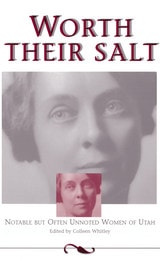
Worth Their Salt
Colleen Whitley
Utah State University Press, 1996
Worth Their Salt Too
More Notable But Often Unnoted Women of UtahColleen Whitley
Utah State University Press, 2000
Writing Maternity
Medicine, Anxiety, Rhetoric, and GenreDara Rossman Regaignon
The Ohio State University Press, 2021
Writing Out My Heart
Selections from the Journal of Frances E. Willard, 1855-96Edited by Carolyn De Swarte Gifford
University of Illinois Press, 1995
Frances E. Willard's powerful leadership of the Woman's Christian Temperance Union (WCTU) made her one of the most commanding figures in the reform movements of the nineteenth century. World renowned and a force to be reckoned with, Willard grappled publicly and private with difficult issues, including temperance, slavery, women's rights, and her own sexuality. These selections from her forty-nine-volume journal reveal the private and confidential side of Willard for the first time. She comes to life in these pages--a person of character, passion, and self-determination who came to represent the woman of the dawning era.
Supplemented by an in-depth introduction and generous annotations, Writing Out My Heart sheds new light on an extraordinary individual and the lives of women in nineteenth-century America.

Writing out of Place
Regionalism, Women, and American Literary CultureJudith Fetterley and Marjorie Pryse
University of Illinois Press, 2002
Regionalist writers such as Alice Cary, Mary E. Wilkins Freeman, Sarah Orne Jewett, Grace King, Alice Dunbar–Nelson, Sui Sin Far, and Mary Austin present narrators who serve as cultural interpreters for persons often considered "out of place" by urban readers. Critiquing the approaches to regional subjects characteristic of local color, this book gives contemporary readers a vantage point from which to approach regions and regional people in the global economy of our own time.
Reclaiming the ground of "close" reading for texts that have been insufficiently read, Fetterley and Pryse situate textual analyses within larger questions such as the ideology of form, feminist standpoint epistemology, queer theory, intersections of race and class, and narrative empathy. In its combination of the critical and the visionary, Writing out of Place proposes regionalism as a model for narrative connection between texts and readers that has the potential to transform American literary culture. Arguing the need for other models for human development than those produced in heroic stories about men and boys, the authors offer regionalism as a source of unconventional and counterhegemonic fictions that should be passed on to future generations of readers.
Writing the Polish American Woman in Postwar Ethnic Fiction
Grazyna J. Kozaczka
Ohio University Press, 2019
Winner of the 2019 Oskar Halecki Prize (Polish American Historical Association)
Though often unnoticed by scholars of literature and history, Polish American women have for decades been fighting back against the patriarchy they encountered in America and the patriarchy that followed them from Poland. Through close readings of several Polish American and Polish Canadian novels and short stories published over the last seven decades, Writing the Polish American Woman in Postwar Ethnic Fiction traces the evolution of this struggle and women’s efforts to construct gendered and classed ethnicity.
Focusing predominantly on work by North American born and immigrant authors that represents the Polish American Catholic tradition, Grażyna J. Kozaczka puts texts in conversation with other American ethnic literatures. She positions ethnic gender construction and performance at an intersection of social class, race, and sex. She explores the marginalization of ethnic female characters in terms of migration studies, theories of whiteness, and the history of feminist discourse. Writing the Polish American Woman in Postwar Ethnic Fiction tells the complex story of how Polish American women writers have shown a strong awareness of their oppression and sought empowerment through resistive and transgressive behaviors.
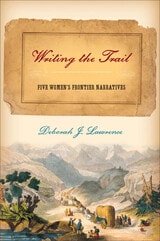
Writing the Trail
Five Women's Frontier NarrativesDeborah Lawrence
University of Iowa Press, 2006
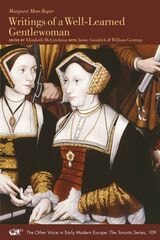
Writings of a Well-Learned Gentlewoman
Margaret More Roper
Iter Press, 2024
Margaret More Roper (1505–44) was, at the age of nineteen, the first early modern woman writer in Tudor England and the first nonroyal woman to have a book printed in the English language. As the eldest daughter of Sir Thomas More, Roper received a cutting-edge education in Latin and Greek that was virtually unprecedented for a woman. Besides gaining an international reputation for her outstanding erudition, Roper served as More’s confidante during his imprisonment. Her correspondence from this period offers valuable insight into a key moment in English history.
This Other Voice series edition recognizes Margaret More Roper as a notable historical figure in her own right and as one of the most learned women of her time. It publishes all her extant writings in modernized spelling, with annotations, a glossary, and a current bibliography of studies about her.
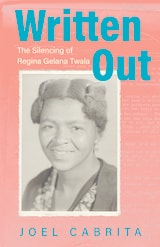
Written Out
The Silencing of Regina Gelana TwalaJoel Cabrita
Ohio University Press, 2023