Results by title
8834 books match the query 'Political science' and 357 start with w
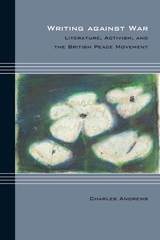
Writing against War
Literature, Activism, and the British Peace MovementCharles Andrews
Northwestern University Press, 2017
The cataclysm of the First World War gave rise to the British Peace Movement, a spectrum of pacifist, internationalist, and antiwar organizations and individuals. Antiwar sentiments found expression not only in editorials, criticism, and journalism but also in novels and other works of literature. Writing against War examines the work of Aldous Huxley, Storm Jameson, Siegfried Sassoon, Rose Macaulay, and Virginia Woolf to analyze the effects of their attempts to employ fiction in the service of peace activism. It further traces how Huxley, Woolf, and others sought to reconcile their antiwar beliefs with implacable military violence.
The British Peace Movement's failure to halt the rise of fascism and the Second World War continues to cast a shadow over contemporary pacifist movements. Writing about War will fascinate scholars of peace studies and literature and offers valuable insights for current-day peace activists and artists who seek to integrate creativity with activism.
Writing the Black Diasporic City in the Age of Globalization
Carol Bailey
Rutgers University Press, 2023
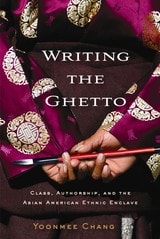
Writing the Ghetto
Class, Authorship, and the Asian American Ethnic EnclaveChang, Yoonmee
Rutgers University Press, 2010
Yoonmee Chang examines the class structure of Chinatowns, Koreatowns, Little Tokyos, and Little Indias, arguing that ghettoization in these spaces is disguised. She maintains that Asian American literature both contributes to and challenges this masking through its marginalization by what she calls the "ethnographic imperative." Chang discusses texts from the late nineteenth century to the present, including those of Sui Sin Far, Winnifred Eaton, Monica Sone, Fae Myenne Ng, Chang-rae Lee, S. Mitra Kalita, and Nam Le. These texts are situated in the contexts of the Chinese Exclusion Era, Japanese American internment during World War II, the globalization of Chinatown in the late twentieth century, the Vietnam War, the 1992 Los Angeles riots, and the contemporary emergence of the "ethnoburb."
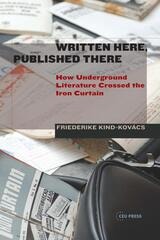
Written Here, Published There
How Underground Literature Crossed the Iron CurtainFriederike Kind-Kovács
Central European University Press, 2015
Written Here, Published There offers a new perspective on the role of underground literature in the Cold War and challenges us to recognize gaps in the Iron Curtain. The book identifies a transnational undertaking that reinforced détente, dialogue, and cultural transfer, and thus counterbalanced the persistent belief in Europe's irreversible division.
It analyzes a cultural practice that attracted extensive attention during the Cold War but has largely been ignored in recent scholarship: tamizdat, or the unauthorized migration of underground literature across the Iron Curtain. Through this cultural practice, I offer a new reading of Cold War Europe's history. Investigating the transfer of underground literature from the 'Other Europe' to Western Europe, the United States, and back illuminates the intertwined fabrics of Cold War literary cultures. Perceiving tamizdat as both a literary and a social phenomenon, the book focuses on how individuals participated in this border-crossing activity and used secretive channels to guarantee the free flow of literature.
Wrong Turnings
How the Left Got LostGeoffrey M. Hodgson
University of Chicago Press, 2017
With Wrong-Turnings, Geoffrey M. Hodgson tracks changes in the meaning of the Left and offers suggestions for how the Left might reclaim some of its core values. The term Left originated during the French Revolution, when revolutionaries sought to abolish the monarchy and privilege and to introduce a new society based on liberty, equality, fraternity, and universal rights. Over time, however, the meaning radically changed, especially through the influence of socialism and collectivism. Hodgson argues that the Left must rediscover its roots in the Enlightenment and readopt Enlightenment values it has abandoned, such as those concerning democracy and universal human rights. Only then will it be prepared to address contemporary problems of inequality and the survival of democracy. Possible measures could include enhanced educational provisions, a guaranteed basic income, and a viable mechanism for fair distribution of wealth.
Wrong-Turnings is a truly pathbreaking work from one of our most prolific and respected institutional theorists. It will change our understanding of how the left got lost.
Wrong-Doing, Truth-Telling
The Function of Avowal in JusticeMichel Foucault
University of Chicago Press, 2014
Three years before his death, Michel Foucault delivered a series of lectures at the Catholic University of Louvain that until recently remained almost unknown. These lectures—which focus on the role of avowal, or confession, in the determination of truth and justice—provide the missing link between Foucault’s early work on madness, delinquency, and sexuality and his later explorations of subjectivity in Greek and Roman antiquity.
Wrongly Convicted
Perspectives on Failed JusticeWestervelt, Saundra D
Rutgers University Press, 2001
The American criminal justice system contains numerous safeguards to prevent the conviction of innocent persons. The Bill of Rights provides nineteen separate rights for the alleged criminal offender, including the right to effective legal representation and the right to be judged without regard to race or creed. Despite these safeguards, wrongful convictions persist, and the issue has reverberated in the national debate over capital punishment.
The essays in this volume are written from a cross-disciplinary perspective by some of the most eminent lawyers, criminologists, and social scientists in the field today. The articles are divided into four sections: the causes of wrongful convictions, the social characteristics of the wrongly convicted, case studies and personal histories, and suggestions for changes in the criminal justice system to prevent wrongful convictions. Contributors examine a broad range of issues, including the fallibility of eyewitness testimony, particularly in cross-racial identifications; the disadvantages faced by racial and ethnic minorities in the criminal justice system; and the impact of new technologies, especially DNA evidence, in freeing the innocent and bringing the guilty to justice. The book also asks such questions as: What legal characteristics do wrongful convictions share? What are the mechanisms that defendants and their attorneys use to overturn wrongful convictions? The book also provides case studies that offer specific examples of what can and does go wrong in the criminal justice system.