Results by title
18284 books match the query 'United States' and 882 start with w

Where Texas Meets the Sea
Corpus Christi and Its HistoryBy Alan Lessoff
University of Texas Press, 2019
A favorite destination of visitors to the Texas coast, Corpus Christi is a midsize city that manages to be both cosmopolitan and provincial, networked and local. It is an indispensable provider of urban services to South Texas, as well as a port of international significance. Its industries and military bases and, increasingly, its coastal research institutes give it a range of connections throughout North America. Despite these advantages, however, Corpus Christi has never made it into the first rank of Texas cities, and a keen self-consciousness about the city’s subordinate position has driven debates over Corpus’s identity and prospects for decades.
In this masterful urban history—a study that will reshape the way that Texans look at all their cities—Alan Lessoff analyzes Corpus Christi’s place within Texas, the American Southwest, the western Gulf of Mexico, and the U.S.-Mexican borderlands from the city’s founding in 1839 to the present. He portrays Corpus as a place where westward Anglo expansion overwhelmed the Hispanic settlement process from the south, leaving a legacy of conflicting historical narratives that colors the city’s character even now. Lessoff also explores how competing visions of the city’s identity and possibilities have played out in arenas ranging from artwork in public places to schemes to embellish, redevelop, or preserve the downtown waterfront and North Padre Island. With a deep understanding of the geographic, historical, economic, and political factors that have formed the city, Lessoff demonstrates that Corpus Christi exemplifies the tensions between regional and cosmopolitan influences that have shaped cities across the Southwest.
Where Valor Proudly Sleeps
A History of Fredericksburg National Cemetery, 1866–1933Donald C. Pfanz
Southern Illinois University Press, 2018

Where Women Run
Gender and Party in the American StatesKira Sanbonmatsu
University of Michigan Press, 2010
“Kira Sanbonmatsu has done a masterful job of linking the representation of women in elective office to the activities of party organizations in the states. She combines qualitative and quantitative data to show how women are navigating the campaign process to become elected leaders and the changing role of party organizations in their recruitment and election. It is a significant contribution to the study of representative democracy.”
--Barbara Burrell, Northern Illinois University
“Sanbonmatsu has produced an excellent study that will invigorate research on the role of political parties and the recruitment of women candidates. Using a variety of methods and data sources, she has crafted a tightly constructed, clearly argued, and exceedingly well-written study. A commendable and convincing job.”
--Gary Moncrief, Boise State University
“Sanbonmatsu offers important insights in two neglected areas of American politics: the role of political parties in recruiting candidates and the continued under-representation of women in elected office. Connecting the two subjects through careful qualitative and statistical methods, insightful interpretation of the literature and interesting findings, the book is a significant new addition to scholarship on parties, gender, and political recruitment.”
--Linda Fowler, Dartmouth College
Kira Sanbonmatsu is Associate Professor of Political Science at Rutgers University and Senior Scholar at the Eagleton Institute of Politics’ Center for American Women and Politics (CAWP). She was previously associate professor at Ohio State University. She is the author of Democrats, Republicans, and the Politics of Women’s Place.

Where the Hood At?
Fifty Years of Change in Black NeighborhoodsMichael C. Lens
Russell Sage Foundation, 2024
Hip hop music was born out of Black neighborhoods in the 1970s and has evolved alongside them. In Where the Hood At? Lens uses rap’s growth and influence across the country to frame discussions about the development and conditions of Black neighborhoods. Lens finds that social and economic improvement in Black neighborhoods since the 1970s has been slow. However, how well Black neighborhoods are doing varies substantially by region. Overall, Black neighborhoods in the South are doing well and growing quickly. Washington D.C. and Atlanta, in particular, stand out as centers of Black affluence. Black neighborhoods in the Midwest and the Rust Belt, on the other hand, are particularly disadvantaged. The welfare of Black neighborhoods is related not only to factors within neighborhoods, such as the unemployment rate, but also to characteristics of the larger metropolitan area, such as overall income inequality. Lens finds that while gentrification is increasingly prevalent, it is growing slowly, and is not as pressing an issue as public discourse would make it seem. Instead, concentrated disadvantage is by far the most common and pressing problem in Black neighborhoods.
Lens argues that Black neighborhoods represent urban America’s greatest policy failures, and that recent housing policies have only had mild success. He provides several suggestions for policies with the goal of uplifting Black neighborhoods. One radical proposal is enacting policies and programs, such as tax breaks for entrepreneurs or other small business owners, that would encourage Black Americans to move back to the South. Black Americans migrating South would have a better chance at moving to an advantaged Black neighborhood as improving neighborhood location is higher when moving across regions. It would also help Black Americans expand their political and economic power. He also suggests a regional focus for economic development policies, particularly in the Midwest where Black neighborhoods are struggling the most. One way to boost economic development would be to move federal agencies to the area. He also calls for building more affordable housing in Black suburbs. Black poverty is lower in suburbs than in central cities, so increasing housing in Black suburbs would allow Black households to relocate to more advantaged neighborhoods, which research has shown leads to improved life outcomes.
Where the Hood At? is a remarkable and comprehensive account of Black neighborhoods that helps us to better understand the places and conditions that allow them flourish or impedes their advancement.
Where the Moon Stands Still
Revealing the Cosmic Genius of Ohio’s Indigenous EarthworksJames W. Graham
The Ohio State University Press, 2026
How did people two millennia ago achieve the stunning architectural and scientific accomplishment that in 2023 became Ohio’s only UNESCO World Heritage Site? In Where the Moon Stands Still, James W. Graham recounts the inspiring true story of two small-town college professors who, without funds or training in archaeology, helped unlock secrets behind an ancient monumental work of land art—the Hopewell Ceremonial Earthworks—all but hidden in plain sight on a local golf course. Ever since the arrival of Europeans, thousands of Native earthworks east of the Mississippi were neglected, vandalized, bulldozed, and plundered. Their origins and purposes baffled scholars. How did ancient people build monuments of such grand scale and geometric sophistication? Why? Crucial answers emerged in the 1980s when philosopher Bob Horn and astronomer Ray Hively, driven by curiosity and a tireless devotion to truth-seeking, made a decades-long effort to conquer the skepticism of experts and unmask the ??astronomical genius behind the Indigenous earthworks. As he recounts Hively and Horn’s investigation, Graham refutes exploitative mythical interpretations and explains the history around these earthworks and of US treatment of its Indigenous people, including the long quest for tribes to regain authority over stories, ancestors, and places. Where the Moon Stands Still signals a global reawakening to the greatness of Indigenous achievement in America’s heartland.
Where the Red-Winged Blackbirds Sing
The Akimel O'odham and Cycles of Agricultural Transformation in the Phoenix BasinJennifer Bess
University Press of Colorado, 2021
Author Jennifer Bess examines the Akimel O’odham’s worldview, which links their origins with a responsibility to farm the Gila River Valley and to honor their history of adaptation and obligations as “world-builders”—co-creators of an evermore life-sustaining environment and participants in flexible networks of economic exchange. Bess considers this worldview in context of the Huhugam–Akimel O’odham agricultural economy over more than a thousand years. Drawing directly on Akimel O’odham traditional ecological knowledge, innovations, and interpretive strategies in archives and interviews, Bess shows how the Akimel O’odham engaged in agricultural economy for the sake of their lifeways, collective identity, enduring future, and actualization of the values modeled in their sacred stories.
Where the Red-Winged Blackbirds Sing highlights the values of adaptation, innovation, and co-creation fundamental to Akimel O’odham lifeways and chronicles the contributions the Akimel O’odham have made to American history and to the history of agriculture. The book will be of interest to scholars of Indigenous, American Southwestern, and agricultural history.

Where the Sky Touched the Earth
The Cosmological Landscapes of the SouthwestDon Lago
University of Nevada Press, 2017
Nowhere else in the world is the link between earth and sky so powerful. Lago witnesses a solar eclipse over the Grand Canyon, climbs primeval volcanos, and sees the universe in tree rings. Through ageless Native American ceremonies, modern telescopes, and even dreams of flying saucers, Lago, who is not only a poet but a true philosopher of science, strives to find order and meaning in the world and brings out the Southwest’s beauty and mystery.

Where the Wild Animals Is Plentiful
Diary of an Alabama Fur Trader's Daughter, 1912-1914May Jordan
University of Alabama Press, 2006
This rare find--a journal of a young backwoods woman--provides a unique picture of rural life in southwestern Alabama early in the 20th century.
"I am a little Alabama girl living on the frontier where the wild animals is plentiful," wrote May Jordan in 1912. During the hunting season her father traveled Washington County buying furs, and May--already 23--accompanied him on two of these trips, cooking meals, helping out with the business, and recording their experiences.
May's diary of these trips from December 1912 to March 1914 describes the routine of the fur trade and provides a vivid portrait of wilderness travel and social customs. Through May's eyes, readers can experience the sights and sounds of pine forests and swamps, the difficulty of wading through waist-deep mud, and the neighborliness of the people living in this isolated area. May also shares both the solace of religious faith and her love of laughter as reflected in the jokes she records.
Elisa Moore Baldwin provides an introduction that traces Jordan family history and describes economic, social, and political conditions during the period. Baldwin also includes annotations based on court records, census rolls, and other primary sources and photographs of many of the characters in May's narrative to provide a vivid picture of the times. Because few first-person accounts exist of the life of poor whites, this diary will be invaluable to students of southern and women's history; no comparable work exists for this part of Alabama during this era. May's journal takes us to another world and teaches us about the lively human spirit in the face of hardship and loneliness.
Where the World Is Not
Cultural Authority and Democratic Desire in Modern American LiteratureKim Savelson
The Ohio State University Press, 2009
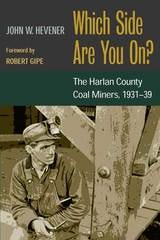
Which Side Are You On?
The Harlan County Coal Miners, 1931-39John W. Hevener. Foreword by Robert Gipe
University of Illinois Press, 1978
Depression-era Harlan County, Kentucky, was the site of one of the most bitter and protracted labor disputes in American history. The decade-long conflict between miners and the coal operators who adamantly resisted unionization has been immortalized in folksong by Florence Reece and Aunt Molly Jackson, contemplated in prose by Theodore Dreiser and Sherwood Anderson, and long been obscured by popular myths and legends.
John W. Hevener separates the fact from the legend in his Weatherford Award-winning investigation of Harlan's civil strife, now available for the first time in paperback. In Which Side Are You On? Hevener attributes the violence–-including the deaths of thirteen union miners–-to more than just labor conflict, viewing Harlan's troubles as sectional economic conflict stemming from the county's rapid industrialization and social disorganization in the preceding decade.
Detailing the dimensions of unionization and the balance of power spawned by New Deal labor policy after government intervention, Which Side Are You On? is the definitive analysis of Harlan's bloody decade and a seminal contribution to American labor history.
While Waiting for Rain
Community, Economy, and Law in a Time of ChangeJohn Henry Schlegel
University of Michigan Press, 2022
What might a sensible community choose to do if its economy has fallen apart and becoming a ghost town is not an acceptable option? Unfortunately, answers to this question have long been measured against an implicit standard: the postwar economy of the 1950s. After showing why that economy provides an implausible standard—made possible by the lack of economic competition from the European and Asian countries, winners or losers, touched by the war—John Henry Schlegel attempts to answer the question of what to do.
While Waiting for Rain first examines the economic history of the United States as well as that of Buffalo, New York: an appropriate stand-in for any city that may have seen its economy start to fall apart in the 1960s, 70s, and 80s. It makes clear that neither Buffalo nor the United States as a whole has had an economy in the sense of “a persistent market structure that is the fusion of an understanding of economic life with the patterns of behavior within the economic, political, and social institutions that enact that understanding” since both economies collapsed. Next, this book builds a plausible theory of how economic growth might take place by examining the work of the famous urbanist, Jane Jacobs, especially her book Cities and the Wealth of Nations. Her work, like that of many others, emphasizes the importance of innovation for economic growth, but is singular in its insistence that such innovation has to come from local resources. It can neither be bought nor given, even by well-intentioned political actors. As a result Americans generally, as well as locally, are like farmers in the midst of a drought, left to review their resources and wait. Finally, it returns to both the local Buffalo and the national economies to consider what these political units might plausibly do while waiting for an economy to emerge.

Whiskey Breakfast
My Swedish Family, My American LifeRichard C. Lindberg
University of Minnesota Press, 2011
Chicago in the 1920s: Clark Street was the city’s last Swedetown, a narrow corridor of weather-beaten storefronts, coal yards, and taverns running along the north side of the city and the locus of Swedish community life in Chicago during the first half of the twentieth century. It represented a way station for a generation of working-class immigrants escaping the hardships of the old country for the promise of a brighter new day in a halfway house of sorts, perched between the old and new lands. For Richard C. Lindberg, whose Swedish immigrant parents and grandparents settled there, it was also the staging ground for an intensely personal, multigenerational, coming-of-age drama based on the struggles of two disparate families—their dreams and their depravities, their victories and their failures.
Whiskey Breakfast is Lindberg’s captivating tale of life as a first-generation baby-boomer Swedish American, caught between the customs of a land he had never been to and the desire to conform and fit into a troubled existence, tragically scarred by alcoholism, divorce, and peer abuse. But it is also a powerful and intimate portrait of his immigrant ancestors, and especially of his father, Oscar—a contractor and master builder who helped develop Chicago’s post–World War II suburbs. A paradoxical man, known to some as a socialist, an anarchist, and a serious drinker, Oscar would carry with him to the grave a sixty-two-year-old family secret, a secret that for Lindberg lies at the very heart of the great Swedish unrest that drove his father and countless other men and women out of Sweden and onward to America.
Masterfully blending autobiography with immigrant history, Whiskey Breakfast surrounds Lindberg’s family story with Swedish cultural history and politics, as well as remarkable Chicago history and how Clark Street and Swedetown became, and in many ways remain, a center of Swedish immigrants’ social and cultural life. Far from a eulogy for an idealized past, Lindberg has crafted a moving and sobering memoir of a young man’s struggle to come to terms with his father and himself, his immigrant heritage, and his native home.

Whiskey Tango Foxtrot
A Photographer's Chronicle of the Iraq WarAshley Gilbertson
University of Chicago Press, 2007
Whiskey Tango Foxtrot gathers the best of Gilbertson’s photographs, chronicling America’s early battles in Iraq, the initial occupation of Baghdad, the insurgency that erupted shortly afterward, the dramatic battle to overtake Falluja, and ultimately, the country’s first national elections. No Western photojournalist has done as much sustained work in occupied Iraq as Gilbertson, and this wide-ranging treatment of the war from the viewpoint of a photographer is the first of its kind. Accompanying each section of the book is a personal account of Gilbertson’s experiences covering the conflict. Throughout, he conveys the exhilaration and terror of photographing war, as well as the challenges of photojournalism in our age of embedded reporting. But ultimately, and just as importantly, Whiskey Tango Foxtrot tells the story of Gilbertson’s own journey from hard-drinking bravado to the grave realism of a scarred survivor. Here he struggles with guilt over the death of a marine escort, tells candidly of his own experience with post-traumatic stress, and grapples with the reality that Iraq—despite the sacrifice in Iraqi and American lives—has descended into a civil war with no end in sight.
A searing account of the American experience in Iraq, Whiskey Tango Foxtrot is sure to become one of the classic war photography books of our time.
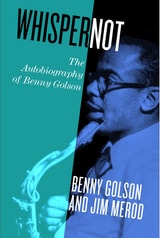
Whisper Not
The Autobiography of Benny GolsonBenny Golson
Temple University Press, 2016
“One of the greatest artists our country has is Benny Golson. He is not only a great musician, but an original and fabulous composer. He is inventive and creative and his work is loved the world over. Benny is a rare, creative genius. All I would like to say is THREE CHEERS for Benny Golson!”—Tony Bennett
“Composer supreme, tenor man supreme, jazz man supreme, good guy supreme: that’s BENNY GOLSON!"—Sonny Rollins
Born during the de facto inaugural era of jazz, saxophonist Benny Golson learned his instrument and the vocabulary of jazz alongside John Coltrane while Golson was still in high school in Philadelphia. Quickly establishing himself as an iconic fixture on the jazz landscape, Golson performed with dozens of jazz greats, from Sonny Rollins, Coleman Hawkins, and Jimmy Heath to Dizzy Gillespie, Freddie Hubbard, and many others. An acclaimed composer, Golson also wrote music for Hollywood films and television and composed such memorable jazz standards as “Stablemates,” “Killer Joe,” and “Whisper Not.”
An eloquent account of Golson’s exceptional life—presented episodically rather than chronologically—Whisper Not includes a dazzling collection of anecdotes, memories, experiences, and photographs that recount the successes, the inevitable failures, and the rewards of a life eternally dedicated to jazz.
Whispered Consolations
Law and Narrative in African American LifeJon-Christian Suggs
University of Michigan Press, 2000

Whispers and Shadows
A Naturalist’s MemoirJerry Apps
Wisconsin Historical Society Press, 2015
Combining his signature lively storytelling and careful observations of nature, Apps draws on a lifetime of experiences, from his earliest years growing up on a central Wisconsin farm to his current ventures as gardener, tree farmer, and steward of wetlands, prairies, and endangered Karner blue butterflies. He also takes inspiration from the writings of Aldo Leopold, Annie Dillard, Henry David Thoreau, Sigurd Olson, Ralph Waldo Emerson, John Muir, Barbara Kingsolver, Wendell Berry, Richard Louv, and Rachel Carson. With these eloquent essays, Jerry Apps reminds us to slow down, turn off technology, and allow our senses to reconnect us to the natural world. For it is there, he writes, that “I am able to return to a feeling I had when I was a child, a feeling of having room to stretch my arms without interfering with another person, a feeling of being a small part of something much larger than I was, and I marvel at the idea.”
Whistle Stop
How 31,000 Miles of Train Travel, 352 Speeches, and a Little Midwest Gumption Saved the Presidency of Harry TrumanPhilip White
University Press of New England, 2015

White Burgers, Black Cash
Fast Food from Black Exclusion to ExploitationNaa Oyo A. Kwate
University of Minnesota Press, 2023
The long and pernicious relationship between fast food restaurants and the African American community
- James Beard Foundation: James Beard Media Award for Reference, History, and Scholarship — Winner
- Urban Affairs Association Best Book in Urban Affairs — Winner
- Association for Humanist Sociology Betty and McClung Lee Book Award — Winner
- Black Caucus of the American Library Association — Honor, Nonfiction category
- Museum of African American History Stone Book Award — Shortlist
- Business History Conference: Hagley Prize — Finalist
- Association for the Study of Food and Society: ASFS Book Award — Winner
- Society for the Study of Social Problems: Eduardo Bonilla-Silva Outstanding Book Award — Winner
- Foreword: INDIES — Silver winner, History category
Today, fast food is disproportionately located in Black neighborhoods and marketed to Black Americans through trgeted advertising. But throughout much of the twentieth century, fast food was developed specifically for White urban and suburban customers, purposefully avoiding Black spaces. In White Burgers, Black Cash, Naa Oyo A. Kwate traces the evolution in fast food from the early 1900s to the present, from its long history of racist exclusion to its current damaging embrace of urban Black communities.
Fast food has historically been tied to the country’s self-image as the land of opportunity and is marketed as one of life’s simple pleasures, but a more insidious history lies at the industry’s core. White Burgers, Black Cash investigates the complex trajectory of restaurant locations from a decided commitment to Whiteness to the disproportionate densities that characterize Black communities today. Kwate expansively charts fast food’s racial and spatial transformation and centers the cities of Chicago, New York City, and Washington, D.C., in a national examination of the biggest brands of today, including White Castle, KFC, Burger King, McDonald’s, and more.
Deeply researched, compellingly told, and brimming with surprising details, White Burgers, Black Cash reveals the inequalities embedded in America’s popular national food tradition.
White But Not Equal
Mexican Americans, Jury Discrimination, and the Supreme CourtIgnacio M. García
University of Arizona Press, 2008
Ignacio García’s White But Not Equal explores this historic but mostly forgotten case, which became the first to recognize discrimination against Mexican Americans. Led by three dedicated Mexican American lawyers, the case argued for recognition of Mexican Americans under the 14th Amendment as a “class apart.” Despite a distinct history and culture, Mexican Americans were considered white by law during this period, yet in reality they were subjected to prejudice and discrimination. This was reflected in Hernández’s trial, in which none of the selected jurors were Mexican American. The concept of Latino identity began to shift as the demand for inclusion in the political and judicial system began.
García places the Hernández v. Texas case within a historical perspective and examines the changing Anglo-Mexican relationship. More than just a legal discussion, this book looks at the whole case from start to finish and examines all the major participants, placing the story within the larger issue of the fight for Mexican American civil rights.
White Care
The Impact of Race on American InfrastructureCotten Seiler
University of Chicago Press, 2026
Infrastructure delivers to its users a range of benefits, from health, safety, and sanitation to mobility, energy, and education. It is, as Cotten Seiler argues, how modern states show care for their populations. White Care recounts the rise and fall of public infrastructure in the United States, unearthing its origins as an investment in those Americans deemed most highly evolved, showing the political stakes of its desegregation, and accounting for its current state of dilapidation.
From the late nineteenth century through much of the twentieth, government investments in physical (“hard”) and social (“soft”) infrastructure constituted a regime of care that Seiler calls “custodial liberalism.” This regime achieved legitimacy with the New Deal, which conferred upon white citizens a bounty of life-enhancing public works. But custodial liberalism began to unravel in the postwar decades, as Americans of color gained access to public schools, housing, swimming pools, parks, and other sites from which they had long been excluded. As the infrastructural commons were desegregated, white Americans withdrew from the social compact that had empowered them and turned toward neoliberalism, with its program of austerity and privatization. This racialized renunciation has deprived everyone—including themselves—of a cleaner, greener, healthier, safer, more affordable, and more functional environment.

White Coat, Clenched Fist
The Political Education of an American PhysicianFitzhugh Mullan, M.D.
University of Michigan Press, 2006
In the sixties, Fitzhugh Mullan was an activist in the civil rights struggle. While in medical school, Mullan was shocked by gaps in what the students learned, and the lack of humanity in the classroom. Later, Dr. Mullan was outraged at the conditions he discovered when he began to practice. He helped found the Student Health Organization, organized the Controversial Medical Collective at Lincoln Hospital in the Bronx, and struggled to offer improved medical care to those who needed it most and could afford it least.
This landmark book charts the state of medical school and practices in the 1960s and 70s. This new edition is updated with a preface in which Dr. Mullan reflects on the changes in the medical field over the last thirty-plus years.
Fitzhugh Mullan is Murdock Head Professor of Medicine and Health Policy at George Washington University. He worked at the U.S. Public Health Service where he attained the rank of Assistant Surgeon General (1991-1996). Dr. Mullan is the co-founder of the National Coalition for Cancer Survivorship and the author of numerous books, including Plagues and Politics: The Story of the United States Public Health Service, and his most recent book, Narrative Matters: The Power of the Personal Essay in Health Policy.

White Field, Black Sheep
A Lithuanian-American LifeDaiva Markelis
University of Chicago Press, 2010
Her parents never really explained what a D.P. was. Years later Daiva Markelis learned that “displaced person” was the designation bestowed upon European refugees like her mom and dad who fled communist Lithuania after the war. Growing up in the Chicago suburb of Cicero, though, Markelis had only heard the name T.P., since her folks pronounced the D as a T: “In first grade we had learned about the Plains Indians, who had lived in tent-like dwellings made of wood and buffalo skin called teepees. In my childish confusion, I thought that perhaps my parents weren’t Lithuanian at all, but Cherokee. I went around telling people that I was the child of teepees.” So begins this touching and affectionate memoir about growing up as a daughter of Lithuanian immigrants.
Markelis was raised during the 1960s and 1970s in a household where Lithuanian was the first language. White Field, Black Sheep derives much of its charm from this collision of old world and new: a tough but cultured generation that can’t quite understand the ways of America and a younger one weaned on Barbie dolls and The Brady Bunch, Hostess cupcakes and comic books, The Monkees and Captain Kangaroo. Throughout, Markelis recalls the amusing contortions of language and identity that animated her childhood. She also humorously recollects the touchstones of her youth, from her First Communion to her first game of Twister. Ultimately, she revisits the troubles that surfaced in the wake of her assimilation into American culture: the constricting expectations of her family and community, her problems with alcoholism and depression, and her sometimes contentious but always loving relationship with her mother.
Deftly recreating the emotional world of adolescence, but overlaying it with the hard-won understanding of adulthood, White Field, Black Sheep is a poignant and moving memoir—a lively tale of this Lithuanian-American life.
White Guys on Campus
Racism, White Immunity, and the Myth of "Post-Racial" Higher EducationCabrera, Nolan L
Rutgers University Press, 2019
On April 22, 2015, Boston University professor Saida Grundy set off a Twitter storm with her provocative question: “Why is white America so reluctant to identify white college males as a problem population?” White Guys on Campus is a critical examination of race in higher education, centering Whiteness, in an effort to unveil the frequently unconscious habits of racism among White male undergraduates. Nolan L. Cabrera moves beyond the “few bad apples” frame of contemporary racism, and explores the structures, policies, ideologies, and experiences that allow racism to flourish. This book details many of the contours of contemporary, systemic racism, while engaging the possibility of White students to participate in anti-racism. Ultimately, White Guys on Campus calls upon institutions of higher education to be sites of social transformation instead of reinforcing systemic racism, while creating a platform to engage and challenge the public discourse of “post- racialism.”

White House Operations
The Johnson PresidencyBy Emmette S. Redford; and Richard T. McCulley
University of Texas Press, 1986
The relation of White House assistants to the president, their appropriate role in the governmental process, and the most effective means for organizing and managing the White House have been subjects of both public concern and academic dispute. White House Operations addresses these and related questions by providing the first thorough analysis of how the thirty-sixth president managed his staff. By grounding their study in original documents from the Lyndon B. Johnson Presidential Library, the authors lift the veil of secrecy that clouds the inner workings of the White House. The result is an insightful elaboration of the complex, extensive, and diverse roles of White House aides—and av fascinating look at such key White House figures as McGeorge Bundy, Joseph Califano, Bill Moyers, George Reedy, Walt Rostow, Lawrence O’Brien, and Johnson himself.
This exploration of Johnson’s highly personalized White House operations provides far-reaching implications for the nature of effective presidential management. The comprehensive analysis of the range of work done under Johnson and the unique nature of White House assistance leads the authors to a strong and vigorous assertion for a positive role for the White House staff that clashes sharply with the thrust of many recommendations for reorganizing the presidency. Redford and McCulley convincingly demonstrate that management of the White House staff and other parts of the president’s advisory system will remain crucial for successful presidential performance.
The book is the fifth volume in a series designed to provide a comprehensive administrative history of the Johnson presidency. The book will be of interest to the informed general reader, presidential scholars, political scientists, U.S. historians, and students of public management and will be an important addition to academic library collections.
White Jacket, or The World in a Man-of-War
Volume Five, Scholarly EditionHerman Melville
Northwestern University Press, 1970
Already that same summer Melville had written Redburn, and he regarded the books as "two jobs, which I have done for money--being forced to it, as other men are to sawing wood." The reviewers were not as hard on White-Jacket as Melville himself was. The English liked its praise of British seamen. The Americans were more interested in Melville's attack on naval abuses, particularly flogging, and his advocacy of humanitarian causes. Soon Melville was acclaimed the best sea writer of the day.
Part autobiography, part epic fiction, White-Jacket remains a brilliantly imaginative social novel by one of the great writers of the sea. This text of the novel is an Approved Text of the Center for Editions of American Authors (Modern Language Association of America).
White Man's Paper Trail
Grand Councils and Treaty-Making on the Central PlainsStan Hoig
University Press of Colorado, 2006
Stan Hoig shows how treaty-making - once considered a viable method of peaceably resolving conflicts - degenerated into a deeply flawed system sullied by political deceptions and broken promises.
White Man's Paper Trail illuminates the pivotal role of treaty negotiations in the buildup to the Plains Indian wars, in American Indians' loss of land and self-determination, and in Euro-American westward expansion.

White Market Drugs
Big Pharma and the Hidden History of Addiction in AmericaDavid Herzberg
University of Chicago Press, 2020
These markets are widely acknowledged but no one has explained how they became so central to the medical system in a nation famous for its “drug wars”—until now. Drawing from federal, state, industry, and medical archives alongside a wealth of published sources, Herzberg re-connects America’s divided drug history, telling the whole story for the first time. He reveals that the driving question for policymakers has never been how to prohibit the use of addictive drugs, but how to ensure their availability in medical contexts, where profitability often outweighs public safety. Access to white markets was thus a double-edged sword for socially privileged consumers, even as communities of color faced exclusion and punitive drug prohibition. To counter this no-win setup, Herzberg advocates for a consumer protection approach that robustly regulates all drug markets to minimize risks while maintaining safe, reliable access (and treatment) for people with addiction.
Accomplishing this requires rethinking a drug/medicine divide born a century ago that, unlike most policies of that racially segregated era, has somehow survived relatively unscathed into the twenty-first century.
By showing how the twenty-first-century opioid crisis is only the most recent in a long history of similar crises of addiction to pharmaceuticals, Herzberg forces us to rethink our most basic ideas about drug policy and addiction itself—ideas that have been failing us catastrophically for over a century.
White Men Challenging Racism
35 Personal StoriesCooper Thompson, Emmett Schaefer, and Harry Brod
Duke University Press, 2003
Ranging in age from twenty-six to eighty-six, the men whose stories are presented here include some of the elder statesmen of antiracism work as well as members of the newest generation of activists. They come from across the United States—from Denver, Nashville, and San Jose; rural North Carolina, Detroit, and Seattle. Some are straight; some are gay. A few—such as historian Herbert Aptheker, singer/songwriter Si Kahn, Stetson Kennedy (a Klan infiltrator in the 1940s), and Richard Lapchick (active in organizing the sports community against apartheid)—are relatively well known; most are not. Among them are academics, ministers, police officers, firefighters, teachers, journalists, union leaders, and full-time community organizers. They work with Latinos and African-, Asian-, and Native-Americans. Many ground their work in spiritual commitments. Their inspiring personal narratives—whether about researching right-wing groups, organizing Central American immigrants, or serving as pastor of an interracial congregation—connect these men with one another and with their allies in the fight against racism in the United States.
All authors’ royalties go directly to fund antiracist work. To read excerpts from the book, please visit http://www.whitemenchallengingracism.com/
White Metropolis
Race, Ethnicity, and Religion in Dallas, 1841-2001By Michael Phillips
University of Texas Press, 2006
Winner, T. R. Fehrenbach Award, Texas Historical Commission, 2007
From the nineteenth century until today, the power brokers of Dallas have always portrayed their city as a progressive, pro-business, racially harmonious community that has avoided the racial, ethnic, and class strife that roiled other Southern cities. But does this image of Dallas match the historical reality? In this book, Michael Phillips delves deeply into Dallas's racial and religious past and uncovers a complicated history of resistance, collaboration, and assimilation between the city's African American, Mexican American, and Jewish communities and its white power elite.
Exploring more than 150 years of Dallas history, Phillips reveals how white business leaders created both a white racial identity and a Southwestern regional identity that excluded African Americans from power and required Mexican Americans and Jews to adopt Anglo-Saxon norms to achieve what limited positions of power they held. He also demonstrates how the concept of whiteness kept these groups from allying with each other, and with working- and middle-class whites, to build a greater power base and end elite control of the city. Comparing the Dallas racial experience with that of Houston and Atlanta, Phillips identifies how Dallas fits into regional patterns of race relations and illuminates the unique forces that have kept its racial history hidden until the publication of this book.

White Scholars/African American Texts
Edited by Lisa A. Long
Rutgers University Press, 2005
What makes someone an authority? What makes one person's knowledge more credible than another's? In the ongoing debates over racial authenticity, some attest that we can know each other's experiences simply because we are all "human," while others assume a more skeptical stance, insisting that racial differences create unbridgeable gaps in knowledge.
Bringing new perspectives to these perennial debates, the essays in this collection explore the many difficulties created by the fact that white scholars greatly outnumber black scholars in the study and teaching of African American literature. Contributors, including some of the most prominent theorists in the field as well as younger scholars, examine who is speaking, what is being spoken and what is not, and why framing African American literature in terms of an exclusive black/white racial divide is problematic and limiting.
In highlighting the "whiteness" of some African Americanists, the collection does not imply that the teaching or understanding of black literature by white scholars is definitively impossible. Indeed such work is not only possible, but imperative. Instead, the essays aim to open a much needed public conversation about the real and pressing challenges that white scholars face in this type of work, as well as the implications of how these challenges are met.
White Slave Crusades
Race, Gender, and Anti-vice Activism, 1887-1917Brian Donovan
University of Illinois Press, 2005
Focusing on the intersection of race, gender, and sex in the antiprostitution campaigns, Brian Donovan analyzes the reactions of native-born whites to new immigrant groups in Chicago, to African Americans in New York City, and to Chinese immigrants in San Francisco. Donovan shows how reformers employed white slavery narratives of sexual danger to clarify the boundaries of racial categories, allowing native-born whites to speak of a collective "us" as opposed to a "them." These stories about forced prostitution provided an emotionally powerful justification for segregation, as well as other forms of racial and sexual boundary maintenance in urban America.
White Slaves, African Masters
An Anthology of American Barbary Captivity NarrativesEdited by Paul Baepler
University of Chicago Press, 1999
Though Barbary privateers began to seize North American colonists as early as 1625, Barbary captivity narratives did not begin to flourish until after the American Revolution. During these years, stories of Barbary captivity forced the U.S. government to pay humiliating tributes to African rulers, stimulated the drive to create the U.S. Navy, and brought on America's first post-revolutionary war. These tales also were used both to justify and to vilify slavery.
The accounts collected here range from the 1798 tale of John Foss, who was ransomed by Thomas Jefferson's administration for tribute totaling a sixth of the annual federal budget, to the story of Ion Perdicaris, whose (probably staged) abduction in Tangier in 1904 prompted Theodore Roosevelt to send warships to Morocco and inspired the 1975 film The Wind and the Lion. Also included is the unusual story of Robert Adams, a light-skinned African American who was abducted by Arabs and used by them to hunt negro slaves; captured by black villagers who presumed he was white; then was sold back to a group of Arabs, from whom he was ransomed by a British diplomat.
Long out of print and never before anthologized, these fascinating tales open an entirely new chapter of early American literary history, and shed new light on the more familiar genres of Indian captivity narrative and American slave narrative.
White Southerners
Lewis M. Killian
University of Massachusetts Press, 1985
Originally published in 1970 as part of the series Ethnic Groups in Comparative Perspective, White Southerners is widely regarded as a classic in the sociology and history of the American South. In it, Lewis M. Killian, himself a white Southerner and a distinguished sociologist of race relations, advances the provocative and influential argument that white Southerners can be understood as a distinct American ethnic group, shaped by a shared regional identity, history, and culture that sets them apart from other white Americans. Drawing on decades of research into race relations and Southern society, Killian examines the formation and persistence of Southern white identity, its relationship to the broader struggles over race and civil rights, and the tensions between regional loyalty and national belonging. This revised edition includes a new preface and a substantial new concluding chapter that extends the analysis through the period from 1970 to 1984, bringing the study up to date with the transformed landscape of the post-civil rights South. Essential reading for students and scholars of American race relations, regional identity, and the sociology of ethnicity, White Southerners remains a foundational text in Southern studies.
White Violence and Black Response
From Reconstruction to MontgomeryHerbert Shapiro
University of Massachusetts Press, 1988
We are taught that America is a society based on respect for the law and orderly procedures. That the Constitution stands as a safeguard of individual freedom, and the courts and the police are supposedly established to enforce the law. When a controversial issue arises in the American fabric, it is to be resolved not in the streets but through the democratic processes of elections. Yet, for blacks these liberal values have been turned into their opposites. The courts have most often stood silent in the face of racist violence or have turned their wrath against the victims, not the perpetrators; the police have protected the mob rather than the mobbed and have often either aided the lynchers or displayed amazing inability to identify them. Where race is concerned, legislative or judicial action to deal with controversial issues has often come late and been partial in nature, while white violence has continued to terrorize black Americans without hindrance.
In White Violence and Black Response: From Reconstruction to Montgomery, Herbert Shapiro explores the depths of violence generated by white racism and the irony of the American association with violence as a behavior of black people. Citing the nation's political leadership, educational institutions, and news media as institutions that fail to educate Americans about the oppressive social conditions that have root in these criminal acts, Shapiro is able to expose the ways in which white supremacy operates within American institutions and the responses by black people in this powerful read.
White Women, Race Matters
The Social Construction of WhitenessRuth Frankenberg
University of Minnesota Press, 1993
American Sociological Association’s Jessie Bernard Book Award winner
Gustavus Myers Center for the Study of Human Rights’s Outstanding Book Award winner
White-Collar Government
The Hidden Role of Class in Economic Policy MakingNicholas Carnes
University of Chicago Press, 2013
With White-Collar Government, Nicholas Carnes answers this question with a resounding—and disturbing—yes. Legislators’ socioeconomic backgrounds, he shows, have a profound impact on both how they view the issues and the choices they make in office. Scant representation from among the working class almost guarantees that the policymaking process will be skewed toward outcomes that favor the upper class. It matters that the wealthiest Americans set the tax rates for the wealthy, that white-collar professionals choose the minimum wage for blue-collar workers, and that people who have always had health insurance decide whether or not to help those without. And while there is no one cause for this crisis of representation, Carnes shows that the problem does not stem from a lack of qualified candidates from among the working class. The solution, he argues, must involve a variety of changes, from the equalization of campaign funding to a shift in the types of candidates the parties support.
If we want a government for the people, we have to start working toward a government that is truly by the people. White-Collar Government challenges long-held notions about the causes of political inequality in the United States and speaks to enduring questions about representation and political accountability.
White-Jacket; or, The World in a Man-of-War
Volume FiveHerman Melville
Northwestern University Press, 2000
Already that same summer Melville had written Redburn, and he regarded the books as "two jobs, which I have done for money--being forced to it, as other men are to sawing wood." The reviewers were not as hard on White-Jacket as Melville himself was. The English liked its praise of British seamen. The Americans were more interested in Melville's attack on naval abuses, particularly flogging, and his advocacy of humanitarian causes. Soon Melville was acclaimed the best sea writer of the day.
Part autobiography, part epic fiction, White-Jacket remains a brilliantly imaginative social novel by one of the great writers of the sea. This text of the novel is an Approved Text of the Center for Editions of American Authors (Modern Language Association of America).

Whiteness Interrupted
White Teachers and Racial Identity in Predominantly Black SchoolsMarcus Bell
Duke University Press, 2021
Whitewashing Uncle Tom's Cabin
Nineteenth-Century Women Novelists Respond to StoweJoy Jordan-Lake
Vanderbilt University Press, 2005

Whitewashing the Movies
Asian Erasure and White Subjectivity in U.S. Film CultureDavid C Oh
Rutgers University Press, 2022

Whither College Sports
Amateurism, Athlete Safety, and Academic IntegrityAndrew Zimbalist
Rutgers University Press, 2022
Whither Opportunity?
Rising Inequality, Schools, and Children's Life ChancesGreg J. Duncan
Russell Sage Foundation, 2012
Whitman among the Bohemians
Joanna Levin and Edward Whitley
University of Iowa Press, 2014
In this milieu, Whitman found sympathetic supporters of his poetic vision, professional connections, rivals, romantic partners, and close friends, and left a lasting impression on poet and critic Edmund Clarence Stedman, an erstwhile bohemian who later in the century emerged as a tastemaker of American poetry. Yet for many years, the bohemians associated with Pfaff’s have served merely as minor background characters in Whitman scholarship. Whitman among the Bohemians corrects that by exploring in depth the connections Whitman made at Pfaff’s and the impact they had on him, his poetry, and his career. In telling the story of these intersecting social and professional links that converged at Pfaff’s in the late 1850s and early 1860s, the essays in this volume powerfully demonstrate just how much we can learn about Whitman and his work by viewing him within the context of American bohemia.
CONTRIBUTORS: Stephanie Blalock, Ruth Bohan, Leif Eckstrom, Logan Esdale, Amanda Gailey, Karen Karbiener, Joanna Levin, Mary Loeffelholz, Eliza Richards, Ingrid Satelmajer, Robert J. Scholnick, Edward Whitley
Whitman and the Irish
Joann P. Krieg
University of Iowa Press, 2000
Though Walt Whitman created no Irish characters in his early works of fiction, he did include the Irish as part of the democratic portrait of America that he drew in Leaves of Grass. He could hardly have done otherwise. In 1855, when the first edition of Leaves of Grass was published, the Irish made up one of the largest immigrant populations in New York City and, as such, maintained a cultural identity of their own. All of this “Irishness” swirled about Whitman as he trod the streets of his Mannahatta, ultimately becoming part of him and his poetry. As members of the working class, famous authors, or close friends, the Irish left their mark on Whitman the man and poet. In Whitman and the Irish, Joann Krieg convincingly establishes their importance within the larger framework of Whitman studies.
Focusing on geography rather than biography, Krieg traces Whitman's encounters with cities where the Irish formed a large portion of the population—New York City, Boston, Camden, and Dublin—or where, as in the case of Washington, D.C., he had exceptionally close Irish friends. She also provides a brief yet important historical summary of Ireland and its relationship with America.
Whitman and the Irish does more than examine Whitman's Irish friends and acquaintances: it adds a valuable dimension to our understanding of his personal world and explores a number of vital questions in social and cultural history. Krieg places Whitman in relation to the emerging labor culture of ante-bellum New York, reveals the relationship between Whitman's cultural nationalism and the Irish nationalism of the late nineteenth century, and reflects upon Whitman's involvement with the Union cause and that of Irish American soldiers.

Whitman's Drama of Consensus
Kerry C. Larson
University of Chicago Press, 1988
Whitman's Drift
Imagining Literary DistributionMatt Cohen
University of Iowa Press, 2017
Still, as the budding poet learned, books neither sell themselves nor move themselves: without an efficient set of connections to get books to readers, the democratic media-saturated future Whitman imagined would have remained warehoused. Whitman’s works sometimes ran through the “many-cylinder’d steam printing press” and were carried in bulk on “the strong and quick locomotive.” Yet during his career, his publications did not follow a progressive path toward mass production and distribution. Even at the end of his life, in the 1890s as his fame was growing, the poet was selling copies of his latest works by hand to visitors at his small house in Camden, New Jersey. Mass media and centralization were only one part of the rich media world that Whitman embraced.
Whitman’s Drift asks how the many options for distributing books and newspapers shaped the way writers wrote and readers read. Writers like Whitman spoke to the imagination inspired by media transformations by calling attention to connectedness, to how literature not only moves us emotionally, but moves around in the world among people and places. Studying that literature and how it circulated can help us understand not just how to read Whitman’s works and times, but how to understand what is happening to our imaginations now, in the midst of the twenty-first century media explosion.
Who Benefits from the Nonprofit Sector?
Edited by Charles T. Clotfelter
University of Chicago Press, 1992
Who Cares? Women, Care, and Culture
Julia T. Wood
Southern Illinois University Press, 1994
At a time when studies suggest the average American woman spends seventeen years caring for children and eighteen years caring for aging parents, Julia T. Wood examines how culture creates and sustains our definitions of caring, determines who cares along gender lines, and assigns the diminished value that caring has in our society.
Wood argues that America’s expanding need for caring is currently being met at an unacceptably high cost to caregivers. It is time, she believes, to examine caregiving roles and the personal, political, and social issues that surround the question of who cares. Caring must be recognized and promoted as an activity that commands the respect and participation of all members of our society—men and women alike.
Only by implementing changes in the basic fabric of American culture, affecting both the structure and the policies of our society and government, can we, Wood concludes, carve out a system of caring that will recognize caring as everyone’s responsibility.
Who Counts?
The Politics of Census-Taking in Contemporary AmericaMargo Anderson
Russell Sage Foundation, 2001
Who Deliberates?
Mass Media in Modern DemocracyBenjamin I. Page
University of Chicago Press, 1996
Page shows how the New York Times presented a restricted set of opinions on whether to go to war with Iraq, shutting out discussion of compromises favored by many Americans. He then examines the media's negative reaction to the Bush administration's claim that riots in Los Angeles were caused by welfare programs. Finally, he shows how talk shows overcame the elite media's indifference to widespread concern about Zoe Baird's hiring of illegal aliens. Page's provocative conclusion identifies the conditions under which media outlets become political actors and actively shape and limit the ideas and information available to the public.
Arguing persuasively that a diversity of viewpoints is essential to true public deliberation, this book will interest students of American politics, communications, and media studies.