Results by title
28167 books match the query 'History' and 1118 start with w

When Grandma Gatewood Took a Hike
Michelle Houts
Ohio University Press, 2016
It took her two tries, but in 1955, sixty-seven-year-old Emma “Grandma” Gatewood became the first woman to solo hike the entire length of the Appalachian Trail in one thru-hike. Gatewood, who left an abusive marriage after raising eleven children, has become a legend for those who hike the trail, and in her home state of Ohio, where she helped found the Buckeye Trail. In recent years, she has been the subject of a bestselling biography and a documentary film.
In When Grandma Gatewood Took a Hike, Michelle Houts brings us the first children’s book about her feat, which she accomplished without professional gear or even a tent. Houts chronicles the spirit of a seasoned outdoorswoman and mother of eleven whose grit and determination helped her to hike over two thousand miles. Erica Magnus’s vibrant illustrations capture the wild animals, people from all walks of life, and unexpected challenges that this strong-willed woman encountered on the journey she initially called a “lark.”
Children ages 4–10 will delight in this narrative nonfiction work as they accompany Emma Gatewood on the adventure of a lifetime and witness her transformation from grandmother to hiking legend, becoming “Grandma” to all.

When Grandpa Delivered Babies and Other Ozarks Vignettes
Benjamin G. Rader
University of Illinois Press, 2024
An alluring blend of remembering and reflection, When Grandpa Delivered Babies and Other Ozarks Vignettes provides a vivid portrait of a fading time.

When Home Is a Photograph
Blackness and Belonging in the WorldLeigh Raiford
Duke University Press, 2026
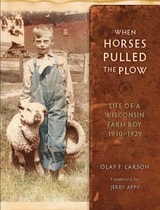
When Horses Pulled the Plow
Life of a Wisconsin Farm Boy, 1910–1929Olaf F. Larson
University of Wisconsin Press, 2011
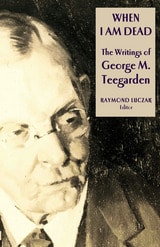
When I Am Dead
The Writings of George M. TeegardenRaymond Luczak
Gallaudet University Press, 2007
The Sixth Volume in the Gallaudet Classics in Deaf Studies Series
George M. Teegarden (1852-1936) taught at the Western Pennsylvania School for the Deaf for 48 years, established the printing department, and also served as the first editor of the school’s magazine. Despite these significant contributions, his greatest gift to deaf people was his skill as a writer and poet who was deaf, as readers will discover in When I Am Dead: The Writings of George M. Teegarden.
Editor Raymond Luczak selected Teegarden’s prose in When I Am Dead from several books, including Raindrop, and Stories, Old and New. Noting that these stories were never written for hearing readers, Luczak marvels at Teegarden’s ability to write English prose that the ASL-familiar reader would find incredibly easy to transliterate. By employing a rich blend of original stories and revisions of fables and myths, Teegarden taught his students the importance of improving their reading and writing skills to outfit them “for the battle of life.” He produced a body of work that Luczak characterizes as “a breath of fresh air: quick, painless, and usually told with a sense of wonder.”
Luczak’s choice of poems came from Teegarden’s self-published volume Vagrant Verses, a summation of his affection for Gallaudet College, the Deaf community, and all deaf people. The eponymous poem “When I Am Dead” articulates concisely the beliefs that directed Teegarden’s life of service:
“When I am dead, I hope to be
Remembered—this is true—
Not for my wit or vanities
But what I did for you.”
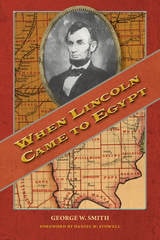
When Lincoln Came to Egypt
George W. Smith, with a Foreword by Daniel W. Stowell
Southern Illinois University Press, 2017

When Mexicans Could Play Ball
Basketball, Race, and Identity in San Antonio, 1928–1945By Ignacio M. García
University of Texas Press, 2014
Winner, Al Lowman Memorial Prize, Texas State Historical Association, 2014
In 1939, a team of short, scrappy kids from a vocational school established specifically for Mexican Americans became the high school basketball champions of San Antonio, Texas. Their win, and the ensuing riot it caused, took place against a backdrop of shifting and conflicted attitudes toward Mexican Americans and American nationalism in the WWII era. “Only when the Mexicans went from perennial runners-up to champs,” García writes, “did the emotions boil over.”
The first sports book to look at Mexican American basketball specifically, When Mexicans Could Play Ball is also a revealing study of racism and cultural identity formation in Texas. Using personal interviews, newspaper articles, and game statistics to create a compelling narrative, as well as drawing on his experience as a sports writer, García takes us into the world of San Antonio’s Sidney Lanier High School basketball team, the Voks, which became a two-time state championship team under head coach William Carson “Nemo” Herrera. An alumnus of the school himself, García investigates the school administrators’ project to Americanize the students, Herrera’s skillful coaching, and the team’s rise to victory despite discrimination and violence from other teams and the world outside of the school. Ultimately, García argues, through their participation and success in basketball at Lanier, the Voks players not only learned how to be American but also taught their white counterparts to question long-held assumptions about Mexican Americans.
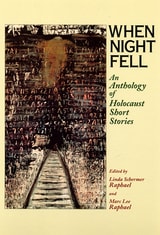
When Night Fell
An Anthology of Holocaust Short StoriesLinda Schermer Raphael and Marc Lee Raphael
Rutgers University Press, 1999
Both survivors of the Holocaust and those who were not there agree that it is impossible to tell what happened as the Nazi Final Solution was put into effect. No writing can adequately imagine the concentration camps, ghettos, and death camps. And that is precisely why writers must tell-and retell-what happened there.
In When Night Fell: An Anthology of Holocaust Short Stories, Linda Schermer Raphael and Marc Lee Raphael have collected twenty-six short stories that tell of the human toll of the Holocaust on those who survived its horrors, as well as later generations touched by its memory. The stories are framed by discussion of the current debate about who owns the Holocaust and who is entitled to speak about it.
Some of the stories included here are by internationally acclaimed authors. Others may be new to many readers. When Night Fell is a fitting memorial to this genocidal horror, putting eloquent voice to human endurance that is-almost-beyond words.

When Peace Is Not Enough
How the Israeli Peace Camp Thinks about Religion, Nationalism, and JusticeAtalia Omer
University of Chicago Press, 2013
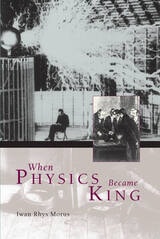
When Physics Became King
Iwan Rhys Morus
University of Chicago Press, 2005
When Physics Became King traces the emergence of this revolutionary science, demonstrating how a discipline that barely existed in 1800 came to be regarded a century later as the ultimate key to unlocking nature's secrets. A cultural history designed to provide a big-picture view, the book ably ties advances in the field to the efforts of physicists who worked to win social acceptance for their research.
Beginning his tale with the rise of physics from natural philosophy, Iwan Morus chronicles the emergence of mathematical physics in France and its later export to England and Germany. He then elucidates the links between physics and industrialism, the technology of statistical mechanics, and the establishment of astronomical laboratories and precision measurement tools. His tale ends on the eve of the First World War, when physics had firmly established itself in both science and society.
Scholars of both history and physics will enjoy this fascinating and studied look at the emergence of a major scientific discipline.
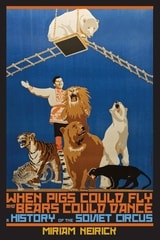
When Pigs Could Fly and Bears Could Dance
A History of the Soviet CircusMiriam Neirick
University of Wisconsin Press, 2012
For more than seven decades the circuses enjoyed tremendous popularity in the Soviet Union. How did the circus—an institution that dethroned figures of authority and refused any orderly narrative structure—become such a cultural mainstay in a state known for blunt and didactic messages? Miriam Neirick argues that the variety, flexibility, and indeterminacy of the modern circus accounted for its appeal not only to diverse viewers but also to the Soviet state. In a society where government-legitimating myths underwent periodic revision, the circus proved a supple medium of communication.
Between 1919 and 1991, it variously displayed the triumph of the Bolshevik revolution, the beauty of the new Soviet man and woman, the vulnerability of the enemy during World War II, the prosperity of the postwar Soviet household, and the Soviet mission of international peace—all while entertaining the public with the acrobats, elephants, and clowns. With its unique ability to meet and reconcile the demands of both state and society, the Soviet circus became the unlikely darling of Soviet culture and an entertainment whose usefulness and popularity stemmed from its ambiguity.
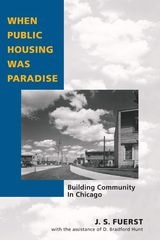
When Public Housing Was Paradise
BUILDING COMMUNITY IN CHICAGOJ. S. Fuerst, with the assistance of D. Bradford Hunt
University of Illinois Press, 2003
J. S. Fuerst has been involved with public housing in Chicago for more than half a century. He retired from Loyola University, where he was a professor of social welfare policy. He was the editor of Public Housing in Europe and America. D. Bradford Hunt is an assistant professor of social science at Roosevelt University. John Hope Franklin is James B. Duke Professor Emeritus of History at Duke University. He has served as president of the Organization of American Historians, the American Historical Association, and many more.
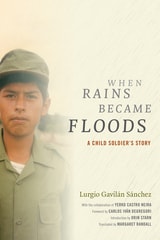
When Rains Became Floods
A Child Soldier's StoryLurgio Gavilán Sánchez
Duke University Press, 2015
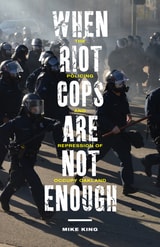
When Riot Cops Are Not Enough
The Policing and Repression of Occupy OaklandKing, Mike
Rutgers University Press, 2017
Drawn from King’s intensive field work, the book focuses on the physical, legal, political, and ideological dimensions of repression—in the streets, in courtrooms, in the media, in city hall, and within the movement itself—When Riot Cops Are Not Enough highlights the central role of political legitimacy, both for mass movements seeking to create social change, as well as for governmental forces seeking to control such movements. Although Occupy Oakland was different from other Occupy sites in many respects, King shows how the contradictions it illuminated within both social movement and police strategies provide deep insights into the nature of protest policing generally, and a clear map to understanding the full range of social control techniques used in North America in the twenty-first century.
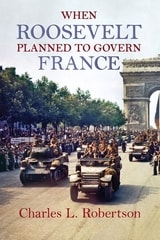
When Roosevelt Planned to Govern France
Charles L. Robertson
University of Massachusetts Press, 2011
This book tells the story of a plan put forth by President Franklin Roosevelt during World War II for an Allied military occupation of France in the aftermath of liberation, and of General Charles de Gaulle's efforts as self-appointed leader of the Free French Movement to thwart FDR's intentions. Charles L. Robertson frames the narrative as a mystery in which he plays the role of detective. He begins at a dinner party thirty years ago, where he first learned of the alleged plan from an elderly former aide to de Gaulle. Yet it wasn't until 2004, when he heard the same story repeated during the 60th commemoration of D-Day, that he set out to investigate whether it was true.
Many French are aware of this episode and believe, on the basis of later Gaullist officials' writings, that until the last moment a military occupation of their country was imminent. This view, across the years, has helped darken relations between France and the United States. Yet few if any Americans have ever heard of this plan, and in the event, no Allied military government of France was ever established.
How and why it never came to be, and why the French still believe it almost did, is the subject of this book. Robertson recounts how the president of the most powerful nation in the world was outmaneuvered in both his earlier plans for an occupation of France and his subsequent attempts to keep General de Gaulle from “seizing” power—in a France that ultimately, despite Roosevelt's intentions and expectations, regained its place among the victorious powers under de Gaulle's leadership.

When Russia Learned to Read
Literacy and Popular Literature, 1861-1917Jeffrey Brooks
Northwestern University Press, 2003
With a new introduction that underscores its relevance to a post-Soviet Russia, When Russia Learned to Read addresses the question of Russia's common heritage with the liberal democratic market societies of Western Europe and the United States. This prize-winning book also exposes the unsuspected complexities of a mass culture little known and less understood in the West. Jeffrey Brooks brings out the characteristically Russian aspect of the nation's popular writing as he ranges through chapbooks, detective stories, newspaper serials, and women's fiction, tracing the emergence of secular, rational, and cosmopolitan values along with newly minted notions of individual initiative and talent. He shows how crude popular tales and serials of the era find their echoes in the literary themes of Dostoevsky, Tolstoy, and other great Russian writers, as well as in the current renaissance of Russian detective stories and thrillers.
When Science and Christianity Meet
Edited by David C. Lindberg and Ronald L. Numbers
University of Chicago Press, 2003
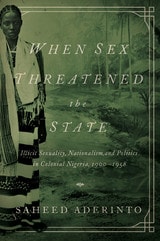
When Sex Threatened the State
Illicit Sexuality, Nationalism, and Politics in Colonial Nigeria, 1900-1958Saheed Aderinto
University of Illinois Press, 2015
As Saheed Aderinto shows, British colonizers saw prostitution as an African form of sexual primitivity and a problem to be solved as part of imperialism's "civilizing mission". He details the Nigerian response to imported sexuality laws and the contradictory ways both African and British reformers advocated for prohibition or regulation of prostitution. Tracing the tensions within diverse groups of colonizers and the colonized, he reveals how wrangling over prostitution camouflaged the negotiating of separate issues that threatened the social, political, and sexual ideologies of Africans and Europeans alike.
The first book-length project on sexuality in early twentieth century Nigeria, When Sex Threatened the State combines the study of a colonial demimonde with an urban history of Lagos and a look at government policy to reappraise the history of Nigerian public life.
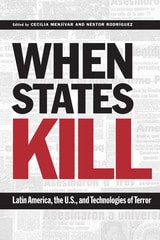
When States Kill
Latin America, the U.S., and Technologies of TerrorEdited by Cecilia Menjívar and Néstor Rodríguez
University of Texas Press, 2005
Since the early twentieth century, technological transfers from the United States to Latin American countries have involved technologies of violence for social control. As the chapters in this book illustrate, these technological transfers have taken various forms, including the training of Latin American military personnel in surveillance and torture and the provision of political and logistic support for campaigns of state terror. The human cost for Latin America has been enormous—thousands of Latin Americans have been murdered, disappeared, or tortured, and whole communities have been terrorized into silence.
Organized by region, the essays in this book address the topic of state-sponsored terrorism in a variety of ways. Most take the perspective that state-directed political violence is a modern development of a regional political structure in which U.S. political interests weigh heavily. Others acknowledge that Latin American states enthusiastically received U.S. support for their campaigns of terror. A few see local culture and history as key factors in the implementation of state campaigns of political violence. Together, all the essays exemplify how technologies of terror have been transferred among various Latin American countries, with particular attention to the role that the United States, as a "strong" state, has played in such transfers.
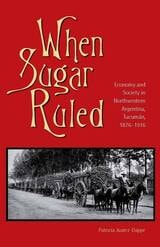
When Sugar Ruled
Economy and Society in Northwestern Argentina, Tucumán, 1876–1916Patricia Juarez-Dappe
Ohio University Press, 2010
Two tropical commodities—coffee and sugar—dominated Latin American export economies in the nineteenth and early twentieth centuries. When Sugar Ruled: Economy and Society in Northwestern Argentina, Tucumán, 1876–1916 presents a distinctive case that does not quite fit into the pattern of many Latin American sugar economies.
During the last quarter of the nineteenth century, the province of Tucumán emerged as Argentina’s main sugar producer, its industry catering almost exclusively to the needs of the national market and financed mostly by domestic capital. The expansion of the sugar industry provoked profound changes in Tucumán’s economy as sugar specialization replaced the province’s diversified productive structure. Since ingenios relied on outside growers for the supply of a large share of the sugarcane, sugar production did not produce massive land dispossession and resulted in the emergence of a heterogeneous planter group. The arrival of thousands of workers from neighboring provinces during the harvest season transformed rural society dramatically. As the most dynamic sector in Tucumán’s economy, revenues from sugar enabled the provincial government to participate in the modernizing movement sweeping turn-of-the-century Argentina.
Patricia Juarez-Dappe uncovers the unique features that characterized sugar production in Tucumán as well as the changes experienced by the province’s economy and society between 1876 and 1916, the period of most dramatic sugar expansion. When Sugar Ruled is an important addition to the literature on sugar economies in Latin America and Argentina.
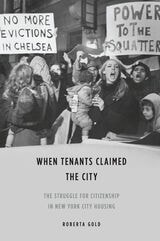
When Tenants Claimed the City
The Struggle for Citizenship in New York City HousingRoberta Gold
University of Illinois Press, 2014
In postwar America, not everyone wanted to move out of the city and into the suburbs. For decades before World War II, New York's tenants had organized to secure renters' rights. After the war, tenant activists raised the stakes by challenging the newly-dominant ideal of homeownership in racially segregated suburbs. They insisted that renters as well as owners had rights to stable, well-maintained homes, and they proposed that racially diverse urban communities held a right to remain in place--a right that outweighed owners' rights to raise rents, redevelop properties, or exclude tenants of color. Further, the activists asserted that women could participate fully in the political arenas where these matters were decided.
Grounded in archival research and oral history, When Tenants Claimed the City: The Struggle for Citizenship in New York City Housing shows that New York City's tenant movement made a significant claim to citizenship rights that came to accrue, both ideologically and legally, to homeownership in postwar America. Roberta Gold emphasizes the centrality of housing to the racial and class reorganization of the city after the war; the prominent role of women within the tenant movement; and their fostering of a concept of "community rights" grounded in their experience of living together in heterogeneous urban neighborhoods.
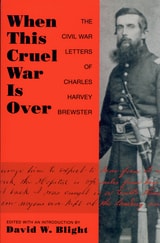
When This Cruel War Is Over
The Civil War Letters of Charles Harvey BrewsterDavid W. Blight
University of Massachusetts Press, 1992
“I am scared most to death every battle we have, but I don't think you need be afraid of my sneaking away unhurt.” Thus wrote Adjutant Charles Harvey Brewster of the 10th Massachusetts to his sister Martha in 1864, in one of over 200 letters he would pen during his four years of service.
Born and raised in Northampton, Massachusetts, Brewster was a twenty-seven-year-old store clerk when he enlisted in Company C of the 10th Massachusetts Volunteers in April 1861. During the next three and a half years he fought in many of the major battles of the Virginia campaigns—Fair Oaks, the Seven Days, Chancellorsville, Gettysburg, the Wilderness, the “Bloody Angle” at Spotsylvania—rising through the ranks to become second lieutenant and later adjutant of his regiment. His letters, most of which were written to his mother and two sisters, record not only the horrors he witnessed on the battlefield, but also his inner struggle with his own values, convictions, and sense of manhood.
In a thoughtful and illuminating introductory essay, David W. Blight explores the evolution of Brewster's understanding of the terrible conflict in which he was engaged. Blight shows how Brewster's attitudes toward race and slavery gradually changed, in part as a result of his contact with escaped slaves and his experience recruiting black troops. He also examines the shift in Brewster's conception of courage, as the realities of war collided with the romantic ideals he had previously embraced. This recently discovered and exceptionally literate collection of 137 letters chronicles the experiences of an ordinary Union soldier caught up in extraordinary events. At times naive and sentimental, at times mature and realistic, Brewster's correspondence not only provides remarkable insight into the meaning of the Civil War for the average Yankee, but also testifies to the persistent power of war to attract and repel the human imagination.
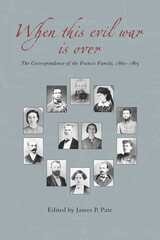
When This Evil War is Over
The Correspondence of the Francis FamilyJames P. Pate
University of Alabama Press, 2006
Six of the seven Francis brothers served in the Confederate army, as did their uncle, four servants, and other kinsmen, and all twelve members of the immediate family of Dr. James Carrington Francis and Amy Ingram Francis—as well as several members of their extended family—are represented in this volume. While the letters refer to the war and the brothers’ military service, they also shed light on this family’s struggle to survive the profound cultural, economic, and political upheaval that ensued.
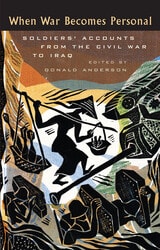
When War Becomes Personal
Soldiers' Accounts from the Civil War to IraqDonald Anderson
University of Iowa Press, 2008
The thirteen essays in When War Becomes Personal tell the enduring truths of battle, stripping away much of the romance, myth, and fantasy.
Soldiers more than anyone know what they are capable of destroying; when they write about war, they are trying to preserve the world.

When We Imagine Grace
Black Men and Subject MakingSimone C. Drake
University of Chicago Press, 2016
In When We Imagine Grace, Drake borrows from Toni Morrison’s Beloved to bring imagination to the center of black masculinity studies—allowing individual black men to exempt themselves and their fates from a hateful, ignorant society and open themselves up as active agents at the center of their own stories. Against a backdrop of crisis, Drake brings forth the narratives of black men who have imagined grace for themselves. We meet African American cowboy, Nat Love, and Drake’s own grandfather, who served in the first black military unit to fight in World War II. Synthesizing black feminist and black masculinity studies, Drake analyzes black fathers and daughters, the valorization of black criminals, the black entrepreneurial pursuits of Marcus Garvey, Berry Gordy, and Jay-Z, and the denigration and celebration of gay black men: Cornelius Eady, Antoine Dodson, and Kehinde Wiley. With a powerful command of its subjects and a passionate dedication to hope, When We Imagine Grace gives us a new way of seeing and knowing black masculinity—sophisticated in concept and bracingly vivid in telling.

When We Say “Hiroshima”
Selected PoemsKurihara Sadako; Translated with an Introduction by Richard H. Minear
University of Michigan Press, 1999
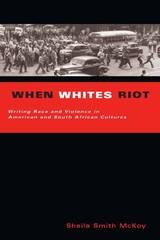
When Whites Riot
Writing Race and Violence in American and South African CulturesSheila Smith McKoy
University of Wisconsin Press, 2001
In a bold work that cuts across racial, ethnic, cultural, and national boundaries, Sheila Smith McKoy reveals how race colors the idea of violence in the United States and in South Africa—two countries inevitably and inextricably linked by the central role of skin color in personal and national identity.
Although race riots are usually seen as black events in both the United States and South Africa, they have played a significant role in shaping the concept of whiteness and white power in both nations. This emerges clearly from Smith McKoy's examination of four riots that demonstrate the relationship between the two nations and the apartheid practices that have historically defined them: North Carolina's Wilmington Race Riot of 1898; the Soweto Uprising of 1976; the Los Angeles Rebellion in 1992; and the pre-election riot in Mmabatho, Bhoputhatswana in 1994. Pursuing these events through narratives, media reports, and film, Smith McKoy shows how white racial violence has been disguised by race riots in the political and power structures of both the United States and South Africa.
The first transnational study to probe the abiding inclination to "blacken" riots, When Whites Riot unravels the connection between racial violence—both the white and the "raced"—in the United States and South Africa, as well as the social dynamics that this connection sustains.

When Women Rule the Court
Gender, Race, and Japanese American BasketballWillms, Nicole
Rutgers University Press, 2017
For nearly one hundred years, basketball has been an important part of Japanese American life. Women’s basketball holds a special place in the contemporary scene of highly organized and expansive Japanese American leagues in California, in part because these leagues have produced numerous talented female players. Using data from interviews and observations, Nicole Willms explores the interplay of social forces and community dynamics that have shaped this unique context of female athletic empowerment. As Japanese American women have excelled in mainstream basketball, they have emerged as local stars who have passed on the torch by becoming role models and building networks for others.
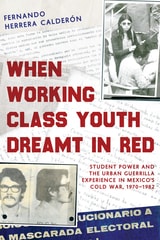
When Working Class Youth Dreamt in Red
Student Power and the Urban Guerrilla Experience in Mexico's Cold War, 1970–1982Fernando Herrera Calderón
University of Arizona Press, 2027
The 1970s in Mexico were turbulent from the start. Insurgent voices converged across cities and rural peripheries. Militant labor, urban popular sectors, and Indigenous collectives erupted in expressions of broad social exhaustion. Rebellion, rooted in the layered betrayals of the postrevolutionary state and the fractures of a deteriorating modernity under the Institutional Revolutionary Party (PRI), fermented and boiled over.
At the core of this moment, Mexican youth found their way to political-military organizations, coalescing around shared ecologies of dissent and embedded in broader currents of revolutionary struggle. When Working Class Youth Dreamt in Red reconstructs these insurgent youth cultures and guerrilla imaginaries, reorienting the historiographical lens to center radical working class youth—especially urban students—as protagonists in a wider saga of revolutionary experimentation and political rupture.
At its conceptual core, this book offers a bold new interpretation of a turbulent moment in Mexican history. It shows how class shaped the epistemic horizons through which proletarian youth understood themselves and makes visible their role as central actors at the vanguard of a revolutionary time.
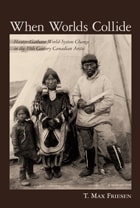
When Worlds Collide
Hunter-Gatherer World-System Change in the 19th Century Canadian ArcticT. Max Friesen
University of Arizona Press, 2013
Max Friesen has adapted and expanded world-system theory in order to develop a model that explains how hunter-gatherer interaction networks, or world-systems, are structured—and why they change. He has utilized this model to better understand the development of Inuvialuit society in the western Canadian Arctic over a 500-year span, from the pre-contact period to the early twentieth century.
As Friesen combines local archaeological data with more extensive ethnographic and archaeological evidence from the surrounding region, a picture emerges of a dynamic Inuvialuit world-system characterized by bounded territories, trade, warfare, and other forms of interaction. This world-system gradually intensified as the impacts of Euroamerican colonial activities increased. This intensification, Friesen suggests, was based on pre-existing Inuvialuit social and economic structures rather than on patterns imposed from outside. Ultimately, this intense interacting network collapsed near the end of the nineteenth century. When Worlds Collide offers a new way to comprehend small-scale world-systems from the point of view of indigenous people. Its approach will prove valuable for understanding hunter-gatherer societies around the globe.
When Writing Met Art
From Symbol to StoryBy Denise Schmandt-Besserat
University of Texas Press, 2007
Denise Schmandt-Besserat opened a major new chapter in the history of literacy when she demonstrated that the cuneiform script invented in the ancient Near East in the late fourth millennium BC—the world's oldest known system of writing—derived from an archaic counting device. Her discovery, which she published in Before Writing: From Counting to Cuneiform and How Writing Came About, was widely reported in professional journals and the popular press. In 1999, American Scientist chose How Writing Came About as one of the "100 or so Books that shaped a Century of Science."
In When Writing Met Art, Schmandt-Besserat expands her history of writing into the visual realm of communication. Using examples of ancient Near Eastern writing and masterpieces of art, she shows that between 3500 and 3000 BC the conventions of writing—everything from its linear organization to its semantic use of the form, size, order, and placement of signs—spread to the making of art, resulting in artworks that presented complex visual narratives in place of the repetitive motifs found on preliterate art objects. Schmandt-Besserat then demonstrates art's reciprocal impact on the development of writing. She shows how, beginning in 2700-2600 BC, the inclusion of inscriptions on funerary and votive art objects emancipated writing from its original accounting function. To fulfill its new role, writing evolved to replicate speech; this in turn made it possible to compile, organize, and synthesize unlimited amounts of information; and to preserve and disseminate information across time and space.
Schmandt-Besserat's pioneering investigation of the interface between writing and art documents a key turning point in human history, when two of our most fundamental information media reciprocally multiplied their capacities to communicate. When writing met art, literate civilization was born.
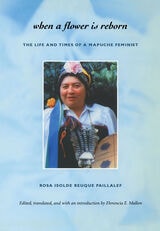
When a Flower Is Reborn
The Life and Times of a Mapuche FeministRosa Isolde Reuque Paillalef, Edited, translated, and with an introduction by Florencia E. Mallon
Duke University Press, 2002
A leading activist during the Pinochet dictatorship, Reuque—a woman, a Catholic, and a Christian Democrat—often felt like an outsider within the male-dominated, leftist Mapuche movement. This sense of herself as both participant and observer allows for Reuque’s trenchant, yet empathetic, critique of the Mapuche ethnic movement and of the policies regarding indigenous people implemented by Chile’s post-authoritarian government. After the 1990 transition to democratic rule, Reuque collaborated with the government in the creation of the Indigenous Development Corporation (CONADI) and the passage of the Indigenous Law of 1993. At the same time, her deepening critiques of sexism in Chilean society in general, and the Mapuche movement in particular, inspired her to found the first Mapuche feminist organization and participate in the 1996 International Women’s Conference in Beijing. Critical of the democratic government’s inability to effectively address indigenous demands, Reuque reflects on the history of Mapuche activism, including its disarray in the early 1990s and resurgence toward the end of the decade, and relates her hopes for the future.
An important reinvention of the testimonial genre for Latin America’s post-authoritarian, post-revolutionary era, When a Flower Is Reborn will appeal to those interested in Latin America, race and ethnicity, indigenous people’s movements, women and gender, and oral history and ethnography.
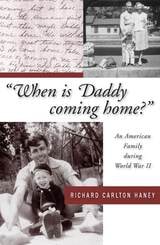
When is Daddy Coming Home?
An American Family during World War IIRichard Carlton Haney
Wisconsin Historical Society Press, 2024
World War II was coming to a close in Europe and Richard Haney was only four years old when the telegram arrived at his family's home in Janesville, Wisconsin. That moment, when Haney learned of his father's death in the final months of fighting, changed his and his mother's lives forever.
In this powerful book, Haney explores the impact of war on an American family. He skillfully weaves together those memories with his parents' wartime letters and his mother's recollections to create a unique blend of history and memoir. Through his father's letters he reveals the war's effect on a man who fought in the Battle of the Bulge with the 17th Airborne but wanted nothing more than to return home. Haney illuminates life on the home front in small-town America as well, describing how profoundly the war changed such communities.
With When Is Daddy Coming Home?, Richard Haney makes an exceptional contribution to the literature on the Greatest Generation—one that is both devastatingly personal and representative of what families all over America endured during that testing time.
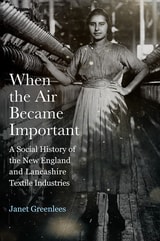
When the Air Became Important
A Social History of the New England and Lancashire Textile IndustriesJanet Greenlees
Rutgers University Press, 2019
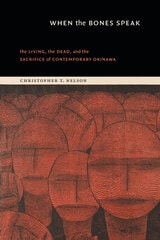
When the Bones Speak
The Living, the Dead, and the Sacrifice of Contemporary OkinawaChristopher T. Nelson
Duke University Press, 2025
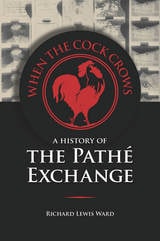
When the Cock Crows
A History of the Pathé ExchangeRichard Lewis Ward
Southern Illinois University Press, 2016
Ward traces the company’s turbulent evolution from its roots as an American distributor for Pathé Frères, its French parent studio, through its many subsequent changes in ownership, to its final years under the controversial leadership of Joseph P. Kennedy and the eventual merger of the company’s production department with RKO. Included are the stories of the unlikely survival of Pathé’s nonproduction assets, such as Pathé Industries, Inc., Pathé-America Distributing Co., Inc., and Pathé Communications Corporation, which continued to operate as part of the industry long after the Exchange had ceased to exist. Ward also provides a fascinating glimpse into the silent movie era and the business and creative decisions that led the Exchange to fail.
Film historians have largely ignored the Pathé Exchange, despite its having produced some of the most famous early serials (including the series that began with The Perils of Pauline) and distributed the first films of comedy legends Harold Lloyd, Harry Langdon, Laurel and Hardy, and Our Gang. When the Cock Crows reveals the promise and peril of early Hollywood and establishes the company’s vital place in film history, creating a more vivid picture of this era.
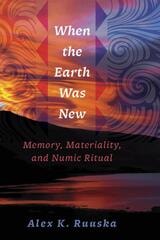
When the Earth Was New
Memory, Materiality, and Numic RitualAlex K. Ruuska
University of Utah Press, 2025
In When the Earth Was New, Alex K. Ruuska explores riveting multigenerational memories of Numic-speaking communities that extend back, potentially, to the late Pleistocene. These diverse oral traditions describe geological, climatic, and ecological events that occurred over thousands of years and were passed down across many generations. Through the examination of place-based memories and the architecture of Numic knowledge, Ruuska demonstrates convergences of oral traditions, ethnography, ethnohistory, archaeology, and geology.
When the Earth Was New critically compares and considers multiple forms of knowledge that contribute to overlapping as well as disparate understandings of both recent and distant pasts in the regions of California, the Great Basin, and the Colorado Plateau. It works at balancing key themes in these regions’ histories within a more holistic framework, exploring ancient and modern strands of knowledge with the assistance of twenty-four Tribes and Consolidated Organizations.

When the Girls Came Out to Play
The Birth Of American SportswearPatricia C. Warner
University of Massachusetts Press, 2006
A study of the evolution of American women's clothing, When the Girls Came Out to Play traces the history of modern sportswear as a universal style that broke down traditional gender roles. Patricia Warner shows how this profound cultural shift, which did not reach fruition until World War II, originated during the previous century with the gradual expansion of socially acceptable physical activity for women. Behind this development was a growing interest in sports and exercise that was further nurtured by the establishment of schools of higher education for women. The participation of women in athletic pursuits previously reserved for men began with the relatively genteel sports of croquet and tennis. With the founding of women's colleges, these “ladylike” games were supplemented by more vigorous activities and competitive team sports, from gymnastics to swimming to basketball. At first, Warner points out, women literally had nothing to wear for these activities. Whereas such fashionable attire as corsets, petticoats, hats, and gloves could be worn while playing outdoor lawn games, more strenuous athletic endeavors required less physically restrictive clothing. Even so, change came only gradually, as women's colleges, shielded from public scrutiny and prying male eyes, permitted the adoption of looser, more comfortable apparel for physical education. Many of these new outfits featured trousers, garments considered taboo for women, though they often remained hidden beneath voluminous skirts.
Over time, however, the practicality and versatility of such clothing led to social acceptance, laying the foundation for the emergence of the now ubiquitous yet distinctly American style known as sportswear. Although we take it for granted, Warner observes, this is the first time in the history of the world that such universality has existed in clothing, and it has lasted now for well over half a century—in itself a marvel, considering the speed of fashion change in an era of instant messages and images.
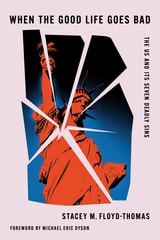
When the Good Life Goes Bad
The US and Its Seven Deadly SinsStacey M. Floyd-Thomas Foreword by Michael Eric Dyson
University of Illinois Press, 2026
Stacey M. Floyd-Thomas examines how the Seven Deadly Sins have shaped the moral strivings and sociopolitical condition of American society and culture in the twenty-first century. Drawing on a multidimensional approach, Floyd-Thomas uses race, gender, class, and other lenses to break down the moral crises that define the American Dream. Her critique exposes the harm done by individual and collective practices of sexual objectification, capitalist materialism, wealth inequality, and technological hubris before pivoting to the rise of right-wing populism, white Christian nationalism, and the politics of cruelty. But Floyd-Thomas also proposes an ethic that emphasizes truth-telling, community engagement, and values rooted in humility, justice, and mercy—a new path for the US to overcome systemic oppression and create a more just society.
Evocative and ambitious, When the Good Life Goes Bad takes readers on a wide-ranging journey through US life and culture to explain what corrupted the American dream.
When the Lamp is Shattered
Desire and Narrative in CatullusMichaela Janan
Southern Illinois University Press, 1993
The poetry of the Late Roman Republican poet Gaius Valerius Catullus, a rich document of the human heart, is the earliest-known reasonably complete body of erotic verse in the West.
Though approximately 116 poems survive, uncertainties about the condition of the fragmented manuscript and the narrative order of the poems make the Catullan text unusually problematic for the modern critic. Indeed, the poems can be arranged in a number of ways, making a multitude of different plots possible and frustrating the reader’s desire for narrative closure.
Micaela Janan contends that since unsatisfied desire structures both the experience of reading Catullus and its subject matter, critical interpretation of the text demands a "poetics of desire." Furthermore, postmodern critical theory, narratology, and psychoanalysis suggest a flexible concept of the "subject" as a site through which a multitude of social, cultural, and unconscious forces move. Human consciousness, Janan contends, is inherently incomplete and in a continuous process of transformation. She therefore proposes an original and provocative feminist reading of Catullus, a reading informed by theories of consciousness and desire as ancient as Plato and as contemporary as Freud and Lacan.
The Late Roman Republic in which Catullus lived, Janan reminds us, was a time of profound social upheaval when political and cultural institutions that had persisted for centuries were rapidly breaking down—a time not unlike our own. Catullus’ poetry provides an unusually honest look at his culture and its contradictory representations of class, gender, and power. By bringing to the study of this major work of classical literature the themes of consciousness and desire dealt with in postmodern scholarship, Janan’s book invites a new conversation among literary disciplines.
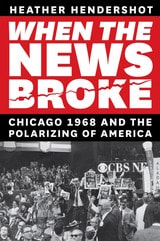
When the News Broke
Chicago 1968 and the Polarizing of AmericaHeather Hendershot
University of Chicago Press, 2022
“The whole world is watching!” cried protestors at the 1968 Democratic convention as Chicago police beat them in the streets. When some of that violence was then aired on network television, another kind of hell broke loose. Some viewers were stunned and outraged; others thought the protestors deserved what they got. No one—least of all Chicago mayor Richard J. Daley—was happy with how the networks handled it.
In When the News Broke, Heather Hendershot revisits TV coverage of those four chaotic days in 1968—not only the violence in the streets but also the tumultuous convention itself, where Black citizens and others forcefully challenged southern delegations that had excluded them, anti-Vietnam delegates sought to change the party’s policy on the war, and journalists and delegates alike were bullied by both Daley’s security forces and party leaders. Ultimately, Hendershot reveals the convention as a pivotal moment in American political history, when a distorted notion of “liberal media bias” became mainstreamed and nationalized.
At the same time, she celebrates the values of the network news professionals who strived for fairness and accuracy. Despite their efforts, however, Chicago proved to be a turning point in the public’s trust in national news sources. Since those critical days, the political Right in the United States has amplified distrust of TV news, to the point where even the truest and most clearly documented stories can be deemed “fake.” As Hendershot demonstrates, it doesn’t matter whether the “whole world is watching” if people don’t believe what they see.
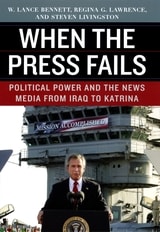
When the Press Fails
Political Power and the News Media from Iraq to KatrinaW. Lance Bennett, Regina G. Lawrence, and Steven Livingston
University of Chicago Press, 2007
“The hand-in-glove relationship of the U.S. media with the White House is mercilessly exposed in this determined and disheartening study that repeatedly reveals how the press has toed the official line at those moments when its independence was most needed.”—George Pendle, Financial Times
“Bennett, Lawrence, and Livingston are indisputably right about the news media’s dereliction in covering the administration’s campaign to take the nation to war against Iraq.”—Don Wycliff, Chicago Tribune
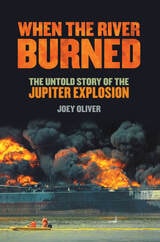
When the River Burned
The Untold Story of the Jupiter ExplosionJoey Oliver
Michigan State University Press, 2026
On September 16, 1990, the tanker ship Jupiter exploded while unloading gasoline at a Bay City pier on the Saginaw River. The blast killed one worker, injured eleven others, and triggered what the U.S. Coast Guard later described as an unprecedented crisis on the Great Lakes. For weeks, the disaster commanded national attention as officials worked to contain the damage and investigate the cause. Then, like so many industrial accidents, the story faded from public memory.
When the River Burned tells the story of this overlooked chapter in Great Lakes maritime history. Drawing on newspaper archives, Coast Guard investigations, and eyewitness accounts, Joey Oliver reconstructs how a series of small oversights—in equipment, procedure, and human judgment—aligned to produce catastrophe.
The book places the Jupiter explosion within a broader history of the Saginaw River, tracing its evolution into a vital artery of Michigan industry. Oliver examines the fragile interdependence of ships, piers, and river traffic, revealing how disasters emerge not from single causes but from the breakdown of complex systems. When the River Burned is not only the account of a deadly tanker explosion; it is a reflection on what caused it, on the safety changes that followed, and on changes that never came.
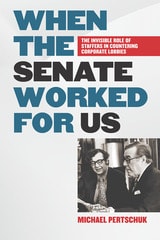
When the Senate Worked for Us
The Invisible Role of Staffers in Countering Corporate LobbiesMichael Pertschuk
Vanderbilt University Press, 2017
What has remained untold is the major behind-the-scenes contribution of entrepreneurial Congressional staff, who planted the seeds of public interest bills in their bosses' minds and maneuvered to counteract the influence of lobbyists to pass laws in consumer protection, public health, and other policy arenas crying out for effective government regulation. They infuriated Nixon's advisor, John Ehrlichman, who called them "bumblebees," a name they wore as a badge of honor.
For his insider account, Pertschuk draws on many interviews, as well as his fifteen years serving on the staff of the Senate Commerce Committee that Senator Warren Magnuson chaired and as the committee's Democratic Staff Director. That committee became, in Ralph Nader's words, "the Grand Central Station for consumer protection advocates."
When the Stakes Are High
Deterrence and Conflict among Major PowersVesna Danilovic
University of Michigan Press, 2002

When the State Fails
Studies on Intervention in the Sierra Leone Civil WarTunde Zack-Williams
Pluto Press, 2012
Compared with Iraq, Afghanistan and Kosovo, the recent western intervention in Sierra Leone has been largely forgotten. When the State Fails rectifies this, providing a comprehensive and critical analysis of the intervention.
The civil war in Sierra Leone began in 1991 and was declared officially over in 2002 after UK, UN and regional African military intervention. Some claimed it as a case of successful humanitarian intervention. The authors in this collection provide an informed analysis of the impact of the intervention on democracy, development and society in Sierra Leone. The authors take a particularly critical view of the imposition of neoliberalism after the conflict.
As NATO intervention in Libya shows the continued use of external force in internal conflicts, When the State Fails is a timely book for all students and scholars interested in Africa and the question of ‘humanitarian intervention’.
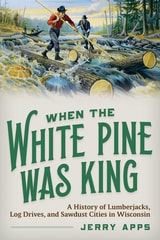
When the White Pine Was King
A History of Lumberjacks, Log Drives, and Sawdust Cities in WisconsinJerry Apps
Wisconsin Historical Society Press, 2020
For more than half a century, logging, lumber production, and affiliated enterprises in Wisconsin’s Northwoods provided jobs for tens of thousands of Wisconsinites and wealth for many individuals. The industry cut through the lives of nearly every Wisconsin citizen, from an immigrant lumberjack or camp cook in the Chippewa Valley to a Suamico sawmill operator, an Oshkosh factory worker to a Milwaukee banker.
When the White Pine Was King tells the stories of the heyday of logging: of lumberjacks and camp cooks, of river drives and deadly log jams, of sawmills and lumber towns and the echo of the ax ringing through the Northwoods as yet another white pine crashed to the ground. He explores the aftermath of the logging era, including efforts to farm the cutover (most of them doomed to fail), successful reforestation work, and the legacy of the lumber and wood products industries, which continue to fuel the state’s economy.
Enhanced with dozens of historic photos, When the White Pine Was King transports readers to the lumber boom era and reveals how the lessons learned in the vast northern forestlands continue to shape the region today.
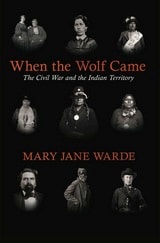
When the Wolf Came
The Civil War and the Indian TerritoryMary Jane Warde
University of Arkansas Press, 2013
Winner of the 2014 Pate Award from the Fort Worth Civil War Round Table.
When the peoples of the Indian Territory found themselves in the midst of the American Civil War, squeezed between Union Kansas and Confederate Texas and Arkansas, they had no way to escape a conflict not of their choosing--and no alternative but to suffer its consequences. When the Wolf Came explores how the war in the Indian Territory involved almost every resident, killed many civilians as well as soldiers, left the country stripped and devastated, and cost Indian nations millions of acres of land. Using a solid foundation of both published and unpublished sources, including the records of Cherokee, Choctaw, and Creek nations, Mary Jane Warde details how the coming of the war set off a wave of migration into neighboring Kansas, the Red River Valley, and Texas. She describes how Indian Territory troops in Unionist regiments or as Confederate allies battled enemies--some from their own nations--in the territory and in neighboring Kansas, Missouri, and Arkansas. And she shows how post-war land cessions forced by the federal government on Indian nations formerly allied with the Confederacy allowed the removal of still more tribes to the Indian Territory, leaving millions of acres open for homesteads, railroads, and development in at least ten states. Enhanced by maps and photographs from the Oklahoma Historical Society's photographic archives, When the Wolf Came will be welcomed by both general readers and scholars interested in the signal public events that marked that tumultuous era and the consequences for the territory's tens of thousands of native peoples.
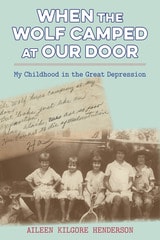
When the Wolf Camped at Our Door
My Childhood in the Great DepressionAileen Kilgore Henderson
University of Alabama Press, 2022
Recounts the hardships and joys the Kilgore family and their neighbors experienced in a close-knit southern rural community during the Great Depression
As the Great Depression tightened its grip on the world, six members of the Kilgore family were living in a cramped farmhouse in Brookwood, Alabama. Crops didn’t grow well, food was scarce, shoes were in short supply, and the few clothes they had were all hand-me-downs. The Kilgores struggled to make ends meet, cobbling together odd jobs and working the land by hand.
Despite all of this, young Aileen thought life was full of hope. She longed to hold on to it and scribbled down daily events on whatever odds and ends of paper she could find. In her new memoir, When the Wolf Camped at Our Door, Aileen Kilgore Henderson creates a vivid portrait of what life was like for so many living in the rural South during the Depression. The book begins when Aileen is ten years old and follows her into her teenage years over the course of twenty-seven episodic chapters. Drawing on her girlhood diaries and told through the charismatic voice of her younger self, Henderson’s nuanced storytelling sheds light on the common struggle for survival during a time when people were at their most vulnerable.
Against the backdrop of a world where hard work and harsh conditions like hunger, privation, sickness, and early death were everyday realities, Henderson’s stories are nevertheless tinged with young Aileen’s lively sense of humor and optimistic faith in people and in the promise of life despite trying circumstances. We follow her rambles in the woods, her visits with friends, a trip to a fortune teller, and a search for the Howton Horror, a mysterious monster rumored to live deep in the Alabama backwoods.
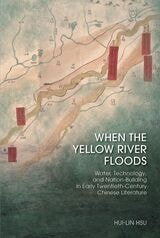
When the Yellow River Floods
Water, Technology, and Nation-Building in Early Twentieth-Century Chinese LiteratureHui-Lin Hsu
Hong Kong University Press, 2024
When the Yellow River Floods explores the relationship between environmental degradation, hydraulic engineering, and nation-building in the context of Liu E’s The Travels of Lao Can. This book provides a unique perspective on modern Chinese literary history that goes beyond conventional narratives that focus solely on political and cultural factors. The main areas covered include the role of water management in literary nation-building and the connections between the novel’s various themes, such as river engineering, medical and political discourses, national sentiment, and landscape description.
By offering a comprehensive analysis of The Travels of Lao Can, this book broadens the understanding of nation-building in early twentieth-century China, highlighting the impact of environmental crises and hydraulics on the formation of national literature and consciousness. When the Yellow River Floods provides a new perspective on the environmental roots of modern Chinese literature, making it an essential read for those seeking to understand the complex interplay between literature, the environment, and national identity in China. This book will be of interest to scholars and students of Chinese literature, history, and environmental studies.