Results by title
1048 books match the query 'African American & Black' and 3 start with y
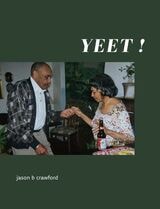
YEET!
jason b. crawford
Omnidawn, 2025
Afrofuturist poetry that envisions Black people finding new worlds of freedom.
Following the traditions of Eve L. Ewing, Rio Cortez, and Douglas Kearney, jason b. crawford’s YEET! envisions the Black community lifted off the earth and set free towards the stars. These poems ask what a free Black people would look like and how we might achieve such a thing. This collection presents a new take on Afrofuturism and utopianism. Rather than looking to a future of technological change, it steps years ahead to show how people are happier once they are no longer owned. These poems speak to racism, gun violence, colonization, global warming, flight, joy, friendship, and noise. This is a book about creating new worlds without the systems of supremacy that held down the old one.
YEET! is the winner of the 2023 Omnidawn 1st/2nd Poetry Book Contest, chosen by Sawako Nakasayu.
[more]

You Don’t Have to Go to Mars for Love
Yona Harvey
Four Way Books, 2020
The poems of award-winning poet Yona Harvey’s much anticipated You Don’t Have to Go to Mars for Love follow an unnamed protagonist on her multidimensional, Afro-futuristic journey. Her story stretches the boundaries normally constraining a black, female body like hers. Half-superhero, half-secret-identity, she encounters side-slipping, speculative realities testing her in poems that appear like the panels of a comic book. Music directs readers through large and small emotional arcs, constantly retroubled by lyric experimentation. Harvey layers her poems with a chorus of women’s voices. Her artful use of refrain emphasizes the protagonist’s meaning making and doubling back: “Who am I to say? The eye is often mistaken. Or is it the mind? Always eager to interpret.” Our hero is captured, escapes, scuba dives, goes interstellar, and she emerges on the other end of her journey renewed, invoking the gods: “taunt the sharks. & when the glaciers get to melting, / all God’s River’s we shall haunt.”
[more]
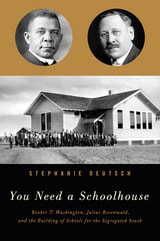
You Need a Schoolhouse
Booker T. Washington, Julius Rosenwald, and the Building of Schools for the Segregated SouthStephanie Deutsch
Northwestern University Press, 2011
Booker T. Washington, the founder of Tuskegee Institute, and Julius Rosenwald, the president of Sears, Roebuck, and Company, first met in 1911 at a Chicago luncheon. By charting the lives of these two men both before and after the meeting, Stephanie Deutsch offers a fascinating glimpse into the partnership that would bring thousands of modern schoolhouses to African American communities in the rural South in the era leading up to the civil rights movement. Trim and vital at just shy of fifty, Rosenwald was the extraordinarily rich chairman of one of the nation’s largest businesses, interested in using his fortune to do good not just in his own Jewish community but also to promote the well-being of African Americans.
Washington, though widely admired, had weathered severe crises both public and private in his fifty-six years. He had dined with President Theodore Roosevelt and drunk tea with Queen Victoria, but he had also been assaulted on a street in New York City. He had suffered personal heartbreak, years of overwork, and the discouraging knowledge that, despite his optimism and considerable success, conditions for African Americans were not improving as he had assumed they would. From within his own community, Washington faced the bitter charge of accommodationism that haunts his legacy to this day. Despite their differences, the two men would work together well and their collaboration would lead to the building of five thousand schoolhouses. By the time segregation ended, the “Rosenwald Schools” that sprang from this unlikely partnership were educating one third of the South’s African American children. These schoolhouses represent a significant step in the ongoing endeavor to bring high quality education to every child in the United States—an ideal that remains to be realized even today.
Washington, though widely admired, had weathered severe crises both public and private in his fifty-six years. He had dined with President Theodore Roosevelt and drunk tea with Queen Victoria, but he had also been assaulted on a street in New York City. He had suffered personal heartbreak, years of overwork, and the discouraging knowledge that, despite his optimism and considerable success, conditions for African Americans were not improving as he had assumed they would. From within his own community, Washington faced the bitter charge of accommodationism that haunts his legacy to this day. Despite their differences, the two men would work together well and their collaboration would lead to the building of five thousand schoolhouses. By the time segregation ended, the “Rosenwald Schools” that sprang from this unlikely partnership were educating one third of the South’s African American children. These schoolhouses represent a significant step in the ongoing endeavor to bring high quality education to every child in the United States—an ideal that remains to be realized even today.
[more]