Results by title
5159 books match the query 'Biography' and 18 start with y
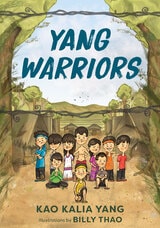
Yang Warriors
Kao Kalia Yang
University of Minnesota Press, 2021
Award-winning author Kao Kalia Yang delivers an inspiring tale of resourceful children confronting adversaries in a refugee camp
After lunch the Yang warriors prepare for battle. They practice drills, balance rocks on their heads, wield magical swords from fallen branches. Led by ten-year-old Master Me (whose name means “little”), the ten cousins are ready to defend the family at all costs. After a week without fresh vegetables , the warriors embark on a dangerous mission to look for food, leaving the camp’s boundaries, knowing their punishment would be severe if they were caught by the guards.
In this inspiring picture book, fierce and determined children confront the hardships of Ban Vinai refugee camp, where the author lived as a child. Yang’s older sister, seven-year-old Dawb, was one of the story’s warriors, and her brave adventure unfolds here with all the suspense and excitement that held her five-year-old sister spellbound many years later. Accompanied by the evocative and rich cultural imagery of debut illustrator Billy Thao, the warriors’ secret mission shows what feats of compassion and courage children can perform, bringing more than foraged greens back to the younger children and to their elders. In this unforgiving place, with little to call their own, these children are the heroes, offering gifts of hope and belonging in a truly unforgettable way.
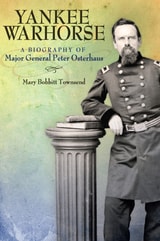
Yankee Warhorse
A Biography of Major General Peter OsterhausMary Bobbit Townsend
University of Missouri Press, 2021
Yaya's Story
The Quest for Well-Being in the WorldPaul Stoller
University of Chicago Press, 2014
Harouna and Stoller would meet in Harlem, at a bustling African market where Harouna built a life as an African art trader and Stoller was conducting research. Moving from Belayara in Niger to Silver Spring, Maryland, and from the Peace Corps to fieldwork to New York, Stoller recounts their separate lives and how the threat posed by cancer brought them a new, profound, and shared sense of meaning. Combining memoir, ethnography, and philosophy through a series of interconnected narratives, he tells a story of remarkable friendship and the quest for well-being. It’s a story of difference and unity, of illness and health, a lyrical reflection on human resiliency and the shoulders we lean on.
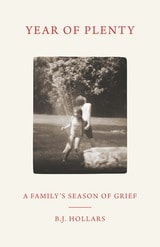
Year of Plenty
A Family's Season of GriefB.J. Hollars
University of Wisconsin Press, 2024
So began the Hollars family’s year of plenty—a cancer diagnosis on top of the ongoing COVID pandemic, then feelings of falling short as parents, partners, and people. While Hollars traces his family’s daily devastations alongside his father-in-law’s decline, he recounts the small mercies along the way: birthdays, campfires, fishing trips, kayaking, and fireflies. As he, his wife, Meredith, and their three young children grapple with how best to say goodbye to the person they love, they are forced to reassess their own lives. How can we make the most of our time, they wonder, when time feels so short?
Written in vignettes and accompanied by photographs and family interviews, Year of Plenty provides a poignant and unflinching account of how death separates us not only from the people we love but from places and memories too. Hollars explores how death’s all-consuming weight has the potential to fracture—rather than strengthen—even those relationships we think we know the best. Ultimately, he cracks wide personal moments from his own life and allows the world to peer in.
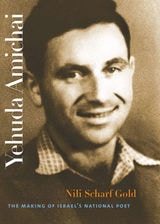
Yehuda Amichai
The Making of Israel's National PoetNili Scharf Gold
Brandeis University Press, 2008
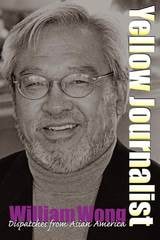
Yellow Journalist
Dispatches from Asian AmericaWilliam Wong
Temple University Press, 2001

Yo Soy
From a Migrant Field Worker to a University ProfessorRoberto E. Villarreal
University of North Texas Press, 2025
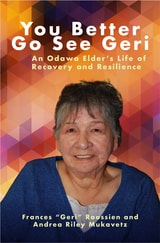
You Better Go See Geri
An Odawa Elder’s Life of Recovery and ResilienceFrances “Geri” Roossien
Oregon State University Press, 2021
While a graduate student, Andrea Riley Mukavetz was invited into Geri’s home to listen to her stories and assist in compiling and publishing a memoir. Geri wanted her stories to serve as a resource, form of support, and affirmation that Indigenous people can be proud of who they are and overcome trauma. Geri hoped to be a model to current and future generations, and she believed strongly that more Indigenous people should become substance abuse counselors and work with their communities in tribally specific ways.
Geri died in 2019, but Riley Mukavetz carried on the work. This book presents Geri’s stories, lightly edited and organized for clarity, with an introduction by Riley Mukavetz that centers Geri’s life and the process of oral history in historical and theoretical context.
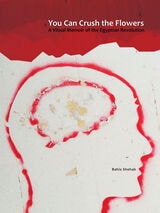
You Can Crush the Flowers
A Visual Memoir of the Egyptian RevolutionBahia Shehab
Gingko, 2021
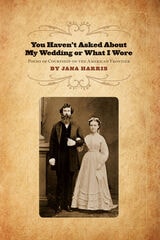
You Haven't Asked About My Wedding or What I Wore
Poems of Courtship on the American FrontierJana Harris
University of Alaska Press, 2014
For thirty years poet Jana Harris researched the diaries and letters of North American pioneer women. While the names and experiences of the authors varied, Harris found one story often connected them: their most powerful memories were of courtships and weddings. They dreamed of having a fine wedding while they spent their lives hauling water, scrubbing floors, and hoping for admirers. Many married men they hardly knew.
Based on primary research of nineteenth-century frontier women, Harris uses her compelling poetry to resurrect a forgotten history. She captures the hope, anxiety, anger, and despair of these women through a variety of characters and poetic strategies, while archival photographs give faces to the names and details to the settings. Harris’s meticulous research and stirring words give these pioneer women a renewed voice that proves the timelessness of the hopes and fears of love and marriage.
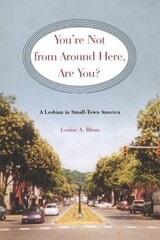
You're Not from Around Here, Are You?
A Lesbian in Small-Town AmericaLouise A. Blum
University of Wisconsin Press, 2001
This is a funny, moving story about life in a small town, from the point of view of a pregnant lesbian. Louise A. Blum, author of the critically acclaimed novel Amnesty, now tells the story of her own life and her decision to be out, loud, and pregnant. Mixing humor with memorable prose, Blum recounts how a quiet, conservative town in an impoverished stretch of Appalachia reacts as she and a local woman, Connie, fall in love, move in together, and determine to live their life together openly and truthfully.
The town responds in radically different ways to the couple’s presence, from prayer vigils on the village green to a feature article in the family section of the local newspaper. This is a cautionary, wise, and celebratory tale about what it’s like to be different in America—both the good and the bad. A depiction of small town life with all its comforts and its terrors, this memoir speaks to anyone who has ever felt like an outsider in America. Blum tells her story with a razor wit and deft precision, a story about two "girls with grit," and the child they decide to raise, right where they are, in small town America.
You've Got to Be Carefully Taught
Learning and Relearning LiteratureJerome Klinkowitz. Foreword by Kurt Vonnegut
Southern Illinois University Press, 2001
Drawing on his own experience in the profession, veteran English professor and internationally renowned scholar Jerome Klinkowitz sorts out the wrong ways of teaching literature before devising a new, successful method. Specifically, he concludes that a historically based “story of English” is precisely the wrong narrative approach to making sense of what literature does. Instead, Klinkowitz proposes a new method focused not on the product of literary writing but on the process of writing. Long involved with the making of contemporary literature, Klinkowitz shows how his classroom approach draws on the same strengths and inspirations writers use in the creation of literature. He involves students in the literary work as production.
Despite almost universal agreement that literary studies fail both writers and students, solutions have been limited to suggestions by superstar theorists teaching cream-of-the-crop students at elite universities. Klinkowitz aims not at the elite but at the ordinary student in an introduction to literature class. His goal is to introduce teachers to a new philosophy of teaching literature and to further deepen students’ natural love for the subject. He also seeks to revive the love of fine writing in those whose joy in the subject fell victim to obtuse teaching methods. Uniquely, his is not an esoteric theory developed by the best academics for elite students but a commonsense approach that works well in the kind of schools most students attend.
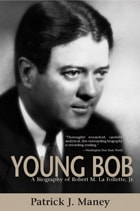
Young Bob
A Biography of Robert M. La Follette, Jr.Patrick J. Maney
Wisconsin Historical Society Press, 2002
United States senator "Young Bob" La Follette entered politics as a young reformer in the shadow of his legendary father, "Fighting Bob" La Follette. He made his own mark as a key architect of Roosevelt’s New Deal and as a champion of labor rights and civil liberties. But in 1946 he was unexpectedly unseated by Joseph McCarthy, whose rise to Cold War notoriety foreshadowed La Follette’s despair and suicide in 1953. This new edition updates the only full scale biography of La Follette,Jr., the first to exploit his voluminous collection of personal papers. Patrick J. Maney makes clear that Young Bob’s story is as relevant today as it was when he died. His life stands as dramatic evidence of how one of the most respected politicians of his time bridged the political spectrum and was admired by both liberals like FDR and Harry Truman and conservatives like Robert Taft and Richard Nixon.
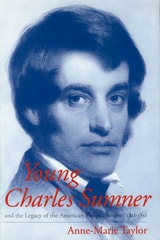
Young Charles Sumner and the Legacy of the American Enlightenment, 1811-1851
Anne-Marie Taylor
University of Massachusetts Press, 2001
In this book, Anne-Marie Taylor challenges that long-standing view, offering in its stead the portrait of a man animated more by principle than by impulse or ambition. According to Taylor, Sumner's reform-minded politics, including his fervent commitment to put an end to slavery, must be understood in the context of a young nation still struggling to live up to the Enlightenment ideals embraced by its founders and embodied in its Constitution.
Focusing on the first forty years of Sumner's life, before he took public office, Taylor traces the evolution of his character and thought among Boston's cultural elite. His belief in the virtues of cosmopolitanism, in the dignity of the human intellect and conscience, and in the possibility of a cultivated and just society, all find their roots in an education steeped in Enlightenment principles. At the same time, as a child of New England Puritanism and Revolutionary republicanism, Sumner was raised to believe in the moral obligation of the individual to work for the common good.
As Taylor shows in this richly drawn biography, much of the triumph and tragedy of Sumner's story—the energy of his idealism as well as the poignancy of his eventual disappointment— derives from the overpowering sense of duty and national destiny imbued by his upbringing.
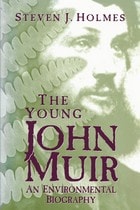
Young John Muir
An Environmental BiographySteven J. Holmes
University of Wisconsin Press, 1999
From his childhood in Scotland and Wisconsin through his young adulthood in the Midwest and Canada, Muir struggled—often without success—to find a place for himself both in nature and in society. Far from granting comfort, the natural world confronted the young Muir with a full range of practical, emotional, and religious conflicts. Only with the help of his family, his religion, and the extraordinary power of nature itself could Muir in his late twenties find a welcoming vision of nature as home—a vision that would shape his lifelong environmental experience, most immediately in his transformative travels through the South and to the Yosemite Valley.
More than a biography, The Young John Muir is a remarkable exploration of the human relationship with wilderness. Accessible and engaging, the book will appeal to anyone interested in the individual struggle to come to terms with the power of nature.
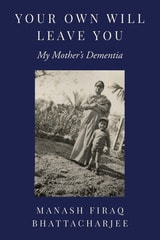
Your Own Will Leave You
My Mother's DementiaManash Firaq Bhattacharjee
Temple University Press, 2026
“Memory’s barriers are without barriers,” writes Manash Firaq Bhattacharjee in the opening of his touching and thoughtful memoir, Your Own Will Leave You. Bhattacharjee eloquently reflects on family, care, and memory as he chronicles his experiences with his elderly mother who suffers from dementia. Working from his journal, Bhattacharjee ruminates on the ways we understand dementia and memory as well as end-of-life issues. He is not only a loving son, but also an Indian with a universal sensibility who turns to ancient and contemporary thinkers that inform his perspective.
Bhattacharjee focuses on the last months of his mother’s life and her changing demeanor—her stubbornness, humor, and vulnerability. He traces her interactions with family members, neighbors, and caregivers, while also addressing burden-of-care issues. Recounting his moments of grief and guilt with candor, Bhattacharjee also re-evaluates how Western culture prejudices popular perceptions of mental illness.
Lyrical, penetrating, occasionally aphoristic, and full of insights, Your Own Will Leave You is a heartfelt, and at times heartbreaking, memoir and a warm elegy for the author’s late mother.
Yours to Command
The Life and Legend of Texas Ranger Captain Bill McDonaldHarold J. Weiss Jr.
University of North Texas Press, 2009
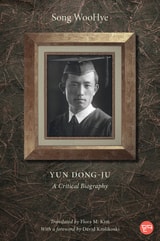
Yun Dong-ju
A Critical BiographySong WooHye
Rutgers University Press, 2026
Historian and novelist Song WooHye chronicles the life of Yun Dong-ju (1917-1945), one of the most beloved and important poets in the modern Korean literary canon, widely considered Korea's "National Poet". Beginning with the history of the North Gando region (now Yanbian, China), where Yun was born, and ending with facts behind the publication of his only and posthumous poetry collection, Sky, Wind, Star, and Poem, this critical biography elucidates who Yun Dong-ju really was, with factual descriptions of the bleak and turbulent period of Japan’s colonization of Korea.
While first working on the book in the 1980s, Song had interviewed the poet’s surviving relatives and friends, most of whom have since passed away. Without her interviews, these important first-hand accounts would have been lost. Song had an added advantage of an “insider,” as she is a niece of Song Mong-gyu, who was the poet’s first cousin and inseparable friend for life. Incorporating newly discovered materials and using interviews with the beloved poet's family and friends, this biography is the most comprehensive, definitive biography of Yun Dong-ju to date, now available in English for the first time.
This book is published with the support of the Literature Translation Institute of Korea (LTI Korea).