Results by title
5448 books match the query 'History and criticism' and 18 start with y
Yankee Twang
Country and Western Music in New EnglandClifford R. Murphy
University of Illinois Press, 2014
As Murphy shows, an extraordinary multiculturalism sets New England country and western music apart from other regional and national forms. Once segregated at work and worship, members of different ethnic groups used the country and western popularized on the radio and by barnstorming artists to come together at social events, united by a love of the music. Musicians, meanwhile, drew from the wide variety of ethnic musical traditions to create the New England style.
But the music also gave--and gives--voice to working-class feeling. Murphy explores how the Yankee love of country and western emphasizes the western, reflecting the longing of many blue collar workers for the mythical cowboy's life of rugged but fulfilling individualism. Indeed, many New Englanders use country and western to comment on economic disenfranchisement and express their resentment of a mass media, government, and Nashville music establishment that they believe neither reflects their experiences nor considers them equal participants in American life.
Yellow Music
Media Culture and Colonial Modernity in the Chinese Jazz AgeAndrew F. Jones
Duke University Press, 2001
The personal and professional histories of three musicians are central to Jones's discussions of shifting gender roles, class inequality, the politics of national salvation, and emerging media technologies: the American jazz musician Buck Clayton; Li Jinhui, the creator of "yellow music"; and leftist Nie Er, a former student of Li’s whose musical idiom grew out of virulent opposition to this Sinified jazz. As he analyzes global media cultures in the postcolonial world, Jones avoids the parochialism of media studies in the West. He teaches us to hear not only the American influence on Chinese popular music but the Chinese influence on American music as well; in so doing, he illuminates the ways in which both cultures were implicated in the unfolding of colonial modernity in the twentieth century.
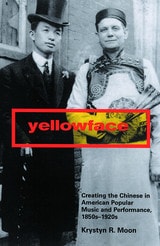
Yellowface
Creating the Chinese in American Popular Music and Performance, 1850s-1920sMoon, Krystyn R.
Rutgers University Press, 2004
Music and performance provide a unique window into the ways that cultural information is circulated and perceptions are constructed. Because they both require listening, are inherently ephemeral, and most often involve collaboration between disparate groups, they inform cultural perceptions differently from literary or visual art forms, which tend to be more tangible and stable.
In Yellowface, Krystyn R. Moon explores the contributions of writers, performers, producers, and consumers in order to demonstrate how popular music and performance has played an important role in constructing Chinese and Chinese American stereotypes. The book brings to life the rich musical period of the late nineteenth and early twentieth centuries. During this time, Chinese and Chinese American musicians and performers appeared in a variety of venues, including museums, community theaters, and world’s fairs, where they displayed their cultural heritage and contested anti-Chinese attitudes. A smaller number crossed over into vaudeville and performed non-Chinese materials. Moon shows how these performers carefully navigated between racist attitudes and their own artistic desires.
While many scholars have studied both African American music and blackface minstrelsy, little attention has been given to Chinese and Chinese American music. This book provides a rare look at the way that immigrants actively participated in the creation, circulation, and, at times, subversion of Chinese stereotypes through their musical and performance work.

Yesterday's Faces, Volume 1
Glory FiguresRobert Sampson
University of Wisconsin Press, 1983
This book and its companion volumes are concerned with the slow shaping of many literary conventions over many decades. This volume begins the study with the dime novels and several early series characters who influenced the direction of pulp fiction at its source.
Yodel in Hi-Fi
From Kitsch Folk to Contemporary ElectronicaBart Plantenga
University of Wisconsin Press, 2012
“If Wisconsin wasn’t on the yodel music map before, this book puts it there.”—Wisconsin State Journal

Yorùbá Bàtá Goes Global
Artists, Culture Brokers, and FansDebra L. Klein
University of Chicago Press, 2007
Yorùbá Bàtá Goes Global describes the dramatic changes and reinventions of traditional bàtá performance in recent years, showing how they are continually recreated, performed, and sold. Klein delves into the lives of Yorùbá musicians, focusing on their strategic collaborations with artists, culture brokers, researchers, and entrepreneurs worldwide. And she explores how reinvigorated performing ensembles are beginning to parlay success on the world stage into increased power and status within Nigeria. Klein’s study of the interwoven roles of innovation and tradition will interest scholars of African, global, and cultural studies, anthropology, and ethnomusicology alike.
You Know My Method
Science of the DetectiveJ.K. Van Dover
University of Wisconsin Press, 1994
The four principal writers covered are Edgar Allan Poe, Sir Arthur Conan Doyle, R. Austin Freeman, and Arthur B. Reeve. Another dozen more writers are treated somewhat more briefly: Gaboriau, Pinkerton, Green, Morrison, Futrelle, and Leroux, among others.

You Shook Me All Campaign Long
Music in the 2016 Presidential Election and BeyondEric T. Kasper
University of North Texas Press, 2018
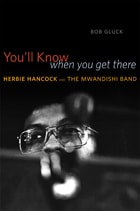
You'll Know When You Get There
Herbie Hancock and the Mwandishi BandBob Gluck
University of Chicago Press, 2012
As the 1960s ended, Herbie Hancock embarked on a grand creative experiment. Having just been dismissed from the celebrated Miles Davis Quintet, he set out on the road, playing with his first touring group as a leader until he eventually formed what would become a revolutionary band. Taking the Swahili name Mwandishi, the group would go on to play some of the most innovative music of the 1970s, fusing an assortment of musical genres, American and African cultures, and acoustic and electronic sounds into groundbreaking experiments that helped shape the American popular music that followed. In You’ll Know When You Get There, Bob Gluck offers the first comprehensive study of this influential group, mapping the musical, technological, political, and cultural changes that they not only lived in but also effected.

You're Only Young Twice
Children's Literature and FilmTim Morris
University of Illinois Press, 2000
Moving from classic texts (The Secret Garden, Goodnight Moon) to ephemera (the Hardy Boys, Goosebumps, and Harry Potter series), from the printed page to the silver screen (Willie Wonka, Jumanji, 101 Dalmatians, Beethoven), Tim Morris employs his experience as a parent and teacher to interrogate children's culture and reveal its conflicting messages.
Books and films for children--favorites accepted as wholesome fare for impressionable young minds --do not always teach straightforward lessons. Instead, they reflect the anxieties of the times and the desires of adults. At the heart of many a children's classic lies power, often expressed through racism, sexism, or violence. Under Morris's gaze, revered animal stories like Black Beauty turn into litanies of abuse; fantasies of childhood like Big are revealed as patriarchal struggles.
You're Only Young Twice redirects the focus on children's literature, asking not "What messages should children receive?" but "What messages do adults actually send?" For example, Morris recounts his own childhood confusion upon viewing Peter Pan, with its queenish, inept pirate and a grown woman (Mary Martin) in tights who pretends to be a crowing boy.
Morris shatters our long-held assumptions and challenges our best intentions, demonstrating how children's literature and films lay bare a troubled and troubling worldview.
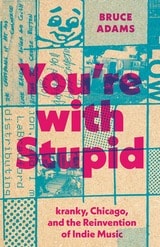
You're with Stupid
kranky, Chicago, and the Reinvention of Indie MusicBruce Adams
University of Texas Press, 2022
2023 ARSC Awards for Excellence in Historical Recorded Sound Research, Association for Recorded Sound Collections
An insider’s look at how Chicago’s underground music industry transformed indie rock in the 1990s.
In the 1990s, Chicago was at the center of indie rock, propelling bands like the Smashing Pumpkins and Liz Phair to the national stage. The musical ecosystem from which these bands emerged, though, was expansive and diverse. Grunge players comingled with the electronic, jazz, psychedelic, and ambient music communities, and an inventive, collaborative group of local labels—kranky, Drag City, and Thrill Jockey, among others—embraced the new, evolving sound of indie “rock.” Bruce Adams, co-founder of kranky records, was there to bear witness.
In You’re with Stupid, Adams offers an insider’s look at the role Chicago’s underground music industry played in the transformation of indie rock. Chicago labels, as Adams explains, used the attention brought by national acts to launch bands that drew on influences outside the Nirvana-inspired sound then dominating pop. The bands themselves—Labradford, Godspeed You! Black Emperor, Low—were not necessarily based in Chicago, but it was Chicago labels like kranky that had the ears and the infrastructure to do something with this new music. In this way, Chicago-shaped sounds reached the wider world, presaging the genre-blending music of the twenty-first century. From an author who helped create the scene and launched some of its best music, You’re with Stupid is a fascinating and entertaining read.
Young Adult Literature, Fourth Edition
From Romance to RealismMichael Cart
American Library Association, 2022
Editorial Advisory Board: Sarah Park Dahlen, Associate Professor, School of Information Sciences, University of Illinois Urbana-Champaign; Marianne Martens, Associate Professor, School of Information, Kent State University; Amy Pattee, Associate Professor and Co-coordinator of Dual-Degree MS LIS/MA Children’s Literature, School of Library and Information Science, Children’s Literature, Simmons University
“Comprehensive and substantial … a highly recommended resource," raved VOYA about the third edition. Now, to keep pace with changes in the field of publishing and realign itself to the newest generation of young adults, Cart returns with a sweeping update of his classic text. Relied upon by educators, LIS instructors and students, and practitioners for its insight and thoroughness, his book
- surveys the landscape of YA lit both past and present, sketching out its origins and showing how it has evolved to deal with subjects every bit as complex as its audience;
- closely examines teen demographics, literacy, audiobooks, the future of print, the role of literary criticism, and other key topics;
- provides updated coverage of perennially popular genre fiction, including horror, sci fi, and dystopian fiction;
- delves deeply into multicultural and LGBTQIA+ literature, substantially updated in this edition;
- features expansive interviews with best-selling authors like Eric Shanower, Jackie Woodson, and Bill Konigsberg as well as several publishers and leaders in the field;
- discusses the impact of the Printz Award, ALAN’s Walden Award, the National Book Award, The Los Angeles Times Book Award, and other honors; and
- features abundant bibliographic material to aid in readers' advisory and collection development.

Young Adult Literature
From Romance to RealismMichael Cart
American Library Association, 2016
Young Adult Literature
From Romance to RealismMichael Cart
American Library Association, 2010
Young Lions
How Jewish Authors Reinvented the American War NovelLeah Garrett
Northwestern University Press, 2015
Finalist, 2015 National Jewish Book Awards in the American Jewish Studies category
Winner, 2017 AJS Jordan Schnitzer Book Award in the category of Modern Jewish History and Culture: Africa, Americas, Asia, and Oceania
Young Lions: How Jewish Authors Reinvented the American War Novel shows how Jews, traditionally castigated as weak and cowardly, for the first time became the popular literary representatives of what it meant to be a soldier and what it meant to be an American. Revisiting best-selling works ranging from Norman Mailer’s The Naked and the Dead to Joseph Heller’s Catch-22, and uncovering a range of unknown archival material, Leah Garrett shows how Jewish writers used the theme of World War II to reshape the American public’s ideas about war, the Holocaust, and the role of Jews in postwar life. In contrast to most previous war fiction these new “Jewish” war novels were often ironic, funny, and irreverent and sought to teach the reading public broader lessons about liberalism, masculinity, and pluralism.
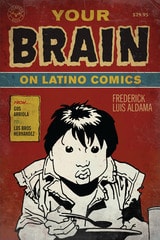
Your Brain on Latino Comics
From Gus Arriola to Los Bros HernandezBy Frederick Luis Aldama
University of Texas Press, 2009
Though the field of comic book studies has burgeoned in recent years, Latino characters and creators have received little attention. Putting the spotlight on this vibrant segment, Your Brain on Latino Comics illuminates the world of superheroes Firebird, Vibe, and the new Blue Beetle while also examining the effects on readers who are challenged to envision such worlds.
Exploring mainstream companies such as Marvel and DC as well as rising stars from other segments of the industry, Frederick Aldama provides a new reading of race, ethnicity, and the relatively new storytelling medium of comics themselves. Overview chapters cover the evolution of Latino influences in comics, innovations, and representations of women, demonstrating Latino transcendence of many mainstream techniques. The author then probes the rich and complex ways in which such artists affect the cognitive and emotional responses of readers as they imagine past, present, and future worlds.
Twenty-one interviews with Latino comic book and comic strip authors and artists, including Laura Molina, Frank Espinosa, and Rafael Navarro, complete the study, yielding captivating commentary on the current state of the trade, cultural perceptions, and the intentions of creative individuals who shape their readers in powerful ways.
Your History with Me
The Films of Penny SiopisSarah Nuttall, editor
Duke University Press, 2024
Contributors. John Akomfrah, Sinazo Chiya, Mark Gevisser, Pumla Dineo Gqola, Katerina Gregos, Brenda Hollweg, William Kentridge, Achille Mbembe, Sarah Nuttall, Griselda Pollock, Laura Rascaroli, Zineb Sedira, Penny Siopis, Hedley Twidle, Zoé Whitley

Yuarn Music Dramas
Studies in Prosody and Structure and a Complete Catalogue of Northern Arias in the Dramatic StyleDale R. Johnson
University of Michigan Press, 1981