Results by title
1787 books match the query 'Literary Collections' and 7 start with y
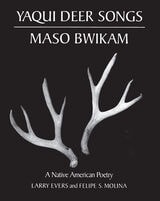
Yaqui Deer Songs/Maso Bwikam
A Native American PoetryLarry Evers and Felipe S. Molina
University of Arizona Press, 1987
Winner of the American Folklore Society’s Chicago Folklore Prize
Yaqui regard song as a kind of lingua franca of the intelligent universe. It is through song that experience with other living things is made intelligible and accessible to the human community. Deer songs often take the form of dialogues in which the deer and others in the wilderness world speak with one another or with the deer singers themselves. It is in this way, according to one deer singer, that “the wilderness world listens to itself even today.”
In this book authentic ceremonial songs, transcribed in both Yaqui and English, are the center of a fascinating discussion of the Deer Song tradition in Yaqui culture. Yaqui Deer Songs/Maso Bwikam thus enables non-Yaquis to hear these dialogues with the wilderness world for the first time.
[more]
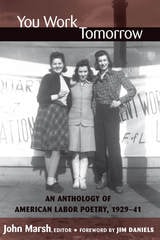
You Work Tomorrow
An Anthology of American Labor Poetry, 1929-41John Marsh, Editor
University of Michigan Press, 2007
"An outstanding piece of scholarship and a welcome contribution to the field, this collection of neglected but powerful poetry speaks to our own time as much as it does to its own era."
---Nicholas Coles, University of Pittsburgh
---Nicholas Coles, University of Pittsburgh
"Opens up a dramatic new aspect of American literature for study, discussion, and enjoyment. The collection of poems is original and engaging and is sure to be useful for classes in literature, American history, and labor studies."
---Alan Wald, University of Michigan
---Alan Wald, University of Michigan
You Work Tomorrow provides a glimpse into a relatively unknown aspect of American literary and labor history---the remarkable but largely forgotten poems published in union newspapers during the turbulent 1930s. Members of all unions---including autoworkers, musicians, teachers, tenant farmers, garment workers, artists, and electricians---wrote thousands of poems during this period that described their working, living, and political conditions. From this wealth of material, John Marsh has chosen poetry that is both aesthetically appealing and historically relevant, dispelling the myth that labor poetry consisted solely of amateurish and predictable sloganeering. A foreword by contemporary poet Jim Daniels is followed by John Marsh's substantive introduction, detailing the cultural and political significance of union poetry.
John Marsh is Assistant Professor of English at the University of Illinois at Urbana-Champaign and Coordinator of The Odyssey Project, a year-long, college-accredited course in the humanities offered at no cost to adults living below or slightly above the federal poverty level.
A volume in the series Class : Culture
[more]

You as of Today My Homeland
Stories of War, Self, and LoveTayseer Al-Sboul
Michigan State University Press, 2016
This volume comprises a translation of the first post-modernist historical Arabic novella, You as of Today, by the renowned Jordanian writer Tayseer al-Sboul, and his two short stories “Red Indian” and “The Rooster’s Cry.” “Red Indian” and “The Rooster’s Cry” complement You as of Today by providing, with striking transparency and precision, narratives that examine man’s journey to self-discovery through events that are culturally unique, transparent, and at times shocking. This volume is rich with tales of war, love, politics, censorship, and the search for self in a complex and conflicting Arab world at a critical time in its history. In a captivating style consistent with the nature of events narrated in the text, al-Sboul unveils the inner nature of social, political, and religious patterns of life in Arab society with an honesty and skill that renders You as of Today My Homeland a testimony of human experiences that transcend the boundaries of time and place.
[more]
You, Me, and the Violence
Catherine Taylor
The Ohio State University Press, 2017
“Things puppets can do to us: charm, deceive, captivate, fool, trick, remind, amuse, distract, bore, repulse, annoy, puzzle, transport, provoke, fascinate, stand in for, kill.” In You, Me, and the Violence, Catherine Taylor ponders the nature of personal and political autonomy, focusing on the surprising juxtaposition of puppetry and military drones. In a book at once politically significant and narratively engaging, Taylor blends genres to question the roles of individuals within society and expose the gritty and emotional underpinnings of the seemingly mechanical process of a remote soldier.
From conversations with her own brother about his military experiences to Punch and Judy, from the original tale of Pinocchio to the radio chatter of soldiers in active drone operation, Taylor writes about family, power, and the “theater” of war in a voice both sly and sobering, heartbreaking and hopeful.
From conversations with her own brother about his military experiences to Punch and Judy, from the original tale of Pinocchio to the radio chatter of soldiers in active drone operation, Taylor writes about family, power, and the “theater” of war in a voice both sly and sobering, heartbreaking and hopeful.
[more]
Your Historical Loveliness Knows No Bounds
Form, Futurity, and Documentary DesireWendy Xu
University of Michigan Press, 2025
Moving freely between essay, close-reading, ekphrasis, memoir, travelogue, lecture notes, poetry, and even monologue, Your Historical Loveliness Knows No Bounds presents a series of “thinking-throughs” of formally innovative and politically oriented poets pushing the boundaries of what poetry can hold. Tracing a personal family history of immigration amidst larger concerns of diaspora, “unsayability,” and absence, Wendy Xu reads the work of poets including Layli Long Soldier, Inger Christensen, Ocean Vuong, Liu Xia, giovanni singleton, Bei Dao, Diana Khoi Nguyen, and others. She explores existential and pedagogical questions in poetry from the point of view of a reader and a teacher. Why write? and why invite the paradoxes of a documentary approach into that writing?
Not an overview or primer, least of all the final word, this free-ranging exploration of contemporary poetry considers larger questions of belonging, diaspora, the violence of language, the allure of the past, genre, witness, and form. It returns to memorable touchstone texts in the author’s life with renewed curiosity about their inner workings. Essays move with restless curiosity across topics, bringing them into conversation with poetry, from considering depictions of Christ in Pier Paolo Pasolini’s The Gospel According to St. Matthew, to the ecstatic illegible texts of Henri Michaux, discomfiting likenesses of agoraphobia and political imprisonment, and the epistolary trouble of fan-mail. Xu is drawn to poetry works of radical hybridity alongside personal experiences of formal intensity, as an immigrant daughter, a parentified child, an occasional agoraphobe, and a writer. Your Historical Loveliness Knows No Bounds is a tour of poetic influences and the futures they’ve made possible.
Not an overview or primer, least of all the final word, this free-ranging exploration of contemporary poetry considers larger questions of belonging, diaspora, the violence of language, the allure of the past, genre, witness, and form. It returns to memorable touchstone texts in the author’s life with renewed curiosity about their inner workings. Essays move with restless curiosity across topics, bringing them into conversation with poetry, from considering depictions of Christ in Pier Paolo Pasolini’s The Gospel According to St. Matthew, to the ecstatic illegible texts of Henri Michaux, discomfiting likenesses of agoraphobia and political imprisonment, and the epistolary trouble of fan-mail. Xu is drawn to poetry works of radical hybridity alongside personal experiences of formal intensity, as an immigrant daughter, a parentified child, an occasional agoraphobe, and a writer. Your Historical Loveliness Knows No Bounds is a tour of poetic influences and the futures they’ve made possible.
[more]
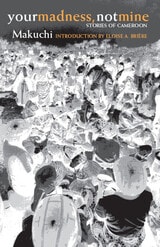
Your Madness, Not Mine
Stories of CameroonMakuchi
Ohio University Press, 1999
Women’s writing in Cameroon has so far been dominated by Francophone writers. The short stories in this collection represent the yearnings and vision of an Anglophone woman, who writes both as a Cameroonian and as a woman whose life has been shaped by the minority status her people occupy within the nation-state. The stories in Your Madness, Not Mine are about postcolonial Cameroon, but especially about Cameroonian women, who probe their day-to-day experiences of survival and empowerment as they deal with gender oppression: from patriarchal expectations to the malaise of maldevelopment, unemployment, and the attraction of the West for young Cameroonians. Makuchi has given us powerful portraits of the people of postcolonial Africa in the so-called global village who too often go unseen and unheard.
[more]
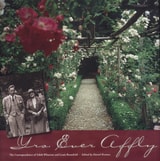
Yrs. Ever Affly
The Correspondence of Edith Wharton and Louis BromfieldDaniel Bratton
Michigan State University Press, 2000
The close friendship between Edith Wharton (Ethan Frome, The Age of Innocence, and The Buccaneers) and Louis Bromfield (Early Autumn, The Farm, and The Rains Came) evolved toward the end of Wharton's long and distinguished life and during the height of Bromfield's career. Despite the disparity in their ages and backgrounds-he was thirty-four years her junior and a Jeffersonian democrat from the Midwest, she an aristocratic Old New Yorker with a penchant for Hamiltonian economics-the bond between them, described by Bromfield was "a close bond, as close in many senses as I have ever known."
During the period of their correspondence (1931-1937), Wharton divided her time between the Pavillon Colombe, an eighteenth-century house north of Paris, and Sainte Claire du Vieux Château, near Hyères in the south of France. Bromfield lived not far from the Pavillon Colombe, in Senlis, at the Presbytère de St. Étienne. The gardens of these estates and the fervor they inspired in these two Pulitzer Prize-winning authors began a relationship that would endure until Wharton's death in 1937.
At the heart of these letters is Wharton and Bromfield's devotion to the earth and to horticultural pursuits, a devotion immediately recognizable to all who share the passion of gardening. But these letters speak of so much more. The two friends wrote of the social-political milieu of America and France during the 1930s, gossiped about the literary worlds in which they lived, discussed the publishing climate of the Depression era, and shared their kindred love of travel and literature. Consisting of thirty-two letters, one postcard, and a note from Wharton's secretary to Bromfield's wife, their correspondence is presented here with meticulous annotation by Daniel Bratton to give an insight into the private worlds of these two literary magnates.
[more]