Results by title
8642 books match the query '20th century' and 11 start with z
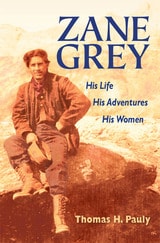
Zane Grey
His Life, His Adventures, His WomenThomas H. Pauly
University of Illinois Press, 2005
Zane Grey was a disappointed aspirant to major league baseball and an unhappy dentist when he belatedly decided to take up writing at the age of thirty. He went on to become the most successful American author of the 1920s, a significant figure in the early development of the film industry, and a central player in the early popularity of the Western.
Thomas H. Pauly's work is the first full-length biography of Grey to appear in over thirty years. Using a hitherto unknown trove of letters and journals, including never-before-seen photographs of his adventures--both natural and amorous--Zane Grey has greatly enlarged and radically altered the current understanding of the superstar author, whose fifty-seven novels and one hundred and thirty movies heavily influenced the world's perception of the Old West.
Zane Grey
Romancing The WestStephen J. May
Ohio University Press, 1997
One of the century’s most enduring American writers, Zane Grey left a legacy to our national consciousness that far outstrips the literary contribution of his often predictable plots and recurring themes. How did Grey capture the attention of millions of readers and promote the Western fantasy that continues to occupy many of the world’s leisure hours? This study assesses the Zane Grey phenomenon by examining Grey’s romantic novels in the context of his life and era.
Grey, whose roots were in Zanesville, Ohio, was the son of a dentist and practiced dentistry himself in his early adulthood. He threw over that life for one of adventure, traveling throughout the world in search of excitement, a course that ultimately led him to become one of America’s most popular authors. But he also was dogged by depression and inertia that affected his ability and will to work.
In Zane Grey: Romancing the West, author Stephen J. May traces the career of Grey by analyzing the development of his novels and popularity and the degree to which that shaped his world.
The book also investigates Grey’s personal life—from his fling with Hollywood to his passion for deep-sea fishing—illuminating the literature that shaped America’s vision of itself through one of its most enduring and cherished myths.

Zapatista!
Reinventing Revolution in MexicoEdited by John Holloway and Eloina Pelaez
Pluto Press, 1998
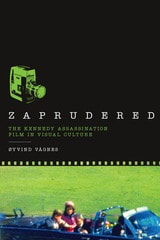
Zaprudered
The Kennedy Assassination Film in Visual CultureBy Øyvind Vågnes
University of Texas Press, 2011
Winner, Peter C. Rollins Book Award, 2012
As the fiftieth anniversary of the Kennedy assassination approaches, the traumatic aspects of the tragedy continue to haunt our perceptions of the 1960s. One reason for this lies in the home movie of the incident filmed by Abraham Zapruder, a bystander who became one of the twentieth century's most important accidental documentarians.
The first book devoted exclusively to the topic, Zaprudered traces the journey of the film and its effect on the world's collective imagination. Providing insightful perspective as an observer of American culture, Norwegian media studies scholar Øyvind Vågnes begins by analyzing three narratives that are projections of Zapruder's images: performance group Ant Farm's video The Eternal Frame, Don DeLillo's novel Underworld, and an episode from Seinfeld. Subsequent topics he investigates include Dealey Plaza's Sixth Floor Museum, Zoran Naskovski's installation Death in Dallas, assassin video games, and other artifacts of the ways in which the footage has made a lasting impact on popular culture and the historical imagination. Vågnes also explores the role of other accidental documentarians, such as those who captured scenes of 9/11.
Zapruder's footage has never yielded a conclusive account of what happened in Dealey Plaza. Zaprudered thoroughly examines both this historical enigma and its indelible afterimages in our collective imagination.
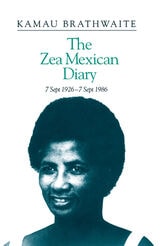
Zea Mexican Diary
7 September 1926—7 September 1986Kamau Brathwaite
University of Wisconsin Press, 1993
Zea Mexican is a tribute to Doris Brathwaite and an exploration of the creative potency of love. (The title comes from the name Brathwaite gave Doris, who was originally from Guyana of part Amerindian descent.) Exposing the intimacy of his marriage, this book is the closest Brathwaite has ever come to an autobiographical statement. In examining his life with Doris he found the courage to reveal something of his own character. But, more than an autobiography, Zea Mexican is an extraordinary work of literature, much of it written in the expressive “nation language” of Jamaica and the Caribbean. Brathwaite filters his pain through his poetic gift, presenting it to the reader with all the poignancy poetry conveys.
Zhang Hongtu
Expanding Visions of a Shrinking WorldLuchia Meihua Lee and Jerome Silbergeld, editors
Duke University Press, 2015
From his early work in China during the Cultural Revolution to his decades as an artist in New York, Zhang reflects the complex attitudes of a scholar-artist toward modernity, as well as toward Asian and Western societies and himself. Placing Zhang in the context of his cultural milieu both in China and in the Chinese immigrant artist community in America, this volume's contributors examine his adaptations of classic art to reflect a contemporary sensibility, his relation to Cubism and Social Realism, his collaboration with the celebrated fashion designer Vivienne Tam, and his visual critique of China's current environmental crisis. Zhang's work will be on display at the Queens Museum in New York City from October 17, 2015 to March 6, 2016.
Contributors: Julia F. Andrews, Alexandra Chang, Tom Finkelpearl, Michael Fitzgerald, Wu Hung, Luchia Meihua Lee, Morgan Perkins, Kui Yi Shen, Jerome Silbergeld, Eugenie Tsai, Thuy Linh Nguyen Tu, Lilly Wei
Co-published by the Queens Museum and Duke University Press.
Zig-Zag-and-Swirl
Alfred W. Lawson's Quest for GreatnessLyell D. Henry
University of Iowa Press, 1991
Zionism in Translation
Encounters in the German-Hebrew ArchiveNa'ama Rokem
University of Chicago Press, 2026
Examining a network of correspondences and encounters that cross between German and Hebrew, Zionism in Translation argues that the space between the languages enabled ambivalent conversations about the foundation of the State of Israel.
Zionism in Translation concerns exchanges—primarily of letters but also drafts, reviews, and other ephemera—sent to or from Jerusalem in the decades after 1948. All were written in German and Hebrew by a fascinating range of literary figures, including Hannah Arendt, Gershom Scholem, Yehuda Amichai, Ludwig Strauss, Erich Auerbach, Walter Benjamin, Leah Goldberg, Peter Szondi, Paul Celan, and Tuvia Ruebner. Na’ama Rokem illuminates the complexities that emerge as the two languages mix in this extraordinary epistolary network.
The writers that Rokem studies here contend with the genocidal violence that brought the rich historical relation between German and Hebrew to a seeming end. They also grapple, in different ways, with the new reality in Israel/Palestine in the wake of the founding of the State of Israel and the Palestinian Nakba. The bilingual conversation that crosses over between German and Hebrew in these letters thus centers around the question of Jewish fate in the twentieth century and is immersed in negotiations about Jewish nationalism, the Zionist movement, and the possibilities of Jewish poetry. In the space between German and Hebrew, Rokem argues, the protagonists of her story voice ambivalences and hesitancies not found elsewhere.
Zionism in Translation joins a growing body of scholarship that uncovers the complex modes of belonging and resistance that unfold around the Zionist movement in the twentieth century. It will interest all readers concerned with modern Jewish intellectual, cultural, and literary history, the history of Zionism, and writers such as Arendt or Celan.
Zombiescapes and Phantom Zones
Ecocriticism and the Liminal from "Invisible Man" to "The Walking Dead"Lee Rozelle
University of Alabama Press, 2016
A Critical Journey Through Zombie Worlds and Ecological Thought.
In Zombiescapes and Phantom Zones: Ecocriticism and the Liminal from “Invisible Man” to “The Walking Dead,” Lee Rozelle chronicles the weirdest, ugliest, and most mixed-up characters to appear on the literary scene since World War II—creatures intimately linked to damaged habitats that rise from the muck, not to destroy or rule the world, but to save it. The book asks what happens to these landscapes after the madness, havoc, and destruction. What monsters and magic surface then?
Rozelle argues that zombiescapes and phantom zones depicted in the book become catalysts for environmental reanimation and sources of hope. Liminality offers exciting and useful new ways to conceptualize places that have historically proven troublesome, unwieldy, or hard to define. Zombiescapes can reduce the effects of pollution, promote environmental justice, lessen economic disparity, and localize food production. The grotesques that ooze and crawl from these passages challenge readers to consider new ways to re-inhabit broken lands at a time when energy efficiency, fracking, climate change, the Pacific trade agreement, local food production, and sustainability shape the intellectual landscape.
Rozelle focuses on literary works from 1950 to 2015—the zombiescapes and monsterscapes of post–World War II literature—that portray in troubling and often devastating ways the “brownfields” that have been divested of much of their biodiversity and ecological viability. However, he also highlights how these literary works suggest a new life and new potential for such environments. With an unlikely focus on places of ruination and an application of interdisciplinary, transnational approaches to a range of fields and texts, Rozelle advances the notion that places of distortion might become a nexus where revelation and advocacy are possible again.
Zombiescapes and Phantom Zones has much to offer to various fields of scholarship, including literary studies, ecocriticism, and environmental studies. Research, academic, and undergraduate audiences will be captivated by Rozelle’s lively prose and unique anthropological, ecocritical, and literary analyses.
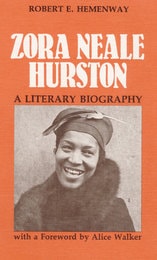
Zora Neale Hurston
A Literary BiographyRobert E. Hemenway. Foreword by Alice Walker
University of Illinois Press, 1977
The life and work of the iconic author and intellectual
Zora Neale Hurston transformed each hour of her life into something bubbling, exuberant, and brimming with joy. Robert Hemenway’s biography is a towering portrait of the novelist, folklorist, and anthropologist. Drawing on archival documents and interviews with people who knew her, Hemenway explores Hurston’s art and work, from her extraordinary novels and autobiography to a popular treatment of black folkways that revealed her deep commitment to the black folk tradition. He also provides a sensitive look at her two marriages; her relationships with Mrs. R. Osgood Mason, Franz Boas, and Langston Hughes; her time as a member of the black literati of the 1920s and 1930s; and the penniless final years leading to her death.
Sophisticated and original, Zora Neale Hurston tells the compelling story of a woman who reveled in a fully lived life dedicated to a lasting art and the preservation of a vital cultural heritage.
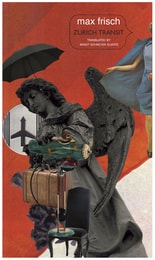
Zurich Transit
Max Frisch
Seagull Books, 2010
This screenplay by Swiss playwright and novelist Max Frisch was developed from an episode in his 1964 novel Gantenbein, or A Wilderness of Mirrors. At the center of both works is Theo Ehrismann, a man who cannot seem to change his life no matter how many times he resolves to do so. Chance comes to Theo one day upon returning from a trip abroad—he arrives home to read his own obituary in the paper. He shows up just on time for his own funeral and observes the attending mourners, and yet he is not able to reveal himself to them, and especially not to his wife. “How does one say that he is alive,” wonders Theo.
Life, as Frisch said, “is the sum of events that happen by chance, and it always could as well have turned out differently; there is not a single action or omission that does not allow for variables in the future.” Zurich Transit presents Frisch at the height of his dramatic powers and exemplifies his ardent believe in a dramaturgy of coincidence rather than causality.