Results by title
5550 books match the query 'Biography & Autobiography' and 8 start with z
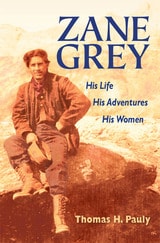
Zane Grey
His Life, His Adventures, His WomenThomas H. Pauly
University of Illinois Press, 2005
Zane Grey was a disappointed aspirant to major league baseball and an unhappy dentist when he belatedly decided to take up writing at the age of thirty. He went on to become the most successful American author of the 1920s, a significant figure in the early development of the film industry, and a central player in the early popularity of the Western.
Thomas H. Pauly's work is the first full-length biography of Grey to appear in over thirty years. Using a hitherto unknown trove of letters and journals, including never-before-seen photographs of his adventures--both natural and amorous--Zane Grey has greatly enlarged and radically altered the current understanding of the superstar author, whose fifty-seven novels and one hundred and thirty movies heavily influenced the world's perception of the Old West.
Zane Grey
Romancing The WestStephen J. May
Ohio University Press, 1997
One of the century’s most enduring American writers, Zane Grey left a legacy to our national consciousness that far outstrips the literary contribution of his often predictable plots and recurring themes. How did Grey capture the attention of millions of readers and promote the Western fantasy that continues to occupy many of the world’s leisure hours? This study assesses the Zane Grey phenomenon by examining Grey’s romantic novels in the context of his life and era.
Grey, whose roots were in Zanesville, Ohio, was the son of a dentist and practiced dentistry himself in his early adulthood. He threw over that life for one of adventure, traveling throughout the world in search of excitement, a course that ultimately led him to become one of America’s most popular authors. But he also was dogged by depression and inertia that affected his ability and will to work.
In Zane Grey: Romancing the West, author Stephen J. May traces the career of Grey by analyzing the development of his novels and popularity and the degree to which that shaped his world.
The book also investigates Grey’s personal life—from his fling with Hollywood to his passion for deep-sea fishing—illuminating the literature that shaped America’s vision of itself through one of its most enduring and cherished myths.
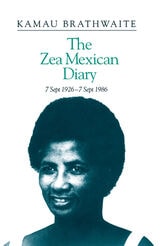
Zea Mexican Diary
7 September 1926—7 September 1986Kamau Brathwaite
University of Wisconsin Press, 1993
Zea Mexican is a tribute to Doris Brathwaite and an exploration of the creative potency of love. (The title comes from the name Brathwaite gave Doris, who was originally from Guyana of part Amerindian descent.) Exposing the intimacy of his marriage, this book is the closest Brathwaite has ever come to an autobiographical statement. In examining his life with Doris he found the courage to reveal something of his own character. But, more than an autobiography, Zea Mexican is an extraordinary work of literature, much of it written in the expressive “nation language” of Jamaica and the Caribbean. Brathwaite filters his pain through his poetic gift, presenting it to the reader with all the poignancy poetry conveys.
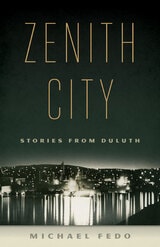
Zenith City
Stories from DuluthMichael Fedo
University of Minnesota Press, 2014
Duluth may be the city of “untold delights” as lampooned in a Kentucky congressman’s speech in 1871. Or it may be portrayed by a joke in Woody Allen’s film Manhattan. Or then again, it may be the “Zenith City of the unsalted seas” celebrated by Dr. Thomas Preston Foster, founder of the city’s first newspaper. But whatever else it may be, this city of granite hills, foghorns, and gritty history, the last stop on the shipping lanes of the Great Lakes, is undeniably a city with character—and characters. Duluth native Michael Fedo captures these characters through the happy-go-melancholy lens nurtured by the people and landscape of his youth. In Zenith City Fedo brings it back home. Framed by his reflections on Duluth’s colorful—and occasionally very dark—history and its famous visitors, such as Sinclair Lewis, Joe DiMaggio, and Bob Dylan, his memories make the city as real as the boy next door but with a better story.
Here, among the graceful, poignant, and often hilarious remembered moments—pranks played on a severe teacher, the family’s unlikely mob connections, a rare childhood affliction—are the coordinates of Duluth’s larger landscape: the diners and supper clubs, the baseball teams, radio days, and the smelt-fishing rites of spring. Woven through these tales of Duluth are Fedo’s curious, instructive, and ultimately deeply moving stories about becoming a writer, from the guidance of an English teacher to the fourteen-year-old reporter’s interview with Louis Armstrong to his absorption in the events that would culminate in his provocative and influential book The Lynchings in Duluth. These are the sorts of essays—personal, cultural, and historical, at once regional and far-reaching—that together create a picture of people in a place as rich in history and anecdote as Duluth and of the forces that forever bind them together.
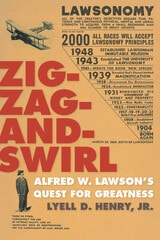
Zig-Zag-and-Swirl
Alfred W. Lawson's Quest for GreatnessLyell D. Henry
University of Iowa Press, 1991
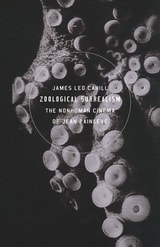
Zoological Surrealism
The Nonhuman Cinema of Jean PainlevéJames Leo Cahill
University of Minnesota Press, 2019
An archive-based, in-depth analysis of the surreal nature and science movies of the pioneering French filmmaker Jean Painlevé
Before Jacques-Yves Cousteau, there was Jean Painlevé, a pioneering French scientific and nature filmmaker with a Surrealist’s eye. Creator of more than two hundred films, his studies of strange animal worlds doubled as critical reimaginations of humanity. With an unerring eye for the uncanny and unexpected, Painlevé and his assistant Geneviève Hamon captured oneiric octopuses, metamorphic crustaceans, erotic seahorses, mythic vampire bats, and insatiable predatory insects.
Zoological Surrealism draws from Painlevé’s early oeuvre to rethink the entangled histories of cinema, Surrealism, and scientific research in interwar France. Delving deeply into Painlevé’s archive, James Leo Cahill develops an account of “cinema’s Copernican vocation”—how it was used to forge new scientific discoveries while also displacing and critiquing anthropocentric viewpoints.
From Painlevé’s engagements with Sergei Eisenstein, Georges Franju, and competing Surrealists to the historiographical dimensions of Jean Vigo’s concept of social cinema, Zoological Surrealism taps never-before-examined sources to offer a completely original perspective on a cutting-edge filmmaker. The first extensive English-language study of Painlevé’s early films and their contexts, it adds important new insight to our understanding of film while also contributing to contemporary investigations of the increasingly surreal landscapes of climate change and ecological emergency.
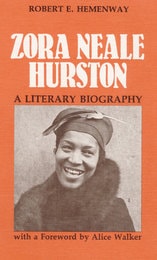
Zora Neale Hurston
A Literary BiographyRobert E. Hemenway. Foreword by Alice Walker
University of Illinois Press, 1977
The life and work of the iconic author and intellectual
Zora Neale Hurston transformed each hour of her life into something bubbling, exuberant, and brimming with joy. Robert Hemenway’s biography is a towering portrait of the novelist, folklorist, and anthropologist. Drawing on archival documents and interviews with people who knew her, Hemenway explores Hurston’s art and work, from her extraordinary novels and autobiography to a popular treatment of black folkways that revealed her deep commitment to the black folk tradition. He also provides a sensitive look at her two marriages; her relationships with Mrs. R. Osgood Mason, Franz Boas, and Langston Hughes; her time as a member of the black literati of the 1920s and 1930s; and the penniless final years leading to her death.
Sophisticated and original, Zora Neale Hurston tells the compelling story of a woman who reveled in a fully lived life dedicated to a lasting art and the preservation of a vital cultural heritage.
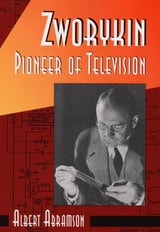
Zworykin, Pioneer of Television
Albert Abramson. Foreword by Erik Barnouw
University of Illinois Press, 1995
"His achievements rank him with Thomas Edison and Alexander Graham Bell," states Albert Abramson in this discerning, often dramatic biography of Vladimir Kosma Zworykin, the Russian-born scientist who "did more to create our present system of cathode-ray television than any other person."