Results by title
5448 books match the query 'History and criticism' and 8 start with z
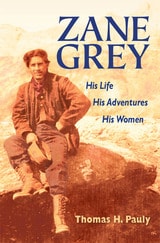
Zane Grey
His Life, His Adventures, His WomenThomas H. Pauly
University of Illinois Press, 2005
Zane Grey was a disappointed aspirant to major league baseball and an unhappy dentist when he belatedly decided to take up writing at the age of thirty. He went on to become the most successful American author of the 1920s, a significant figure in the early development of the film industry, and a central player in the early popularity of the Western.
Thomas H. Pauly's work is the first full-length biography of Grey to appear in over thirty years. Using a hitherto unknown trove of letters and journals, including never-before-seen photographs of his adventures--both natural and amorous--Zane Grey has greatly enlarged and radically altered the current understanding of the superstar author, whose fifty-seven novels and one hundred and thirty movies heavily influenced the world's perception of the Old West.
Zane Grey
Romancing The WestStephen J. May
Ohio University Press, 1997
One of the century’s most enduring American writers, Zane Grey left a legacy to our national consciousness that far outstrips the literary contribution of his often predictable plots and recurring themes. How did Grey capture the attention of millions of readers and promote the Western fantasy that continues to occupy many of the world’s leisure hours? This study assesses the Zane Grey phenomenon by examining Grey’s romantic novels in the context of his life and era.
Grey, whose roots were in Zanesville, Ohio, was the son of a dentist and practiced dentistry himself in his early adulthood. He threw over that life for one of adventure, traveling throughout the world in search of excitement, a course that ultimately led him to become one of America’s most popular authors. But he also was dogged by depression and inertia that affected his ability and will to work.
In Zane Grey: Romancing the West, author Stephen J. May traces the career of Grey by analyzing the development of his novels and popularity and the degree to which that shaped his world.
The book also investigates Grey’s personal life—from his fling with Hollywood to his passion for deep-sea fishing—illuminating the literature that shaped America’s vision of itself through one of its most enduring and cherished myths.

Zen, Poetry, the Art of Lucien Stryk
Susan Porterfield
Ohio University Press, 1993
Lucien Stryk has been a presence in American letters for almost fifty years. Those who know his poetry well will find this collection particularly gratifying. Like journeying again to places visited long ago, Stryk’s writing is both familiar and wonderfully fresh.
For those just becoming acquainted with Stryk’s work, Zen, Poetry, the Art of Lucien Stryk makes an excellent introduction. It includes his early essay, “The American Scene Versus the International Scene,” written shortly after his service in the Pacific during World War II, and “Digging In,” his first published poem, as well as some of his best-known pieces on Zen and Zen poetry. Among the latter are “Beginnings, Ends,” “Poetry and Zen,” “I Fear Nothing: A Note on the Zen Poetry of Death,” and his introduction to the great haiku poets, Issa and Basho. Selections of his most recent work include “The Red Rug: An Introduction to Poetry,” and an imagined conversation among all four leading haiku poets called “Meeting at Hagi-no-Tera.”
Porterfield’s informative collection includes essays about Stryk’s work as well as his own prose and poetry. As the volume makes clear, writing poetry is for Lucien Stryk a sacred act. It is both escape and communion, inseparable from life’s daily activities.
Zombie Cinema
Olney, Ian
Rutgers University Press, 2017
Zombie Cinema is a lively and accessible introduction to this massively popular genre. Presenting a historical overview of zombie appearances in cinema and on television, Ian Olney also considers why, more than any other horror movie monster, zombies have captured the imagination of twenty-first-century audiences.
Surveying the landmarks of zombie film and TV, from White Zombie to The Walking Dead, the book also offers unique insight into why zombies have gone global, spreading well beyond the borders of American and European cinema to turn up in films from countries as far-flung as Cuba, India, Japan, New Zealand, and Nigeria. Both fun and thought-provoking, Zombie Cinema will give readers a new perspective on our ravenous hunger for the living dead.
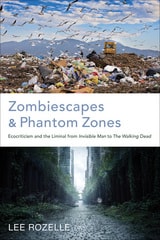
Zombiescapes and Phantom Zones
Ecocriticism and the Liminal from "Invisible Man" to "The Walking Dead"Lee Rozelle
University of Alabama Press, 2016
A Critical Journey Through Zombie Worlds and Ecological Thought.
In Zombiescapes and Phantom Zones: Ecocriticism and the Liminal from “Invisible Man” to “The Walking Dead,” Lee Rozelle chronicles the weirdest, ugliest, and most mixed-up characters to appear on the literary scene since World War II—creatures intimately linked to damaged habitats that rise from the muck, not to destroy or rule the world, but to save it. The book asks what happens to these landscapes after the madness, havoc, and destruction. What monsters and magic surface then?
Rozelle argues that zombiescapes and phantom zones depicted in the book become catalysts for environmental reanimation and sources of hope. Liminality offers exciting and useful new ways to conceptualize places that have historically proven troublesome, unwieldy, or hard to define. Zombiescapes can reduce the effects of pollution, promote environmental justice, lessen economic disparity, and localize food production. The grotesques that ooze and crawl from these passages challenge readers to consider new ways to re-inhabit broken lands at a time when energy efficiency, fracking, climate change, the Pacific trade agreement, local food production, and sustainability shape the intellectual landscape.
Rozelle focuses on literary works from 1950 to 2015—the zombiescapes and monsterscapes of post–World War II literature—that portray in troubling and often devastating ways the “brownfields” that have been divested of much of their biodiversity and ecological viability. However, he also highlights how these literary works suggest a new life and new potential for such environments. With an unlikely focus on places of ruination and an application of interdisciplinary, transnational approaches to a range of fields and texts, Rozelle advances the notion that places of distortion might become a nexus where revelation and advocacy are possible again.
Zombiescapes and Phantom Zones has much to offer to various fields of scholarship, including literary studies, ecocriticism, and environmental studies. Research, academic, and undergraduate audiences will be captivated by Rozelle’s lively prose and unique anthropological, ecocritical, and literary analyses.
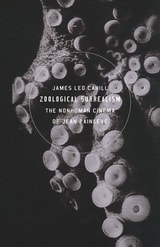
Zoological Surrealism
The Nonhuman Cinema of Jean PainlevéJames Leo Cahill
University of Minnesota Press, 2019
An archive-based, in-depth analysis of the surreal nature and science movies of the pioneering French filmmaker Jean Painlevé
Before Jacques-Yves Cousteau, there was Jean Painlevé, a pioneering French scientific and nature filmmaker with a Surrealist’s eye. Creator of more than two hundred films, his studies of strange animal worlds doubled as critical reimaginations of humanity. With an unerring eye for the uncanny and unexpected, Painlevé and his assistant Geneviève Hamon captured oneiric octopuses, metamorphic crustaceans, erotic seahorses, mythic vampire bats, and insatiable predatory insects.
Zoological Surrealism draws from Painlevé’s early oeuvre to rethink the entangled histories of cinema, Surrealism, and scientific research in interwar France. Delving deeply into Painlevé’s archive, James Leo Cahill develops an account of “cinema’s Copernican vocation”—how it was used to forge new scientific discoveries while also displacing and critiquing anthropocentric viewpoints.
From Painlevé’s engagements with Sergei Eisenstein, Georges Franju, and competing Surrealists to the historiographical dimensions of Jean Vigo’s concept of social cinema, Zoological Surrealism taps never-before-examined sources to offer a completely original perspective on a cutting-edge filmmaker. The first extensive English-language study of Painlevé’s early films and their contexts, it adds important new insight to our understanding of film while also contributing to contemporary investigations of the increasingly surreal landscapes of climate change and ecological emergency.

Zoological Surrealism
The Nonhuman Cinema of Jean PainlevéJames Leo Cahill
University of Minnesota Press, 2019
Zouk
World Music in the West IndiesJocelyne Guilbault
University of Chicago Press, 1993
"This invigorating reference work and companion CD of the Antilles' sexy zouk dance sound will lift readers out of their easy chairs and their complacency about the nonreggae aspects of Caribbean pop. . . . [Zouk] is a landmark achievement."—Timothy White, Billboard