Results by title
2 books match the query '1571-1630'

Kepler's Geometrical Cosmology
J. V. Field
University of Chicago Press, 1987
The work of Johannes Kepler (1571-1630), regarded by many as the founder of modern astronomy, is also historically important to the philosophy and methodology of science as a whole. While most studies of Kepler have concentrated on his astronomical work, particularly his laws describing the revolutions of the planets, the. V. Field focuses on one of Kepler's major preoccupations, his search for the geometrical plan according to which God created teh universe. She demonstrates how Kepler's cosmological theories, which embrace music and astrology as well as astronomy, relate to his other work. Drawing on the whole body of Kepler's writings, Field traces the impact of Plato, Euclid, and Proclus on his thinking, as well as the influence of his contemporaries Galileo and Robert Fludd.
Kepler has suffered from a dual image as both hero of science and eccentric mystagogue. Field's sound scholarship provides a more complete picture of the man and his work that will be of value to historians of science, mathematics, philosophy, and the late Renaissance.
Kepler has suffered from a dual image as both hero of science and eccentric mystagogue. Field's sound scholarship provides a more complete picture of the man and his work that will be of value to historians of science, mathematics, philosophy, and the late Renaissance.
[more]
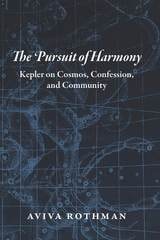
The Pursuit of Harmony
Kepler on Cosmos, Confession, and CommunityAviva Rothman
University of Chicago Press, 2017
A committed Lutheran excommunicated from his own church, a friend to Catholics and Calvinists alike, a layman who called himself a “priest of God,” a Copernican in a world where Ptolemy still reigned, a man who argued at the same time for the superiority of one truth and the need for many truths to coexist—German astronomer Johannes Kepler was, to say the least, a complicated figure. With The Pursuit of Harmony, Aviva Rothman offers a new view of him and his achievements, one that presents them as a story of Kepler’s attempts to bring different, even opposing ideas and circumstances into harmony.
Harmony, Rothman shows, was both the intellectual bedrock for and the primary goal of Kepler’s disparate endeavors. But it was also an elusive goal amid the deteriorating conditions of his world, as the political order crumbled and religious war raged. In the face of that devastation, Kepler’s hopes for his theories changed: whereas he had originally looked for a unifying approach to truth, he began instead to emphasize harmony as the peaceful coexistence of different views, one that could be fueled by the fundamentally nonpartisan discipline of mathematics.
Harmony, Rothman shows, was both the intellectual bedrock for and the primary goal of Kepler’s disparate endeavors. But it was also an elusive goal amid the deteriorating conditions of his world, as the political order crumbled and religious war raged. In the face of that devastation, Kepler’s hopes for his theories changed: whereas he had originally looked for a unifying approach to truth, he began instead to emphasize harmony as the peaceful coexistence of different views, one that could be fueled by the fundamentally nonpartisan discipline of mathematics.
[more]