Results by title
5 books match the query 'Founding'
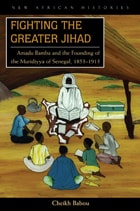
Fighting the Greater Jihad
Amadu Bamba and the Founding of the Muridiyya of Senegal, 1853–1913Cheikh Anta Babou
Ohio University Press, 2007
In Senegal, the Muridiyya, a large Islamic Sufi order, is the single most influential religious organization, including among its numbers the nation’s president. Yet little is known of this sect in the West. Drawn from a wide variety of archival, oral, and iconographic sources in Arabic, French, and Wolof, Fighting the Greater Jihad offers an astute analysis of the founding and development of the order and a biographical study of its founder, Cheikh Ahmadu Bamba Mbakke.
Cheikh Anta Babou explores the forging of Murid identity and pedagogy around the person and initiative of Amadu Bamba as well as the continuing reconstruction of this identity by more recent followers. He makes a compelling case for reexamining the history of Muslim institutions in Africa and elsewhere in order to appreciate believers’ motivation and initiatives, especially religious culture and education, beyond the narrow confines of political collaboration and resistance. Fighting the Greater Jihad also reveals how religious power is built at the intersection of genealogy, knowledge, and spiritual force, and how this power in turn affected colonial policy.
Fighting the Greater Jihad will dramatically alter the perspective from which anthropologists, historians, and political scientists study Muslim mystical orders.
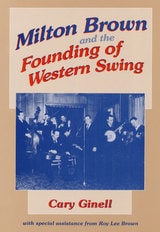
Milton Brown and the Founding of Western Swing
Cary Ginell
University of Illinois Press, 1994
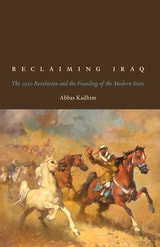
Reclaiming Iraq
The 1920 Revolution and the Founding of the Modern StateBy Abbas Kadhim
University of Texas Press, 2012
While some scholars would argue that there was no “Iraq” before King Faysal’s coronation in 1921, Iraqi history spans fourteen centuries of tribal communities that endured continual occupation in their historic homeland, including Mongol invasions in the thirteenth century and subsequent Ottoman and British invasions. An Iraqi identity was established long before the League of Nations defined the nation-state of Iraq in 1932. Drawing on neglected primary sources and other crucial accounts, including memoirs and correspondence, Reclaiming Iraq puts the 1920 revolt against British occupation in a new light—one that emphasizes the role of rural fighters between June and November of that year.
While most accounts of the revolution have been shaped by the British administration and successive Iraqi governments, Abbas Kadhim sets out to explore the reality that the intelligentsia of Baghdad and other cities in the region played an ideological role but did not join in the fighting. His history depicts a situation we see even today in conflicts in the Middle East, where most military engagement is undertaken by rural tribes that have no central base of power. In the study of the modern Iraqi state, Kadhim argues, Faysal’s coronation has detracted from the more significant, earlier achievements of local attempts at self-rule. With clarity and insight, this work offers an alternative perspective on the dawn of modern Iraq.
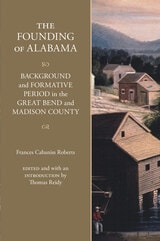
The Founding of Alabama
Background and Formative Period in the Great Bend and Madison CountyFrances Cabaniss Roberts, edited and introduced by Thomas Reidy
University of Alabama Press, 2020
The most thorough history of Alabama’s Madison County region, widely available for the first time
The 1956 dissertation by Frances Cabaniss Roberts is a classic text on Alabama history that continues to be cited by southern historians. Roberts was the first woman to earn a PhD from the University of Alabama’s history department. In the 1950s, she was the only full-time faculty member at what is now the University of Alabama in Huntsville, where she was appointed chair of the history department in 1966.
Roberts’s dissertation, “Background and Formative Period in the Great Bend and Madison County,” remains the most thorough history of the region yet produced. While certainly a product of its era, Roberts work is visionary in its own way and offers a useful look at Alabama’s rise to statehood. Thomas Reidy, editor of this edition, has kept Roberts’s words intact except for correction of minor typographical errors and helpful additions to the notes and citations. His introduction describes both the value of Roberts’s decades of service to UAH and the importance of her dissertation over time. While highlighting the great intrinsic value of Roberts’s research and writing, Reidy also notes its significance in demonstrating how the practice of history—its methods, priorities, and values—has evolved over the intervening decades.
In her examination of Madison County, Roberts spotlights exemplars of civic performance and good community behavior, giving readers one of the earliest accountings of the antebellum southern middle class. Unlike many historians of her time, Roberts displays an interest in both the “common folks” and leaders who built the region—rural and urban—and created the institutions that shaped Madison County. She examines the contributions of merchants, shopkeepers, lawyers, doctors, architects, craftsmen, planters, farmers, elected and appointed officials, board members, and entrepreneurs.
The Imperial Discipline
Race and the Founding of International RelationsAlexander E Davis
Pluto Press, 2021
This book questions the accepted origins of the field of International Relations (IR). Commonly understood to have emerged from the horrors of WW1 with the goal of bringing about world peace, the authors argue that on the contrary, IR came from a somewhat less noble tradition – that of the Round Table.
The Round Table were a network of imperialists emerging in the late 1800s across five key British imperial societies: Australia, Canada, New Zealand, South Africa and India. Their aim was to improve imperial governance, placing the empire into a position to control world affairs. Although they ultimately failed to rearrange world order according to their vision, they did help to build what we now call the discipline of IR.
The Round Table's 'scientific method' for the study of world affairs was rapidly subsumed into each geopolitical context. Through telling this story, the authors recover it, and interrogate its meanings for the discipline of IR today. They show the importance of the Global South to IR's foundations, and argue that IR scholarship in this period was intertwined with imperial racial thought in ways that it should not and cannot forget.