Results by title
4 books match the query '1573-1610'
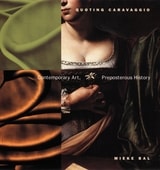
Quoting Caravaggio
Contemporary Art, Preposterous HistoryMieke Bal
University of Chicago Press, 1999
As period, as style, as sensibility, the Baroque remains elusive, its definition subject to dispute. Perhaps this is so in part because baroque vision resists separation of mind and body, form and matter, line and color, image and discourse. In Quoting Caravaggio, Mieke Bal deploys this insight of entanglement as a form of art analysis, exploring its consequences for both contemporary and historical art, as well as for current conceptions of history.
Mieke Bal’s primary object of investigation in Quoting Caravaggio is not the great seventeenth-century painter, but rather the issue of temporality in art. In order to retheorize linear notions of influence in cultural production, Bal analyzes the productive relationship between Caravaggio and a number of late-twentieth-century artists who "quote" the baroque master in their own works. These artists include Andres Serrano, Carrie Mae Weems, Ken Aptekar, David Reed, and Ana Mendieta, among others. Each chapter of Quoting Caravaggio shows particular ways in which quotation is vital to the new art but also to the source from which it is derived. Through such dialogue between present and past, Bal argues for a notion of "preposterous history" where works that appear chronologically first operate as an aftereffect caused by the images of subsequent artists.
Quoting Caravaggio is a rigorous, rewarding work: it is at once a meditation on history as creative, nonlinear process; a study of the work of Caravaggio and the Baroque; and, not least, a brilliant critical exposition of contemporary artistic representation and practice.
"[A] profoundly enlivening exercise in art criticism, in which the lens of theory magnifies rather than diminishes its object. . . . [A] remarkable book. . . . The power of Quoting Caravaggio resides in the intelligence and authority of the writer."—Roger Malbert, Times Literary Supplement
[more]
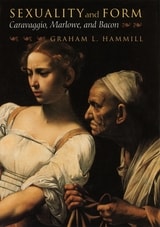
Sexuality and Form
Caravaggio, Marlowe, and BaconGraham Hammill
University of Chicago Press, 2000
This ambitious, wide-ranging study of sexuality, aesthetics, and epistemology covers everything from the aesthetics of war to the works of Caravaggio, Michaelangelo, Christopher Marlowe, and Francis Bacon, synthesizing queer theory and psychoanalysis and demonstrating the role of the body and the flesh as both a problem and a promise within the narrative arts.
[more]
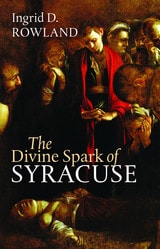
The Divine Spark of Syracuse
Ingrid D. Rowland
Brandeis University Press, 2018
Focusing on the figures of Plato, Archimedes, and Caravaggio, The Divine Spark of Syracuse discloses the role that Syracuse, a Greek cultural outpost in Sicily, played in fueling creative energies. Among the topics this book explores are Plato and the allegory of the cave, and the divine spark mentioned in his Seventh Letter. It also considers the machines of Archimedes, including his famous screw, and the variety of siege and antisiege weapons that he developed for the defense of his hometown during the siege of Syracuse during the Second Punic War, including “the hand” (a giant claw), the “burning mirror,” and the catapult. The final chapter offers a look at the artist and roustabout Caravaggio. On the run after yet another street brawl, Caravaggio traveled to Syracuse, where he painted Burial of St. Lucy (Santa Lucia) in 1608. Typical of his late works, the painting is notable for its subdued tones and emotional and psychological delicacy. This captivating book lends clear insight into the links between the sense of place and inspiration in philosophy, mathematics, and art. Rowland is the most learned tour guide we could ask for.
[more]
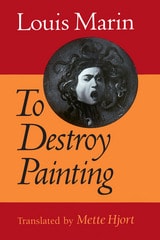
To Destroy Painting
Louis Marin
University of Chicago Press, 1994
The work of the eminent French cultural critic Louis Marin (1931-92) is becoming increasingly important to English-speaking scholars concerned with issues of representation. To Destroy Painting, first published in France in 1977, marks a milestone in Marin's thought about the aims of painting in Europe in the sixteenth and seventeenth centuries. A meditation on the work of Poussin and Caravaggio and on their milieux, the book explores a number of notions implied by theories of painting and offers insight into the aims and effects of visual representaion.
[more]