Results by title
5 books match the query '1789-1869'
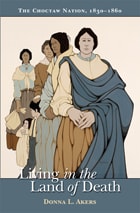
Living in the Land of Death
The Choctaw Nation, 1830-1860Donna L. Akers
Michigan State University Press, 2004
With the Indian Removal Act of 1830, the Choctaw people began their journey over the Trail of Tears from their homelands in Mississippi to the new lands of the Choctaw Nation. Suffering a death rate of nearly 20 percent due to exposure, disease, mismanagement, and fraud, they limped into Indian Territory, or, as they knew it, the Land of the Dead (the route taken by the souls of Choctaw people after death on their way to the Choctaw afterlife). Their first few years in the new nation affirmed their name for the land, as hundreds more died from whooping cough, floods, starvation, cholera, and smallpox.
Living in the Land of the Dead depicts the story of Choctaw survival, and the evolution of the Choctaw people in their new environment. Culturally, over time, their adaptation was one of homesteads and agriculture, eventually making them self-sufficient in the rich new lands of Indian Territory. Along the Red River and other major waterways several Choctaw families of mixed heritage built plantations, and imported large crews of slave labor to work cotton fields. They developed a sub-economy based on interaction with the world market. However, the vast majority of Choctaws continued with their traditional subsistence economy that was easily adapted to their new environment.
The immigrant Choctaws did not, however, move into land that was vacant. The U.S. government, through many questionable and some outright corrupt extralegal maneuvers, chose to believe it had gained title through negotiations with some of the peoples whose homelands and hunting grounds formed Indian Territory. Many of these indigenous peoples reacted furiously to the incursion of the Choctaws onto their rightful lands. They threatened and attacked the Choctaws and other immigrant Indian Nations for years. Intruding on others’ rightful homelands, the farming-based Choctaws, through occupation and economics, disrupted the traditional hunting economy practiced by the Southern Plains Indians, and contributed to the demise of the Plains ways of life.
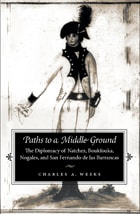
Paths to a Middle Ground
The Diplomacy of Natchez, Boukfouka, Nogales, and San Fernando de las Barrancas, 1791-1795Charles A. Weeks
University of Alabama Press, 2005
Weeks shows how diplomatic relations were established and maintained in the Gulf South between Choctaw, Chickasaw, Creek, and Cherokee chiefs and their Spanish counterparts aided by traders who had become integrated into Indian societies. He explains that despite the absence of a European state system, Indian groups had diplomatic skills that Europeans could understand: full-scale councils or congresses accompanied by elaborate protocol, interpreters, and eloquent metaphorical language.
Paths to a Middle Ground is both a narrative and primary documents. Key documents from Spanish archival sources serve as a basis for the examination of the political culture and imperial rivalry playing out in North America in the waning years of the 18th century.
Peacekeeping on the Plains
Army Operations in Bleeding KansasTony R. Mullis
University of Missouri Press, 2004
The Collected Works of Benjamin Hawkins, 1796–1810
Benjamin Hawkins, edited and with an introduction by H. Thomas Foster, II
University of Alabama Press, 2003
In 1795 Benjamin Hawkins, a former US senator and advisor to George Washington, was appointed US Indian agent and superintendent of all the tribes south of the Ohio River. Unlike most other agents, he lived among the Creek Indians for his entire tenure, from 1796 to 1816. Journeying forth from his home on the Flint River in Georgia, he served southeastern Indians as government intermediary during one of the longest eras of peace in the historic period.
Hawkins’s journals provide detailed information about European-Indian relations in the 18th-century frontier of the South. His descriptions of the natural and cultural environment are considered among the best sources for the ethnohistory of the Choctaw, Cherokee, Chickasaw, and, especially, the Creek Indians and the natural history of their territory.
Two previously published bodies of work by Benjamin Hawkins are included here—A Sketch of the Creek Country in the Years 1798 and 1799 and The Letters of Benjamin Hawkins 1796-1806. A third body of work that has never been published, “A Viatory or Journal of Distances” (describing routes and distances of a 3,578-mile journey through parts of Georgia, Alabama, and Mississippi), has been added. Together, these documents make up the known body of Hawkins’ work—his talks, treaties, correspondence, aboriginal vocabularies, travel journals, and records of the manners, customs, rites, and civil polity of the tribes. Hawkins' work provides an invaluable record of the time period.

Their Determination to Remain
A Cherokee Community's Resistance to the Trail of Tears in North CarolinaLance Greene
University of Alabama Press, 2023
The remarkable story of a North Carolina Cherokee community who avoided forced removal on the Trail of Tears
During the 1838 forced Cherokee removal by the US government, a number of close-knit Cherokee communities in the Southern Appalachian Mountains refused to relinquish their homelands, towns, and way of life. Using a variety of tactics, hundreds of Cherokees avoided the encroaching US Army and remained in the region.
In his book Their Determination to Remain: A Cherokee Community’s Resistance to the Trail of Tears in North Carolina, Lance Greene explores the lives of wealthy plantation owners Betty and John Welch who lived on the southwestern edge of the Cherokee Nation. John was Cherokee and Betty was White. Although few Cherokees in the region participated in slavery, the Welches held nine African Americans in bondage.
During removal, the Welches assisted roughly 100 Cherokees hiding in the steep mountains. Afterward, they provided land for these Cherokees to rebuild a new community, Welch’s Town. Betty became a wealthy and powerful plantation mistress because her husband could no longer own land. Members of Welch’s Town experienced a transitional period in which they had no formal tribal government or clear citizenship yet felt secure enough to reestablish a townhouse, stickball fields, and dance grounds.
Greene’s innovative study uses an interdisciplinary approach, incorporating historical narrative and archaeological data, to examine how and why the Welches and members of Welch’s Town avoided expulsion and reestablished their ways of life in the midst of a growing White population who resented a continued Cherokee presence. The Welch strategy included Betty’s leadership in demonstrating outwardly their participation in modern Western lifestyles, including enslavement, as John maintained a hidden space—within the boundaries of their land—for the continuation of traditional Cherokee cultural practices. Their Determination to Remain explores the complexities of race and gender in this region of the antebellum South and the real impacts of racism on the community.