Results by title
2 books match the query '1796-1918'
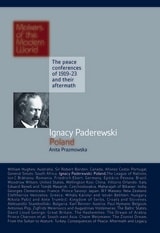
Ignacy Paderewski
PolandAnita Prazmowska
Haus Publishing, 2009
The thirteenth of President Wilson's Fourteen Points of 1918 read: "An independent Polish state should be erected which should include the territories inhabited by indisputably Polish populations, which should be assured a free and secure access to the sea, and whose political and economic independence and territorial integrity should be guaranteed by international covenant." Ever since the Third Partition in 1795 brought Polish independence to an end, nationalists had sought the restoration of their country, and the Paris Peace Conference of 1919 did indeed produce the modern Polish state. The Western Allies saw a revived Poland as both a counter to German power and a barrier to the westward expansion of the Bolshevik Revolution in Russia—a role the Polish army fulfilled by defeating a Soviet invasion in 1920. But caught between two powers and composed of territory taken from both of them, Poland was vulnerable, and in 1939 it was divided up between the Soviet Union and Nazi Germany following the Molotov-Ribbentrop Pact. The highest profile Polish representative at the Conference was the pianist and politician Ignacy Paderewski (1860-1941), the "most famous Pole in the world", whose image had done much to promote the Polish cause in the West. But he was joined by the altogether less romantic figure of Roman Dmowski (1864-1939), whose anti-Semitic reputation Paderewski took pains to distance himself from when seeking support in the United States.
[more]
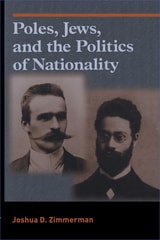
Poles, Jews, and the Politics of Nationality
The Bund and the Polish Socialist Party in Late Tsarist Russia, 1892–1914Joshua D. Zimmerman
University of Wisconsin Press, 2004
The Jewish experience on Polish lands is often viewed backwards through the lens of the Holocaust and the ethnic rivalries that escalated in the period between the two world wars. Critical to the history of Polish-Jewish relations, however, is the period prior to World War I when the emergence of mass electoral politics in Czarist Russia led to the consolidation of modern political parties. Using sources published in Polish, Yiddish, Hebrew, and Russian, Joshua D. Zimmerman has compiled a full-length English-language study of the relations between the two dominant progressive movements in Russian Poland. He examines the Polish Socialist Party (PPS), which sought social emancipation and equal civil rights for minority nationalities, including Jews, under a democratic Polish republic, and the Jewish Labor Bund, which declared that Jews were a nation distinct from Poles and Russians and advocated cultural autonomy. By 1905, the PPS abandoned its call for Jewish assimilation, and recognized Jews as a separate nationality. Zimmerman demonstrates persuasively that Polish history in Czarist Russia cannot be fully understood without studying the Jewish influence and that Jewish history was equally infused with the Polish influence.
[more]