Results by title
3 books match the query '1800 - 1850'
Demos Rising
Democracy and the Popular Construction of Public Power in France, 1800–1850Stephen W. Sawyer
University of Chicago Press, 2025
In his previous book, Demos Assembled, historian Stephen W. Sawyer offered a transatlantic account of the birth and transformation of the modern democratic state. In Demos Rising, he presents readers of political history with a prequel whose ambitious claim is that a genuine demos became possible in France only with the development of government regulation and administration. Focusing on democracy as a form of administration rather than as a form of sovereignty allows Sawyer to explore urban planning, work and private enterprise, health administration, and much more as cornerstones of a self-governing society of equals.
Examining the period between 1800 and 1850, Sawyer studies a set of thinkers who debated at length over the material problems of everyday life, sparking calls for political action and social reform in the face of conflict wreaked by deforestation, urbanization, health crises, labor relations, industrial capitalism, religious tensions, and imperial expansion. The solutions to these problems, Sawyer argues, were sought—and sometimes found—not through elections, as one might assume, but rather through the “care for all” promised by modern administrative power, regulatory intervention, and social welfare programs. By studying this profound transformation in governance, the book wagers, we can better understand the origin and meaning of democracy—even when events in our own time have thrown the concept into doubt.
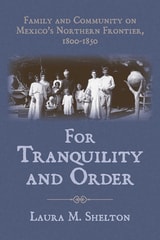
For Tranquility and Order
Family and Community on Mexico's Northern Frontier, 1800–1850By Laura M. Shelton
University of Arizona Press, 2010
Laura Shelton has plumbed the legal archives of early Sonora to reveal the extent to which both court officials and quarreling relatives imagined connections between gender hierarchies and civilized order. As she describes how the region’s nascent legal system became the institution through which spouses, parents, children, employers, and servants settled disputes over everything from custody to assault to debt, she reveals how these daily encounters between men and women in the local courts contributed to the formation of republican governance on Mexico’s northwestern frontier.
Through an analysis of some 700 civil and criminal trial records—along with census data, military reports, church records, and other sources—Shelton describes how courtroom encounters were conditioned by an Iberian legal legacy; brutal ethnic violence; emerging liberal ideas about trade, citizenship, and property rights; and a growing recognition that honor—buenas costumbres—was dependent more on conduct than on bloodline. For Tranquility and Order offers new insight into a legal system too often characterized as inept as it provides a unique gender analysis of family relations on the frontier.

Sugar and Slavery in Puerto Rico
The Plantation Economy of Ponce, 1800–1850Francisco A. Scarano
University of Wisconsin Press, 1984
This important study of Ponce, a major sugar-producing district in Puerto Rico, examines in detail the processes by which a predominantly peasant economy an society was transformed into a plantation system. Scarano’s work, one of the first full investigations into Puerto Rico’s nineteenth-century economic history, dispels the long-held belief that slavery was an inconsequential factor in this society; indeed, he finds that the new plantation system was fully dependent on African slave labor, and that the initial stimuli for economic change came from immigrants.